
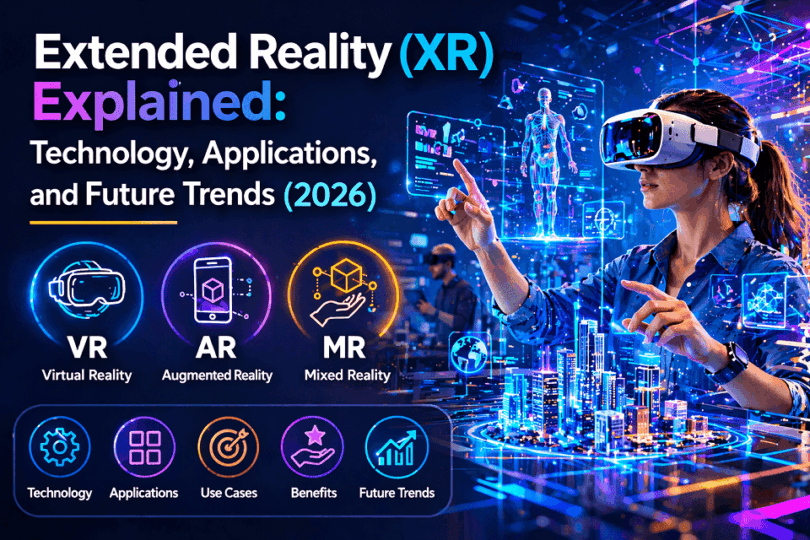

Extended Reality (XR) is an umbrella term that includes Virtual Reality (VR), Augmented Reality (AR), and Mixed Reality (MR), used to create immersive digital experiences.
XR is expected to become a core computing layer alongside mobile and cloud technologies, transforming how users interact with digital systems.
What Is Extended Reality (XR)?
Extended Reality (XR) is a collective term for immersive technologies that blend the physical and digital worlds. It includes Virtual Reality (VR), Augmented Reality (AR), and Mixed Reality (MR), creating interactive experiences beyond traditional screens.
XR works as an umbrella category. Each component plays a different role:
- VR (Virtual Reality): Fully digital environments that replace the real world
- AR (Augmented Reality): Digital elements added on top of the real world
- MR (Mixed Reality): Real and virtual objects interact in real time
The key idea is immersion. XR moves users from “watching” to “experiencing.”
In 2025, XR is no longer experimental. It is becoming part of daily workflows and consumer tech. Devices are lighter. Software is more stable. Costs are slowly dropping.
Businesses are using XR for training, design, and remote collaboration. Healthcare is using it for simulation and therapy. Education is moving toward interactive learning instead of passive content.
At the same time, major tech companies are investing heavily in spatial computing. This signals a shift from flat interfaces to 3D environments.
XR matters in 2025 because it changes how people interact with technology. It is not another device upgrade. It is a new computing layer.
Types of Extended Reality (XR): VR, AR, and MR Explained
Extended Reality (XR) is a collective term for immersive technologies. It includes Virtual Reality (VR), Augmented Reality (AR), and Mixed Reality (MR).
The difference between them comes down to one factor: how digital content interacts with the real world.
Virtual Reality (VR)
Virtual Reality creates a completely digital environment. The user is fully immersed and disconnected from the physical world.
A headset replaces real-world vision with a simulated space. This makes VR ideal for scenarios where full control of the environment is required.
Devices like the Meta Quest 3 and the PlayStation VR2 are widely used in gaming and professional training.
VR is commonly applied in gaming, flight simulation, and skill-based training where real-world risks are high.
Augmented Reality (AR)
Augmented Reality adds digital elements to the real world instead of replacing it. Users continue to see their surroundings with added layers of information.
This makes AR practical for everyday use. It works on smartphones and tablets, which removes the need for specialized hardware.
A well-known example is Pokémon GO, where digital objects appear in real-world locations.
AR is widely used in navigation, retail visualization, and education because it enhances real-world interaction without isolating the user.
Mixed Reality (MR)
Mixed Reality combines the strengths of VR and AR. Digital objects are placed in the real world and can interact with it.
Users can move around virtual objects, manipulate them, and even collaborate with others in the same mixed environment.
Advanced devices such as Microsoft HoloLens 2 and Apple Vision Pro support this experience.
MR is used in engineering, medical visualization, and remote collaboration, where interaction between real and virtual elements is essential.
XR vs VR vs AR vs MR: Comparison Table
| Feature | VR (Virtual Reality) | AR (Augmented Reality) | MR (Mixed Reality) |
| Real World Visibility | No | Yes | Yes |
| Digital Content | Fully virtual | Overlay only | Interactive objects |
| Immersion Level | High | Medium | High |
| Interaction | Virtual only | Limited | Real + virtual |
| Devices | Headsets | Phones, AR glasses | MR headsets |
| Use Cases | Gaming, training | Retail, navigation | Design, collaboration |
Quick Summary
XR includes three main technologies: VR, AR, and MR. VR replaces the real world, AR enhances it, and MR blends both with interaction.
This distinction is important because it defines how users experience digital content and how businesses apply these technologies in real-world scenarios.
XR vs MR: What’s the Difference?
XR and MR are closely related, which often creates confusion. The key point is simple.
Extended Reality (XR) is a broad term. It includes all immersive technologies, such as VR, AR, and MR.
Mixed Reality (MR) is a specific type of XR that blends the real and digital worlds with interaction.
MR sits inside XR. It is not a separate category.
XR vs MR: Quick Comparison
| Feature | XR (Extended Reality) | MR (Mixed Reality) |
| Definition | Umbrella term for immersive technologies | Technology within XR |
| Scope | Includes VR, AR, and MR | Focused on blending real + virtual |
| Real World Use | Depends on type (VR/AR/MR) | Always includes real-world interaction |
| Interaction Level | Varies | High, real-time interaction |
| Use Cases | Broad across industries | Design, healthcare, collaboration |
| Example Devices | Meta Quest 3, Apple Vision Pro | Microsoft HoloLens 2 |
Quick Summary
- XR is the overall category
- MR is one part of XR
- MR focuses on real and virtual interaction
Understanding this difference helps avoid confusion when comparing XR technologies and use cases.
How Extended Reality Works: Technology Behind XR
Extended Reality is not a single system. It is a combination of hardware, software, and real-time processing.
At a basic level, XR systems do three things at once. They track the user, understand the environment, and render digital content in real time. This happens within milliseconds to avoid lag and motion sickness.
Sensors and Motion Tracking
Sensors are the foundation of XR. They track movement and position.
Devices use multiple sensors together. These include accelerometers, gyroscopes, and external cameras. This combination helps detect head movement, hand gestures, and controller input.
Tracking works in two main ways. Inside-out tracking uses built-in cameras on the headset. Outside-in tracking relies on external sensors placed in the room.
Accurate tracking is critical. Even small delays can break immersion and cause discomfort.
Computer Vision and Spatial Mapping
XR systems need to understand the physical world. This is where computer vision comes in.
Cameras scan the environment and build a digital map. This process is often called spatial mapping.
Many systems use SLAM (Simultaneous Localization and Mapping). It helps the device track its position while mapping the surroundings at the same time.
This allows digital objects to stay fixed in place. For example, a virtual table will not drift when you move around it.
3D Rendering and Graphics Processing
Rendering is what users actually see. It converts data into visual output.
XR systems use real-time 3D rendering. This means the scene updates instantly as the user moves.
Graphics processing units (GPUs) handle most of this work. Game engines like Unity and Unreal Engine are commonly used to build XR environments.
Performance matters here. High frame rates reduce motion sickness and improve realism.
Role of AI in XR
Artificial Intelligence is becoming a core part of XR systems.
AI improves how devices understand users and environments. It enables features like hand tracking, voice interaction, and object recognition.
It also helps optimize performance. AI can predict user movement and adjust rendering in advance. This reduces latency.
In advanced systems, AI powers intelligent assistants inside XR environments. These assistants can guide users, automate tasks, and improve interaction.
Why This Matters
These technologies work together to create a seamless experience:
- Sensors track movement
- Computer vision understands the environment
- Rendering creates the visuals
- AI improves interaction and performance
Without this integration, XR would feel slow, inaccurate, and disconnected from reality.
This technical foundation is what makes XR practical in fields like healthcare, engineering, and training.
Key Technologies Powering XR
Extended Reality depends on a set of core technologies working together in real time. These systems allow devices to understand the environment and deliver smooth experiences.
SLAM (Simultaneous Localization and Mapping)
SLAM helps XR devices map the environment while tracking their position at the same time.
This allows virtual objects to stay fixed in place as the user moves. Without SLAM, digital elements would drift or feel unstable.
It is essential for AR and MR experiences where real-world alignment matters.
Computer Vision
Computer vision enables XR systems to interpret the physical world.
Cameras detect surfaces, objects, and depth. This helps devices understand where to place digital content.
It also powers features like object recognition and hand tracking, which improve interaction.
Edge Computing and Cloud Rendering
XR requires high processing power. Not all devices can handle this locally.
Edge computing processes data closer to the user, reducing delay. Cloud rendering shifts heavy graphics processing to remote servers.
This improves performance and allows lightweight devices to run complex XR applications.
Quick Summary
- SLAM enables real-time mapping and tracking
- Computer vision helps devices understand the environment
- Edge and cloud systems improve performance and scalability
These technologies form the technical backbone of modern XR systems.
Extended Reality Examples in Real Life
Extended Reality is already used across industries. It is not limited to demos or labs. Real-world applications show how XR improves training, decision-making, and user experience.
Below are clear examples of how XR works in everyday scenarios.
Gaming
Gaming was the first major driver of XR adoption. It offers full immersion and interactive environments.
In VR, players enter a completely digital world. Games feel physical because users can move, look around, and interact naturally. Devices like Meta Quest 3 have made this more accessible.
AR gaming blends virtual elements with real locations. A well-known example is Pokémon GO, where players interact with digital characters in real spaces.
XR gaming improves engagement because it shifts from passive play to active experience.
Healthcare
Healthcare uses XR for both training and treatment.
Doctors use VR simulations to practice complex procedures without risk. This improves skill development and reduces errors.
In therapy, VR helps treat conditions like anxiety and PTSD. Patients are placed in controlled environments where exposure can be managed safely.
MR is used for visualization. Surgeons can view 3D models of organs during planning, which improves precision.
Retail
Retail uses XR to improve buying decisions.
AR allows customers to place products in their space before purchasing. For example, furniture can be visualized inside a room using a phone.
Virtual try-ons help users see how products like glasses or clothing will look.
Some brands also use virtual showrooms. Customers can explore products in a digital space without visiting a store.
This reduces returns and improves customer confidence.
Education
Education is shifting from passive learning to interactive learning.
Students can explore historical sites, scientific models, or complex systems in 3D. This improves understanding compared to textbooks.
VR creates immersive lessons, while AR adds interactive layers to real-world study materials.
XR is also used in skill-based training. Students can practice real-world tasks in a safe environment.
Quick Summary
- Gaming uses XR for immersive experiences
- Healthcare uses XR for training and therapy
- Retail uses XR for visualization and shopping
- Education uses XR for interactive learning
These examples show that XR is already solving real problems. It is becoming part of everyday technology, not a future concept.
Applications of Extended Reality Across Industries
Extended Reality is moving from niche use to core business tools. It improves training, reduces errors, and speeds up decision-making.
Industries are adopting XR because it delivers practical value, not only visual appeal.
XR in Healthcare
Healthcare uses XR for training, planning, and treatment.
Doctors can practice procedures in virtual environments before real surgeries. This reduces risk and improves confidence.
Mixed Reality helps in surgical planning. 3D models of organs can be visualized in real space. It supports better precision.
XR is also used in therapy. Patients undergo controlled exposure in VR for conditions like anxiety and PTSD.
Where it helps most:
- Surgical training and simulation
- Patient therapy and rehabilitation
- Medical visualization and planning
XR in Education
Education is becoming more interactive with XR.
Students can explore concepts in 3D instead of reading static content. This improves retention and understanding.
VR enables immersive learning environments. AR adds interactive layers to textbooks and real-world objects.
XR is also used in vocational training. Students can practice skills without real-world risk.
Key impact areas:
- Interactive and immersive lessons
- Skill-based training simulations
- Remote learning with engagement
XR in Manufacturing
Manufacturing uses XR to improve efficiency and accuracy.
Workers can see step-by-step instructions through AR while performing tasks. This reduces errors and training time.
Engineers use VR and MR to design and test products before production. This lowers cost and speeds up development cycles.
Remote assistance is another use case. Experts can guide on-site workers through XR systems.
Primary benefits:
- Faster training and onboarding
- Reduced production errors
- Improved design and prototyping
XR in Retail & E-commerce
Retail and e-commerce use XR to improve customer experience.
AR allows customers to visualize products before buying. Furniture, clothing, and accessories can be tested virtually.
Virtual showrooms create immersive shopping experiences. Customers can explore products without visiting a physical store.
XR reduces uncertainty in buying decisions. This leads to higher conversions and fewer returns.
Business impact:
- Better product visualization
- Increased customer confidence
- Lower return rates
XR in Entertainment & Gaming
Entertainment and gaming remain the largest XR markets.
VR gaming offers full immersion. Players interact with digital worlds in real time. Devices like Meta Quest 3 have made this more accessible.
AR gaming blends digital content with real-world environments. Pokémon GO is a strong example.
XR is also used in virtual concerts and events. Users can attend experiences without being physically present.
Key applications:
- Immersive gaming experiences
- AR-based interactive games
- Virtual events and concerts
How Businesses Are Using XR Today
XR is moving from pilot projects to daily operations. Companies adopt it when it shows clear returns, better customer outcomes, or faster product cycles.
Training ROI
XR reduces training time and errors. Teams learn by doing, not by watching.
Companies run repeatable simulations for safety, equipment handling, and onboarding. This cuts travel, lowers risk, and standardizes outcomes across locations.
Where ROI shows up:
- Faster onboarding and skill acquisition
- Fewer mistakes in high-risk tasks
- Lower travel and material costs
Customer Experience
XR improves how customers explore and choose products.
Shoppers can place items in their space or try them virtually. This reduces uncertainty and increases confidence before purchase.
Brands also use virtual showrooms to present products without physical stores.
Business impact:
- Higher conversion rates
- Fewer returns
- More engaging product discovery
Product Design
XR speeds up design and review cycles.
Teams can build and test 3D models before manufacturing. Stakeholders review designs in shared spaces and make changes in real time.
This reduces rework and shortens time to market.
Key advantages:
- Faster prototyping and iteration
- Better design validation before production
- Real-time collaboration across teams
Quick Summary
- XR improves training with measurable ROI
- XR enhances customer experience and conversions
- XR accelerates product design and reduces costs
These use cases explain why XR is becoming a practical tool for businesses, not an experimental one.
XR Market Size and Growth Trends
Extended Reality is one of the fastest-growing technology sectors. Growth is driven by enterprise adoption, better hardware, and rising demand for immersive experiences.
Here are the key numbers that define the XR market.
Market Projections
The XR market is expanding at a rapid pace.
- The global XR market is projected to grow from $253.5 billion in 2025 to over $1.6 trillion by 2032
- Another estimate shows the market reaching over $1 trillion by 2030, growing at nearly 30% CAGR
This level of growth places XR among the fastest-scaling emerging technologies.
Adoption Growth
Adoption is moving beyond early-stage experimentation.
- Enterprises are shifting from pilot projects to full-scale XR deployment
- Industries like healthcare, manufacturing, and retail are leading the adoption due to clear ROI
Consumer adoption is also rising, especially with AR apps and VR headsets becoming more accessible.
Industry Investment
Investment in XR is increasing across both private and public sectors.
- Strong funding is coming from tech companies and governments, especially in the Asia-Pacific
- Growth is driven by advances in 5G, AI, and spatial computing, which improve XR performance and scalability
Major players like Apple, Meta, and Microsoft are investing heavily in XR ecosystems, signaling long-term commitment.
Quick Summary
- The XR market is projected to cross $1 trillion+ in the next decade
- Adoption is accelerating across industries
- Investment is driven by AI, 5G, and enterprise demand
These trends confirm that XR is not a niche technology. It is becoming a core part of the global digital economy.
Benefits of Extended Reality (XR)
Extended Reality offers clear advantages across industries. It improves how people learn, work, and interact with digital systems.
Here are the key benefits of XR in simple terms.
Immersive Learning
XR turns passive learning into an active experience.
Instead of reading or watching, users can interact with 3D environments. This improves understanding and memory retention.
Students can explore complex concepts visually. Professionals can practice real-world tasks in safe virtual settings.
Cost Efficiency
XR reduces operational and training costs.
Physical resources are not always required. Training can be done in virtual environments without materials or travel.
Companies can test products using virtual prototypes before production. This lowers development costs and reduces waste.
Remote Collaboration
XR improves how teams work together across locations.
People can meet in shared virtual spaces and interact with the same digital objects. This feels more natural than video calls.
It is useful for design reviews, training sessions, and technical discussions.
Better User Engagement
XR increases user attention and interaction.
Experiences are more engaging because users are part of the environment. They are not passive viewers.
This is valuable in marketing, education, and entertainment, where engagement directly impacts results.
Quick Summary
- XR improves learning through interaction
- XR reduces costs by replacing physical processes
- XR enables real-time remote collaboration
- XR increases engagement through immersive experiences
These benefits explain why XR adoption is growing across industries.
Challenges and Limitations of Extended Reality
Extended Reality has strong potential, but it also comes with real challenges. These issues affect adoption, user experience, and long-term scalability.
Understanding these limitations helps businesses make better decisions and builds trust with readers. XR systems collect sensitive data, which raises risks similar to those discussed in AI in cybersecurity.
High Cost
XR hardware is still expensive, especially for enterprise use.
Advanced headsets like Apple Vision Pro and Microsoft HoloLens 2 require a significant investment. Beyond devices, companies also spend on software development and integration.
For small businesses, this cost can slow adoption.
Hardware Limitations
Current XR devices still have physical and technical limits.
Headsets can feel heavy during long sessions. Battery life is limited, and the field of view is not yet close to natural human vision.
Performance also depends on processing power. Lower-end devices may struggle with complex environments.
These limitations affect comfort and long-term usability.
Privacy Concerns
XR systems collect large amounts of data.
This includes location, movement, and sometimes biometric data like eye tracking. Such data raises privacy and security concerns.
Users may hesitate to adopt XR if they are unsure how their data is stored or used.
Companies need strong policies and transparency to address this issue.
Motion Sickness
Some users experience discomfort while using XR.
This is often called motion sickness or cybersickness. It happens when there is a mismatch between visual input and physical movement.
Low frame rates or lag can make this worse. While technology is improving, it is still a barrier for many users.
Quick Summary
- High cost limits access and scalability
- Hardware still has comfort and performance issues
- Privacy concerns affect user trust
- Motion sickness impacts user experience
These challenges do not stop XR growth, but they highlight areas that need improvement for wider adoption.
XR vs Metaverse: Are They the Same?
No, XR and the metaverse are not the same. They are closely related, but they serve different roles.
Extended Reality (XR) is the technology layer. It includes tools like VR, AR, and MR that create immersive experiences.
The metaverse is a network of virtual spaces where people can interact, work, and socialize.
In simple terms, XR is how you access immersive environments. The metaverse is the environment itself.
XR vs Metaverse: Key Difference
| Feature | XR (Extended Reality) | Metaverse |
| Type | Technology | Ecosystem/platform |
| Purpose | Create immersive experiences | Host virtual worlds and interactions |
| Components | VR, AR, MR | Virtual spaces, avatars, economies |
| Access | Through XR devices | Through XR, web, or apps |
| Example | Meta Quest 3 | Virtual worlds like Roblox |
Quick Summary
- XR is the technology
- Metaverse is a virtual environment
- XR enables access to the metaverse
Understanding this difference helps avoid confusion, especially when both terms are often used together.
Extended Reality vs Virtual Reality vs Augmented Reality
Many users search for XR vs VR vs AR to understand the difference. The confusion comes from how these terms overlap.
The key point is simple. XR is the umbrella, while VR and AR are specific technologies within it.
What Is the Core Difference?
Extended Reality (XR) is a broad category. It includes both Virtual Reality (VR) and Augmented Reality (AR), along with Mixed Reality (MR).
VR and AR are not competitors. They solve different problems based on how much of the real world is involved.
- XR: umbrella term that includes all immersive technologies
- VR: replaces the real world with a virtual environment
- AR: adds digital elements to the real world
XR vs VR vs AR: Detailed Comparison
| Feature | XR (Extended Reality) | VR (Virtual Reality) | AR (Augmented Reality) |
| Definition | Umbrella term for immersive tech | Fully virtual environment | Digital overlay on the real world |
| Real World Visibility | Depends on type (VR/AR/MR) | No | Yes |
| Level of Immersion | Varies | High | Low to medium |
| User Experience | Combination of real + virtual | Fully immersive | Enhanced real-world view |
| Interaction | Depends on the technology used | Inside the virtual world | Limited interaction |
| Devices | Headsets, AR glasses, mobile devices | VR headsets | Smartphones, AR glasses |
| Use Cases | Broad (training, design, collaboration) | Gaming, simulations | Retail, navigation, education |
| Flexibility | High | Moderate | High |
| Example Technologies | VR, AR, MR | Meta Quest 3 | Apps like Pokémon GO |
XR vs VR vs AR: Practical Understanding
The difference becomes clear when you look at real-world usage.
VR is used when full immersion is needed. For example, training simulations or gaming.
AR is used when users need real-world awareness. For example, navigation or product visualization.
XR brings everything together. It allows businesses to choose the right level of immersion for each use case.
Quick Summary
- XR is the parent category
- VR creates a fully virtual world
- AR enhances the real world with digital content
Understanding this difference helps in choosing the right technology for both personal and business use.
Extended Reality Devices and Platforms
Extended Reality depends on both hardware and software. Devices deliver the experience, while platforms power the content and interaction.
This ecosystem is growing fast. It now includes consumer headsets, enterprise tools, and development platforms.
XR Headsets
XR headsets are the main entry point into immersive environments. They combine display systems, sensors, and processors in one device.
Devices like Apple Vision Pro focus on high-end Mixed Reality and spatial computing. Meta Quest 3 targets consumers with standalone VR experiences. Microsoft HoloLens 2 is widely used in enterprise and industrial settings.
Each device serves a different purpose, from entertainment to professional workflows.
AR Glasses
AR glasses are designed for lightweight, real-world use. Unlike headsets, they do not block the environment.
They project digital information directly into the user’s field of view. This makes them useful for navigation, maintenance, and real-time guidance.
Adoption is still growing, but AR glasses are expected to become more common as hardware improves.
Software Platforms
Software platforms power XR experiences. They handle rendering, interaction, and environment design.
Popular platforms include Unity and Unreal Engine. These tools are used to build games, simulations, and enterprise applications.
Developers use these platforms to create scalable and interactive XR solutions.
Why This Ecosystem Matters
The XR ecosystem is not limited to devices. It is a combination of hardware, software, and content.
- Devices deliver the experience
- Platforms enable development
- Integration drives real-world use
As this ecosystem grows, XR will become more accessible and more useful across industries.
The Future of Extended Reality (XR) in 2025 and Beyond
Extended Reality is moving from early adoption to long-term infrastructure. The next phase is not about demos. It is about integration into daily work and digital life.
Three trends define the future of XR: spatial computing, metaverse ecosystems, and AI-driven interaction. XR is expected to become a core computing layer, as discussed in our future technology trends 2025 guide.
Spatial Computing
Spatial computing changes how users interact with digital systems. Instead of flat screens, content exists in a 3D space around the user.
Devices like Apple Vision Pro are pushing this shift. Apps are no longer limited to windows on a screen. They can be placed, resized, and interacted with in physical space.
This approach improves productivity. It allows multiple workflows to exist at once without switching between tabs or devices.
In the coming years, spatial interfaces may replace traditional desktops in many use cases.
Metaverse Integration
The metaverse is evolving as a network of persistent virtual environments. XR acts as the access layer to these spaces.
Users can work, attend events, or collaborate inside shared digital environments. These spaces continue to exist even when users log out.
Companies are experimenting with virtual offices, training environments, and digital marketplaces.
The focus is shifting from hype to utility. Instead of isolated virtual worlds, future systems will be connected and purpose-driven.
AI + XR Convergence
Artificial Intelligence is becoming a core layer in XR systems.
AI improves how devices understand users and their surroundings. It enables natural interaction through voice, gestures, and eye tracking.
It also enhances performance. AI can predict user behavior and optimize rendering in real time.
In advanced use cases, AI acts as an assistant inside XR environments. It can guide users, automate tasks, and provide contextual information.
What This Means Going Forward
XR is shifting toward a more integrated digital experience. The focus is no longer on hardware alone.
- Interfaces are becoming spatial instead of screen-based
- Virtual environments are becoming persistent and connected
- AI is making interaction more natural and efficient
The future of XR is not a single breakthrough. It is the combination of these trends working together.
As costs decrease and technology improves, XR is likely to become a standard layer in computing, similar to how smartphones and cloud systems evolved. AI improves how XR systems understand users. However, challenges like AI hallucination explained show why accuracy still matters.
Top Extended Reality Trends to Watch in 2026
Extended Reality is entering a more practical phase. The focus is shifting from experiments to real business use.
These trends show where XR is heading next.
Enterprise XR
Enterprises are adopting XR for training, design, and operations.
Companies use immersive simulations to train employees faster. This reduces errors and improves safety. In industries like manufacturing and healthcare, XR is already part of daily workflows.
Devices such as Microsoft HoloLens 2 are used for on-site guidance and remote support.
XR in Remote Work
Remote work is evolving beyond video calls.
XR enables shared virtual workspaces where teams can interact with the same content. This makes collaboration more natural compared to traditional tools.
With devices like Apple Vision Pro, users can create multi-screen setups in a virtual environment.
This trend is important for global teams and distributed companies.
XR + AI Automation
AI is becoming tightly integrated with XR systems.
It enables automation inside immersive environments. In XR AI integration, tasks like object recognition, voice control, and workflow guidance are handled by AI.
This reduces manual effort and improves efficiency.
AI-driven XR systems can also adapt in real time based on user behavior.
Lightweight Wearable Tech
Hardware is becoming smaller and more comfortable.
The trend is moving from bulky headsets to lightweight wearables. AR glasses are expected to become more common in daily use.
This shift will make XR more accessible and less intrusive.
As design improves, users are more likely to adopt XR for long periods without discomfort.
Quick Takeaway
- XR is moving into enterprise use at scale
- Remote work is becoming more immersive
- AI is automating interactions inside XR
- Devices are becoming lighter and more practical
These trends indicate that XR is evolving into a mainstream technology layer rather than a niche innovation.
Pros and Cons of Extended Reality
Extended Reality offers clear advantages, but it also comes with limitations. Understanding both sides helps in making informed decisions.
Pros of Extended Reality
XR improves how people learn, work, and interact with digital systems.
- Better learning experience: Interactive environments improve understanding and retention
- Cost savings: Reduces travel, physical resources, and training expenses
- Improved collaboration: Teams can work together in shared virtual spaces
- Higher engagement: Users interact instead of passively consuming content
Cons of Extended Reality
XR still faces challenges that affect adoption and usability.
- High cost: Advanced devices like Apple Vision Pro and Microsoft HoloLens 2 are expensive
- Hardware limitations: Comfort, battery life, and field of view are still improving
- Privacy risks: Devices collect sensitive data like movement and eye tracking
- Motion sickness: Some users experience discomfort during extended use
Quick Comparison
| Aspect | Pros (Advantages) | Cons (Limitations) |
| User Experience | Immersive and interactive | Can cause motion discomfort |
| Cost | Saves long-term operational costs | High initial investment |
| Accessibility | Growing adoption across industries | Limited by hardware availability |
| Technology | Advanced and evolving rapidly | Still has performance limitations |
Quick Summary
- XR improves learning, collaboration, and engagement
- It reduces long-term costs but requires initial investment
- Challenges exist, but technology is improving
This balanced view helps businesses and users evaluate XR realistically.
Who Should Use Extended Reality?
Extended Reality is not limited to one group. It is useful for anyone who needs better visualization, training, or interaction with digital content.
The value depends on the use case, not the industry alone.
Businesses and Enterprises
Organizations use XR to improve efficiency and reduce costs.
It is especially useful where training, design, or remote collaboration is involved.
- Training teams in high-risk or complex tasks
- Visualizing products before manufacturing
- Enabling remote support and collaboration
Educators and Students
XR helps make learning more practical and engaging.
Students can interact with concepts instead of only reading about them. Teachers can explain complex topics using 3D models and simulations.
This improves understanding and retention.
Healthcare Professionals
Medical professionals use XR for both training and real-world applications.
It allows safe practice through simulations and better planning using 3D visualization.
XR is also used in therapy and rehabilitation programs.
Developers and Creators
XR offers new ways to build digital experiences.
Developers, designers, and content creators can create immersive applications using tools like Unity and Unreal Engine.
This is a growing field with increasing demand.
Everyday Users
XR is becoming more accessible to general users.
People use it for gaming, virtual experiences, shopping, and entertainment. Devices like Meta Quest 3 make it easier to explore XR at home.
Quick Summary
- Businesses use XR for training and operations
- Educators and students use it for interactive learning
- Healthcare professionals use it for simulation and therapy
- Developers build XR applications and experiences
- Consumers use XR for entertainment and daily use
XR is expanding across all user groups as technology becomes more accessible.
How to Get Started with Extended Reality
Getting started with Extended Reality does not require deep technical knowledge. You can begin with simple tools and scale as you learn.
The process depends on whether you want to use XR or build XR applications.
Devices Needed
Start with a device that fits your goal and budget.
For beginners, standalone headsets are the easiest option. Devices like Meta Quest 3 work without a high-end PC. If you want advanced Mixed Reality, Apple Vision Pro offers a more powerful experience. For enterprise use, Microsoft HoloLens 2 is widely used.
You can also begin with a smartphone for AR. This is the simplest entry point.
Tools and Software
If you want to create XR content, you need development tools.
Game engines like Unity and Unreal Engine are the most common. They support VR, AR, and MR development.
You also need basic knowledge of 3D design and programming. Many beginners start with simple templates and pre-built assets.
Learning Resources
There are many ways to learn XR step by step.
Start with free tutorials and official documentation. Then move to structured courses and hands-on projects.
Focus on learning by building small projects. This helps you understand how XR systems work in real scenarios.
Simple path to begin:
- Start with AR apps on your phone
- Try a VR headset for basic experiences
- Learn a tool like Unity or Unreal Engine
Quick Summary
- Choose a device based on your goal
- Use platforms like Unity or Unreal Engine
- Learn through practice and small projects
XR has a learning curve, but starting small makes it manageable.
Frequently Asked Questions About Extended Reality (XR)
What is XR in simple terms?
Extended Reality (XR) is a term used for technologies that combine the real world with digital content. It includes Virtual Reality (VR), Augmented Reality (AR), and Mixed Reality (MR).
In simple words, XR lets you experience digital content instead of only viewing it.
Is XR the same as VR?
No, XR and VR are not the same.
XR is the broader category, while VR is just one part of it.
- XR includes VR, AR, and MR
- VR is fully immersive and replaces the real world
This is why VR is considered a subset of XR.
What are XR devices?
XR devices are hardware used to experience immersive environments.
Common examples include headsets and smart glasses. Devices like Meta Quest 3, Apple Vision Pro, and Microsoft HoloLens 2 are widely used.
These devices combine displays, sensors, and processing systems to deliver XR experiences.
How is XR used today?
XR is already used across many industries.
- Gaming uses XR for immersive experiences.
- Healthcare uses XR for training and therapy
- Retail uses XR for product visualization
It is also used in education, manufacturing, and remote collaboration.
XR is moving from experimental use to practical applications in daily workflows.
Final Thoughts: Why Extended Reality Matters
Extended Reality is changing how people interact with technology. It moves beyond screens and brings digital content into real-world experiences.
What makes XR important is not the technology itself, but its impact. It improves how we learn, work, and make decisions.
- It makes training more practical and safe
- It improves collaboration across locations
- It creates more engaging user experiences
XR is also shaping the next phase of computing. With devices like Apple Vision Pro and Meta Quest 3, the shift toward immersive and spatial interfaces is already visible.
The future of XR will depend on how well it solves real problems. As costs decrease and hardware improves, adoption will continue to grow.
XR is not a trend. It is becoming a core layer of modern technology. Want to explore XR tools? Want to explore XR tools and devices? Check out our recommended XR platforms and headsets.
People Also Ask About Extended Reality (XR)
What is the difference between XR, AR, and VR?
XR is the umbrella term. It includes AR and VR.
- VR creates a fully virtual world.
- AR adds digital elements to the real world
- XR covers both, along with MR
Is Extended Reality the future of technology?
Yes, XR is becoming a key part of future computing.
It enables immersive experiences, better collaboration, and new ways to interact with digital systems. Many industries are already adopting it.
Do you need expensive devices to use XR?
Not always. Entry-level XR can start with a smartphone for AR.
For advanced experiences, devices like Meta Quest 3 or Apple Vision Pro are used, which can be costly.
Can XR be used for education?
Yes, XR is widely used in education.
It helps students understand complex topics through interactive 3D content and simulations.
What industries use Extended Reality the most?
XR is used across multiple sectors.
- Healthcare for training and therapy
- Manufacturing for design and maintenance
- Retail for product visualization
It is also growing in education, gaming, and remote work.
About the Author
Rajkumar RR is a technology writer and digital strategist at ProDigitalWeb.com, focusing on emerging technologies such as AI, cybersecurity, and next-generation computing. He creates research-driven content that explains complex topics in a clear and practical way for students, professionals, and tech enthusiasts worldwide.
About the Editor
Dharini R R is the editor at ProDigitalWeb.com, where she reviews and refines content for clarity, accuracy, and SEO performance. She focuses on making complex technology topics easy to understand while ensuring each article meets high editorial and search quality standards.
Last updated: April 2026 | Reviewed by Dharini R R