
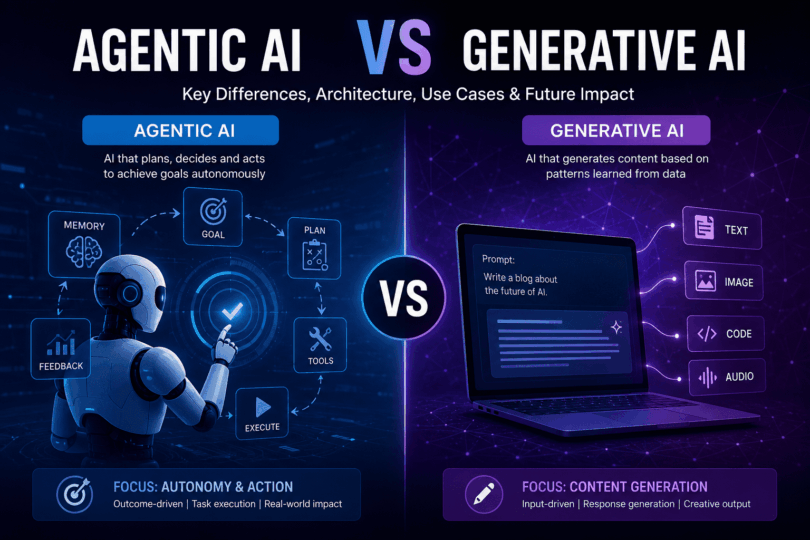

Understanding Agentic AI vs Generative AI helps you explore the next evolution of artificial intelligence, from content-generating systems to autonomous AI agents capable of planning, reasoning, and taking action.
Introduction
Artificial intelligence is evolving rapidly. Over the past few years, Generative AI has transformed how people create content, write code, generate images, and interact with intelligent systems. Tools such as ChatGPT, Gemini, Claude, and Midjourney have demonstrated that AI can produce human-like outputs with remarkable speed and quality.
However, a new paradigm is beginning to emerge. Instead of simply generating content in response to prompts, modern AI systems are increasingly being designed to act autonomously, make decisions, use external tools, and complete complex objectives with minimal human supervision. This new category of intelligent systems is known as Agentic AI.
Agentic AI vs Generative AI
Agentic AI and Generative AI serve different purposes. Generative AI focuses on creating content such as text, images, audio, and code based on user prompts. Agentic AI goes a step further by planning tasks, making decisions, interacting with tools, and executing multi-step actions to achieve specific goals autonomously.
The distinction between these two approaches is becoming increasingly important. Many organizations are already using Generative AI to improve productivity and creativity. At the same time, technology companies are investing heavily in AI agents capable of performing tasks that traditionally required continuous human involvement.
Consider a simple example. A Generative AI system can write an email when instructed to do so. An Agentic AI system can determine to whom the email should be sent, gather relevant information, draft the message, schedule delivery, monitor responses, and initiate follow-up actions if necessary. The difference is not merely in output generation but in the ability to pursue objectives independently.
This shift represents one of the most significant developments in artificial intelligence since the rise of large language models. Researchers, software developers, business leaders, and policymakers are increasingly exploring how autonomous AI agents could reshape industries ranging from healthcare and finance to cybersecurity, education, and scientific research.
Understanding the differences between Agentic AI and Generative AI is therefore essential for anyone seeking to stay informed about the future of intelligent systems. While both technologies are built upon similar foundational advances in machine learning and large language models, they differ substantially in autonomy, decision-making, memory, goal execution, and real-world applications.
In this article, we will explore how Generative AI and Agentic AI work, examine their key differences, analyze real-world examples, evaluate their strengths and limitations, and discuss why Agentic AI is widely regarded as the next major evolution of artificial intelligence.
What Is Generative AI?
What Is Generative AI?
Generative AI is a type of artificial intelligence that creates new content, including text, images, videos, audio, and computer code, based on patterns learned from large datasets. Instead of following fixed rules, it generates original outputs in response to user prompts.
Generative AI has become one of the most transformative technologies of the modern digital era. Unlike traditional software, which follows predefined instructions, Generative AI can produce entirely new content that resembles human-created work. This capability has enabled businesses, researchers, educators, and content creators to automate tasks that once required significant human effort.
At its core, Generative AI learns from vast amounts of existing data. During training, machine learning models analyze patterns, relationships, structures, and contextual information within datasets. Once trained, the model can use this knowledge to generate new outputs that are statistically similar to the information it has learned from.
For example, when a user asks an AI chatbot to write an article, summarize a report, create a marketing email, or generate computer code, the system predicts the most relevant sequence of words or instructions based on patterns identified during training. Similarly, AI image generators create new visuals by learning the characteristics of millions of images and then synthesizing entirely new ones.
How Generative AI Works
Most modern Generative AI systems are powered by deep learning architectures known as foundation models. These models are trained on enormous datasets containing text, images, audio recordings, videos, or a combination of multiple data types.
The process typically involves three key stages:
1. Data Training
The AI model is exposed to massive datasets that may contain books, websites, research papers, images, videos, and other digital content. During training, the model learns statistical relationships between different pieces of information.
2. Pattern Recognition
The model identifies recurring patterns, structures, and contextual relationships. For example, a language model learns grammar, sentence structure, factual associations, and semantic relationships between words and concepts.
3. Content Generation
When a user provides a prompt, the model predicts and generates the most likely output based on the patterns it has learned. The result may be text, images, audio, video, software code, or other forms of digital content.
Common Types of Generative AI
Generative AI encompasses several specialized categories designed for different tasks.
Text Generation
Text-based models generate articles, reports, emails, summaries, chatbot responses, and programming code. Large Language Models (LLMs) have become the dominant technology in this category.
Image Generation
Image generation models create realistic or artistic visuals from text descriptions. These systems can produce illustrations, marketing graphics, concept art, and photorealistic images.
Audio Generation
AI-powered audio models generate speech, music, voiceovers, and sound effects. They are increasingly used in entertainment, customer service, and accessibility applications.
Video Generation
Video generation systems can create animations, visual effects, training videos, and synthetic media from text prompts or image inputs.
Code Generation
Specialized AI models assist software developers by generating code snippets, debugging programs, suggesting optimizations, and accelerating software development workflows.
Real-World Applications of Generative AI
Generative AI is already integrated into many everyday technologies and business processes.
Some common applications include:
- Content creation and copywriting
- Software development and code assistance
- Customer support chatbots
- Marketing campaign development
- Graphic design and image creation
- Educational tutoring systems
- Research assistance and document summarization
- Video and multimedia production
Organizations use Generative AI to improve productivity, reduce repetitive work, accelerate innovation, and enhance customer experiences.
Limitations of Generative AI
Despite its impressive capabilities, Generative AI has important limitations.
The technology is primarily designed to generate content rather than independently accomplish goals. It typically requires user prompts to initiate tasks and often lacks the ability to plan complex workflows without additional guidance.
Generative AI systems may also produce inaccurate information, fabricate facts, misunderstand context, or generate biased outputs. These issues are commonly referred to as AI hallucinations and remain an active area of research.
Most importantly, Generative AI does not inherently possess autonomous decision-making capabilities. While it can generate recommendations and responses, it generally does not take independent actions in the real world. This limitation is one of the primary reasons why researchers and technology companies are increasingly exploring Agentic AI systems.
As artificial intelligence continues to evolve, Generative AI is becoming the foundation upon which more autonomous and goal-oriented systems are being built. Understanding its strengths and limitations provides the necessary context for examining the next stage of AI evolution: Agentic AI.
What Is Agentic AI?
What Is Agentic AI?
Agentic AI is a type of artificial intelligence that can autonomously plan, reason, make decisions, and execute multi-step tasks to achieve specific goals. Unlike Generative AI, which primarily creates content in response to prompts, Agentic AI can take actions, use tools, adapt to changing conditions, and work toward completing objectives with minimal human supervision.
Artificial intelligence is rapidly evolving beyond content generation. While Generative AI has transformed industries by creating text, images, code, audio, and video, organizations increasingly need AI systems capable of doing more than producing outputs. They need systems that can analyze objectives, determine the steps required to achieve them, and execute those steps autonomously. This emerging category of intelligent systems is known as Agentic AI.
The term “agentic” originates from the concept of agency—the ability to act independently and make decisions. In the context of artificial intelligence, an AI agent is designed not only to process information but also to pursue goals. Rather than waiting for a user to provide instructions for every step, the system can evaluate a task, develop a strategy, and perform actions that move it closer to a desired outcome.
For example, a Generative AI model can write a market research report when prompted. An Agentic AI system can identify relevant sources, collect information, analyze findings, generate visualizations, draft the report, and revise the document if new data becomes available. The difference lies in autonomy. One generates content, while the other actively works toward completing an objective.
How Agentic AI Works
Agentic AI combines several advanced technologies, including large language models, reasoning systems, memory architectures, planning frameworks, and tool integration capabilities. Together, these components allow the system to function more like an intelligent digital worker than a traditional chatbot.
When given a goal, the agent first interprets the objective and determines what success looks like. It then breaks the task into smaller sub-tasks and develops a plan for completing them. Throughout execution, the system continuously evaluates its progress, gathers new information when necessary, and adjusts its strategy based on changing circumstances.
A key capability that distinguishes Agentic AI from conventional Generative AI is tool usage. Modern AI agents can interact with external applications, databases, APIs, search engines, software platforms, and enterprise systems. This allows them to retrieve information, perform calculations, generate reports, automate workflows, and execute actions in real-world digital environments.
Key Characteristics of Agentic AI
Several characteristics define Agentic AI and distinguish it from earlier generations of artificial intelligence.
The first is autonomy. Agentic systems can operate with significantly less human guidance than traditional AI applications. Once a goal is established, they can independently determine many of the steps required to achieve it.
The second is goal-oriented behavior. Instead of focusing solely on generating responses, Agentic AI evaluates every action according to whether it contributes to the completion of a broader objective. This shift from response generation to goal achievement represents one of the most significant developments in modern AI.
Another defining characteristic is adaptive decision-making. Agentic systems can assess multiple options, choose appropriate actions, and revise their plans when conditions change. This enables them to function effectively in dynamic environments where static instructions may be insufficient.
Many advanced agents also incorporate memory mechanisms that allow them to retain context across interactions. This capability improves continuity, supports long-term planning, and enables the system to learn from previous actions within a workflow.
Real-World Applications of Agentic AI
Agentic AI is already beginning to reshape how organizations approach automation. In software development, autonomous coding agents can write, test, debug, and improve applications with limited supervision. In cybersecurity, intelligent agents can monitor networks, investigate anomalies, prioritize threats, and assist security teams in responding to incidents more efficiently.
Businesses are also exploring agentic systems for customer service, research, financial analysis, supply chain management, and workflow automation. Rather than handling isolated tasks, these systems can coordinate multiple activities across different platforms while maintaining awareness of the overall objective.
Although today’s AI agents still require human oversight in many situations, they represent an important step toward more autonomous digital systems capable of managing increasingly complex responsibilities.
Why Agentic AI Matters
The rise of Agentic AI marks a fundamental shift in the evolution of artificial intelligence. For decades, AI systems have primarily focused on prediction, classification, and content generation. Agentic AI introduces a new paradigm in which intelligent systems can plan, reason, act, and adapt in pursuit of specific goals.
This capability has the potential to significantly increase productivity and automation across industries. Instead of assisting with individual tasks, future AI agents may manage entire workflows, collaborate with other agents, and function as intelligent partners that augment human expertise.
As advances in reasoning, memory, planning, and tool integration continue, Agentic AI is expected to become one of the most influential developments in the next generation of intelligent systems. Understanding how it differs from Generative AI is therefore essential for anyone seeking to understand the future direction of artificial intelligence.
How Generative AI Works
How Does Generative AI Work?
Generative AI works by learning patterns, relationships, and structures from massive datasets and then using that knowledge to create new content. Modern Generative AI models rely on deep learning architectures, particularly large language models and transformer networks, to predict and generate text, images, code, audio, and other forms of content.
To understand the differences between Agentic AI and Generative AI, it is important to first examine how Generative AI operates beneath the surface. While users often interact with AI through simple prompts and responses, the underlying technology involves sophisticated machine learning models trained on enormous volumes of data.
At its core, Generative AI is designed to recognize patterns and generate new outputs that resemble the data it learned during training. Unlike traditional software, which follows predefined rules, Generative AI uses statistical learning to predict the most appropriate response based on context.
For example, when a user asks an AI chatbot to explain quantum computing, write software code, or draft a marketing email, the model analyzes the prompt and predicts the sequence of words most likely to satisfy the request. Similarly, image generation systems create visuals by predicting how pixels, shapes, textures, and colors should be arranged to match a textual description.
The Training Process
The foundation of every Generative AI system is its training data. During training, AI models are exposed to vast collections of text, images, audio files, videos, or other forms of digital information. By processing these datasets, the model learns patterns, contextual relationships, language structures, and semantic meanings.
Modern large language models may be trained on trillions of words collected from books, websites, research papers, technical documentation, and other publicly available sources. Through repeated exposure to this information, the model develops an understanding of grammar, facts, concepts, reasoning patterns, and contextual relationships.
The objective is not to memorize every piece of information but to learn the statistical relationships that govern how information is organized and expressed.
The Role of Transformer Architecture
A major breakthrough in Generative AI came with the introduction of the Transformer architecture. Transformers enable AI systems to process large amounts of information simultaneously while understanding relationships between words, phrases, and concepts within a given context.
This architecture allows models to determine which parts of an input are most relevant when generating a response. As a result, modern AI systems can produce coherent paragraphs, answer complex questions, generate software code, and maintain context across lengthy conversations.
The Transformer architecture has become the foundation of most advanced Generative AI systems, including large language models, image generators, and multimodal AI platforms.
Content Generation Through Prediction
Despite their impressive capabilities, most Generative AI systems fundamentally operate as prediction engines.
When generating text, the model predicts the next most probable word or token based on the context provided by previous words. This process occurs repeatedly and at extraordinary speed until a complete response is produced.
For image generation, the process is similar. Instead of predicting words, the model predicts visual elements and gradually constructs an image that aligns with the user’s prompt. The same principle applies to audio generation, video creation, and code generation.
This predictive mechanism enables AI systems to create content that often appears creative, intelligent, and human-like.
Why Generative AI Excels at Content Creation
Generative AI is particularly effective because it can synthesize information from a vast range of learned patterns. Rather than retrieving a single stored answer, it dynamically generates responses tailored to each prompt.
This capability makes Generative AI highly valuable for tasks such as:
- Writing articles and reports
- Creating marketing content
- Generating software code
- Producing images and graphics
- Summarizing documents
- Translating languages
- Assisting with research and education
The flexibility of these systems has driven widespread adoption across industries ranging from healthcare and finance to education and software development.
Limitations of Generative AI
Although Generative AI can produce highly sophisticated outputs, its primary purpose remains content generation. The model itself does not inherently possess goals, intentions, or autonomous decision-making capabilities.
Once a response is generated, the system typically waits for the next instruction. It does not independently determine what task should be performed next, nor does it actively pursue long-term objectives without additional frameworks built around it.
Generative AI can also struggle with factual accuracy, reasoning consistency, and long-term context retention. Because responses are generated through probability-based prediction, the system may occasionally produce incorrect or fabricated information, a phenomenon commonly known as AI hallucination.
These limitations highlight an important distinction between Generative AI and Agentic AI. While Generative AI excels at producing content, Agentic AI extends beyond generation by incorporating planning, memory, reasoning, and autonomous action. This evolution transforms AI from a tool that creates information into a system capable of working toward complex objectives.
Understanding these foundational mechanisms provides the context needed to explore how Agentic AI operates and why it is increasingly viewed as the next major stage in the evolution of artificial intelligence.
How Agentic AI Works
How Does Agentic AI Work?
Agentic AI works by combining reasoning, planning, memory, decision-making, and tool usage to achieve specific goals. Unlike Generative AI, which primarily generates content in response to prompts, Agentic AI can break down objectives into smaller tasks, execute actions, evaluate results, and adapt its strategy until the desired outcome is achieved.
While Generative AI is designed to generate content, Agentic AI is designed to accomplish objectives. This distinction fundamentally changes how the system operates. Instead of producing a single response and waiting for the next prompt, an AI agent continuously evaluates its environment, determines what actions should be taken, and works toward completing a defined goal.
At a high level, Agentic AI functions much like a human professional managing a project. When given an objective, it first analyzes the problem, develops a plan, gathers the resources required for execution, performs tasks, monitors progress, and adjusts its approach whenever circumstances change. This process enables the system to handle complex workflows that would normally require multiple human interactions.
Goal Interpretation and Task Decomposition
The process begins when an agent receives a goal from a user, organization, or another software system. Rather than treating the request as a simple prompt, the agent interprets the desired outcome and identifies the steps needed to achieve it.
For example, if a user requests a comprehensive market analysis of the cybersecurity industry, a Generative AI model may generate a report based on its existing knowledge. An Agentic AI system, however, can approach the task differently. It may first identify relevant information sources, collect current market data, analyze industry trends, compare competitors, organize findings, and then generate the final report.
This ability to decompose a complex objective into smaller tasks is one of the defining characteristics of Agentic AI.
Planning and Reasoning
Once tasks have been identified, the agent develops an execution strategy. This planning stage allows the system to determine the most efficient sequence of actions while considering constraints such as time, resources, accuracy requirements, or organizational policies.
Reasoning plays a critical role during this phase. The agent evaluates multiple options, predicts potential outcomes, and selects actions that are most likely to achieve the desired objective. If conditions change during execution, the agent can revise its plan and pursue an alternative approach.
This dynamic decision-making process enables Agentic AI to function effectively in environments that are too complex or unpredictable for traditional rule-based automation systems.
Memory and Context Management
A key limitation of many early AI systems was their inability to retain context over extended periods. Agentic AI addresses this challenge through memory mechanisms that help maintain awareness of goals, completed tasks, previous decisions, and relevant information gathered during execution.
Short-term memory allows the agent to track ongoing activities within a workflow. Long-term memory enables the system to store knowledge, recall past experiences, and apply previous insights to future tasks.
Memory significantly improves continuity and allows agents to manage projects that may require hundreds or even thousands of individual actions over extended periods.
Tool Usage and External System Integration
One of the most important advancements in Agentic AI is the ability to interact with external tools and digital environments. Rather than relying solely on information stored within a language model, agents can access real-time data and perform actions through connected systems.
Modern AI agents may interact with databases, search engines, APIs, enterprise applications, cloud platforms, software development tools, communication systems, and cybersecurity platforms. These integrations allow agents to gather information, execute commands, automate workflows, and verify outcomes in real-world environments.
This capability transforms AI from a passive information generator into an active participant capable of influencing digital systems and business operations.
Feedback Loops and Adaptive Execution
Agentic AI continuously monitors the results of its actions. After completing a task, the system evaluates whether the outcome aligns with the original objective. If the result is unsatisfactory, the agent can modify its strategy and attempt a different approach.
This feedback-driven process creates a cycle of planning, execution, evaluation, and refinement. The agent learns from each step and adjusts its behavior to improve performance.
Such adaptability is particularly valuable in situations where objectives are complex, information is incomplete, or conditions change unexpectedly during execution.
The Technology Stack Behind Agentic AI
Most modern agentic systems are built on top of large language models. These models provide language understanding, reasoning capabilities, and communication skills. However, Agentic AI extends far beyond the capabilities of a standalone language model.
A typical agent architecture combines multiple components, including reasoning engines, planning frameworks, memory systems, tool integrations, workflow orchestration mechanisms, and monitoring modules. Together, these technologies enable the agent to move from simple content generation to autonomous task execution.
This layered architecture explains why many experts view Agentic AI as the next evolutionary stage of artificial intelligence rather than a completely separate technology.
Why Agentic AI Represents a Major Shift
The emergence of Agentic AI marks a transition from AI systems that primarily generate information to systems that actively pursue objectives. Instead of acting as sophisticated assistants that respond to prompts, AI agents can function as autonomous collaborators capable of managing workflows, coordinating resources, and solving complex problems.
As advances in reasoning, memory, planning, and tool integration continue, Agentic AI is expected to play an increasingly important role in software development, cybersecurity, healthcare, scientific research, business operations, and countless other domains.
Understanding how Agentic AI works provides the foundation for examining the specific differences between Agentic AI and Generative AI, particularly in areas such as autonomy, decision-making, memory, adaptability, and real-world applications.
Generative AI Architecture Explained
What Is the Architecture of Generative AI?
Generative AI architecture consists of several layers that transform user inputs into text, images, code, or other outputs. The core components include the Input Layer, Embedding Layer, Transformer Layer, Attention Mechanism, Training Data Foundation, and Output Generation Layer.
Modern Generative AI systems are built on deep learning models and Transformer architectures. Together, these components enable AI to understand context, identify patterns, and generate human-like content.
Input Layer
The process begins when a user provides a prompt, question, instruction, or image description. This raw input serves as the starting point for content generation.
Embedding Layer
The embedding layer converts words and concepts into numerical vectors that machines can process. These vectors capture semantic relationships, allowing the model to understand that related terms such as “doctor” and “physician” have similar meanings.
Transformer Layer
The Transformer is the core processing engine of modern Generative AI. It analyzes relationships between words, phrases, and concepts while considering the entire context of the input. This capability allows models to generate coherent and context-aware responses.
Attention Mechanism
The attention mechanism helps the model determine which parts of the input are most important. By focusing on relevant information, the system can better understand context and generate more accurate outputs.
Training Data Foundation
Generative AI models learn from massive datasets that may include books, websites, research papers, software repositories, images, and videos. During training, the model learns patterns and relationships rather than memorizing individual pieces of information.
Output Generation Layer
The final layer generates the response. In language models, this occurs through token prediction, where the model repeatedly predicts the most likely next word until a complete response is produced. Image models use a similar process to generate visual content.
Key Takeaway
Generative AI architecture is designed to understand input, process context, identify patterns, and generate new content. While highly effective at content creation, it primarily focuses on producing outputs rather than autonomously pursuing goals.
Agentic AI Architecture Explained
What Is the Architecture of Agentic AI?
Agentic AI architecture extends Generative AI by adding memory, planning, tool integration, execution, and feedback mechanisms. These additional layers enable AI systems to pursue goals, make decisions, and perform tasks autonomously.
Unlike Generative AI, which mainly generates responses, Agentic AI is designed to achieve objectives. It combines the intelligence of large language models with systems that support planning, action, and continuous adaptation.
LLM Layer
At the core of most AI agents is a Large Language Model (LLM). This layer provides language understanding, reasoning, communication, and problem-solving capabilities. It acts as the cognitive engine that interprets goals and generates potential solutions.
Memory Layer
The memory layer enables the agent to retain context, track progress, and remember previous actions. Short-term memory supports active workflows, while long-term memory helps maintain continuity across tasks and sessions.
Planning Layer
The planning layer converts goals into actionable steps. Instead of responding to a single prompt, the agent breaks complex objectives into smaller tasks, prioritizes them, and develops an execution strategy.
Tool Layer
AI agents often need access to information beyond their training data. Through APIs, databases, search engines, software platforms, and enterprise systems, the tool layer allows agents to gather information and perform real-world actions.
Execution Layer
The execution layer carries out the planned actions. It coordinates workflows, interacts with tools, processes outputs, and monitors progress toward the overall objective.
Feedback Loop
After completing an action, the agent evaluates the outcome. If the result does not meet expectations, it can revise its strategy and try an alternative approach. This feedback cycle enables continuous improvement and adaptation.
Goal → Plan → Execute → Evaluate → Improve
Multi-Agent Coordination
Advanced Agentic AI systems may use multiple specialized agents working together. One agent may gather information, another may analyze data, while a third prepares reports. This collaborative approach improves scalability and efficiency.
How the Architecture Works Together
The LLM provides intelligence and reasoning. Memory maintains context. Planning defines the strategy. Tools connect the agent to external systems. Execution performs actions, while feedback enables adaptation and optimization.
Together, these layers allow Agentic AI to move beyond content generation and actively work toward achieving objectives.
Key Takeaway
Agentic AI architecture transforms Generative AI into an autonomous system capable of planning, reasoning, acting, and learning from outcomes. By combining intelligence with execution capabilities, AI agents can automate complex workflows and pursue goals with significantly less human intervention.
Key Differences Between Agentic AI and Generative AI
What Are the Key Differences Between Agentic AI and Generative AI?
Agentic AI differs from Generative AI in its level of autonomy, goal-oriented behavior, decision-making capabilities, tool usage, memory management, and degree of human involvement. While Generative AI focuses on creating content in response to prompts, Agentic AI is designed to independently execute tasks and achieve objectives.
Although Agentic AI and Generative AI often rely on similar underlying technologies, particularly large language models, their capabilities and intended purposes differ significantly. Generative AI excels at producing content, whereas Agentic AI extends beyond content creation by incorporating planning, reasoning, memory, and autonomous action.

1. Autonomy
Autonomy is perhaps the most significant distinction between the two technologies.
Generative AI is largely reactive. It waits for user instructions, generates a response, and then requires additional prompts to continue performing tasks. Its actions are generally limited to responding to requests made by the user.
Agentic AI operates with a much higher degree of independence. Once a goal is defined, the system can determine the necessary steps, execute actions, evaluate outcomes, and continue working without requiring constant human guidance.
For example, a Generative AI chatbot can draft a project proposal when asked. An Agentic AI system can create the proposal, gather supporting information, revise the document based on feedback, distribute it to stakeholders, and monitor responses.
2. Goal-Oriented Behavior
Generative AI is designed to produce outputs. Its success is measured by the quality, relevance, and coherence of the generated content.
Agentic AI focuses on achieving objectives rather than simply generating responses. Every action taken by the agent contributes toward a larger goal.
This distinction may appear subtle, but it fundamentally changes how the system operates. Instead of asking, “What should I generate?” the agent asks, “What should I do next to achieve the desired outcome?”
As a result, Agentic AI can manage complex workflows that involve multiple interconnected tasks and long-term objectives.
3. Decision-Making Capability
Generative AI can provide recommendations and suggestions, but it typically does not make independent decisions. Human users usually evaluate its outputs and decide how they should be applied.
Agentic AI incorporates decision-making mechanisms that allow it to select actions, prioritize tasks, and adapt strategies based on changing conditions.
For example, if an AI agent encounters incomplete information while conducting research, it can decide whether to gather additional data, consult alternative sources, or modify its approach. This capability allows the system to function more effectively in dynamic environments.
4. Tool Usage
Modern Generative AI systems can interact with external tools when explicitly instructed. However, tool usage is often limited to specific requests initiated by the user.
Agentic AI treats tools as integral components of problem-solving. Agents can independently determine when external resources are required and select appropriate tools to complete a task.
An AI agent may search the web, access databases, interact with APIs, analyze spreadsheets, execute software commands, or communicate with enterprise applications without requiring detailed instructions for every action.
This capability significantly expands the range of tasks that AI systems can perform.
5. Memory and Learning
Most Generative AI systems primarily rely on the context available within a conversation. While some platforms support memory features, their primary focus remains content generation rather than long-term task management.
Agentic AI places much greater emphasis on memory and context retention. Agents often maintain awareness of previous actions, completed tasks, ongoing objectives, and information collected during execution.
This persistent context allows the system to manage complex projects, coordinate multiple activities, and maintain continuity over extended periods.
Memory also enables agents to improve efficiency by avoiding redundant work and leveraging knowledge acquired during previous interactions.
6. Human Involvement
Generative AI generally requires frequent human interaction. Users must provide prompts, evaluate outputs, refine instructions, and guide the overall workflow.
Agentic AI reduces the need for continuous supervision. While humans still define objectives, establish constraints, and provide oversight, the agent can handle many operational decisions independently.
This shift allows organizations to automate entire workflows rather than isolated tasks.
However, human oversight remains essential in high-risk areas such as healthcare, finance, cybersecurity, and legal decision-making.
7. Workflow Execution
Generative AI is optimized for individual tasks. It performs exceptionally well when asked to generate a document, summarize information, create code, or answer questions.
Agentic AI is designed to manage complete workflows consisting of multiple interconnected tasks. It can coordinate activities across different systems, monitor progress, and ensure that each task contributes toward the final objective.
This capability makes Agentic AI particularly valuable for enterprise automation and business process optimization.
8. Adaptability to Changing Conditions
Generative AI typically generates outputs based on the information available at the time of the request. If circumstances change, users often need to provide new instructions.
Agentic AI continuously evaluates its environment and can adapt its behavior accordingly. If new information emerges or a strategy proves ineffective, the agent can modify its plan and pursue alternative solutions.
This adaptability is essential for operating in real-world environments where conditions frequently change.
9. Scalability of Complex Tasks
Generative AI performs best when handling clearly defined and relatively isolated tasks. As complexity increases, users often need to break projects into smaller steps and manage the workflow manually.
Agentic AI is specifically designed to scale across complex, multi-stage projects. It can coordinate numerous tasks simultaneously while maintaining awareness of dependencies, priorities, and overall objectives.
This makes Agentic AI particularly suitable for large-scale enterprise operations and autonomous workflow management.
10. Real-World Impact
The practical impact of these differences is substantial. Generative AI is transforming how content is created, enabling individuals and organizations to work faster and more creatively.
Agentic AI has the potential to transform how work itself is performed. By combining reasoning, planning, memory, and autonomous execution, AI agents can automate processes that previously required extensive human involvement.
As organizations continue to adopt intelligent automation, the distinction between content generation and autonomous action will become increasingly important. Generative AI represents a powerful productivity tool, while Agentic AI represents a new class of intelligent systems capable of pursuing goals and executing complex workflows with unprecedented levels of autonomy.
11. Multi-Agent Collaboration
Agentic AI systems can work alongside other AI agents to complete complex objectives.
For example, one agent may gather information, another may analyze data, and a third may generate reports. These agents can communicate and coordinate tasks much like a human team.
Generative AI systems generally operate as standalone models. They generate responses but do not naturally collaborate with multiple specialized agents to accomplish larger objectives.
As enterprise AI platforms evolve, multi-agent architectures are becoming one of the most promising applications of Agentic AI.
12. Real-Time Action Capability
Generative AI primarily generates information.
Agentic AI can generate information and take action based on that information.
For instance, a Generative AI model may recommend scheduling a meeting. An Agentic AI system can check calendars, find an available time slot, send invitations, monitor responses, and reschedule if conflicts arise.
This ability to move from recommendation to execution is one of the key reasons Agentic AI is considered the next stage of AI evolution.
While Generative AI excels at creating content and assisting users, Agentic AI extends those capabilities by introducing autonomy, planning, memory, tool orchestration, and goal-driven execution. In many modern AI systems, Generative AI serves as the cognitive engine, while Agentic AI provides the framework that enables intelligent action. Together, they represent two complementary stages in the evolution of artificial intelligence.
Agentic AI vs Generative AI: Comparison Table
Agentic AI vs Generative AI Comparison
Generative AI and Agentic AI differ in several important areas, including autonomy, planning, decision-making, memory, workflow execution, and human involvement. Generative AI focuses on creating content, while Agentic AI is designed to achieve goals through autonomous action and task execution.
Although both technologies are built upon advances in machine learning and large language models, they serve fundamentally different purposes. Generative AI excels at producing text, images, code, and other forms of content. Agentic AI extends these capabilities by introducing planning, reasoning, memory, tool orchestration, and autonomous execution.
The table below summarizes the most important differences between the two approaches.
| Feature | Generative AI | Agentic AI |
| Primary Purpose | Generate content and responses | Achieve goals and complete tasks |
| Core Function | Content creation and information generation | Planning, decision-making, and task execution |
| Operating Style | Reactive | Proactive |
| Autonomy | Low to moderate | High |
| User Dependency | Requires frequent prompts and guidance | Can operate with minimal supervision |
| Goal Orientation | Focuses on generating outputs | Focuses on achieving objectives |
| Planning Capability | Limited | Advanced multi-step planning |
| Decision-Making | Generates suggestions and recommendations | Selects actions and executes strategies |
| Workflow Management | Handles individual tasks | Manages complete workflows |
| Task Execution | Produces information and content | Performs actions and completes tasks |
| Tool Usage | Usually user-directed | Can independently choose and use tools |
| Memory Management | Primarily session-based context | Persistent memory and context tracking |
| Adaptability | Responds to prompts and instructions | Continuously adapts to changing conditions |
| Learning from Workflow Context | Limited | Strong contextual awareness across tasks |
| Real-Time Action Capability | Limited | Extensive |
| Multi-Step Reasoning | Available but often prompt-dependent | Integrated into task execution |
| Multi-Agent Collaboration | Generally standalone | Can collaborate with multiple AI agents |
| External System Integration | Optional | Typically essential |
| Human Involvement | High | Moderate to low, depending on use case |
| Business Value | Productivity and creativity enhancement | Workflow automation and operational efficiency |
| Typical Examples | ChatGPT, Gemini, Midjourney | AutoGPT, Devin, Manus, OpenHands |
| Best Use Cases | Writing, coding assistance, image generation, research support | Process automation, software engineering, cybersecurity, operations management |
| Enterprise Adoption | Widely adopted today | Emerging but rapidly growing |
| Risk Profile | Hallucinations and content inaccuracies | Decision errors, security risks, and governance challenges |
| Future Potential | Enhanced content generation and multimodal capabilities | Autonomous digital workers and intelligent workflow orchestration |
Understanding the Bigger Picture
The comparison highlights an important reality: Agentic AI and Generative AI are not competing technologies. In many modern systems, they work together.
Generative AI provides the intelligence required to understand language, generate content, reason about problems, and communicate with users. Agentic AI builds upon these capabilities by adding planning frameworks, memory systems, decision engines, and tool integrations that enable autonomous action.
A useful analogy is to think of Generative AI as the brain responsible for creating and understanding information, while Agentic AI serves as the executive system that transforms knowledge into action. One specializes in generating ideas and responses, while the other focuses on accomplishing objectives.
Key Takeaway
Generative AI is ideal for creating content, answering questions, generating code, and supporting human creativity. Agentic AI is designed for organizations that need autonomous systems capable of planning tasks, making decisions, coordinating workflows, and executing actions.
As artificial intelligence continues to evolve, the most advanced solutions will increasingly combine the strengths of both approaches. Generative AI will provide intelligence and communication capabilities, while Agentic AI will provide the autonomy required to turn those capabilities into measurable business outcomes.
Real-World Examples of Generative AI
What Are Some Examples of Generative AI?
Popular examples of Generative AI include ChatGPT, Gemini, and Midjourney. These systems generate text, images, code, and other content based on user prompts.
ChatGPT
OpenAI’s ChatGPT is one of the most widely used Generative AI tools. It can answer questions, summarize information, generate content, assist with coding, and support research tasks. Its primary role is to create and process information rather than autonomously execute workflows.
Gemini
Developed by Google, Gemini is a multimodal AI model capable of understanding and generating text, images, audio, video, and code. It is widely used for content creation, research assistance, data analysis, and productivity tasks.
Midjourney
Midjourney specializes in AI-generated images. Using natural language prompts, users can create artwork, illustrations, marketing visuals, and photorealistic images within seconds.
What These Examples Have in Common
ChatGPT, Gemini, and Midjourney all focus on generating content from user instructions. They excel at creativity, communication, and productivity, but typically rely on human guidance rather than independently pursuing goals.
Real-World Examples of Agentic AI
What Are Some Examples of Agentic AI?
Examples of Agentic AI include AutoGPT, Devin, Manus, OpenHands, enterprise AI agents, cybersecurity agents, and research agents. These systems can plan tasks, use tools, make decisions, and execute workflows with limited human supervision.
AutoGPT
AutoGPT was one of the earliest demonstrations of Agentic AI. It can break complex goals into smaller tasks, gather information, evaluate results, and continue working toward an objective with minimal user intervention.
Devin
Developed by Cognition AI, Devin is an autonomous software engineering agent capable of writing code, debugging applications, running tests, and managing development tasks.
Manus
Manus is a general-purpose AI agent designed to complete end-to-end tasks such as research, analysis, reporting, and workflow coordination. It emphasizes goal completion rather than content generation.
OpenHands
OpenHands is an open-source AI agent platform that can interact with software environments, modify code, execute commands, and assist with development workflows.
Enterprise, Cybersecurity, and Research Agents
Many organizations deploy specialized AI agents to automate business operations, investigate cybersecurity threats, monitor systems, conduct research, and generate reports. These agents combine planning, memory, reasoning, and tool usage to achieve specific objectives.
What These Examples Have in Common
Unlike Generative AI systems, Agentic AI platforms are designed to achieve goals rather than simply generate content. They can plan actions, use external tools, adapt to changing conditions, and execute multi-step workflows with greater autonomy.
Can Generative AI Become Agentic AI?
Can Generative AI Become Agentic AI?
Yes, Generative AI can become part of an Agentic AI system, but Generative AI alone is not Agentic AI. By adding capabilities such as planning, memory, decision-making, tool integration, and autonomous task execution, Generative AI models can function as the intelligence layer within a broader Agentic AI framework.
One of the most common misconceptions in the artificial intelligence industry is that Agentic AI and Generative AI are entirely separate technologies. In reality, many modern Agentic AI systems are built on top of Generative AI models.
Large language models provide the natural language understanding, reasoning, and content generation capabilities that make AI agents possible. However, these models alone do not possess the autonomy required to function as true agents. They can generate responses, answer questions, write code, and create content, but they generally cannot independently pursue goals or manage complex workflows.
To become agentic, additional layers must be added around the Generative AI model.
From Content Generator to Autonomous Agent
A standalone Generative AI model typically follows a simple pattern. It receives a prompt, generates a response, and waits for the next instruction. Its role is primarily reactive.
Agentic AI introduces a more sophisticated operating model. The system receives a goal rather than a single prompt. It then determines how to achieve that goal by creating plans, breaking tasks into smaller components, gathering information, making decisions, and executing actions.
In this architecture, the Generative AI model acts as the cognitive engine that provides reasoning and communication capabilities, while the agent framework manages planning, memory, tool usage, and workflow execution.
As a result, the AI moves from generating information to actively accomplishing objectives.
The Building Blocks That Transform Generative AI into Agentic AI
Several additional capabilities are required before a Generative AI system can function as an autonomous agent.
Planning and Task Decomposition
Agentic systems must be able to analyze a goal and divide it into manageable tasks. This allows the agent to create structured workflows rather than simply responding to individual prompts.
For example, instead of merely generating a market analysis, an agent can identify relevant data sources, gather information, evaluate findings, and prepare a complete report.
Memory Systems
Traditional Generative AI often operates within the context of a single conversation. Agentic AI requires memory mechanisms that enable the system to track progress, retain context, and maintain awareness of long-term objectives.
Memory allows agents to work on complex tasks that may span multiple interactions or extended periods.
Tool Integration
A Generative AI model is limited by the information available within its training data and immediate context. Agentic AI expands these capabilities through integration with external tools and systems.
Agents can search the web, access databases, interact with APIs, execute software commands, analyze documents, and communicate with enterprise applications. These capabilities enable them to operate effectively in real-world environments.
Decision-Making and Reasoning
Agentic systems must evaluate multiple options and determine the most appropriate course of action. This requires reasoning frameworks that allow the agent to assess outcomes, adapt strategies, and make informed decisions throughout task execution.
Feedback and Self-Correction
An important characteristic of Agentic AI is its ability to evaluate results and adjust its behavior. If an action fails or produces an unsatisfactory outcome, the agent can revise its plan and attempt an alternative approach.
This feedback loop creates a level of adaptability that is typically absent from standalone Generative AI systems.
Real-World Examples of Generative AI Becoming Agentic
Many emerging AI platforms already demonstrate how Generative AI can evolve into Agentic AI.
Autonomous coding agents use large language models to understand programming tasks, generate code, test applications, identify bugs, and improve software projects. Similarly, AI research agents combine language models with search tools, databases, and planning frameworks to gather information and produce detailed analyses.
In these cases, the underlying Generative AI model provides reasoning and communication abilities, while the surrounding agent architecture enables autonomous action.
This trend is becoming increasingly common as organizations seek AI systems capable of handling entire workflows rather than isolated tasks.
Why the Future of AI Is Likely Hybrid
Many experts believe that the future of artificial intelligence will not involve a choice between Generative AI and Agentic AI. Instead, the two technologies will work together.
Generative AI excels at understanding language, generating content, and communicating information. Agentic AI adds planning, memory, decision-making, and execution capabilities that allow the system to act on that information.
As these technologies continue to mature, future AI systems will likely combine the strengths of both approaches. Generative AI will serve as the intelligence layer, while Agentic frameworks will provide the autonomy needed to accomplish complex goals.
Key Takeaway
Generative AI does not automatically become Agentic AI simply because it generates sophisticated responses. However, when combined with memory systems, planning frameworks, decision-making mechanisms, and tool integrations, it can evolve into a powerful autonomous agent.
In many modern AI systems, Agentic AI is best understood not as a replacement for Generative AI but as its next evolutionary stage. The most advanced intelligent systems of the future will likely merge the creativity of Generative AI with the autonomy and goal-oriented behavior of Agentic AI.
Benefits and Challenges of Agentic AI
What Are the Benefits and Challenges of Agentic AI?
Agentic AI offers significant advantages, including autonomous task execution, improved productivity, enhanced decision-making, and workflow automation. However, it also introduces challenges related to reliability, security, accountability, governance, and the need for human oversight.
Agentic AI is widely regarded as one of the most important developments in the evolution of artificial intelligence. By combining reasoning, planning, memory, and autonomous action, AI agents can perform tasks that were previously difficult or impossible for traditional AI systems. These capabilities have the potential to transform industries, improve operational efficiency, and redefine how organizations approach automation.
At the same time, increasing autonomy introduces new technical, ethical, and governance challenges. As AI agents gain the ability to make decisions and execute actions independently, ensuring their reliability and accountability becomes increasingly important.
Benefits of Agentic AI
Greater Automation
One of the most significant advantages of Agentic AI is its ability to automate complete workflows rather than isolated tasks.
Traditional automation systems often require predefined rules and extensive human supervision. Agentic AI can analyze objectives, determine the necessary steps, and execute tasks with minimal intervention. This capability enables organizations to automate processes that involve decision-making, problem-solving, and adaptation.
As a result, businesses can reduce repetitive work and allow employees to focus on higher-value activities.
Improved Productivity
Agentic AI can perform many tasks simultaneously and operate continuously without fatigue. This allows organizations to complete projects faster and respond more quickly to changing business requirements.
For example, an AI agent may collect information, analyze data, generate reports, and communicate findings within a fraction of the time required for manual execution. The cumulative productivity gains can be substantial, particularly in data-intensive industries.
Enhanced Decision Support
AI agents can process large volumes of information, identify patterns, and evaluate multiple options more rapidly than humans.
By providing data-driven recommendations and insights, Agentic AI can support decision-making across areas such as finance, healthcare, cybersecurity, supply chain management, and business operations. While human judgment remains essential, AI agents can significantly improve the speed and quality of analysis.
Continuous Monitoring and Response
Unlike human teams that operate within limited working hours, AI agents can monitor systems around the clock.
This capability is particularly valuable in environments where rapid response is critical. In cybersecurity, for instance, agents can continuously analyze network activity, identify anomalies, investigate alerts, and assist security teams in responding to threats before they escalate.
Continuous monitoring can improve operational resilience and reduce the risk of costly disruptions.
Scalability
Agentic AI enables organizations to scale operations without proportionally increasing human resources.
An agent that successfully manages one workflow can often be replicated across multiple departments or business functions. This scalability makes Agentic AI an attractive solution for organizations seeking to grow while controlling operational costs.
Challenges of Agentic AI
Reliability and Accuracy
Although Agentic AI systems can perform sophisticated tasks, they are not infallible. Errors in reasoning, inaccurate information, or flawed decision-making can affect outcomes.
Because agents often execute multiple actions autonomously, a single mistake can potentially propagate through an entire workflow. Ensuring reliability, therefore, remains one of the most significant technical challenges facing the industry.
Organizations must implement validation mechanisms and monitoring processes to reduce the risk of unintended consequences.
Security Risks
As AI agents gain access to enterprise systems, databases, APIs, and digital infrastructure, they also create new attack surfaces.
Malicious actors may attempt to manipulate agents, exploit vulnerabilities, or use compromised systems to gain unauthorized access to sensitive information. Protecting Agentic AI systems requires robust security controls, access management policies, and continuous monitoring.
Security considerations become increasingly important as agents are entrusted with more critical responsibilities.
Accountability and Responsibility
Determining responsibility for decisions made by autonomous systems presents a complex challenge.
If an AI agent makes an incorrect recommendation, causes financial loss, or performs an unintended action, organizations must determine who is accountable. Questions surrounding liability, governance, and oversight are becoming increasingly relevant as AI autonomy expands.
Clear policies and human supervision are essential to ensure responsible deployment.
Ethical Concerns
Agentic AI systems may inherit biases from training data or decision-making processes. If not properly managed, these biases can influence outcomes in ways that are unfair or discriminatory.
Organizations must ensure that AI agents operate transparently, adhere to ethical guidelines, and align with legal and regulatory requirements. Responsible AI practices are critical for maintaining trust and preventing unintended harm.
Human Oversight Requirements
Despite advances in autonomy, Agentic AI is not ready to operate entirely without human involvement in most high-stakes environments.
Healthcare, finance, legal services, and cybersecurity often require expert review and oversight to ensure that decisions are accurate, ethical, and compliant with regulations. Human-in-the-loop frameworks remain an important safeguard against errors and unintended consequences.
Rather than replacing human expertise, Agentic AI is currently most effective when functioning as a collaborative partner.
Governance and Regulatory Challenges
Governments and regulatory bodies around the world are increasingly focused on how autonomous AI systems should be governed.
Organizations deploying Agentic AI must consider issues related to transparency, explainability, data privacy, risk management, and compliance. As regulations continue to evolve, businesses will need robust governance frameworks to ensure the responsible use of AI agents.
Failure to address these concerns could create legal, financial, and reputational risks.
Balancing Opportunity and Risk
Agentic AI offers unprecedented opportunities for automation, productivity, and intelligent decision-making. Its ability to plan, reason, adapt, and execute tasks autonomously represents a major advancement beyond traditional AI systems and conventional automation technologies.
However, greater autonomy also increases the importance of security, governance, accountability, and human oversight. Organizations that successfully balance innovation with responsible deployment will be best positioned to benefit from the transformative potential of Agentic AI.
As the technology continues to mature, the focus will increasingly shift from whether AI agents can perform complex tasks to how they can do so safely, reliably, and ethically. This balance will play a crucial role in determining the future impact of Agentic AI across industries and society as a whole.
Is Agentic AI the Future of Artificial Intelligence?
Is Agentic AI the Future of AI?
Many experts believe Agentic AI represents the next major evolution of artificial intelligence. While Generative AI has revolutionized content creation, Agentic AI extends these capabilities by enabling systems to plan, reason, make decisions, and execute tasks autonomously, making it a strong candidate for the future of intelligent automation.
The history of artificial intelligence can be viewed as a progression toward increasing autonomy. Early AI systems were designed to perform narrowly defined tasks based on predefined rules. Machine learning introduced the ability to learn from data. Generative AI brought unprecedented capabilities in content creation and natural language understanding. Agentic AI represents the next step in this evolution by allowing intelligent systems to move beyond generating information and begin acting on it.
This transition is attracting significant attention from technology companies, researchers, and business leaders because it addresses one of the most important limitations of current AI systems. While Generative AI can provide valuable insights and recommendations, it typically relies on humans to decide what actions should be taken next. Agentic AI seeks to close that gap by enabling systems to independently execute tasks and pursue objectives.
Why Industry Interest Is Growing
Organizations increasingly need more than content generation. Businesses want AI systems that can automate complex workflows, coordinate activities across multiple applications, analyze information, make recommendations, and take action when appropriate.
For example, a customer service chatbot may answer questions and generate responses. An AI agent can go further by reviewing customer records, initiating support processes, scheduling follow-ups, updating databases, and tracking resolution status. This ability to manage end-to-end workflows offers substantial productivity benefits.
As a result, many technology companies are investing heavily in autonomous agents, multi-agent systems, intelligent workflow platforms, and AI-powered digital assistants capable of handling increasingly sophisticated responsibilities.
The Role of Generative AI in the Future
The rise of Agentic AI does not mean Generative AI will become obsolete. In fact, the future of artificial intelligence is likely to depend on the combination of both technologies.
Generative AI provides the language understanding, reasoning, communication, and content creation capabilities that agents rely on. Agentic AI adds planning, memory, decision-making, and execution mechanisms that transform those capabilities into meaningful action.
Rather than competing technologies, they are increasingly becoming complementary components of the same intelligent systems.
Many of the most advanced AI platforms being developed today combine large language models with agent frameworks, tool integrations, and memory architectures. This hybrid approach allows AI systems to both generate information and act upon it.
Emerging Applications of Agentic AI
The potential applications of Agentic AI extend across nearly every industry.
In software development, AI agents are already assisting with coding, testing, debugging, and project management. In cybersecurity, agents can monitor networks, investigate threats, and support incident response. Healthcare organizations are exploring AI systems that can analyze medical data, coordinate administrative tasks, and assist clinicians with decision support.
Research institutions are using intelligent agents to gather information, review scientific literature, identify trends, and accelerate discovery. Businesses are deploying AI agents to streamline operations, improve customer experiences, and automate repetitive workflows.
As these capabilities mature, the role of AI is expected to expand from assistant to collaborator and, in some cases, autonomous operator.
Challenges That May Shape the Future
Despite its promise, Agentic AI still faces significant obstacles before widespread adoption can occur.
Reliability remains a major concern. Autonomous systems must consistently make accurate decisions and perform tasks safely. Security is another critical challenge, particularly when agents have access to sensitive data and operational systems.
Questions surrounding transparency, accountability, ethics, and regulation also require careful consideration. Organizations must ensure that AI agents operate within clearly defined boundaries and remain subject to appropriate human oversight.
These challenges do not diminish the potential of Agentic AI, but they highlight the importance of responsible development and deployment.
A Future of Human-AI Collaboration
The most likely future is not one in which AI completely replaces human workers. Instead, Agentic AI is expected to augment human capabilities by handling routine tasks, processing information at scale, and supporting decision-making.
Human expertise, creativity, judgment, and ethical reasoning will continue to play essential roles in areas where context, responsibility, and nuanced understanding are required. AI agents will increasingly serve as intelligent collaborators that help individuals and organizations achieve more with fewer resources.
This partnership between humans and autonomous AI systems may become one of the defining characteristics of the next era of technological innovation.
Key Takeaway
Agentic AI is widely regarded as one of the most important directions in the future of artificial intelligence. By combining the strengths of Generative AI with autonomy, planning, memory, reasoning, and task execution, AI agents have the potential to transform how work is performed across industries.
Although technical, ethical, and regulatory challenges remain, the broader trend is clear. Artificial intelligence is evolving from systems that generate content to systems that can understand goals, make decisions, and take action. For this reason, many experts view Agentic AI not merely as another AI trend, but as a significant milestone in the continuing evolution of intelligent systems.
Agentic AI vs Generative AI: Use Cases Across Industries
How Are Agentic AI and Generative AI Used Across Industries?
Generative AI is primarily used for content creation, knowledge assistance, and information processing, while Agentic AI is used to automate workflows, coordinate tasks, make decisions, and execute complex processes. Across industries, Generative AI enhances productivity, whereas Agentic AI focuses on operational efficiency and autonomous execution.
The practical differences between Agentic AI and Generative AI become most apparent when examining real-world applications. Although both technologies can deliver significant business value, they are often deployed to solve different types of problems.
Generative AI is particularly effective when organizations need to create content, summarize information, analyze documents, or support human decision-making. Agentic AI becomes valuable when businesses need systems that can perform actions, manage workflows, and coordinate multiple tasks with minimal supervision.
As enterprises increasingly adopt artificial intelligence, many are combining both approaches to create more capable and efficient systems.
Healthcare
In healthcare, Generative AI is commonly used to summarize medical records, generate clinical documentation, assist with medical research, and support patient communication. These capabilities help reduce administrative burdens and improve access to information.
Agentic AI extends these capabilities by managing healthcare workflows. AI agents can coordinate appointments, monitor patient data, prioritize cases, track treatment plans, and assist healthcare professionals in managing complex operational processes.
While Generative AI helps create and organize information, Agentic AI helps ensure that information is translated into actionable outcomes.
Cybersecurity
Cybersecurity has emerged as one of the most promising applications of Agentic AI.
Generative AI can assist security teams by generating incident reports, summarizing threat intelligence, explaining vulnerabilities, and helping analysts understand complex attack patterns.
Agentic AI can go much further. Autonomous security agents can continuously monitor networks, investigate suspicious activities, collect evidence, correlate alerts, prioritize risks, and support incident response efforts. These capabilities help organizations respond more quickly to evolving cyber threats.
As cyberattacks become more sophisticated, agent-based security systems are expected to play an increasingly important role in modern defense strategies.
Finance and Banking
Financial institutions use Generative AI to create market summaries, generate financial reports, assist customer service teams, and explain complex financial concepts to clients.
Agentic AI can automate more advanced financial processes. AI agents may monitor market conditions, assess portfolio performance, identify anomalies, track compliance requirements, and assist with risk management activities.
Because financial environments are highly dynamic, the ability to analyze information and take action autonomously can provide significant operational advantages.
Marketing and Content Creation
Marketing is currently one of the most widely adopted areas for Generative AI.
Businesses use AI to create blog posts, advertising copy, email campaigns, social media content, product descriptions, and creative assets. These tools help marketing teams produce content faster and at greater scale.
Agentic AI introduces a higher level of automation. Instead of merely generating content, AI agents can manage campaign workflows, monitor performance metrics, analyze audience behavior, optimize advertising strategies, and recommend adjustments based on real-time data.
This shift enables marketing teams to focus more on strategy while agents handle many operational tasks.
Software Development
Generative AI has become an essential tool for software developers. It can generate code, explain programming concepts, identify bugs, create documentation, and accelerate development workflows.
Agentic AI builds upon these capabilities by acting as an autonomous software engineering assistant. AI agents can analyze project requirements, write and test code, debug applications, manage development tasks, review documentation, and coordinate activities across software projects.
This represents a significant step beyond traditional coding assistants and demonstrates how Agentic AI can transform technical workflows.
Research and Education
Researchers and educators increasingly rely on Generative AI to summarize documents, explain complex topics, generate educational materials, and support learning activities.
Agentic AI can automate entire research workflows. Research agents can gather information from multiple sources, analyze findings, identify trends, compare evidence, and produce comprehensive reports with limited human involvement.
These capabilities can significantly accelerate knowledge discovery and improve productivity in academic and professional research environments.
Customer Service and Business Operations
Generative AI-powered chatbots have become common tools for answering customer questions and providing basic support.
Agentic AI enhances customer service by managing complete service workflows. An AI agent can retrieve customer information, process requests, update records, schedule follow-ups, coordinate with other systems, and monitor issue resolution from start to finish.
Similarly, businesses can use AI agents to automate operational processes such as procurement, inventory management, workflow coordination, and internal support functions.
Industry Comparison at a Glance
| Industry | Generative AI Applications | Agentic AI Applications |
| Healthcare | Clinical documentation, patient communication, and medical summaries | Patient workflow management, monitoring, and care coordination |
| Cybersecurity | Threat reports, vulnerability explanations, analyst assistance | Threat investigation, incident response, security automation |
| Finance | Financial reports, customer support, market summaries | Portfolio monitoring, risk management, compliance workflows |
| Marketing | Content creation, advertising copy, campaign assets | Campaign optimization, workflow automation, performance monitoring |
| Software Development | Code generation, debugging assistance, and documentation | Autonomous coding, testing, and project execution |
| Research | Literature reviews, content summarization, and educational support | Autonomous research, data collection, and trend analysis |
| Customer Service | Chatbots, response generation, knowledge assistance | End-to-end customer workflow management and issue resolution |
Agentic AI vs Generative AI: Which One Should Businesses Use?
Featured Snippet: Should Businesses Choose Agentic AI or Generative AI?
The best choice depends on business goals. Generative AI is ideal for content creation, communication, and knowledge-based tasks, while Agentic AI is better suited for workflow automation, decision-making, and complex multi-step processes. Many organizations will benefit from using both technologies together.
As businesses adopt artificial intelligence, the choice between Generative AI and Agentic AI depends largely on the problems they are trying to solve.
When Generative AI Is the Better Choice
Generative AI is well-suited for tasks that involve creating, summarizing, or processing information. Marketing teams use it to generate blog posts, social media content, and advertising copy. Customer service teams use AI chatbots to answer questions, while developers use coding assistants to accelerate software development.
Organizations seeking productivity improvements without major workflow changes often achieve the fastest return on investment with Generative AI.
When Agentic AI Is the Better Choice
Agentic AI becomes valuable when businesses need to automate complete workflows rather than individual tasks. These systems can plan actions, coordinate multiple tools, make decisions, and execute tasks with limited human intervention.
Examples include cybersecurity threat investigation, logistics management, automated research, compliance monitoring, and enterprise workflow orchestration.
Why Many Businesses Will Use Both
For most organizations, the future is not Agentic AI versus Generative AI. Instead, the two technologies will work together.
A customer support system may use Generative AI to communicate naturally with customers while Agentic AI retrieves account information, processes requests, and updates records. Similarly, research agents may use Generative AI to analyze information while relying on agentic capabilities to collect data and manage workflows.
Key Factors to Consider
Before adopting either technology, businesses should evaluate:
- Business objectives and workflow complexity
- Security, governance, and compliance requirements
- Integration with existing systems
- Organizational readiness and AI maturity
Businesses should choose Generative AI when the primary goal is content creation, communication, or knowledge assistance. Agentic AI is better suited for organizations seeking workflow automation and autonomous task execution.
In practice, the greatest business value will come from combining both technologies—using Generative AI for intelligence and communication, and Agentic AI for planning, coordination, and execution.
The difference between Agentic AI and Generative AI is not simply a matter of technological sophistication but of purpose. Generative AI excels at creating and processing information, making it an invaluable productivity tool across industries. Agentic AI focuses on transforming information into action by planning tasks, making decisions, coordinating workflows, and executing objectives.
As organizations continue their digital transformation journeys, the most powerful solutions will likely combine both technologies. Generative AI will provide intelligence and communication capabilities, while Agentic AI will deliver the autonomy needed to execute complex tasks and drive real-world outcomes.
Conclusion
Agentic AI and Generative AI represent two important stages in the evolution of artificial intelligence. While Generative AI excels at creating content, generating insights, and assisting knowledge workers, Agentic AI extends these capabilities by planning tasks, making decisions, using tools, and executing actions to achieve specific goals.
The key difference lies in their purpose. Generative AI focuses on producing outputs, whereas Agentic AI focuses on accomplishing objectives. As a result, they are not competing technologies but complementary ones.
For individuals and organizations, the choice depends on the problem being solved. Generative AI is ideal for content creation, research assistance, and productivity enhancement. Agentic AI is better suited for workflow automation, operational efficiency, and complex task execution.
As AI continues to evolve, the most powerful solutions will combine the strengths of both approaches. Generative AI will provide intelligence and communication capabilities, while Agentic AI will transform those capabilities into meaningful action.
Understanding the differences between Agentic AI and Generative AI is essential for anyone seeking to navigate the next generation of artificial intelligence technologies.
Frequently Asked Questions on Agentic AI vs Generative AI
Is ChatGPT Agentic AI?
No, ChatGPT is primarily a Generative AI system. It is designed to generate text, answer questions, assist with coding, summarize information, and create content based on user prompts. While newer versions can interact with tools and perform more complex tasks, ChatGPT does not inherently function as a fully autonomous AI agent. Agentic AI systems go beyond content generation by independently planning, making decisions, and executing multi-step workflows to achieve specific goals.
Is Agentic AI Better Than Generative AI?
Agentic AI is not necessarily better than Generative AI; it serves a different purpose. Generative AI excels at creating content, generating ideas, and assisting with knowledge-based tasks. Agentic AI is designed to automate workflows, coordinate actions, and achieve objectives with greater autonomy. The best choice depends on the use case. Many organizations achieve the greatest value by combining both technologies.
Can Generative AI Become Agentic AI?
Yes, Generative AI can become part of an Agentic AI system when additional capabilities are added. These capabilities typically include planning, memory management, decision-making frameworks, tool integration, and autonomous task execution. In many modern AI agents, Generative AI serves as the reasoning and communication engine, while the agent framework enables autonomous action.
What Are Examples of Agentic AI?
Examples of Agentic AI include AutoGPT, Devin, Manus, OpenHands, autonomous research agents, cybersecurity agents, and enterprise workflow automation agents. These systems can analyze goals, break tasks into smaller steps, use external tools, and execute actions with limited human intervention.
What Industries Will Benefit Most From Agentic AI?
Agentic AI has applications across many industries. Healthcare organizations can use AI agents for patient workflow management and administrative automation. Financial institutions can automate compliance monitoring and risk assessment. Cybersecurity teams can deploy agents to investigate threats and support incident response. Other industries expected to benefit include software development, research, education, manufacturing, logistics, customer service, and business operations.
Is Agentic AI the Next Stage of AI Evolution?
Many researchers and industry experts consider Agentic AI to be the next major step in the evolution of artificial intelligence. Traditional AI focused on prediction and analysis, whereas Generative AI introduced advanced content-creation capabilities. Agentic AI builds upon these advances by enabling systems to plan, reason, make decisions, and take action autonomously. Although the technology is still evolving, it is widely viewed as a significant milestone in the development of intelligent systems.
What Are the Risks of Agentic AI?
Agentic AI introduces several challenges and risks. These include inaccurate decision-making, security vulnerabilities, privacy concerns, biased outcomes, and difficulties related to accountability and governance. Because AI agents can perform actions autonomously, organizations must implement appropriate safeguards, monitoring mechanisms, and human oversight to ensure responsible use.
Will Agentic AI Replace Human Workers?
Agentic AI is more likely to augment human workers than completely replace them. AI agents can automate repetitive and time-consuming tasks, allowing people to focus on strategic thinking, creativity, leadership, and complex problem-solving. While certain job roles may evolve as automation increases, human judgment, ethical reasoning, and domain expertise will remain essential in many industries.
Can Agentic AI Work Without Generative AI?
Most modern Agentic AI systems rely on Generative AI models for language understanding, reasoning, and communication. While an AI agent can theoretically be built using other technologies, Generative AI currently provides the foundation for many advanced agentic systems. As a result, the two technologies are increasingly interconnected.
What Is the Difference Between an AI Agent and a Large Language Model?
A Large Language Model (LLM) is designed to understand and generate language. It serves as the intelligence engine behind many AI applications. An AI agent builds upon an LLM by adding memory, planning, decision-making, tool usage, and workflow execution capabilities. In simple terms, an LLM generates responses, while an AI agent uses those capabilities to pursue goals and perform actions.
Will Businesses Eventually Use More Agentic AI Than Generative AI?
Many analysts believe businesses will increasingly adopt Agentic AI as organizations seek greater automation and operational efficiency. However, Generative AI will remain an essential component of enterprise AI systems because it provides content generation, reasoning, and communication capabilities. The future will likely involve hybrid systems that combine the strengths of both technologies rather than replacing one with the other.
About the Author
Rajkumar R.R. is a technology writer, researcher, and digital publisher with a strong interest in artificial intelligence, cybersecurity, emerging computing technologies, and digital innovation. Through ProDigitalWeb.com, he creates in-depth, research-driven content that helps students, professionals, and technology enthusiasts understand complex topics in a clear and practical way.
His work covers areas such as AI, machine learning, cybersecurity, advanced memory technologies, networking, and future computing trends. He focuses on combining technical accuracy with real-world insights to make cutting-edge technologies accessible to a global audience.
When not researching the latest developments in technology, he explores emerging innovations that are shaping the future of business, science, and society.
By Rajkumar R.R. | Last Updated: June 9, 2026