

Introduction
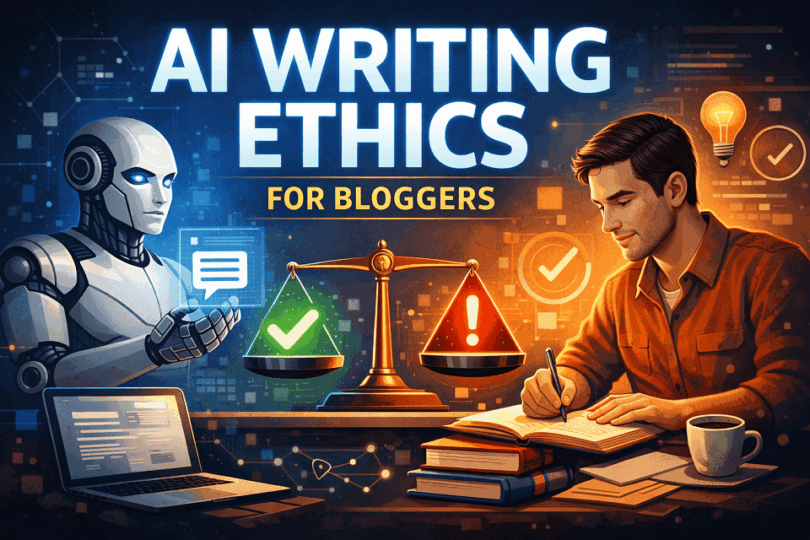
AI writing ethics for bloggers in 2026 means using AI as a support tool, not a replacement, while ensuring originality, accuracy, transparency, and reader trust. In an era where automation can dilute trust faster than it builds efficiency, this guide helps bloggers protect credibility while using AI responsibly—aligning ethical practice with Google’s Helpful Content expectations.
How AI Tools Changed Blogging after 2023–2025
Between 2023 and 2025, blogging underwent more significant changes in two years than it had in the previous decade. Generative AI tools made it possible to create articles, outlines, rewrites, and summaries in minutes. It is something that once took hours or days. For many bloggers, AI initially felt like a productivity breakthrough. Content creation became faster, cheaper, and seemingly scalable.
But that speed came with a hidden cost.
As AI-generated content flooded the web, search results became saturated with articles that looked different on the surface but said the same things underneath. Google responded with aggressive updates focused on helpfulness, originality, and trust. At the same time, AI-powered search answers began appearing directly on result pages. This reduces clicks to independent blogs even when they are ranked well.
By the end of 2025, it was clear that AI had not simply “helped bloggers write faster,” it had fundamentally altered how content is evaluated, surfaced, and trusted.
A Personal Reality: AI Answers, Traffic Loss, and Trust Erosion
For many independent bloggers, this period was not theoretical; it was painful. Traffic dropped, sometimes suddenly and without warning. Articles that once performed consistently were outranked by generic summaries or replaced entirely by AI-generated answers on search pages.
Even well-researched, original posts struggled when surrounded by mass-produced AI content that diluted quality signals across the web.
At the same time, readers became more skeptical. They could sense when content felt automated, shallow, or disconnected from real experience. Trust, once built slowly through consistency, became fragile. Bloggers were no longer competing only with other writers, but with machines that could generate “acceptable” content at scale.
This erosion of trust is the defining problem of the AI content era.
Why AI Writing Ethics Is About Survival in 2026
In 2026, AI writing ethics is no longer a philosophical debate about right and wrong. It is a practical question of survival.
Ethical AI use determines:
- Whether your content is trusted by readers.
- Whether search engines view your site as helpful or disposable.
- Whether your work stands out or blends into the noise.
Bloggers who treat AI as a shortcut to mass production risk becoming indistinguishable from automated content farms. Those who use AI responsibly, as a support tool guided by human judgment, retain what machines cannot replicate: context, experience, accountability, and voice.
Ethics is now inseparable from strategy.
What Bloggers Risk If Ethics Are Ignored in 2026
Ignoring AI writing ethics in 2026 carries real consequences:
- Loss of credibility: Once readers suspect automation without value, trust is difficult to regain.
- Algorithmic vulnerability: Sites built on unverified or scaled AI content are more likely to be hit by quality updates.
- Brand erosion: Blogs lose identity when human perspective disappears.
- Long-term invisibility: Content that adds no original value becomes replaceable by AI or by competitors.
In a web increasingly shaped by automation, ethical AI use is not a moral luxury. It is the line between sustainable blogging and gradual irrelevance.
This guide is written for independent bloggers, creators, and publishers who use AI as a support tool—but remain fully responsible for what they publish.
What “Ethical AI Writing” Actually Means for Bloggers
Ethical AI writing does not mean avoiding AI tools, nor does it require constant disclosure of automation. In 2026, ethical AI writing is about control, responsibility, and value.
Simply put:
AI may assist the process, but a human must own the outcome.
AI as an Assistant — Not the Author
In ethical blogging, AI plays a supporting role. It can help streamline work. But it must never replace human intent or accountability.
AI can ethically be used to:
- Organize ideas and outlines
- Assist with drafts or rewrites
- Speed up research and structuring
AI should not be used to:
- Decide what is true or important
- Replace the author’s voice or judgment
- Publish content without human oversight
When AI becomes the primary author, ethical boundaries are crossed.
Human Responsibility in Ethical AI Writing
No matter how advanced AI becomes, responsibility remains human. Ethical AI writing requires bloggers to actively oversee four core areas.
Accuracy
AI can generate fluent but incorrect information. Bloggers are responsible for:
- Verifying facts and statistics
- Cross-checking sources
- Correcting hallucinated claims
Accuracy failures are ethical failures, not technical ones.
Originality
AI rearranges existing knowledge; it does not create insight. Ethical blogging ensures:
- Content is not a disguised rewrite of competitors.
- New perspectives, examples, or analyses are added.
- The article contributes value beyond repetition.
Originality comes from human thought, not automation.
Context
AI lacks awareness of the audience and situation. Bloggers must decide:
- What applies to their readers
- What requires explanation or limitation
- What could mislead if left unqualified
Context transforms information into usefulness.
Judgment
AI cannot assess consequences or nuance. Human judgment is required to:
- Decide what advice is appropriate
- Acknowledge uncertainty when needed
- Avoid overstating conclusions
Judgment is where ethics becomes visible.
Ethical AI Use vs AI Content Abuse
The difference is not subtle; it lies in intent and execution.
Ethical AI Writing
- Human-led ideas with AI support
- Verified facts and editorial control
- Clear value added through insight or experience
AI-Generated Content Abuse
- Entire articles produced at scale
- Minimal human review or verification
- Content published purely for ranking
One builds trust and longevity; the other creates short-term output with long-term risk.
Why This Distinction Matters in 2026
Search engines and readers are no longer asking how fast content was produced. They are judging whether it deserves attention. Ethical AI writing ensures that efficiency does not replace responsibility and that blogs remain human, credible, and relevant in an automated web.
How Google Views AI-Written Content in 2026
There is a persistent myth among bloggers that Google “penalizes AI content.” In 2026, that idea is both outdated and misleading. Google does not evaluate content based on how it is created. It evaluates content based on what it delivers to users.
AI-written content is not banned. However, Google consistently penalizes content that is:
- Low-value – content that adds nothing new or useful
- Scaled – mass-produced pages created primarily to rank
- Unverified – articles containing errors, hallucinations, or misleading claims
The problem is not AI itself. The problem is irresponsible use of AI.
The Helpful Content System — Explained Simply
Google’s Helpful Content System is designed to answer one core question:
Does this content genuinely help a human reader?
It looks for signals that indicate:
- Real expertise or experience.
- Clear purpose beyond search manipulation.
- Depth, accuracy, and relevance.
- Evidence of human editorial oversight.
When AI is used ethically, under human control, it does not conflict with this system. When AI is used to generate pages at scale with minimal thought or review, those signals disappear.
That is where rankings collapse.
Why Intent and Quality Matter More Than Tools
In 2026, Google is far less interested in whether you used AI and far more interested in why the content exists.
Content created to:
- Answer real questions
- Solve real problems
- Share an informed perspective
is rewarded, regardless of tools.
Content created to:
- Flood search results
- Mimic competitors
- Exploit keyword patterns
is filtered out, whether written by AI or humans.
Intent shapes quality, and quality determines visibility.
What Triggers Algorithmic Distrust
Algorithmic distrust builds gradually, not instantly. Common triggers include:
- Repetitive AI-style language across multiple pages.
- Articles that confidently present incorrect or fabricated information.
- Large volumes of similar content with minor rewrites.
- Lack of author perspective, judgment, or specificity.
Once trust is lost, recovery becomes difficult. That is not because AI was used, but because editorial responsibility was absent.
Why This Matters for Ethical AI Writing
For bloggers, this reinforces a simple reality:
AI must operate inside a human editorial framework, not outside it.
When AI supports research, drafting, and structuring, while humans control accuracy, intent, and judgment, and content aligns naturally with Google’s expectations.
This is also why understanding AI hallucinations and responsible AI use is critical, not optional. Ethical practices are no longer separate from SEO; they are part of it.
Common Ethical Mistakes Bloggers Make With AI
Most ethical problems with AI writing do not come from bad intentions. They come from pressure. That is, pressure to publish faster, keep up with competitors, or recover lost traffic. In that environment, AI shortcuts can quietly turn into long-term mistakes.
Below are the most common ethical errors bloggers make when using AI, and why they matter.
Publishing AI Output Without Verification
One of the most widespread mistakes is publishing AI-generated content with little or no human verification. AI tools often sound confident, even when they are wrong.
When bloggers skip verification:
- Incorrect facts and outdated information slip through.
- Hallucinated claims appear credible but are false.
- Reader trust erodes quietly over time.
This is not a productivity issue; it is a responsibility issue.
Rewriting Competitors at Scale
Another common misuse of AI is the large-scale rewriting of competitor content. While this may appear efficient, it creates content that adds no original value.
At scale, this approach:
- Produces derivative articles with no distinct insight.
- Creates search results filled with near-duplicates.
- Signals low editorial effort to search engines.
Rewriting is not research, and automation does not create originality.
Hallucinated Facts, Citations, and Statistics
AI hallucinations are not rare edge cases; they are predictable failure modes. When AI is asked to summarize, explain, or cite information, it may fabricate details that look legitimate.
This often results in:
- Non-existent studies or statistics.
- Incorrect technical explanations.
- False authority through invented citations.
Publishing hallucinated information crosses from technical error into ethical risk.
Generic Tone and Loss of Author Voice
AI-generated drafts tend to converge on a neutral, generic tone. When bloggers rely too heavily on AI, their content slowly loses personality and perspective.
Over time, this leads to:
- Articles that sound interchangeable.
- Reduced emotional connection with readers.
- Weak brand identity.
Voice is not cosmetic; it is how trust is built.
Over-Automation of Entire Blogs
The final mistake is treating AI as a content factory rather than a tool. Fully automated blogs may publish consistently. However, consistency alone does not equal value.
Over-automation typically results in:
- Shallow coverage across many topics.
- Minimal human insight or accountability.
- Increased vulnerability to quality updates.
Automation without judgment may scale output, but it also scales risk.
Why These Mistakes Matter in 2026
In 2026, search engines and readers are increasingly aligned in what they reject: content that exists without care, accountability, or contribution. Ethical AI use is not about avoiding tools; it is about avoiding these patterns.
Bloggers who recognize and correct these mistakes early retain credibility. Those who ignore them often discover the damage only after trust is lost.
AI Hallucinations: The Hidden Ethical Risk
AI hallucinations are often discussed as a technical limitation of large language models. For bloggers, however, hallucinations are not primarily a technical problem, but they are an ethical one. The moment hallucinated information is published, responsibility no longer belongs to the tool. It belongs to the human who chose to trust it.
Why Hallucinations Are an Ethical Issue, Not a Technical Bug
From an engineering perspective, hallucinations are a known behavior: AI systems generate responses based on probability, not truth. From an editorial perspective, that explanation is irrelevant to the reader.
When hallucinated information appears in a blog post:
- Readers assume it was researched and verified.
- Search engines treat it as a factual claim.
- The blogger’s credibility is directly affected.
The ethical failure is not that AI produced incorrect information; it is that the information was published without verification.
Real Examples Bloggers Unknowingly Publish
In practice, hallucinations show up in subtle but damaging ways. Common examples include:
- Confident explanations of concepts that are partially or entirely wrong.
- Statistics or studies that sound legitimate but do not exist.
- Citations to organizations, reports, or experts that were never published.
These errors are rarely obvious at first glance. They blend into otherwise well-written content. This makes them dangerous in educational or technical blogs.
The Responsibility of the Human Editor
AI tools do not have accountability. Bloggers do.
Ethical AI writing requires editors to:
- Treat AI output as unverified drafts, not sources.
- Cross-check factual claims before publishing.
- Remove or rewrite sections that cannot be validated.
This responsibility does not diminish with experience or scale. In fact, the more authority a blog claims, the greater its ethical obligation to ensure accuracy.
Why Disclaimers Alone Are Not Enough
Some bloggers attempt to manage hallucination risk with disclaimers such as “this content may contain AI-generated information.” While transparency is valuable, disclaimers do not absolve responsibility.
Disclaimers fail because:
- Readers still rely on the content to be accurate.
- Search engines do not excuse misinformation.
- Ethical responsibility cannot be outsourced to a warning.
Accuracy must be built into the editorial process, not added as a footnote.
Why This Matters for Ethical AI Writing
Hallucinations sit at the intersection of ethics, trust, and credibility. They are the clearest example of why AI cannot operate independently in content creation. Human judgment, verification, and accountability are not optional safeguards; they are the foundation of ethical AI use.
This is also why understanding and actively mitigating hallucinations is essential for any blogger using AI responsibly. Ethical AI writing is not about perfection. It is about ownership.
Ethical AI Writing Workflow for Bloggers (2026)
Ethical AI writing is not about using fewer tools. It is about using them in the right order. Blogs that struggle in 2026 often fail not because they use AI, but because they let AI decide too much, too early, or without review.
The workflow below keeps AI efficient without surrendering human responsibility.
Step 1: Idea Validation (Human-Driven)
Every ethical AI workflow starts with a human decision. Before involving AI, bloggers should validate whether an idea is worth writing about at all.
This step requires:
- Understanding the audience’s real questions.
- Defining the purpose of the article.
- Deciding what unique value or perspective can be added.
AI can help generate ideas, but choosing the topic is a human judgment, not an automated one.
Step 2: AI-Assisted Outlining
Once the idea is validated, AI can be used to accelerate structure, not strategy.
Used ethically, AI can:
- Organize sections logically.
- Identify subtopics that need coverage.
- Surface gaps that require deeper explanation.
The outline should be reviewed and reshaped by the blogger to ensure it reflects intent, audience level, and originality.
Step 3: Human Drafting and Personalization
AI may assist with drafting, but this is where the article becomes human.
Ethical drafting involves:
- Adding personal experience or interpretation.
- Rewriting generic sections in the author’s voice.
- Adjusting tone, emphasis, and clarity for readers.
If a section sounds interchangeable with hundreds of others, it needs human intervention.
Step 4: Fact-Checking and Source Verification
This is the most critical ethical checkpoint.
Before publishing, bloggers must:
- Verify factual claims, data, and definitions.
- Replace or remove unsupported statements.
- Confirm that sources actually exist and are relevant.
AI output should be treated as unverified by default.
Step 5: Editorial Judgment
Not everything accurate is appropriate. Editorial judgment ensures responsibility.
This step includes:
- Deciding what advice requires context or caution.
- Removing speculative or misleading claims.
- Ensuring the content aligns with the reader’s trust.
Judgment cannot be automated. It is the ethical core of publishing.
Step 6: Final Human Review
The final review answers one question:
Would I trust this article if I did not write it?
This last pass ensures:
- Consistency of voice
- Clarity and coherence
- Alignment with the article’s purpose
Only after this review should content be published.
Why This Workflow Works in 2026
This workflow satisfies both human readers and search engines because it:
- Preserves originality and accountability.
- Reduces hallucination risk.
- Signals real editorial oversight.
- Scales responsibly without degrading quality.
It also creates a repeatable system that teams, solo bloggers, and editors can adopt. This makes it naturally link-worthy.
Ethical AI writing is not slower.
It is structured, intentional, and sustainable.
Transparency: Should Bloggers Disclose AI Use?
Transparency around AI use is often misunderstood. In 2026, ethical AI writing does not require bloggers to announce every instance of AI assistance. At the same time, complete silence is not always the best choice either. The ethical question is not whether AI was used, but whether disclosure meaningfully helps the reader.
When Disclosure Helps Build Trust
Disclosure is valuable when AI use directly affects how readers interpret the content.
It helps when:
- Content provides advice that could influence decisions.
- Automation plays a significant role in analysis or summarization.
- Readers reasonably expect human-only judgment.
In these cases, transparency strengthens credibility rather than weakening it.
When Disclosure Is Unnecessary
Not every ethical AI use requires disclosure. If AI is used as a background productivity tool, similar to spell-checkers or grammar assistants, then disclosure adds little value.
Disclosure is often unnecessary when:
- AI assists with outlining, editing, or language clarity.
- Final content reflects clear human judgment and verification.
- The article’s value does not depend on how it was produced.
Over-disclosure can distract from substance and reduce clarity.
Reader Expectations vs Legal Requirements
Ethical transparency is not the same as legal compliance. Laws and platform policies vary by region and evolve slowly, while reader expectations shift quickly.
In practice:
- Readers care more about accuracy and usefulness than tools.
- Misleading content damages trust more than undisclosed AI assistance.
- Legal requirements rarely mandate disclosure for editorial content.
Bloggers should prioritize reader trust over performative compliance.
Ethical Transparency vs Performative Disclosure
There is a growing trend of adding generic AI disclaimers to appear responsible. This often backfires.
Performative disclosure:
- Signals uncertainty rather than confidence.
- Does not protect against misinformation.
- Shifts responsibility instead of accepting it.
Ethical transparency, by contrast, focuses on:
- Clear editorial standards
- Verified information
- Consistent human accountability
Trust is built through reliability, not labels.
A Practical Rule for Bloggers in 2026
If disclosure helps readers understand or evaluate the content, include it.
If it adds noise without value, omit it.
Ethical AI writing is about earning trust through substance, not signaling virtue.
Ethics Vs Compliance
- Ethics = editorial responsibility
- Compliance = legal / platform rules
- You must meet both, but ethics goes beyond the minimum rules
Copyright, Originality & Plagiarism Concerns in 2026
Copyright and originality are where ethical AI writing becomes most misunderstood. Much of the fear around AI content is driven by misinformation, while real risks are often ignored. In 2026, ethical blogging requires clarity, not assumptions about how AI-generated text intersects with ownership and originality.
AI Training Data: Clearing Common Misconceptions
A frequent misconception is that AI tools “copy” or “store” existing articles and reproduce them on demand. That is not how modern language models operate.
In reality:
- AI does not retrieve or quote specific articles from its training data.
- It generates text based on learned patterns, not stored documents.
- Output similarity usually comes from common phrasing, not direct copying.
The ethical risk is not hidden copying; it is uncritical reuse of generic patterns that already dominate the web.
Who Owns AI-Assisted Content?
In most jurisdictions, content ownership depends on human involvement, not the tools used. When a blogger directs, edits, and finalizes an article, the content is treated as human-authored.
From a practical standpoint:
- Bloggers are responsible for what they publish.
- Editorial control determines authorship.
- AI does not hold copyright or accountability.
Ownership is not transferred to AI, but responsibility is not transferred away from the blogger either.
How to Avoid Unintentional Plagiarism
Plagiarism risks with AI are usually indirect, not intentional. They occur when bloggers rely too heavily on AI-generated phrasing without meaningful transformation.
To avoid this:
- Rewrite AI drafts in your own voice and structure.
- Add original analysis, examples, or experience.
- Avoid publishing AI-generated text verbatim.
Plagiarism is less about matching words and more about failing to add independent value.
Why Originality Still Depends on Humans
AI can assist with expression, but it cannot originate a perspective. It does not:
- Have lived experience
- Make editorial choices
- Understand why something matters now
Originality emerges from judgment, context, and interpretation—qualities that remain human even in 2026. AI can help articulate ideas. But it cannot decide which ideas deserve attention or how they should be framed.
That responsibility belongs to the blogger.
Why This Matters for Ethical AI Writing
Copyright and originality concerns reinforce a central ethical truth:
Using AI does not reduce responsibility; it increases it.
Bloggers who understand this produce content that is:
- Safer legally
- Stronger editorially
- More resilient to algorithm changes
In an era of automation, originality is no longer about writing alone. It is about thinking, choosing, and owning the work.
Ethical vs Unethical AI Content: A Clear Comparison
The difference between ethical and unethical AI content is not about tools; it is about intent, oversight, and responsibility. The table below highlights how the same technology can produce either long-term value or long-term risk, depending on how it is used.
| Ethical AI Use | Unethical AI Use |
| Human-led ideas and clear editorial intent | AI-generated content published at scale |
| Verified facts and reviewed claims | Hallucinated or unverified information |
| Unique insights, context, and perspective | Rewritten or mimicked competitor content |
| Content created for reader value | Content created to manipulate search rankings |
Why This Distinction Matters in 2026
Search engines and readers are increasingly aligned in what they reward and reject. Ethical AI use produces content that is trusted, referenced, and revisited. Unethical use produces content that may rank briefly but erodes credibility over time.
The tools are the same. The outcomes are not.
Ethical AI content strengthens authority and resilience. Unethical AI content increases visibility risk, trust loss, and long-term instability.
How Ethical AI Writing Protects Your Blog Long-Term
Ethical AI writing is often discussed as a constraint. But in reality, it is a protective strategy. In 2026, blogs that survive algorithm shifts, audience skepticism, and AI saturation are not the fastest publishers. They are the most consistent and trustworthy.
The benefits of ethical AI use compound over time.
Stability During Google Updates
Search updates increasingly target patterns, not platforms. Blogs that rely on mass AI generation tend to show uniform structure, tone, and intent. This makes them easy to filter during quality updates.
Ethical AI writing provides stability because:
- Content is reviewed and contextualized by humans.
- Pages differ meaningfully from one another.
- Editorial intent is clear and consistent.
This reduces volatility and protects long-term visibility.
Stronger Reader Trust
Trust is no longer built through volume. It is built through reliability.
When readers recognize that your content:
- Is accurate and carefully framed
- Reflects real judgment and experience
- Respects their time and intelligence
They return. Ethical AI writing reinforces this trust by ensuring the blog feels authored, not automated.
Higher Engagement Metrics
Engagement metrics such as time on page, scroll depth, and return visits are indirect but powerful signals of content quality. AI-heavy content often underperforms here because it lacks voice and specificity.
Ethical AI use improves engagement because:
- Articles feel intentional rather than templated
- Readers find insight, not repetition
- Content invites understanding rather than skimming
Engagement becomes a byproduct of quality, not manipulation.
Better Brand Positioning
In an environment where AI-generated content is everywhere, restraint becomes differentiation.
Blogs that use AI ethically:
- Stand out as thoughtful and credible.
- They are more likely to be referenced or linked.
- Build authority beyond search rankings.
Brand identity strengthens when readers associate the site with care, clarity, and responsibility.
Sustainable Traffic vs Short-Term Spikes
Unethical AI use may produce temporary visibility through scale or speed. Ethical AI writing produces durable traffic.
Sustainable traffic comes from:
- Content that remains relevant after updates.
- Articles that earn backlinks naturally.
- Readers who trust and return.
Short-term spikes fade. Ethical practices endure.
The Strategic Reality in 2026
Ethical AI writing is not about avoiding tools; it’s about using them responsibly. It is about using them in ways that preserve what algorithms and audiences ultimately reward: trust, usefulness, and accountability.
Blogs that understand this are not merely compliant—they are resilient.
Practical Ethical Guidelines Bloggers Should Follow in 2026
Ethical AI writing becomes sustainable only when it translates into daily practice. The guidelines below are not theoretical principles. They are editorial habits that protect credibility, rankings, and reader trust over time.
1. Never Publish Without Human Review
AI output should always be treated as a draft, not a finished product.
Before publishing:
- Read the article end to end
- Adjust tone, clarity, and intent
- Confirm the content reflects human judgment
If no human has fully reviewed it, it is not ready to publish.
2. Fact-Check All Claims
Accuracy is non-negotiable in ethical AI writing.
At minimum:
- Verify statistics, dates, and technical claims
- Remove or qualify uncertain information
- Avoid confident statements without sources
Trust is built when readers know your content can be relied upon.
3. Avoid Bulk AI Page Generation
Scale without oversight is the fastest way to erode quality.
Ethical use means:
- Publishing fewer, stronger pages
- Avoiding near-duplicate content at scale
- Treating each article as a standalone responsibility
Consistency matters—but not at the expense of care.
4. Add Personal Experience Where Relevant
Human experience is what AI cannot replicate.
Whenever appropriate:
- Share real observations or lessons
- Explain why something worked—or failed—for you
- Add perspective that goes beyond generic advice
Experience transforms information into insight.
5. Optimize for Humans, Not Bots
Search visibility is a result, not a goal.
Ethical optimization focuses on:
- Clear explanations
- Logical structure
- Reader understanding
When content genuinely helps humans, algorithms tend to follow.
Why This Checklist Works
These guidelines are intentionally simple. They scale across niches, tools, and experience levels, and they remain relevant even as AI technology evolves.
Ethical AI writing is not about doing more. It is about doing the right things consistently.
FAQs: AI Writing Ethics for Bloggers (2026)
Is AI-generated content allowed by Google in 2026?
Yes. Google does not ban AI-generated content. What it penalizes is low-value, unverified, or scaled content created primarily to manipulate search results rather than help users.
Can Google detect AI-written articles?
Google does not rely on simple “AI detection.” It evaluates patterns of quality, such as originality, usefulness, accuracy, and human oversight. Poor AI content is filtered because of its outcomes, not because it uses AI.
Should bloggers disclose AI use in their articles?
Disclosure is optional and situational. It helps when AI plays a significant role in analysis or advice, but it is unnecessary when AI is used only for drafting or editing under full human control. Transparency should add value, not noise.
Is using AI for blogging considered plagiarism?
Using AI is not plagiarism by itself. Plagiarism occurs when bloggers publish derivative or unoriginal content without adding independent value, insight, or transformation. Human editing and originality are essential safeguards.
Are AI hallucinations a serious risk for bloggers?
Yes. Hallucinations can introduce fabricated facts, citations, or explanations that look credible. Bloggers are ethically responsible for verifying AI output before publication in technical or educational content.
Can ethical AI writing still rank well in search results?
Absolutely. Ethical AI writing often ranks more consistently because it aligns with Google’s Helpful Content expectations like accuracy, originality, and human value. Ethical practices reduce volatility during algorithm updates.
Will AI replace bloggers in 2026?
AI can assist with writing tasks, but it cannot replace judgment, experience, accountability, or voice. Bloggers who use AI ethically remain essential as curators, editors, and trusted communicators.
What is the safest way to use AI for blogging in 2026?
Use AI as a support tool, not a decision-maker. Maintain human control over ideas, facts, context, and final review. Treat every published article as a human responsibility.
Final Thoughts: Ethics as a Competitive Advantage
In 2026, ethics is no longer an optional layer added to AI-assisted blogging. It is part of the foundation. The rapid adoption of AI has lowered the barrier to publishing. However, it has also raised the standard for credibility. When content is easy to produce, trust becomes the differentiator.
AI alone does not build trust. Tools can generate text, but they cannot take responsibility for accuracy, judgment, or impact. Readers place that responsibility on the human behind the content. When blogs feel automated, trust erodes. When they feel authorized, then the trust compounds.
Bloggers who adapt ethically are not limiting themselves. They are positioning themselves to survive and grow. Ethical AI use leads to clearer thinking, a stronger voice, and more resilient content. It reduces dependency on shortcuts and builds systems that endure algorithm updates, platform shifts, and audience skepticism.
The future of blogging is not human versus AI. It is a responsible AI guided by human values.
Ethical AI writing works best when it is embedded into an editorial standard, not applied case by case.
In 2026, the bloggers who win will not be the fastest publishers or the most automated ones. They will be the ones who combine efficiency with accountability, and technology with judgment. Ethics, done right, is no longer a constraint — it is a competitive advantage.
Author
Rajkumar RR is a tech and digital marketing blogger specializing in AI, cybersecurity, and ethical content practices. He focuses on responsible AI use, search quality, and building sustainable, human-first blogs in a rapidly automated web.
Editorial Review
Reviewed by the ProDigitalWeb editorial team, with a focus on factual verification, ethical AI usage, and human editorial oversight. The review process prioritizes reader trust, accuracy, and long-term content quality.
All articles are written or reviewed with human editorial oversight and fact-checking.