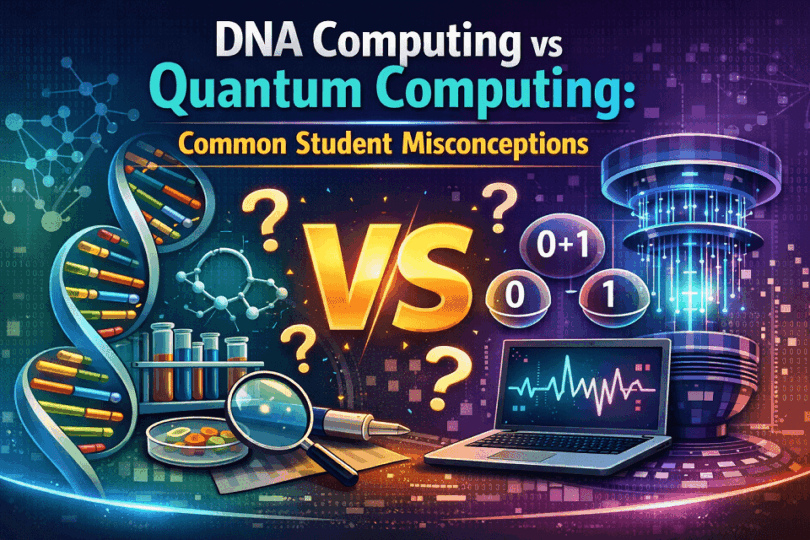

DNA computing uses biological molecules to perform massively parallel computations, while quantum computing relies on quantum mechanical properties like superposition and entanglement. This guide compares both approaches in a student-friendly, concept-first way.
Introduction
Silicon-based processors are approaching the physical limits of computing. Therefore, researchers have begun exploring radically different models of computation that operate beyond traditional electronics. Two of the most discussed alternatives are DNA computing and quantum computing. Both of them challenge conventional ideas about how information can be processed.
At a glance, DNA computing and quantum computing may appear similar.
Both promise massive parallelism and theoretical advantages over classical computers.
However, they are based on fundamentally different principles. DNA computing relies on biochemical reactions within DNA molecules to perform computation. Quantum computing uses quantum-mechanical properties such as superposition and entanglement to manipulate information encoded in qubits.
This comparison is written specifically for students who are trying to understand how these two emerging computing paradigms differ, not just in theory, but in practicality, learning requirements, and future relevance. Rather than repeating complex mathematical or biological formalisms, this guide focuses on conceptual clarity, real-world research context, and how each approach fits into the broader landscape of future computing technologies.
By the end of this comparison, you will clearly understand:
- What makes DNA computing and quantum computing fundamentally different?
- The types of problems each approach is designed to solve.
- Which field may be more appropriate to study, depending on your academic background and interests?
Quick Comparison – DNA Computing vs Quantum Computing
Before diving into detailed explanations, it helps to see DNA computing and quantum computing side by side. This quick comparison is designed for students who want an immediate conceptual overview of how these two computing models differ in practice, not just in theory.
Although both approaches are often described as “beyond classical computing”, they solve problems in very different ways. Both operate in entirely different physical environments and face distinct technical limitations.
DNA Computing vs Quantum Computing — Core Differences at a Glance
| Aspect | DNA Computing | Quantum Computing |
| Basic Computing Unit | DNA strands (nucleotide sequences) | Qubits |
| Underlying Principle | Biochemical reactions and molecular binding | Quantum mechanics (superposition & entanglement) |
| Type of Parallelism | Massive biological parallelism | Quantum parallelism |
| Physical Environment | Wet laboratory conditions | Cryogenic or highly controlled environments |
| Error Sources | Chemical noise, reaction inefficiencies | Decoherence, quantum noise |
| Current Maturity | Largely experimental and academic | Early-stage commercial and research systems |
| Best-Suited Problems | Combinatorial and search problems | Cryptography, optimization, and quantum simulations |
| Student Prerequisites | Biology + algorithms | Linear algebra + physics |
How to Interpret This Comparison as a Student
This table is not meant to declare a “winner.” Instead, it highlights an important idea: DNA computing and quantum computing are designed for different problem spaces.
- DNA computing leverages the natural parallelism of molecular reactions. The natural parallelism makes it theoretically powerful for exploring large solution spaces simultaneously. However, practical execution is slow, error-prone, and confined mostly to laboratory research.
- Quantum computing, on the other hand, manipulates probability amplitudes rather than physical molecules. While quantum computers are difficult to build and stabilize, they already demonstrate real advantages for specific classes of algorithms.
From a learning perspective, the choice between DNA computing and quantum computing depends less on performance claims and more on your academic background, mathematical comfort level, and research interests.
Why a Quick Comparison Matters
Students often encounter DNA computing and quantum computing in isolation, which can make both fields feel abstract or disconnected from real-world applications. A direct comparison helps clarify:
- Why do both approaches exist simultaneously?
- Neither replaces classical computing entirely.
- And why future computing is likely to be hybrid, not singular.
This foundation makes it easier to understand the deeper explanations that follow in the next sections.
What Is DNA Computing? (Student-Level Explanation)
DNA computing is a form of computation that uses biological molecules, specifically DNA, as the medium for processing information. Instead of relying on electronic circuits and transistors, this approach encodes data within sequences of nucleotides and performs computation through controlled biochemical reactions.
The idea of DNA computing emerged from the observation that molecular biology already performs information processing at an enormous scale. Inside living cells, DNA is constantly copied, modified, and interpreted with remarkable efficiency. Researchers realized that these same mechanisms could be repurposed to solve computational problems by representing possible solutions as DNA strands and allowing chemical processes to act on them.
For students, DNA computing is best understood as a conceptual extension of computer science into biology. It does not aim to replace classical or quantum computers in everyday use. Instead, it explores how physical and biological systems can be used to perform computation in fundamentally different ways. This approach is particularly relevant for problems involving large search spaces and parallel evaluation.
This perspective makes DNA computing an important topic in the study of future and unconventional computing models, even though it remains primarily a research-driven field.
Basic Concept
At its core, DNA computing treats DNA strands as carriers of information, similar to how bits are used in classical computing. Instead of representing data with electrical states such as 0s and 1s, DNA computing represents information using the sequence of nucleotides: adenine (A), thymine (T), cytosine (C), and guanine (G).
In this model, a computational problem is translated into a set of DNA strands where each strand corresponds to a possible data element or partial solution. The rules of molecular biology, such as complementary base pairing, ensure that only specific sequences bind together. This binding behavior acts as a natural form of logic. This logic allows biochemical interactions to represent computational operations.
Because DNA strands can exist and interact in extremely large numbers at the same time, DNA computing enables massive parallelism at the molecular level. Rather than processing one operation after another, many potential solutions are explored simultaneously through chemical reactions.
For students, the key idea is to view DNA computing as computation through molecular interactions. In this model the structure and behavior of DNA replace electronic circuits as the mechanism for storing and manipulating information.
How DNA Performs Computation
DNA computing does not follow the instruction-by-instruction execution model used in electronic computers. Instead, computation emerges from a sequence of biochemical operations that act on DNA strands in a laboratory environment. Each operation plays a logical role in filtering and refining possible solutions.
Hybridization is the process by which complementary DNA strands bind together according to base-pairing rules (A with T, C with G). In computational terms, this step functions like a matching or constraint-checking operation. Hybridization ensures that only compatible data elements combine.
Ligation joins shorter DNA fragments into longer strands. This step is often used to assemble partial solutions into complete candidate solutions, analogous to constructing valid paths or combinations in a computational problem.
Separation and amplification are used to manage and refine the solution space. Unwanted or incorrect DNA strands are separated and discarded. However, relevant strands are selectively copied using biochemical amplification techniques. Over successive cycles, this process enriches DNA strands that represent valid solutions.
Together, these operations allow DNA computing to perform computation by selection rather than calculation. This is the concept that is central to understanding how biological processes can be harnessed for problem-solving.
Typical Problems DNA Computing Targets
DNA computing is most effective for problems where many possible solutions must be explored simultaneously, rather than calculated sequentially. Because DNA molecules naturally support massive parallelism, this approach is theoretically well-suited for search-heavy and combinatorial problems.
One of the most frequently cited examples is the traveling salesman problem (TSP). In early theoretical demonstrations, DNA strands were used to represent possible paths through a graph. And biochemical operations filtered out invalid routes. While this approach is not practical for large, real-world instances, it proved that molecular computation could, in principle, solve complex combinatorial problems through parallel exploration.
DNA computing has also been explored for pattern-matching tasks. In these tasks, specific DNA sequences are designed to bind only to the matching target patterns? This makes it conceptually useful for problems involving recognition, classification, or sequence alignment, particularly in bioinformatics contexts.
Another important category is parallel search problems. In it, the goal is to identify valid solutions from a vast solution space. Instead of checking each possibility one by one, DNA computing allows many candidates to exist and be evaluated at the same time, with biochemical processes eliminating incorrect options.
For a deeper and more technical discussion of these problem classes, this section should be read alongside our main article:
What Is Quantum Computing? (Simplified Explanation)
Quantum computing is a computational model that uses the principles of quantum mechanics to process information in ways that are fundamentally different from classical computers. Instead of bits that exist strictly as 0 or 1, quantum computers use quantum bits (qubits). Qubits can exist in multiple states simultaneously under certain conditions.
The motivation behind quantum computing comes from the limits of classical computation. As problems become more complex in cryptography, optimization, and physical simulation, classical computers struggle because they must evaluate possibilities sequentially or with limited parallelism. Quantum computing approaches these problems differently by exploiting quantum phenomena to represent and manipulate many possibilities at once.
For students, quantum computing should be understood as a probabilistic and mathematical model of computation, rather than a faster version of today’s computers. It does not replace classical systems for everyday tasks. Instead, it is designed for specific problem domains where quantum effects provide a measurable advantage.
In the context of future computing technologies, quantum computing represents a shift toward physics-driven computation. In this model, the behavior of subatomic particles becomes an active part of how information is processed.
Basic Concept
The fundamental building block of quantum computing is the quantum bit, or qubit. Unlike a classical bit, which can exist only as 0 or 1, a qubit can exist in a combination of both states at the same time. This property is known as superposition and allows quantum systems to represent multiple possibilities simultaneously.
Another essential concept is entanglement. Entanglement is a uniquely quantum phenomenon where two or more qubits become linked in such a way that the state of one qubit is directly related to the state of another, even when they are physically separated. Entanglement enables coordinated behavior across qubits and plays a crucial role in quantum algorithms.
Together, superposition and entanglement allow quantum computers to process information in ways that have no classical equivalent. For students, the key takeaway is that quantum computing does not rely on checking every possibility individually. Instead, it uses the mathematical structure of quantum states to encode and manipulate many potential outcomes at once, with final results emerging through measurement.
These concepts form the foundation for understanding how quantum algorithms achieve advantages over classical approaches for certain types of problems.
How Quantum Computation Works
Quantum computation is carried out by applying a sequence of quantum gates to qubits. These gates are mathematical operations. It changes the state of qubits by rotating them within a quantum state space. Unlike classical logic gates, quantum gates are reversible and operate on probability amplitudes rather than fixed values.
Once a quantum algorithm has applied the required gates, the system is measured. Measurement causes the quantum state to collapse from a superposition of possibilities into a single, definite outcome. This process, known as measurement collapse, is irreversible and marks the point at which quantum information becomes classical data.
Because quantum algorithms work with probability distributions, the output of a quantum computation is inherently probabilistic. A single execution may not produce the correct answer with certainty. Instead, the computation is repeated many times, and statistical analysis is used to identify the most likely correct result.
For students, it is important to understand that quantum computers do not directly “calculate” answers in the traditional sense. They are designed to shape probability landscapes so that correct solutions appear more frequently when measurements are taken.
Problems Quantum Computing Targets
Quantum computing is designed for a specific class of problems where quantum effects provide measurable advantages over classical computation. It is not a general-purpose replacement for traditional computers. However, it is a specialized tool for tasks that are mathematically or physically difficult to solve using classical methods.
One of its major application areas is cryptography. That is particularly through Shor’s algorithm, which can factor large integers exponentially faster than the best-known classical algorithms. This capability has important implications for modern public-key cryptographic systems and is a key reason quantum computing attracts attention from governments and security researchers.
Another important category is search and optimization. Grover’s algorithm offers a quadratic speedup for searching unsorted databases and solving certain optimization problems. While this speedup is not exponential, it is still significant for large problem spaces.
Quantum computing is also uniquely suited for quantum simulations. It is modeling physical systems that themselves obey quantum mechanics. Simulating molecules, materials, and quantum interactions is extremely challenging for classical computers. However, it becomes more natural when performed on quantum hardware.
For a deeper technical explanation of these applications and underlying algorithms, readers should refer to your primary pillar article:
Key Differences Explained Simply (Conceptual Level)
Although DNA computing and quantum computing are often grouped together as next-generation computing models, the similarity largely ends at that label. Conceptually, they approach computation from entirely different directions. Both are using different physical systems, assumptions, and problem-solving strategies.
At a high level, DNA computing relies on physical abundance, while quantum computing relies on physical probability.
DNA computing works by creating a vast number of physical DNA strands. Each one represents a possible solution. Computation happens through biochemical reactions that gradually eliminate incorrect options. The strength of this approach lies in scale and parallelism, not speed. Many possibilities exist at once, but each step is slow and constrained by laboratory processes.
Quantum computing, in contrast, does not create physical copies of all possibilities. Instead, it encodes many potential outcomes into the mathematical state of qubits. Computation proceeds by carefully manipulating probability amplitudes so that correct answers become more likely when the system is measured. Here, the power comes from interference and probability shaping, not from brute-force exploration.
Another key conceptual difference is determinism versus probability. DNA computing is largely deterministic once the biochemical setup is fixed; given the same conditions, the same molecular interactions will occur. Quantum computing is inherently probabilistic: even a correctly designed algorithm must be run multiple times to extract reliable results.
Finally, the two models differ in how close they are to practical deployment. DNA computing remains primarily an experimental research technique used to explore unconventional computation, while quantum computing has already progressed to early hardware platforms and real-world demonstrations, albeit with significant limitations.
For students, understanding these conceptual differences is more important than memorizing technical details. DNA computing expands the definition of computation by showing how biology can process information, while quantum computing challenges classical logic by showing how physics can reshape computation itself.
Parallelism – Biological vs Quantum
Both DNA computing and quantum computing are described as parallel. But the meaning of parallelism in each case is fundamentally different.
In DNA computing, parallelism is physical and literal. Millions to trillions of DNA strands can exist in a solution at the same time, with each strand representing a possible candidate solution. When biochemical reactions occur, all of these strands are processed simultaneously. This form of parallelism comes from sheer molecular quantity: many physical objects acting at once. The computer does not “choose” a path; it allows chemistry to explore the entire solution space in parallel.
In quantum computing, parallelism is mathematical and probabilistic, not physical in the same sense. A quantum computer does not maintain separate physical copies of each possible solution. Instead, a system of qubits exists in a superposition of states, representing many possibilities at once within a single quantum state. Computation proceeds by manipulating this superposition so that desired outcomes interfere constructively while undesired ones interfere destructively.
The key distinction for students is that DNA computing explores possibilities by abundance, while quantum computing explores possibilities by interference. DNA computing scales by adding more molecules, whereas quantum computing scales by increasing the number of well-controlled qubits.
Understanding this difference helps clarify why the two approaches are not interchangeable, even though both are often described as massively parallel forms of computation.
Error Handling and Stability
Error and stability are central challenges in both DNA computing and quantum computing. But the sources of error arise from very different physical realities.
In DNA computing, errors are mainly caused by chemical noise. DNA strands may bind incorrectly, reactions may not complete as intended, or unwanted byproducts may form during biochemical processes. Small variations in temperature, concentration, or reaction time can significantly affect outcomes. As the number of DNA strands increases, managing these variables becomes increasingly difficult. This is making large-scale computations hard to control reliably.
In quantum computing, the dominant source of error is quantum decoherence. Qubits are extremely sensitive to their environment. Even minimal interaction with external noise can cause them to lose their quantum state. Once decoherence occurs, the information stored in superposition or entanglement is effectively destroyed. Maintaining qubit stability requires highly controlled environments, such as ultra-low temperatures and electromagnetic isolation.
Scaling is challenging in both systems for different reasons. DNA computing struggles because larger problem sizes require more complex laboratory procedures and tighter control over biochemical conditions. Quantum computing struggles because adding more qubits dramatically increases the difficulty of preserving coherence and correcting errors.
For students, the key takeaway is that scaling is not limited by theory alone. In both DNA and quantum computing, physical constraints play a decisive role in determining what is feasible beyond small experimental systems.
Hardware and Infrastructure Requirements
The practical requirements for running DNA computing and quantum computing systems differ as much as their underlying principles.
DNA computing depends on wet laboratory infrastructure. Experiments require biological materials, reagents, and equipment such as pipettes, centrifuges, thermal cyclers, and sequencing or detection tools. Computation takes place through chemical reactions, often over hours or days, and must be carefully supervised to avoid contamination or degradation. As a result, DNA computing is closely tied to laboratory access and biological expertise rather than conventional computing hardware.
Quantum computing, by contrast, relies on highly specialized physical environments designed to preserve fragile quantum states. Many quantum systems operate in cryogenic conditions close to absolute zero. Quantum systems use dilution refrigerators, vacuum chambers, and advanced control electronics. These environments are necessary to reduce noise and maintain qubit coherence. But they are expensive, energy-intensive, and technically complex.
From a student’s perspective, this difference highlights an important reality: neither DNA computing nor quantum computing is easily accessible in everyday settings. DNA computing requires biological laboratories, while quantum computing requires advanced physics infrastructure. This is one reason both fields remain largely within research institutions and specialized organizations rather than mainstream computing environments.
Common Student Misconceptions About DNA vs Quantum Computing
- “DNA computing happens naturally inside living cells.”
- While DNA is a biological molecule, DNA computing is usually carried out in controlled laboratory settings, not as part of normal cellular activity. The computation is engineered, not biological, by default.
- “Quantum computers test every possible answer simultaneously.”
- This is a misleading simplification. Quantum computers work by manipulating probability amplitudes through interference, not by explicitly evaluating each solution one by one.
- “DNA computing and quantum computing solve the same problems.”
- They do not. DNA computing is better suited to certain combinatorial and search-based problems, while quantum computing targets problems where quantum mechanics provides algorithmic advantages.
- “One of these will replace classical computers.”
- Neither approach is intended to replace classical computing. Both are specialized models that complement classical systems rather than substitute for them.
Addressing these misconceptions helps students form a clearer, more realistic understanding of how unconventional computing models actually differ and where each fits academically and practically.
Which One Should Students Learn First?
For students interested in emerging computing technologies, choosing where to begin can be confusing. DNA computing and quantum computing both sit outside traditional computer science, but they demand very different foundational skills. The right starting point depends less on which field is “more powerful” and more on your academic background and long-term goals.
Where Students Typically Encounter These Topics
From an academic and practical standpoint, students are likely to encounter DNA computing and quantum computing in different educational contexts.
DNA computing most commonly appears in:
- theoretical computer science electives, where alternative models of computation are discussed
- bioinformatics and computational biology courses that blend biological systems with algorithmic thinking
- unconventional or emerging computing modules, often taught at an advanced undergraduate or postgraduate level
In contrast, quantum computing has a broader and more visible presence. Students frequently encounter it in:
- computer science and physics electives, especially those focused on advanced computation or modern physics
- online certifications and learning platforms, which introduce quantum concepts using simulators
- internship screening and technical interviews, where basic quantum concepts may be tested for research-oriented roles
Understanding where these topics appear helps students set realistic expectations about academic exposure, assessment relevance, and career alignment, and reinforces why the two fields serve different educational purposes despite often being compared.
Learning DNA Computing – Prerequisites
DNA computing is inherently interdisciplinary, combining concepts from computer science and molecular biology. Students interested in this area should be comfortable with:
- Molecular biology basics, including DNA structure, base pairing, and biochemical reactions
- Algorithms, particularly those involving search and combinatorial problems
- Computational theory, to understand how problems are formally encoded and evaluated
Because of this mix, DNA computing is often more approachable for students with a background in life sciences who want to explore computational thinking.
Learning Quantum Computing – Prerequisites
Quantum computing is more mathematically intensive and builds directly on principles from physics. A strong foundation typically includes:
- Linear algebra, especially vectors, matrices, and eigenvalues.
- Probability theory is used to interpret measurement outcomes and algorithmic behavior.
- Introductory quantum mechanics, focusing on concepts such as wavefunctions and measurement.
Students with a background in mathematics, physics, or theoretical computer science often find quantum computing more accessible.
Practical Learning Resources (Next Steps for Students)
Students who want to go beyond conceptual understanding should approach DNA computing and quantum computing differently.
For quantum computing, a practical starting point is simulator-based learning. Many introductory courses use software simulators that allow students to experiment with qubits and quantum gates without requiring physical hardware. A math-first approach, focusing on linear algebra and probability, is especially effective for building long-term understanding.
For DNA computing, learning is typically more theory- and research-oriented. Students benefit most from reading academic papers, studying conceptual models of molecular computation, and exploring interdisciplinary material that combines computer science with molecular biology. Hands-on experimentation usually requires laboratory access and is less common at the introductory level.
This distinction helps students choose learning paths that are both realistic and aligned with the nature of each field.
Exam and Interview Takeaway (Quick Memory Aid)
For exams, coursework, or technical interviews, the most reliable distinction to remember is this:
DNA computing relies on physical parallelism, where many DNA molecules represent and process possible solutions at the same time.
Quantum computing relies on probabilistic interference, where quantum states are manipulated so that correct solutions become more likely upon measurement.
This simple contrast captures the core difference between the two models and is often sufficient to answer comparison-based academic or interview questions accurately and concisely.
Recommended Learning Path
For most students, the most effective approach is progressive rather than immediate specialization.
Begin with classical computation, focusing on algorithms, data structures, and computational complexity. This foundation is essential for understanding why alternative models are even necessary.
Next, explore quantum computing, as it has clearer industry momentum, more accessible learning platforms, and growing real-world relevance.
Finally, approach DNA computing as a specialized interdisciplinary study. It is best treated as a research-focused field that deepens your understanding of unconventional computation rather than as a direct career pathway.
This staged learning path helps students build both conceptual clarity and practical competence without becoming overwhelmed.
Is DNA Computing a Replacement for Quantum Computing?
DNA computing is sometimes presented as an alternative to quantum computing, especially because both challenge the limits of classical machines. However, from a conceptual and practical standpoint, DNA computing is not a replacement for quantum computing. The two approaches address different types of problems and are constrained by very different physical realities.
Why They Are Not Direct Competitors
Although both models are described as unconventional computing methods, they operate in different problem spaces. DNA computing is most effective for problems that can be expressed as large combinatorial searches and explored through molecular parallelism. Quantum computing, in contrast, excels at problems where quantum interference and probability manipulation provide algorithmic advantages, such as factoring and quantum simulation.
They are also limited by different physical constraints. DNA computing is constrained by chemical reaction accuracy, laboratory scalability, and time-consuming experimental procedures. Quantum computing is constrained by qubit stability, decoherence, and the difficulty of maintaining controlled quantum environments. These constraints shape what each model can realistically achieve and prevent one from directly substituting for the other.
Complementary Future of Computing
Rather than competing, DNA computing and quantum computing are better viewed as complementary approaches within a broader computing ecosystem.
Future research may explore hybrid models, where classical systems coordinate with quantum processors for specific algorithms, or where biological computation is used for highly parallel search or pattern-matching tasks.
More importantly, both models illustrate the idea of specialized computation domains. As computing evolves, no single architecture is likely to dominate all workloads. Instead, classical, quantum, and biological computing methods will coexist, each optimized for particular types of problems.
For students, this perspective reinforces an important lesson: advances in computing are driven not by replacements, but by the expansion of computational paradigms.
Future of Computing – Where Do DNA and Quantum Fit?
As computing continues to push against physical and theoretical limits, both DNA computing and quantum computing are shaping how researchers think about the long-term future of computation. While neither technology is ready to replace classical systems, each occupies a distinct role in ongoing research and innovation.
Research Status and Funding Trends
At present, DNA computing remains primarily an academic research field. Most work is conducted within universities and research laboratories. In Research laboratories, the focus is on theoretical models, proof-of-concept experiments, and interdisciplinary exploration. Funding for DNA computing is often tied to broader initiatives in synthetic biology, bioinformatics, and unconventional computing rather than standalone commercial products.
Quantum computing, by contrast, has attracted substantial industry investment alongside academic research. Technology companies, startups, and government agencies are funding quantum hardware development, software frameworks, and workforce training. This stronger industry presence reflects the expectation that quantum computing will deliver near-term advantages in specialized areas such as cryptography, optimization, and material science.
For students, this distinction explains why quantum computing currently offers more visible career pathways, while DNA computing remains closely aligned with research and academic exploration.
Long-Term Possibilities
Looking further ahead, both DNA computing and Quantum computing face significant scalability challenges. DNA computing must overcome issues related to reaction reliability, time efficiency, and laboratory complexity as problem sizes grow. Quantum computing must address error correction, qubit stability, and the difficulty of scaling hardware without excessive resource costs.
Beyond technical challenges, there are also ethical and environmental considerations. DNA computing raises questions about the responsible use of biological materials and laboratory safety, while quantum computing raises concerns about energy consumption, resource-intensive infrastructure, and the future impact on digital security.
Together, these challenges suggest that the future of computing will not be defined by a single breakthrough technology. Instead, DNA computing and quantum computing will contribute selectively, expanding the range of tools available for solving problems that lie beyond the reach of classical machines.
FAQ: DNA Computing vs Quantum Computing
Is DNA computing faster than quantum computing?
No. DNA computing is not faster in terms of execution time. Its strength lies in massive parallelism, where many possible solutions are explored simultaneously through biochemical reactions. Quantum computing, on the other hand, can achieve speedups for specific algorithms by exploiting quantum mechanics, making it faster for certain problem classes despite strict hardware limitations.
Can DNA computing replace classical or quantum computers?
DNA computing is not a replacement for classical or quantum computers. It is a specialized research model designed to explore unconventional ways of computation. Classical computers remain dominant for general-purpose tasks, while quantum computers target specific high-impact problems. DNA computing complements these systems rather than replacing them.
Is quantum computing practical today?
Quantum computing is partially practical. Small-scale quantum processors already exist and can run limited algorithms, but large, fault-tolerant quantum computers are still under development. Most current applications are experimental or exploratory rather than production-ready.
Which is easier for students to learn—DNA computing or quantum computing?
This depends on the background. Students with strengths in biology and life sciences may find DNA computing more intuitive, while students with strong mathematics and physics backgrounds often find quantum computing more approachable. Both require solid foundations in classical computation.
Does DNA computing have real-world applications today?
DNA computing applications are mostly confined to research and experimental settings, particularly in bioinformatics and theoretical computation. While promising, it has not yet transitioned into widespread practical use.
Will quantum computing break modern encryption?
In theory, large-scale quantum computers could break certain public-key encryption systems using algorithms like Shor’s algorithm. However, such machines do not yet exist, and post-quantum cryptography is actively being developed to address this future risk.
Which field offers better career opportunities for students?
At present, quantum computing offers clearer industry and research career pathways, supported by corporate investment and government funding. DNA computing careers are more research-oriented and typically found in academia or interdisciplinary labs.
Should students study both DNA and quantum computing?
Yes, at a conceptual level. Studying both helps students understand how computation can emerge from different physical systems. This is broadening their perspective on computer science, physics, and biology without requiring immediate specialization.
Final Thoughts – Choosing the Right Learning Focus
DNA computing and quantum computing represent two very different ways of thinking about what computation can be. One draws inspiration from biological systems and molecular interactions, while the other is grounded in the laws of quantum physics.
Understanding this distinction is more important for students than ranking one approach above the other.
From a learning perspective, the key is conceptual clarity. DNA computing helps students see computation as a physical process that can exist outside electronic hardware, while quantum computing introduces a probabilistic and mathematical view of information processing that challenges classical intuition.
Both expand how computation is defined, even if their practical uses remain limited today.
For students deciding where to focus, the best advice is to align learning choices with background, interests, and long-term goals. Quantum computing currently offers clearer academic and industry pathways, while DNA computing remains a highly specialized, interdisciplinary research area.
Neither choice is inherently better; they simply serve different purposes within the broader computing landscape.
Most importantly, students should approach these fields with curiosity rather than hype. Both DNA computing and quantum computing are often surrounded by exaggerated claims.
A thoughtful, exploratory approach, grounded in fundamentals and realistic expectations, will provide far more value than chasing trends.