
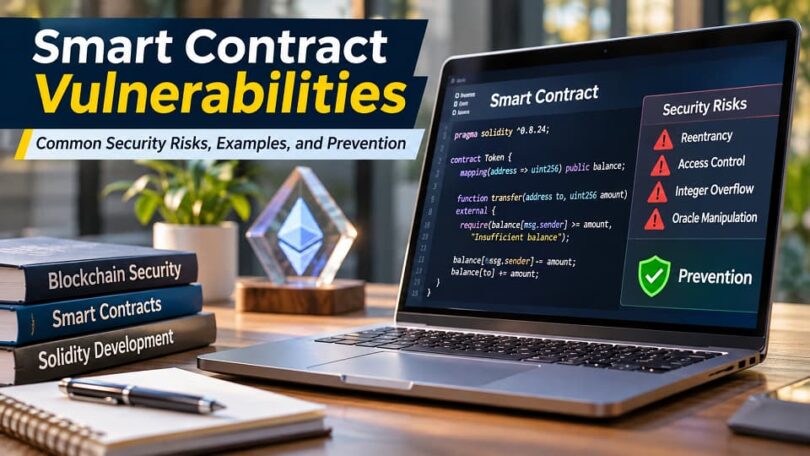

Smart contracts make blockchain applications work without relying on traditional intermediaries. They automatically execute predefined instructions when specific conditions are met. However, a mistake in their code or design can expose digital assets, transactions, and entire blockchain applications to security threats. These weaknesses are known as smart contract vulnerabilities.
Unlike traditional software, deployed smart contracts can be difficult to modify. Some operate with large amounts of cryptocurrency and digital assets. Attackers may exploit weaknesses to steal funds, manipulate transactions, disrupt services, or gain unauthorized access to contract functions. Even a small programming error can create serious financial consequences.
Smart contract vulnerabilities can arise from several sources. Common examples include reentrancy attacks, access control failures, integer overflow and underflow, oracle manipulation, and transaction ordering dependence. Other risks involve weak randomness, unsafe external calls, proxy configuration errors, and flawed business logic. Understanding these weaknesses is essential for anyone developing, auditing, or using blockchain applications.
In this guide, we explore the most common smart contract vulnerabilities, their classifications, and how attackers exploit them. We also examine real-world security incidents, explain the tools used to identify weaknesses, and discuss practical ways to prevent smart contract attacks. Whether you are a blockchain beginner, developer, or security enthusiast, this guide will help you understand the risks and the importance of building secure smart contracts.
Smart contracts operate within broader blockchain technology environments, where their security depends on code quality, execution rules, and external interactions.
Quick Answer: What Are the Main Smart Contract Vulnerabilities?
Smart contract vulnerabilities are weaknesses in code, protocol design, configuration, or external integrations that can cause unintended behavior or expose digital assets. Common examples include reentrancy, access-control failures, oracle manipulation, unsafe external calls, flawed business logic, transaction-ordering risks, and proxy upgrade errors. Developers reduce these risks through secure design, strong authorization, invariant and adversarial testing, independent security reviews, and post-deployment monitoring.
What Are Smart Contract Vulnerabilities?
Smart contract vulnerabilities are weaknesses in the code, architecture, configuration, or execution logic of blockchain applications. They can allow unintended behavior, unauthorized actions, incorrect state changes, or the loss of digital assets.
A vulnerability may affect a single function or emerge from interactions between several contracts and blockchain components. Its impact depends on the conditions required for exploitation and the assets or operations exposed.
Not every programming mistake is automatically an exploitable vulnerability. A weakness becomes a security vulnerability when it can be exploited under specific conditions to cause an adverse impact, such as unauthorized transfers, corrupted contract state, or disrupted services.
Understanding Smart Contracts and How They Work
A smart contract is a program deployed at a blockchain address. Its executable code and persistent data define how it responds when users or other contracts interact with it.
On Ethereum, smart contracts execute inside the Ethereum Virtual Machine (EVM). The EVM provides a standardized execution environment in which participating network nodes process transactions and independently verify the resulting state changes. Solidity is one of the most widely used programming languages for developing EVM-compatible smart contracts. Developers can also use languages such as Vyper.
A smart contract generally contains two fundamental components:
Code: Defines the contract’s functions, conditions, permissions, calculations, and execution rules.
State: Stores persistent information, including account balances, ownership records, configuration values, and transaction-related data.
These components work together to determine how the contract responds to interactions. For example, a decentralized lending contract may contain functions for depositing collateral, borrowing assets, repaying loans, and withdrawing funds. Its stored state tracks user positions, outstanding debts, collateral balances, and protocol parameters.
How Smart Contract Execution Works
A typical smart contract interaction follows these stages:
1. Contract development and compilation
Developers write contract logic using a supported programming language, such as Solidity. The source code is compiled into EVM bytecode, which the blockchain can execute. The compiler also produces an Application Binary Interface (ABI), describing how external applications encode function calls and interpret returned data.
2. Contract deployment
A deployment transaction publishes the compiled bytecode to the blockchain. After successful deployment, the contract receives an address and becomes accessible through blockchain transactions. Its constructor or initialization logic establishes the initial configuration and state.
3. Transaction submission
A user or another contract initiates an interaction by submitting a transaction containing the destination address, function selector, encoded arguments, and, where applicable, transferred cryptocurrency.
4. EVM execution
The EVM executes the requested contract function. It evaluates conditions, performs calculations, accesses storage, and may interact with other contracts. Execution consumes gas according to the computational and storage operations performed.
5. State modification and transaction settlement
If execution completes successfully, the resulting state changes are included in the blockchain’s transaction processing. If execution reverts, the transaction’s state changes are rolled back, although the sender generally still pays for the gas consumed.
It is also important to distinguish between reading and writing operations. Reading contract data through a call does not modify blockchain state and generally does not require an on-chain transaction. State-changing operations require transactions and consume gas.
How Smart Contracts Interact With Other Contracts
Smart contracts often interact with other contracts and services rather than operating in isolation.
A decentralized finance (DeFi) application, for example, may use token contracts, decentralized exchanges, oracle networks, lending protocols, and governance contracts.
Token contracts to transfer and manage digital assets.
Decentralized exchanges to execute token swaps.
Oracle networks to obtain external price information.
Lending protocols to manage collateral and borrowing.
Governance contracts to enforce administrative decisions.
This interconnected architecture, known as composability, lets developers combine existing blockchain components to build more complex applications.
However, each dependency introduces assumptions about the other component’s behavior, availability, and returned data. A failure or weakness in one component can affect applications that rely on it.
Because smart contracts cannot independently retrieve arbitrary off-chain information, applications use oracles to bring external data on-chain. Specific oracle security risks are examined later in this guide.
What Makes a Smart Contract Vulnerable?
A smart contract becomes vulnerable when its code, design, configuration, or operating environment permits behavior that violates its intended security rules.
A weakness may exist in one component or arise from interactions among several components. For example, an external call may become dangerous when the contract updates its state in the wrong order. The detailed mechanism belongs in the reentrancy section later in this guide.
The Difference Between a Software Weakness and an Exploitable Vulnerability
A potential weakness and a confirmed exploitable vulnerability are not always the same. This distinction matters when assessing severity and practical risk.
| Term | Meaning |
|---|---|
| Coding error | An incorrect implementation or programming mistake |
| Security weakness | A design or implementation condition that could introduce a security problem |
| Vulnerability | An exploitable security flaw that can produce an adverse impact |
| Exploit | A method or sequence of actions used to take advantage of a vulnerability |
| Attack | An attempt to compromise a contract, application, or protocol |
For example, an unchecked external call may indicate a weakness. Whether it becomes exploitable depends on how the calling contract handles failure and what state changes follow.
The OWASP Smart Contract Security Weakness Enumeration (SCWE) provides a structured reference for documenting weaknesses, impacts, and mitigations.
Why Smart Contract Security Matters
Smart contract security matters because blockchain applications often control valuable assets and execute operations automatically. Confirmed transactions are generally difficult to reverse.
A successful exploit can also affect connected protocols. Decentralized applications may depend on shared token contracts, bridges, oracles, and liquidity providers, allowing a weakness in one component to create wider financial or operational consequences.
The main reasons security matters include:
1. Protecting Digital Assets and User Funds
Smart contracts frequently control cryptocurrency, stablecoins, tokenized assets, and other digital holdings.
A vulnerability in a withdrawal function, authorization mechanism, or accounting system may allow an attacker to transfer assets without permission.
Security controls must protect both the assets held by a contract and the accounting records used to determine ownership.
2. Maintaining Data Integrity and Contract State
Smart contract state records important information, including ownership, balances, permissions, collateral positions, and protocol configurations.
An attacker who gains unauthorized access to state-changing functions may modify these records or trigger operations that violate the application’s intended rules.
This can lead to:
Incorrect token balances.
Unauthorized ownership transfers.
Manipulated lending positions.
Invalid governance decisions.
Incorrect reward calculations.
Inconsistent accounting records.
Maintaining state integrity is particularly important in financial applications, where several contracts may rely on the same information.
3. Preserving Protocol Availability
Security also protects the availability of contract functions. A vulnerability may prevent users from completing withdrawals, liquidations, or other critical operations.
Gas exhaustion, unbounded processing, and unexpected reverts are examples of conditions that can disrupt availability. These mechanisms are explained in the dedicated gas and denial-of-service sections.
Developers should account for worst-case execution costs, failure handling, and recovery paths when designing critical functions.
4. Protecting Connected Blockchain Applications
Decentralized applications frequently depend on composable smart contracts.
A lending platform may use an oracle for price information, a token contract for collateral, and another protocol for liquidity management.
If one component becomes compromised or returns unreliable information, dependent applications may act on incorrect assumptions.
This can create cascading failures across interconnected protocols.
Security assessments should therefore examine dependency relationships, not just individual contracts.
5. Maintaining User Confidence and Protocol Credibility
A major security incident can damage user confidence, reduce liquidity, discourage adoption, and harm a protocol’s reputation.
Transparent security practices, independent assessments, responsible disclosure, and continuous monitoring can support operational credibility. However, an audit cannot guarantee complete security.
6. Reducing Financial, Legal, and Operational Exposure
Smart contract exploits can cause financial losses for users, developers, protocol operators, and connected applications.
Depending on the application and jurisdiction, an incident may also create regulatory, contractual, reporting, or legal obligations.
Development teams should complement code reviews with documented security procedures, access-control policies, and incident-response plans.
Smart contract security protects asset ownership, transaction integrity, application availability, and the reliability of connected blockchain systems.
Can Smart Contract Vulnerabilities Be Exploited?
Yes. An attacker may exploit a smart contract vulnerability when the required conditions can be met and the contract exposes an operation or asset the attacker can affect.
Practical exploitability depends on the implementation, permissions, blockchain environment, available assets, and attacker’s capabilities. A reported weakness does not by itself prove that an attack can succeed.
| Vulnerability | Potential exploitation | Possible consequence |
|---|---|---|
| Reentrancy | Repeatedly invoking a function before state updates | Unauthorized withdrawals |
| Access control failure | Calling a privileged function without authorization | Administrative compromise |
| Integer arithmetic error | Triggering incorrect calculations | Balance or accounting manipulation |
| Oracle manipulation | Supplying or exploiting incorrect price information | Incorrect borrowing or liquidation |
| Weak randomness | Predicting or influencing random outcomes | Unfair reward distribution |
| Transaction ordering dependence | Manipulating transaction execution order | Financial advantage or value extraction |
| Storage collision | Corrupting proxy or implementation storage | Contract malfunction or privilege compromise |
| Denial of service | Preventing critical functions from executing | Interrupted operations or inaccessible funds |
Are All Smart Contract Exploits Successful?
No. A vulnerability may be difficult or impractical to exploit if required conditions cannot be satisfied.
For example:
The vulnerable function may require an authorization level the attacker cannot obtain.
The exploit may require more gas than the transaction can practically consume.
A security mechanism may prevent the attack from completing.
The affected contract may no longer hold valuable assets.
The vulnerability may depend on an external condition that is not currently available.
Security researchers distinguish between theoretical weaknesses, practically exploitable vulnerabilities, and confirmed exploitation incidents.
This distinction is important when evaluating smart contract security reports. A vulnerability’s severity should consider its exploitability, potential impact, required privileges, and the assets or operations exposed.
Can Exploited Smart Contracts Be Recovered?
Recovery depends on the contract’s architecture, the nature of the incident, and the response options available to its operators.
Emergency pause mechanisms, protected upgrade paths, administrative controls, or migration procedures may help contain an attack and restore affected operations.
These mechanisms cannot necessarily reverse completed transactions or recover assets that have already been transferred.
Operators may also coordinate with validators, exchanges, security researchers, or affected users to limit further damage. The available options vary by blockchain and incident.
Incident-response planning should therefore be part of security preparation before deployment.
Why Are Smart Contracts Vulnerable to Attacks?
Smart contracts operate in an environment where transactions, code execution, and asset transfers follow predefined blockchain rules. Although this automation reduces dependence on intermediaries, it introduces security challenges that differ from those found in conventional software applications.
A smart contract can execute exactly as programmed and still produce an unsafe result. This often happens because developers make incorrect assumptions about transaction ordering, external contract behavior, authorization, data accuracy, or execution costs. Attackers exploit these assumptions to trigger operations that the developers did not intend.
The vulnerability may originate in the contract’s source code, its deployment configuration, an external dependency, or the way several blockchain components interact. In many incidents, an attack succeeds because multiple weaknesses combine to create an exploitable condition.
Understanding these root causes is important for developers and security auditors. It helps them identify risks during architecture design, implementation, deployment, and ongoing contract operation.
Immutable Code and Deployment Risks
On public blockchains such as Ethereum, a directly deployed contract generally retains its runtime bytecode at the same address. Developers cannot simply edit that code after deployment as they might update a conventional application.
Why Immutability Creates Security Challenges
Conventional applications can often be patched by replacing vulnerable code or temporarily disabling affected features. A directly deployed immutable contract does not normally offer the same flexibility.
The consequences depend on the contract’s architecture:
Immutable contracts: The original code generally cannot be replaced at its existing address.
Upgradeable contracts: A proxy architecture may allow the implementation logic to change while preserving the proxy address and storage.
Pausable contracts: An authorized administrator may temporarily disable selected operations if emergency controls were implemented.
Migration-based contracts: Users or administrators may move assets and operations to a replacement contract, subject to the original contract’s available functionality.
These mechanisms do not guarantee recovery. A pause cannot reverse completed transactions, and an upgrade mechanism introduces its own authorization and configuration risks.
Risks Introduced During Smart Contract Deployment
Deployment also establishes a contract’s initial state, permissions, dependencies, and operational configuration.
A deployment mistake can therefore expose a contract even when its core business logic is sound.
Common deployment risks include:
1. Incorrect initialization
Some contracts use initialization functions instead of constructors, particularly when deployed behind proxies. If an initializer remains publicly accessible, an attacker may call it before the legitimate administrator and acquire ownership or privileged permissions.
2. Misconfigured access permissions
Developers may assign administrative privileges to the wrong address, leave sensitive functions accessible to unauthorized callers, or incorrectly configure role-based permissions.
3. Incorrect contract addresses
A contract may reference an incorrect token, oracle, implementation, or external service address. Interacting with an unintended contract can cause failed operations or expose assets to malicious behavior.
4. Incorrect network configuration
Contracts deployed across different blockchain networks may require different addresses, chain identifiers, oracle configurations, and administrative settings. Reusing deployment parameters without verifying them can introduce serious integration errors.
5. Exposed administrative privileges
If a single externally owned account controls critical functions without appropriate safeguards, compromising that account may allow an attacker to modify protocol parameters, upgrade implementations, or transfer assets.
How Upgradeable Contracts Introduce Additional Risks
Upgradeable contracts provide a way to change application logic after deployment. A common design uses a proxy to retain application state while forwarding execution to a separate implementation contract.
Weak or missing authorization for upgrades.
Unprotected or incorrectly ordered initialization.
Incompatible storage layouts between implementation versions.
Compromised administrator accounts or malicious implementation code.
This design commonly relies on `delegatecall`, so implementation code operates in the proxy’s storage context.
This architecture provides flexibility, but it introduces additional security considerations:
If an attacker compromises an upgrade administrator, they may install a malicious implementation that can alter the proxy’s state or control assets held by the application.
Upgradeable systems therefore require strict upgrade authorization, safe initialization, and storage-compatibility checks. The detailed mechanics and failure modes are examined later in this guide.
Security takeaway: Developers must decide before deployment how a contract will handle updates, emergencies, and administrative control. Both immutable and upgradeable designs require deliberate security planning.
Programming Errors and Incorrect Logic
Programming errors arise during smart contract design, implementation, integration, or maintenance. Because contracts often manage assets and financial operations directly on-chain, an implementation mistake can affect ownership, settlement, or protocol accounting.
Successful compilation confirms that code meets the compiler’s syntax and type requirements; it does not prove that the contract implements its intended rules securely.
Many serious errors arise when developers misunderstand EVM execution, persistent state, external interactions, or the assumptions made about transaction inputs.
1. Arithmetic and Precision Errors
Smart contracts calculate token balances, exchange rates, collateral ratios, interest, and rewards. These calculations require careful handling of integer arithmetic and token precision.
Integer division, rounding, scaling factors, and fixed-point representations can produce results that differ from a protocol’s intended financial calculations.
For example, Solidity uses integer arithmetic rather than native floating-point arithmetic. When a calculation produces a fractional result, the remainder is discarded.
Consider:
uint256 result = 5 / 2;The result is 2, not 2.5.
In a financial contract, repeated rounding operations can create discrepancies between deposited assets, issued shares, accrued interest, and withdrawals.
Other precision-related risks include:
Overflow and underflow in older compiler versions or explicitly `unchecked` operations (examined separately in the vulnerability section).
Incorrect decimal scaling between tokens.
Precision loss during division.
Incorrect multiplication and division ordering.
Rounding differences in financial calculations.
These errors can break accounting invariants and, in some protocols, allow value to be extracted over repeated transactions.
2. Incorrect State Management
Smart contracts maintain persistent state through storage variables. Functions modify this state when users deposit assets, transfer tokens, borrow funds, repay loans, or change administrative settings.
A vulnerability can occur when a contract updates only part of its related state or performs updates in an unsafe sequence.
For example, a lending protocol must maintain consistent relationships between collateral, outstanding debt, interest, and user balances. If a repayment function reduces the recorded debt without correctly accounting for the received assets, the protocol may develop an accounting inconsistency.
Unsafe ordering of state updates and external calls can also create reentrancy conditions; the attack mechanism is covered in the dedicated reentrancy section.
Developers should define the accounting and state invariants that must always hold, then test them across relevant functions and transaction sequences.
3. Missing or Incorrect Input Validation
Contracts receive inputs from users, administrators, other contracts, and external data providers. Each input must be valid for the operation and safe under the protocol’s rules.
Without adequate validation, an attacker may supply values that violate assumptions made by the implementation.
Examples of unsafe assumptions include:
Zero or invalid addresses.
Values outside permitted ranges.
Unexpected token amounts.
Invalid function parameters.
Incorrect signature data.
Malformed cross-contract or cross-chain messages.
Validation must also account for context: a syntactically valid address or value may still refer to an untrusted contract or an unsafe business condition.
Detailed input-validation weaknesses and historical ABI issues are covered in the dedicated input-validation subsection.
4. Incorrect Authorization and Function Logic
A function can perform its operation correctly but still be vulnerable if it allows an unauthorized account to invoke it.
Privileged operations such as changing protocol parameters or upgrading an implementation require explicit authorization. The detailed permission models and exploit patterns are addressed in the access-control and proxy sections.
Other examples include:
Incorrect role verification.
Missing ownership checks.
Inconsistent authorization across related functions.
Improper initialization.
Trusting tx.origin instead of using appropriate caller authorization.
An authorization error can expose critical functions or compromise the wider application.
5. Incorrect Error Handling
External calls and token interactions may revert, reject a request, return unexpected data, or consume more gas than expected.
If the caller ignores a low-level call’s result, it may continue as though an operation succeeded when it did not.
For example:
(bool success, ) = recipient.call{value: amount}("");The caller must check and handle `success`. Otherwise, its accounting may record a payment that never occurred.
Return-value handling alone is not enough; developers must also preserve state consistency and account for reentrancy. The detailed low-level call patterns are covered later.
6. Unsafe Use of Solidity Features
Certain Solidity features expose lower-level execution behavior and therefore require particular care.
Examples include:
delegatecall, which executes another contract’s code using the caller’s storage context.
Low-level call, which transfers control to an external address.
Assembly and inline Yul, which provide lower-level execution capabilities.
unchecked blocks, which disable Solidity’s automatic arithmetic overflow and underflow checks.
Fallback functions, which handle certain calls that do not match declared function signatures.
These features are not inherently insecure. Risk depends on implementation, permissions, and the developer’s understanding of their execution semantics. Their specific failure modes are explained in the relevant vulnerability sections.
Developers should consult the Solidity security guidance for the compiler version and language features used by their project.
Security takeaway: Correct compilation and normal execution do not establish security. Developers must validate financial calculations, preserve state invariants, enforce permissions, and handle unexpected inputs and external behavior.
External Dependencies and Third-Party Integrations
Most decentralized applications depend on components beyond their own contracts, including token contracts, oracle networks, libraries, bridges, and other blockchain services.
Composability lets developers reuse infrastructure instead of implementing every feature themselves.
Each dependency also adds a trust assumption. A contract with sound internal logic may still fail if a dependency is compromised, misconfigured, unavailable, or behaves differently than expected.
Security review must therefore include the dependencies and integration boundaries, not just the application’s own source code.
1. Vulnerabilities in External Smart Contracts
Contracts call external components to transfer tokens, exchange assets, verify permissions, or perform other operations.
A flaw or unexpected behavior in the called contract can affect the caller, especially when the caller relies on its return values, token behavior, or callbacks.
A lending protocol that accepts a token as collateral must understand that token’s balance and transfer behavior.
A malicious, compromised, or non-standard token may return unexpected values or execute callbacks that the lending protocol did not anticipate.
Potential risks include:
Malicious token contracts.
Unexpected external function behavior.
Reentrancy through callbacks and token hooks.
Incorrect assumptions about token return values.
External contracts that revert or consume excessive gas.
Changes in the behavior of upgradeable dependencies.
Deployment or source-code verification does not by itself establish that an external contract is safe or suitable for integration.
2. Oracle Dependency and Manipulated External Data
Smart contracts cannot independently retrieve arbitrary off-chain information. Oracles deliver data such as asset prices, exchange rates, interest rates, and real-world events to on-chain applications.
A lending protocol may use an oracle price to value deposited collateral.
Inaccurate, stale, or manipulated data can cause the protocol to make unsafe borrowing or liquidation decisions.
Potential consequences include:
Undervaluing collateral.
Incorrect liquidation decisions.
Excessive borrowing.
Unfair asset valuation.
Manipulation of decentralized exchange prices.
Financial losses across connected protocols.
Oracle integrations require checks for data freshness, source reliability, aggregation methods, acceptable deviation, and failure conditions. Detailed oracle manipulation techniques are covered in the dedicated oracle subsection.
Developers should also understand how the selected oracle obtains and publishes its data.
3. Vulnerabilities in Third-Party Libraries
Third-party libraries provide reusable components for access control, token operations, calculations, and upgradeability.
Although established libraries can reduce custom-code risk, they are not automatically safe in every version or configuration.
Potential risks include:
Known vulnerabilities in outdated versions.
Incorrect library configuration.
Unsafe custom modifications.
Incompatible dependencies.
Unverified source code.
Incorrect assumptions about library behavior.
An outdated dependency may contain a known weakness. It becomes a practical risk when the vulnerable component is reachable through the application’s execution path.
Teams should pin dependency versions, monitor security advisories, review changes, and test the exact versions intended for production.
4. Cross-Contract and Cross-Chain Integration Risks
Applications may also depend on integrations that span several contracts or blockchain networks.
Bridges and cross-chain messaging systems, for example, depend on source-chain verification, message relaying, and destination-chain execution.
A failure in message verification, replay protection, asset accounting, or authorization can compromise the integration.
A destination contract must verify that a message represents a valid source-chain operation before releasing or minting corresponding assets.
If an attacker can forge a message or bypass verification, the destination contract may release assets without a valid source-chain operation.
Cross-chain systems must establish message authenticity, prevent replay, enforce authorization, and maintain consistent accounting between networks. Specific signature and bridge exploits are discussed in the relevant vulnerability and incident sections.
5. Trust Assumptions and Dependency Failure
A recurring design mistake is assuming that an external dependency will remain trustworthy and available indefinitely.
Even established services can experience outages, configuration changes, governance failures, or security incidents.
Contracts should define how critical operations behave when a dependency becomes unavailable or returns invalid information.
Depending on the application, appropriate protections may include:
Validating external contract addresses.
Checking return values and execution results.
Enforcing oracle freshness requirements.
Using multiple independent data sources where appropriate.
Implementing circuit breakers or emergency pause mechanisms.
Restricting privileged dependency changes.
Monitoring external contracts for unexpected behavior.
Controls should match the dependency’s role and failure impact. Adding more providers does not automatically improve security; each additional integration can expand the attack surface.
Security takeaway: Assess every critical dependency, its trust assumptions, and its failure modes. The security of an application depends on how safely it integrates external code, data, and infrastructure.
Complex Blockchain Transactions and Interactions
Individual blockchain operations follow protocol rules, but sequences of transactions and contract calls can produce outcomes that are difficult to anticipate.
A single user action may trigger multiple contract calls, callbacks, token transfers, and state changes within one EVM transaction.
Security depends on how these operations interact, including their ordering, execution context, shared state, and failure behavior.
On public networks, transaction inclusion and ordering can also affect financial outcomes, particularly in decentralized finance. Specific MEV strategies are explained in the transaction-ordering and front-running sections.
1. Transaction Ordering and Front-Running
On some public networks, pending transactions can be observed before block inclusion.
Searchers may use this visibility to submit transactions intended to execute before or after a target transaction.
A pending swap can therefore be exposed to transaction-ordering strategies.
The exact outcome depends on liquidity, ordering, fees, and the transaction’s execution limits.
This is one source of transaction-ordering risk and maximal extractable value (MEV), covered in detail later.
2. Reentrancy Through External Contract Interactions
An external call can transfer control to another contract, which may execute its own code and call back into the caller before the original operation completes.
If critical state has not been updated, the callback may interact with outdated state.
Whether this creates an exploitable reentrancy condition depends on the state changes and callable functions. The attack sequence and defenses are covered in the dedicated reentrancy section.
External calls should therefore be treated as interactions with potentially untrusted code.
The same execution concern can arise with token hooks, NFT receiver callbacks, and flash-loan callbacks.
3. Composability and Multi-Contract Execution
Composability allows contracts to combine functionality from multiple protocols.
A DeFi operation may depend on a lending protocol, an automated market maker, a token contract, and an oracle.
This creates useful functionality but increases the number of assumptions that must hold simultaneously.
A failure or manipulated output in one component can affect downstream components.
Potential risks include:
Inconsistent accounting across contracts.
Unexpected callbacks.
Incorrect assumptions about token behavior.
Reentrancy across multiple contracts.
Manipulated intermediate prices.
Failed operations within complex execution sequences.
Reviewers must therefore analyze the full execution path and its dependencies, not only the function that first receives the transaction.
4. Transaction Atomicity and Partial Failure Assumptions
An EVM transaction is generally atomic: if an uncaught failure reverts the top-level transaction, its state changes are rolled back.
Atomicity does not mean that every low-level operation inside a transaction succeeds.
A low-level call can fail and return a failure indicator without automatically reverting the caller. If the caller ignores the result, execution may continue despite an incomplete operation.
A contract that ignores a failed transfer result may update its accounting as though the asset movement succeeded.
The result can be a mismatch between recorded balances and actual holdings; detailed return-value handling is covered in the unchecked external calls section.
Developers must define failure behavior and preserve consistent state when an external operation does not complete.
5. Block-Level Information and Execution Constraints
Contracts can read blockchain context such as block timestamps, block numbers, and transaction-related values.
These values may influence contract decisions, but they have specific security and predictability limits.
Problems arise when developers treat these values as unpredictable, precise, or suitable for security-critical decisions without considering their protocol-specific properties.
Examples include:
Using block timestamps as a source of randomness.
Depending on precise transaction ordering.
Making financial decisions using easily manipulated spot prices.
Assuming external calls will always complete within available gas.
Relying on predictable block-related information for sensitive outcomes.
Such assumptions can expose contracts to timing and ordering manipulation or unexpected execution failures. The specific timestamp, randomness, and ordering weaknesses are examined separately in H2 4.
Security takeaway: Analyze the complete transaction path, including callbacks, dependencies, ordering, and failure handling. A function that appears safe in isolation may behave differently when composed with other contracts.
Insufficient Testing and Security Auditing
Vulnerabilities can survive development when testing checks expected functionality but does not examine how an attacker might make the contract behave incorrectly.
Passing unit tests and compiling successfully do not establish that a contract is secure under adversarial conditions.
Attackers may use unexpected inputs, unusual function sequences, malicious contracts, or manipulated dependencies that ordinary test cases do not cover.
Security assessment must examine both intended behavior and adversarial conditions.
1. Inadequate Unit and Integration Testing
Unit tests examine individual functions under specified conditions. Integration tests examine how multiple components behave when they interact.
Both are necessary; narrow test coverage can leave important execution paths unexamined.
Common testing deficiencies include:
Testing only successful transaction paths.
Ignoring invalid or unexpected inputs.
Failing to test unauthorized callers.
Not examining boundary values.
Overlooking external contract callbacks.
Testing contracts independently without examining their integrations.
Ignoring failure conditions and transaction reverts.
Ordinary tests may confirm that a user with sufficient balance can withdraw successfully.
They may still miss callback behavior if tests do not include a recipient contract that re-enters the withdrawal function. The reentrancy mechanism itself is explained in H2 4.
2. Failure to Test Contract Invariants
An invariant is a property that must remain true across valid contract states and transaction sequences.
A lending protocol may need to preserve consistent relationships among debt, collateral, and available liquidity.
A token vault may need its recorded liabilities and shares to remain consistent with the assets it holds.
Testing isolated function outputs may miss violations that emerge only after a sequence of transactions.
Developers should define protocol-specific invariants and test them across relevant inputs, transaction sequences, and execution conditions.
This is particularly important in financial protocols, where accounting errors can accumulate over time.
3. Insufficient Fuzz Testing
Fuzz testing generates inputs and transaction sequences to search for behavior that violates expected properties.
It complements manually written tests by exploring combinations that developers may not anticipate.
A fuzzer may generate:
Unexpected token amounts.
Boundary values.
Repeated deposits and withdrawals.
Different function execution sequences.
Invalid addresses.
Unauthorized calls.
Unusual combinations of contract operations.
Property-based tests express expected properties and check whether generated executions preserve them.
Fuzzing is not exhaustive proof, but it can expose edge cases missed by manually selected test inputs.
4. Lack of Static and Dynamic Security Analysis
Static analysis examines source code or compiled representations without executing the contract’s normal transaction flow.
It can flag suspicious patterns and operations for further review.
Dynamic analysis evaluates runtime behavior under selected inputs, states, and transaction sequences.
These approaches are complementary; neither provides complete coverage on its own.
A flagged pattern may require manual review or execution-based testing to determine whether it is exploitable in the protocol’s actual context.
Specific tools and their capabilities are compared in the following tools section; no single scanner or testing framework replaces contextual review.
5. Treating Security Audits as a One-Time Activity
An independent audit reviews a contract’s implementation, architecture, and security assumptions.
An audit reduces risk but cannot guarantee that every vulnerability has been found.
Audit coverage depends on factors such as:
The completeness of the code submitted for review.
The auditor’s technical expertise.
The depth of manual and automated analysis.
The complexity of the contract architecture.
The quality of test coverage.
The examination of external dependencies.
Whether the final deployed bytecode matches the reviewed implementation.
Subsequent code changes, configuration updates, dependency changes, or implementation upgrades can introduce risks that were outside the original audit scope.
Repeat relevant security reviews when meaningful changes affect the contract’s attack surface.
6. Ignoring Deployment and Post-Deployment Monitoring
Security work continues after deployment because production conditions can differ from test environments.
Live contracts face real transaction activity, changing dependencies, economic incentives, and adversarial behavior.
Monitoring can help identify suspicious transactions, unexpected interactions, unusual asset movements, and changes to critical protocol behavior.
Depending on the application, monitoring systems may track:
Unexpected administrative operations.
Unusual token transfers.
Changes to critical contract parameters.
Abnormal transaction volumes.
Suspicious oracle price movements.
Failed transactions and repeated execution attempts.
Proxy implementation and upgrade changes.
An incident-response plan should define who investigates alerts, who can activate emergency controls, how users are informed, and what recovery or migration options exist.
What a Comprehensive Smart Contract Security Process Should Include
| Security activity | Primary purpose |
|---|---|
| Unit testing | Verify individual functions |
| Integration testing | Examine interactions between components |
| Invariant testing | Verify critical protocol properties |
| Fuzz testing | Discover unexpected execution behavior |
| Static analysis | Identify suspicious code patterns |
| Dynamic analysis | Examine runtime behavior |
| Formal verification | Mathematically verify specified properties |
| Independent auditing | Conduct expert security assessment |
| Deployment verification | Confirm deployed code and configuration |
| Continuous monitoring | Detect suspicious post-deployment activity |
Effective assurance combines secure design, code review, testing, independent assessment, and post-deployment monitoring rather than relying on one measure.
Security takeaway: Testing, auditing, and monitoring serve different purposes and should work together throughout the contract lifecycle. Functional tests check expected behavior; security assessment probes how that behavior can fail under adversarial conditions.
How Are Smart Contract Vulnerabilities Classified?
Smart contract vulnerabilities can be grouped by the type of weakness involved, the component affected, or the way an attack occurs. These categories help organize security findings, although a single vulnerability may fit more than one group.
Categories can overlap. Reentrancy, for example, involves external-call handling and state management, while oracle manipulation combines external data dependency with economic risk. No single classification captures every smart contract weakness. The OWASP Smart Contract Weakness Enumeration (SCWE) provides a structured reference for documenting weaknesses. The separate OWASP Smart Contract Top 10: 2026 is a forward-looking awareness ranking based on practitioner input and 2025 incident data; it highlights selected risks rather than providing an exhaustive taxonomy. The seven categories used in this guide are an editorial framework, not an official OWASP classification. Official references: | |
No single classification captures every smart contract weakness. The OWASP Smart Contract Security Weakness Enumeration (SCWE) provides a structured reference for documenting weaknesses, while the OWASP Smart Contract Top 10 highlights selected security risks.
For practical analysis, we can organize smart contract vulnerabilities into seven broad categories:
Code-level vulnerabilities.
Access control and authorization vulnerabilities.
Logic and business logic vulnerabilities.
Blockchain and transaction-level vulnerabilities.
External dependency and integration vulnerabilities.
Upgradeability and configuration vulnerabilities.
Economic and protocol-level vulnerabilities.
The seven categories below are an editorial framework for this guide, not an official OWASP classification. They are not mutually exclusive, and the detailed vulnerability explanations follow in H2 4.
Code-Level Vulnerabilities
Code-level vulnerabilities arise from mistakes in contract implementation, including unsafe operations, incorrect data handling, or flawed function behavior. They affect how the code executes. Detailed examples, including reentrancy, arithmetic errors, and unsafe external calls, are examined in H2 4.
Access Control and Authorization Vulnerabilities
Access-control vulnerabilities occur when contracts fail to enforce who may perform privileged actions. Common areas of concern include ownership, role assignments, initialization, and administrative permissions. The specific weaknesses and defenses are covered in the access-control subsection in H2 4.
Logic and Business Logic Vulnerabilities
Logic and business logic vulnerabilities arise when the contract’s rules, calculations, or state transitions do not enforce the application’s intended behavior. A contract may execute exactly as coded while still producing an unsafe financial or operational result. H2 4 examines these failures in greater detail.
Blockchain and Transaction-Level Vulnerabilities
These vulnerabilities arise from blockchain execution properties, including transaction ordering, block-related information, and gas constraints. Transaction-ordering dependence, front-running, timestamp reliance, and predictable randomness belong to this broad category, but they are distinct mechanisms and are explained separately in H2 4.
External Dependency and Integration Vulnerabilities
These weaknesses arise when a contract relies on external code, data, libraries, bridges, or services that are compromised, misconfigured, unavailable, or incorrectly trusted. Oracle manipulation and cross-contract integration failures are examples explored later in the guide.
Upgradeability and Configuration Vulnerabilities
These vulnerabilities involve deployment settings, initialization, privileged configuration, and mechanisms for changing contract implementations. Proxy storage compatibility and upgrade authorization are important examples. Their technical mechanics are covered in the relevant H2 4 subsections.
Economic and Protocol-Level Vulnerabilities
Economic and protocol-level vulnerabilities arise from exploitable assumptions about prices, liquidity, collateral, incentives, or financial interactions. They may exist even when individual functions execute as programmed. Flash-loan-enabled exploits and market manipulation can expose these weaknesses, as discussed in H2 4.
19 Common Smart Contract Vulnerabilities Explained

Understanding these vulnerabilities requires more than knowing their definitions. Developers and security researchers must examine the underlying execution mechanisms, the conditions that make exploitation possible, and the potential consequences for affected applications.
A vulnerability may exist in a single function or emerge through interactions between multiple contracts. Attackers can exploit these weaknesses to bypass authorization, manipulate financial calculations, extract assets, disrupt contract operations, or compromise protocol integrity.
The following sections examine 18 important smart contract vulnerability and attack categories. Each explanation focuses on how the weakness occurs, how it can be exploited, its potential impact, and the security measures developers should consider.
The examples primarily use Solidity and the Ethereum Virtual Machine (EVM). Some vulnerabilities also apply to other EVM-compatible networks, although their execution rules and security implications may differ.
1. Reentrancy Attacks
A reentrancy attack occurs when an external contract calls back into a vulnerable contract before the original operation finishes. If critical state has not been updated before the external interaction, the callback may repeat an operation using outdated state. This can cause unauthorized withdrawals, incorrect accounting, or other unintended state changes.
Reentrancy is particularly dangerous in contracts that transfer cryptocurrency or interact with external contracts while processing financial operations.
How Does a Reentrancy Attack Work?
An external call transfers execution control to another contract. The receiving contract may run its own code and call back into the original contract before the first execution completes.
Consider a vulnerable withdrawal function that follows this sequence:
Check whether the caller has sufficient balance.
Transfer cryptocurrency to the caller.
The unsafe ordering is the central weakness: the contract transfers funds before updating the caller’s recorded balance.
If the recipient is a malicious contract, its fallback or receive function may execute automatically when it receives Ether. That function can call the vulnerable withdrawal function again.
Because the balance remains unchanged during the callback, the repeated withdrawal may pass the same check. The attack can continue until funds or execution resources are exhausted.
Example of a Vulnerable Solidity Contract
Consider the following simplified withdrawal implementation:
// SPDX-License-Identifier: MIT
pragma solidity ^0.8.24;
contract VulnerableBank {
    mapping(address => uint256) public balances;
    function deposit() external payable {
        balances[msg.sender] += msg.value;
    }
    function withdraw(uint256 amount) external {
        require(
            balances[msg.sender] >= amount,
"Insufficient balance"
        );
        (bool success, ) = payable(msg.sender).call{
            value: amount
        }("");
        require(success, "Transfer failed");
        balances[msg.sender] -= amount;
    }
}
The vulnerability exists because the external call occurs before the contract reduces the user’s recorded balance.
Although Solidity 0.8 and later automatically check ordinary arithmetic operations for overflow and underflow, those protections do not prevent reentrancy.
How an Attacker Exploits the Vulnerability
An attacker can deploy another contract that deposits Ether into the vulnerable bank and invokes its withdrawal function.
The malicious contract then uses its receive() function to call withdraw() again whenever it receives Ether.
A simplified execution sequence looks like this:
Reentrancy attack execution flow
Initial deposit
The attacker deposits Ether into the vulnerable contract.
First withdrawal
The attacker requests a withdrawal. The bank checks the recorded balance.
External call
The bank transfers Ether to the attacker’s contract before updating its balance.
Malicious callback
The attacker’s receive function executes and calls the withdrawal function again.
Repeated execution
The vulnerable balance check may continue passing because the original balance has not been updated.
Unauthorized withdrawals
The attacker may withdraw more Ether than the amount legitimately deposited.
The actual amount that can be extracted depends on the contract’s available balance, withdrawal logic, gas limits, and other execution conditions.
Types of Reentrancy Attacks
Reentrancy can affect more than repeated calls to one withdrawal function. The main forms differ in how the callback reaches shared state or exposes an inconsistent view of that state.
1. Single-function reentrancy
The attacker repeatedly invokes the same vulnerable function before its original execution completes.
2. Cross-function reentrancy
An attacker enters a contract through one function and then calls another function that relies on the same shared state.
For example, a malicious callback may enter a withdrawal function and then invoke a borrowing function that uses the same outdated accounting information.
3. Cross-contract reentrancy
The attacker exploits interactions between multiple contracts that share or depend on related state.
A vulnerability may exist even when the individual functions appear safe in isolation.
4. Read-only reentrancy
A callback temporarily exposes inconsistent contract state to another contract that reads that state without modifying it.
The second contract may use the temporary information to make an incorrect financial decision.
Read-only reentrancy is particularly relevant to DeFi protocols that use external contracts to calculate collateral values, exchange rates, or share prices.
Real-World Example: The DAO Hack
The 2016 DAO incident is one of the most prominent examples of a reentrancy exploit.
The attacker exploited a withdrawal mechanism that allowed repeated withdrawals before the relevant internal accounting was updated. This enabled the extraction of substantial Ether from the DAO.
The incident resulted in a major Ethereum community response and the eventual hard fork that created the Ethereum and Ethereum Classic chains.
The DAO incident demonstrated how a seemingly small execution-order weakness could have major financial and ecosystem-wide consequences.
How to Prevent Reentrancy Attacks
Developers should treat every external contract interaction as a potential reentrancy boundary.
Several defensive measures can reduce the risk.
1. Apply the Checks-Effects-Interactions pattern
This pattern requires developers to:
Check all required conditions.
Update internal contract state.
Perform external interactions only after the state changes.
A safer withdrawal implementation follows this approach:
// SPDX-License-Identifier: MIT
pragma solidity ^0.8.24;
contract SecureBank {
    mapping(address => uint256) public balances;
    function deposit() external payable {
        balances[msg.sender] += msg.value;
    }
    function withdraw(uint256 amount) external {
        require(
            balances[msg.sender] >= amount,
"Insufficient balance"
        );
        // Effects: update state first
        balances[msg.sender] -= amount;
        // Interactions: transfer funds afterward
        (bool success, ) = payable(msg.sender).call{
            value: amount
        }("");
        require(success, "Transfer failed");
    }
}
If the external transfer fails, the require statement reverts the transaction, including the earlier balance update.
2. Use a reentrancy guard
A reentrancy guard prevents a protected function from being entered again while its previous execution remains active.
For example, OpenZeppelin provides a ReentrancyGuard utility that developers can use with the nonReentrant modifier.
3. Minimize external calls
Avoid unnecessary external interactions during sensitive state-changing operations.
Reducing external calls can decrease the number of opportunities for unexpected callbacks and reentrant execution.
4. Validate shared state across functions
Developers should examine whether multiple functions depend on the same accounting information.
Protecting only one withdrawal function may not prevent cross-function or cross-contract reentrancy.
5. Test callback behavior
Security testing should include malicious recipient contracts, repeated function calls, and unexpected execution sequences.
Fuzz testing and invariant testing can help identify reentrancy conditions that ordinary unit tests may miss.
2. Access Control and Authorization Vulnerabilities
Access control and authorization vulnerabilities occur when a smart contract fails to properly restrict who can execute sensitive functions or modify protected state. These weaknesses allow unauthorized accounts or malicious contracts to perform operations intended only for owners, administrators, or users with specific permissions.
Smart contracts frequently manage valuable assets and critical protocol functions. Administrative operations may include transferring treasury funds, changing contract parameters, granting permissions, pausing operations, updating oracle addresses, or upgrading implementations.
If authorization checks are missing, incorrectly implemented, or inconsistently enforced, an attacker may gain control over these operations. In severe cases, a single access control failure can compromise the entire application without requiring any additional programming vulnerability.
Unlike reentrancy, which exploits the sequence of external calls and state updates, access control vulnerabilities exploit weaknesses in the rules that determine who is allowed to perform an operation.
How Access Control Works in Smart Contracts
Smart contracts use authorization mechanisms to determine whether an account can execute a particular function.
The EVM exposes two important transaction-related values:
msg.sender: The immediate caller of the current contract or function.
tx.origin: The externally owned account that originated the transaction.
For most contract authorization checks, developers should use msg.sender together with an appropriate permission model. Using tx.origin for authorization can expose contracts to phishing-style attacks involving intermediary contracts.
Common authorization approaches include:
1. Ownership-based access control
A contract assigns ownership to a particular address. Only that address can execute functions protected by an ownership check.
2. Role-based access control (RBAC)
Different accounts receive specific roles with different permissions. For example, an administrator may manage protocol settings, while a separate operator can pause selected functions.
3. Multisignature authorization
Sensitive operations require approval from multiple authorized signers rather than a single account.
4. Governance-based authorization
A decentralized autonomous organization (DAO) or governance contract controls important protocol changes through voting and proposal execution.
Each approach has different security assumptions. The appropriate model depends on the contract’s responsibilities, asset exposure, administrative structure, and recovery requirements.
Common Types of Access Control Vulnerabilities
1. Missing Access Restrictions
A missing access restriction occurs when a sensitive function does not verify the caller’s permissions.
Consider this vulnerable Solidity implementation:
// SPDX-License-Identifier: MIT
pragma solidity ^0.8.24;
contract VulnerableVault {
    address public owner;
    constructor() {
        owner = msg.sender;
    }
    function changeOwner(address newOwner) external {
        owner = newOwner;
    }
}
The changeOwner() function allows anyone to replace the current owner because it does not contain an authorization check.
An attacker can call this function and assign ownership to their own address.
Once ownership changes, the attacker may gain access to other administrative functions protected by the ownership variable.
The security problem: The contract stores an owner address but does not enforce the ownership restriction when changing it.
A secure implementation must verify the caller before modifying privileged state.
2. Improper Role-Based Access Control
Role-based access control provides more granular permissions than a single-owner model. It allows developers to assign different responsibilities to different accounts.
For example, a DeFi protocol might define:
DEFAULT_ADMIN_ROLE for managing permissions.
PAUSER_ROLE for emergency suspension.
UPGRADER_ROLE for implementation upgrades.
TREASURY_ROLE for authorized treasury operations.
A vulnerability can occur when roles are assigned incorrectly or when a sensitive function checks the wrong permission.
Consider a protocol where an ordinary operator is accidentally granted the ability to upgrade the contract. Even if the upgrade function checks permissions correctly, the role configuration itself creates an authorization weakness.
Other common mistakes include granting administrator privileges to untrusted addresses, failing to revoke compromised roles, and allowing unauthorized accounts to grant themselves additional permissions.
3. Privilege Escalation
Privilege escalation occurs when an account gains permissions beyond those intended for its role.
This may happen through incorrect role administration, exposed ownership functions, unsafe initialization, or flawed permission inheritance.
For example, an attacker with limited operational privileges might exploit a poorly protected role-management function to obtain administrator-level access.
The resulting compromise may allow the attacker to:
Change critical protocol parameters.
Grant permissions to additional accounts.
Replace contract implementations.
Disable protective mechanisms.
Access restricted financial operations.
Privilege escalation is particularly dangerous in upgradeable contracts because administrative control may extend to the entire application’s execution logic.
4. Unprotected Initialization Functions
Initialization vulnerabilities commonly affect proxy-based smart contract systems.
Unlike conventional contracts, upgradeable implementations often use initializer functions instead of constructors to configure ownership, permissions, and other initial state.
If an initializer remains publicly accessible, an attacker may call it before the legitimate administrator and acquire privileged control.
Consider this simplified implementation:
// SPDX-License-Identifier: MIT
pragma solidity ^0.8.24;
contract VulnerableImplementation {
    address public owner;
    bool public initialized;
    function initialize() external {
        require(!initialized, "Already initialized");
        owner = msg.sender;
        initialized = true;
    }
}
The function prevents repeated initialization, but it does not restrict who can perform the first initialization.
If the contract is deployed without being initialized securely, an attacker may call initialize() first and become its owner.
In a proxy architecture, developers must also ensure that the proxy’s own storage is initialized correctly. Initializing the implementation contract does not automatically initialize the proxy because they maintain separate storage.
Prevention: Use established initializer mechanisms, such as OpenZeppelin’s Initializable, restrict initialization to the intended deployment process, and lock implementation contracts where appropriate using _disableInitializers().
5. Improper Use of tx.origin for Authorization
The tx.origin variable identifies the externally owned account that originally initiated a transaction. In contrast, msg.sender identifies the immediate caller.
Confusing these values can create authorization vulnerabilities.
Consider the following example:
// SPDX-License-Identifier: MIT
pragma solidity ^0.8.24;
contract VulnerableWallet {
    address public owner;
    constructor() {
        owner = msg.sender;
    }
    function withdraw() external {
        require(tx.origin == owner, "Not authorized");
        payable(tx.origin).transfer(
            address(this).balance
        );
    }
    receive() external payable {}
}
At first glance, the function appears to restrict withdrawals to the owner. However, the authorization check relies on the original transaction initiator rather than the immediate caller.
An attacker can deploy a malicious intermediary contract and persuade the wallet owner to interact with it. When the intermediary calls withdraw(), tx.origin still identifies the owner, so the authorization check may pass.
This is commonly known as a phishing-style tx.origin attack.
Prevention: Use msg.sender for caller authorization, combined with an appropriate ownership or role-based permission system. Do not rely on tx.origin as the primary authorization mechanism.
6. Incorrect Ownership Transfer and Administrative Controls
Ownership transfer functions are another potential source of authorization failures.
A poorly implemented transfer mechanism may allow ownership to be transferred to an invalid address, accidentally remove the only administrator, or leave sensitive permissions assigned to an account that should no longer control the contract.
Consider these possible weaknesses:
Allowing ownership transfer to the zero address.
Failing to verify the new owner’s acceptance.
Leaving old administrative roles active after ownership changes.
Allowing unauthorized ownership renunciation.
Using a single externally owned account for every critical operation without additional safeguards.
Established ownership and access-control implementations help reduce these risks.
For example, OpenZeppelin provides Ownable2Step, which uses a two-step ownership transfer process. The proposed new owner must accept the transfer, reducing the risk of accidentally transferring ownership to an incorrect address.
How Access Control Attacks Affect Smart Contracts
The consequences depend on the permissions exposed by the vulnerable function.
| Vulnerability | Possible attack | Potential impact |
|---|---|---|
| Missing access restriction | Unauthorized function execution | Asset theft or configuration changes |
| Incorrect role assignment | Abuse of excessive permissions | Administrative compromise |
| Privilege escalation | Obtaining higher-level permissions | Control over critical operations |
| Unprotected initialization | Attacker initializes first | Unauthorized ownership |
| tx.origin misuse | Phishing through an intermediary contract | Unauthorized execution |
| Unsafe ownership transfer | Loss or misdirection of administrative control | Permanent or temporary control failure |
Access control failures can be particularly damaging because they may allow attackers to bypass otherwise secure contract functionality.
For example, an attacker who obtains upgrade privileges may replace an implementation with malicious code. This can expose assets and application state even when the original implementation contains no obvious financial vulnerability.
Real-World Example: The Parity Multisig Wallet Incident
The 2017 Parity multisig wallet incidents demonstrate the serious consequences of authorization and initialization weaknesses.
In the July 2017 incident, attackers exploited a vulnerability in the wallet implementation to bypass intended authorization controls and withdraw approximately 153,000 ETH.
A separate incident in November 2017 involved a user triggering a library destruction operation in the Parity wallet architecture. This rendered numerous dependent multisignature wallets unusable, leaving approximately 513,000 ETH inaccessible.
These incidents involved different technical failures. They should not be presented as one identical attack.
Together, they demonstrate why developers must carefully protect privileged functions, library contracts, initialization procedures, and shared contract dependencies.
How to Prevent Access Control and Authorization Vulnerabilities
Preventing access control vulnerabilities requires a clearly defined permission model, secure initialization, and careful management of privileged operations.
Developers should consider the following security practices.
1. Implement Explicit Authorization Checks
Every sensitive function should verify that the caller has the required permissions.
For simple ownership models, developers can use established ownership mechanisms rather than implementing authorization logic independently.
For example:
// SPDX-License-Identifier: MIT
pragma solidity ^0.8.24;
import {Ownable} from
"@openzeppelin/contracts/access/Ownable.sol";
contract SecureVault is Ownable {
    constructor(address initialOwner)
        Ownable(initialOwner) {}
    function changeSettings()
        external
        onlyOwner
    {
        // Restricted administrative operation
    }
}
The onlyOwner modifier restricts the function to the designated owner.
2. Apply the Principle of Least Privilege
Accounts should receive only the permissions necessary to perform their assigned responsibilities.
Avoid giving every administrator unrestricted access to all contract functions. Separate operational permissions, treasury management, emergency controls, and upgrade authority wherever appropriate.
3. Use Established Role-Based Access Control
For applications requiring multiple permission levels, use established implementations such as OpenZeppelin’s AccessControl.
Developers should carefully configure role administrators, role assignments, and permission revocation. A role system is only as secure as its configuration.
4. Secure Initialization and Deployment
Initialize proxy contracts atomically during deployment whenever possible. Protect initializer functions and prevent implementation contracts from being initialized unexpectedly.
For upgradeable contracts, established initialization utilities should be used rather than manually implementing initialization safeguards.
5. Avoid tx.origin for Authorization
Use msg.sender for direct caller authorization, combined with the appropriate ownership or role checks.
Remember that msg.sender identifies the immediate caller, which may itself be another contract. Applications involving smart wallets or relayers may require more sophisticated authorization mechanisms.
6. Protect Ownership and Administrative Transfers
Use two-step ownership transfer mechanisms where appropriate. Consider multisignature wallets or timelocked governance for critical administrative operations.
This reduces the risk of accidental ownership transfers and single-account compromise.
7. Test Authorization Boundaries
Security tests should verify that:
Unauthorized accounts cannot execute privileged functions.
Authorized accounts can perform their intended operations.
Revoked roles no longer provide access.
Ownership transfers update permissions correctly.
Initialization cannot be repeated or hijacked.
Administrative functions enforce the intended permission hierarchy.
8. Monitor Privileged Operations
Critical administrative actions should emit appropriate events and be monitored after deployment.
Unexpected ownership changes, role assignments, implementation upgrades, and configuration modifications should trigger investigation.
Access Control Security Checklist
| Security requirement | Recommended practice |
|---|---|
| Function authorization | Enforce explicit permission checks |
| Role management | Apply least privilege |
| Ownership transfer | Use two-step transfers where appropriate |
| Initialization | Prevent unauthorized initialization |
| Transaction authorization | Avoid tx.origin |
| Upgrade permissions | Restrict implementation changes |
| Administrative control | Consider multisignature authorization |
| Security testing | Test authorized and unauthorized callers |
3. Integer Overflow and Underflow
Integer overflow and underflow occur when arithmetic results fall outside an integer type’s representable range. They can affect balances, token supply, payments, interest, collateral, and other financial calculations. Solidity 0.8.0 added checked arithmetic by default, but unchecked blocks, unsafe conversions, assembly, and incorrect numerical logic still require attention.
An integer overflow happens when a calculation exceeds the maximum value that a data type can store. An integer underflow occurs when a calculation produces a value below its minimum supported range.
Before Solidity 0.8.0, arithmetic could silently wrap around. Modern Solidity checks ordinary arithmetic by default, but these checks do not validate every numerical assumption or protect every conversion.
Understanding Integer Overflow and Underflow
Solidity uses fixed-width integer types. Each type has a defined range of representable values.
For example:
The uint types represent unsigned integers. They cannot store negative values. The int types represent signed integers and support both positive and negative values.
Consider a uint8 variable with a maximum value of 255.
If a calculation attempts to add 1, the mathematical result becomes 256. That value cannot fit inside uint8.
Similarly, subtracting 1 from an unsigned integer holding zero produces a mathematical result of -1. That value is outside the type’s supported range.
In wrapping arithmetic, these calculations roll over to the opposite end of the representable range. In checked arithmetic, they trigger a revert instead.
How Integer Overflow and Underflow Can Be Exploited
Historically, attackers could exploit arithmetic operations that silently wrapped around.
Consider this simplified contract written for Solidity 0.7.x:
// SPDX-License-Identifier: MIT
pragma solidity ^0.7.6;
contract VulnerableToken {
    mapping(address => uint256) public balances;
    function transfer(
        address recipient,
        uint256 amount
    ) external {
        balances[msg.sender] -= amount;
        balances[recipient] += amount;
    }
}
The contract does not verify whether the sender has enough tokens before subtracting the transfer amount.
Suppose an account has a balance of zero and attempts to transfer one token.
Under Solidity versions before 0.8.0, the subtraction can underflow. The resulting balance wraps around to the maximum uint256 value:
\[ 2^{256}-1 \]
This could create an extremely large recorded balance and potentially compromise the token’s accounting.
The example illustrates a historical arithmetic weakness. It is not a valid demonstration of the same silent underflow behavior under Solidity 0.8.x checked arithmetic.
Solidity 0.8.0 and Built-In Arithmetic Protection
Solidity 0.8.0 changed the default behavior of arithmetic operations.
In Solidity 0.8.x, ordinary addition, subtraction, and multiplication are checked automatically. If an operation overflows or underflows, the transaction reverts instead of silently wrapping around.
For example:
// SPDX-License-Identifier: MIT
pragma solidity ^0.8.24;
contract CheckedArithmetic {
    function addNumbers(
        uint8 a,
        uint8 b
    ) external pure returns (uint8) {
        return a + b;
    }
    function subtractNumbers(
        uint8 a,
        uint8 b
    ) external pure returns (uint8) {
        return a - b;
    }
}
If addNumbers(255, 1) is called, the arithmetic check causes a revert.
Likewise, subtractNumbers(0, 1) reverts because an unsigned integer cannot represent the negative result.
This protection prevents the silent wrapping behavior that affected older Solidity code. However, it does not automatically validate every numerical assumption in a contract.
Important Arithmetic Risks That Still Exist in Solidity 0.8+
The introduction of checked arithmetic significantly reduced traditional overflow and underflow vulnerabilities. However, it did not eliminate every numerical security risk.
Developers must pay particular attention to the following cases.
1. Unchecked Arithmetic Blocks
Solidity allows developers to disable automatic arithmetic checks inside an unchecked block.
This feature can reduce gas costs in carefully designed calculations. However, it also restores wrapping behavior for the arithmetic operations covered by the block.
Consider this example:
// SPDX-License-Identifier: MIT
pragma solidity ^0.8.24;
contract UncheckedExample {
    function unsafeSubtract(
        uint256 balance,
        uint256 amount
    ) external pure returns (uint256) {
        unchecked {
            return balance - amount;
        }
    }
}
If balance is zero and amount is one, the subtraction wraps around to the maximum uint256 value.
The compiler does not revert because the operation is inside an unchecked block.
This becomes dangerous when the result affects token balances, account credits, withdrawal limits, or financial calculations.
Security recommendation: Use unchecked only when the contract establishes and maintains a clear mathematical guarantee that the operation cannot overflow or underflow. Do not use it simply to reduce gas consumption without proving the safety of the calculation.
2. Unsafe Integer Type Conversions
Explicit type conversions can introduce numerical errors even when Solidity’s arithmetic checks are enabled.
For example, converting a uint256 value into a smaller type such as uint128 can truncate the value if it exceeds the smaller type’s maximum.
Consider:
// SPDX-License-Identifier: MIT
pragma solidity ^0.8.24;
contract UnsafeCasting {
    function convertToUint8(
        uint256 value
    ) external pure returns (uint8) {
        return uint8(value);
    }
}
If the input is 300, the conversion produces 44 because uint8 can store values only between 0 and 255.
The conversion does not automatically revert.
This is important because Solidity’s checked arithmetic does not provide automatic range validation for ordinary explicit integer downcasts.
Solidity Programming Language+1
A safer implementation checks the value before conversion:
// SPDX-License-Identifier: MIT
pragma solidity ^0.8.24;
contract SafeCasting {
    function convertToUint8(
        uint256 value
    ) external pure returns (uint8) {
        require(
            value <= type(uint8).max,
"Value exceeds uint8 range"
        );
        return uint8(value);
    }
}
Established libraries, including OpenZeppelin’s SafeCast, also provide checked conversion functions for common integer types.
3. Precision Loss in Division
Integer division in Solidity discards the fractional portion of the result.
For example:
uint256 result = 5 / 2;The result is 2, not 2.5.
This behavior is not technically an overflow or underflow. However, it can create serious financial accounting errors when contracts calculate token distributions, interest, collateral ratios, exchange rates, or protocol fees.
Consider a simplified reward calculation:
uint256 reward = (userShare * totalRewards) / totalShares;If the calculation produces a fractional result, Solidity truncates the remainder.
Repeated calculations can accumulate rounding differences, potentially benefiting one participant over another or breaking accounting invariants.
Security recommendation: Define the protocol’s precision requirements, choose appropriate scaling factors, and analyze rounding direction. Where necessary, use established fixed-point arithmetic libraries and test boundary values.
4. Multiplication and Intermediate Calculation Risks
Multiplication deserves particular attention in financial contracts.
A calculation may produce an intermediate value that exceeds the supported range even when the final mathematical result would fit.
For example:
uint256 result = (amount * price) / precision;The multiplication happens before the division. Therefore, amount * price may overflow before the contract can divide the result.
Solidity 0.8.x will revert in checked arithmetic, but this can still cause a function to become unusable for certain valid inputs.
Developers should validate input ranges and use carefully designed arithmetic routines. They should not assume that dividing by a precision factor afterward makes the multiplication safe.
How to Prevent Integer Overflow and Underflow Vulnerabilities
Preventing arithmetic vulnerabilities requires more than selecting a recent Solidity compiler. Developers must also validate inputs, understand integer ranges, and preserve the mathematical invariants of the application.
1. Use Solidity 0.8.0 or Later
For new Solidity projects, use a maintained compiler version with built-in arithmetic checks.
Older contracts should be reviewed carefully before migration. Changing the compiler version alone does not resolve unsafe conversions, incorrect formulas, or flawed financial logic.
2. Validate Inputs and Arithmetic Boundaries
Check that user-supplied values fall within acceptable ranges before performing calculations.
Pay particular attention to:
Maximum token supply.
Deposit and withdrawal amounts.
Interest and reward calculations.
Multiplication of user-controlled values.
Counters and sequence numbers.
Values converted into smaller integer types.
3. Use unchecked Only When Mathematically Safe
Every unchecked operation should have a documented reason and a verifiable range guarantee.
Review unchecked arithmetic during code audits. Pay special attention to loops, counters, balance updates, and calculations involving user-controlled inputs.
4. Use Safe Integer Conversion Libraries
Use checked conversion functions when reducing integer widths.
OpenZeppelin’s SafeCast library provides utilities that revert when a value cannot safely fit into the destination type.
5. Protect Financial Calculations Against Precision Loss
Define how the contract handles rounding and fractional values.
Test calculations involving very small amounts, very large amounts, different token decimal configurations, and repeated operations.
6. Test Arithmetic Invariants
A contract should preserve important accounting relationships after every relevant operation.
For example, a token contract may need to maintain:

The exact invariant depends on the token’s design, but tests should verify that transfers, minting, burning, and other state changes preserve the intended accounting rules.
7. Use Static Analysis and Fuzz Testing
Tools such as Slither and Echidna can help identify suspicious arithmetic operations and test unexpected input combinations.
Fuzz testing is especially useful for finding boundary conditions that ordinary unit tests may miss.
Integer Overflow and Underflow Security Checklist
| Security area | Recommended practice |
|---|---|
| Compiler version | Use Solidity 0.8.0 or later |
| Arithmetic operations | Retain checked arithmetic by default |
| Unchecked blocks | Verify mathematical safety |
| Integer conversions | Validate ranges before downcasting |
| Financial calculations | Review multiplication and division order |
| Precision | Define rounding rules |
| Input validation | Test minimum and maximum values |
| Security testing | Use fuzzing and arithmetic invariants |
4. Input Validation and Short Address Attacks
Input validation vulnerabilities occur when a smart contract accepts external data without checking whether it is valid, expected, and safe to process. Attackers can exploit these weaknesses by supplying unexpected values, malformed parameters, invalid addresses, or carefully constructed transaction data.
Smart contracts receive inputs from users, other contracts, decentralized applications, or cross-chain messaging systems. These inputs may control token transfers, fees, collateral calculations, voting parameters, access permissions, and other important operations.
A contract should never assume that incoming data is trustworthy simply because it was submitted through a valid transaction. The EVM executes the instructions in the contract, but it does not automatically understand the application’s business rules.
For example, a function may accept a token withdrawal amount without checking the caller’s balance. Another may accept an unrestricted fee percentage or an invalid address. These mistakes can cause financial losses, unexpected state changes, or denial of service.
OWASP identifies insufficient input validation as a major smart contract security risk. Its guidance covers numeric parameters, addresses, signed data, calldata, and cross-chain messages.
How Input Validation Vulnerabilities Work
Every externally supplied parameter should be checked against the contract’s intended rules before it affects sensitive operations.
Consider a function that allows an administrator to configure a protocol fee:
// SPDX-License-Identifier: MIT
pragma solidity ^0.8.24;
contract VulnerableFeeManager {
    uint256 public feePercentage;
    function setFee(uint256 newFee) external {
        feePercentage = newFee;
    }
}
This example contains two problems.
First, anyone can change the fee because the function has no access control. Second, the function does not enforce a maximum fee.
If another part of the protocol assumes that the fee cannot exceed 100%, an attacker or unauthorized caller could set an unexpected value and disrupt financial calculations.
A safer implementation validates both the caller and the input:
// SPDX-License-Identifier: MIT
pragma solidity ^0.8.24;
contract SecureFeeManager {
    address public owner;
    uint256 public feePercentage;
    constructor() {
        owner = msg.sender;
    }
    function setFee(uint256 newFee) external {
        require(msg.sender == owner, "Not authorized");
        require(newFee <= 10, "Fee exceeds maximum");
        feePercentage = newFee;
    }
}
Here, the example defines a maximum fee of 10%. The value is illustrative; an actual protocol must establish its own fee limits and units.
This demonstrates an important security principle: input validation and access control are separate requirements. A function can validate its parameters correctly and still be vulnerable if unauthorized users can call it.
Common Types of Input Validation Vulnerabilities
1. Missing or Inadequate Parameter Validation
A contract may accept a parameter without checking whether it falls within the application’s permitted range.
Common examples include:
Allowing zero or unexpectedly large transaction amounts.
Accepting fee percentages above the protocol limit.
Using unrestricted collateral ratios or interest rates.
Accepting invalid token IDs or array indexes.
Allowing unrealistic deadlines or slippage values.
Failing to validate configuration changes.
The consequences depend on how the contract uses the input. An invalid value may break accounting, bypass business rules, or make an important function unusable.
2. Zero-Address Validation Failures
Ethereum represents the zero address as:
0x0000000000000000000000000000000000000000
A contract that accepts this address without considering its consequences may accidentally assign ownership, configure a token, or direct assets to an unusable destination.
For example:
// SPDX-License-Identifier: MIT
pragma solidity ^0.8.24;
contract VulnerableAddressManager {
    address public treasury;
    function setTreasury(address newTreasury) external {
        treasury = newTreasury;
    }
}
If the contract accepts the zero address, it may configure an unusable treasury destination.
A basic validation check can prevent this:
require(
    newTreasury != address(0),
"Invalid treasury address"
);
However, zero-address validation is not sufficient for every application. Some protocols must also verify that an address represents an approved token, oracle, implementation, or other expected contract.
3. Unvalidated Arrays, Indexes, and Dynamic Data
Contracts that process arrays or dynamically sized data must verify their structure and permitted size.
For example, an administrative function may accept an array of recipients and distribute tokens to each address. If the contract does not impose sensible limits, an attacker may submit an extremely large array and make execution exceed the available gas.
Other risks include:
Accessing an array using an invalid index.
Accepting duplicate entries when uniqueness is required.
Processing unexpected empty arrays.
Trusting malformed encoded data.
Failing to validate nested structures or dynamic parameters.
Solidity performs bounds checks on ordinary array indexing, so an invalid index generally causes a revert rather than silently accessing arbitrary storage. However, that does not protect the application from denial of service, incorrect business logic, or unsafe low-level data handling.
4. Improper Calldata and ABI Decoding
Smart contracts often receive transaction arguments through calldata, the read-only input data supplied when a function is called.
The Application Binary Interface (ABI) defines how function calls and their arguments are encoded. The contract’s ABI decoder interprets this data and makes the decoded values available to the function.
Problems can arise when contracts or supporting systems handle encoded data incorrectly.
Examples include:
Decoding data without validating its expected structure.
Using incorrect parameter types or offsets.
Trusting arbitrary calldata from an external caller.
Accepting malformed cross-contract or cross-chain messages.
Building security-sensitive hashes from ambiguous packed data.
One important example involves abi.encodePacked().
Packed encoding omits some length and padding information. When multiple dynamic values are concatenated, different input combinations can produce identical encoded byte sequences.
For example:
abi.encodePacked("ab", "c")and
abi.encodePacked("a", "bc")produce the same concatenated bytes.
If a contract uses the resulting hash for authorization, signature verification, or other security-sensitive decisions, an attacker may exploit this ambiguity.
A safer approach is generally to use abi.encode() when constructing hashes from multiple values:
// SPDX-License-Identifier: MIT
pragma solidity ^0.8.24;
contract SecureHashing {
    function createHash(
        string calldata first,
        string calldata second
    ) external pure returns (bytes32) {
        return keccak256(
            abi.encode(first, second)
        );
    }
}
The standard ABI encoding preserves the structure and boundaries of the two dynamic values.
This does not mean abi.encodePacked() is always unsafe. It can be appropriate when the encoded values have an unambiguous structure. Developers must understand the encoding rules before using it in security-sensitive operations.
5. Short Address Attacks
A short address attack is a historically documented vulnerability involving incorrectly handled address parameters in transaction data.
Ethereum addresses contain 20 bytes, or 40 hexadecimal characters excluding the 0x prefix. ABI function arguments are encoded in 32-byte words. An address is therefore represented within a 32-byte ABI word, with padding.
The historical attack occurred when a client, exchange, or transaction-processing system failed to validate the length of an encoded address parameter before processing it.
If an address was shortened by omitting trailing bytes, an incorrectly implemented decoder could interpret subsequent data at the wrong position. This could shift the following parameter and cause a transaction to use an unintended amount or other value.
For example, imagine a token transfer containing two arguments:
transfer(address recipient, uint256 amount)If a faulty external system mishandles the address length, the amount parameter may be decoded incorrectly. Depending on the integration, the resulting transaction could transfer an unintended quantity of tokens.
An important modern distinction: Short address attacks should not be presented as a routine weakness in current Solidity contracts. Modern ABI handling and properly implemented transaction libraries provide length and decoding protections. The historical issue is mainly relevant when reviewing legacy clients, custom ABI decoders, exchanges, relayers, or other systems that construct or process raw transaction data.
Developers should use established ABI libraries and verify the complete encoded payload rather than manually manipulating address bytes.
How to Prevent Input Validation and Short Address Vulnerabilities
Input validation should happen before external data affects contract state, transfers assets, or triggers sensitive operations.
1. Validate Every External Parameter
Check amounts, addresses, fees, rates, identifiers, and other values against the application’s requirements.
Do not rely on assumptions about what a user interface or another contract will submit.
2. Enforce Numeric Boundaries
Define acceptable minimum and maximum values for financial parameters.
For example, validate fee limits, collateral factors, slippage tolerances, and withdrawal amounts before using them in calculations.
3. Validate Addresses and Contract Dependencies
Reject zero addresses where they are not valid. Where a protocol expects a specific token or oracle, verify that the supplied address belongs to an approved dependency.
Do not assume that every address containing contract code implements the interface or behavior your application expects.
4. Handle Calldata and ABI Data Carefully
Use established ABI encoders and decoders. Avoid custom decoding logic unless there is a clear requirement and the implementation has been thoroughly reviewed.
Prefer abi.encode() over ambiguous packed encoding when constructing hashes from multiple dynamic values.
5. Validate Cross-Chain Messages and Signed Payloads
Verify message formats, authorized senders, destination chain IDs, nonces, and expiration conditions.
A correctly formatted message is not necessarily an authentic or authorized message.
6. Limit Dynamic Input Sizes
Set reasonable limits for arrays, batches, and dynamic byte data. This reduces the risk of gas exhaustion and unexpected execution behavior.
7. Test Invalid and Boundary Inputs
Test more than normal user interactions. Include:
Zero values and maximum permitted values.
Values just below and above permitted limits.
Zero and unexpected addresses.
Empty and oversized arrays.
Duplicate entries.
Malformed encoded data.
Invalid signatures and expired messages.
Unexpected combinations of otherwise valid parameters.
8. Use Automated Security Testing
Static analysis, fuzz testing, and property-based testing can help identify input-handling weaknesses.
Fuzzing is particularly valuable because it explores combinations of values that developers may not anticipate during ordinary unit testing.
Input Validation Security Checklist
| Security area | Recommended practice |
|---|---|
| Function parameters | Validate every externally supplied value |
| Numeric limits | Enforce minimums and maximums |
| Addresses | Reject invalid or unexpected addresses |
| ABI encoding | Use established encoding and decoding libraries |
| Dynamic data | Validate structure and impose size limits |
| Hash construction | Avoid ambiguous packed encoding |
| Short address handling | Validate complete transaction payloads |
| Cross-chain messages | Verify sender, chain ID, format, and nonce |
| Security testing | Include malformed and boundary inputs |
5. Insecure or Weak Randomness
Insecure randomness vulnerabilities occur when a smart contract uses predictable or manipulable values as random numbers. Attackers can exploit these weaknesses to influence outcomes in lotteries, blockchain games, NFT distributions, gambling applications, and other systems that depend on unpredictable results.
Blockchain execution is deterministic: every validating node must process the same transaction against the same state and reach the same result. A contract therefore cannot generate a private random value independently during ordinary execution.
Developers sometimes use block timestamps, block hashes, block numbers, or other blockchain properties to create random-looking values. However, these values are public, predictable, or subject to influence by participants involved in block production.
The problem becomes particularly serious when an attacker can calculate the outcome before committing to an action. Instead of accepting a random result, the attacker may participate only when the outcome is favorable.
Why Is Randomness Difficult to Generate on a Blockchain?
Traditional applications can obtain entropy from operating-system sources or cryptographically secure random-number generators. Smart contracts cannot use that model directly because their execution must remain deterministic across validating nodes.
If two nodes process the same transaction against the same blockchain state, they must produce the same result. This consensus requirement prevents a contract from independently generating secret randomness during execution.
For example, a conventional programming language might provide a function such as:
const randomNumber = Math.random();Solidity does not provide an equivalent secure, unpredictable random-number generator.
Developers must instead use carefully designed randomness mechanisms, such as verifiable random functions (VRFs) or properly constructed commit-reveal schemes.
Common Sources of Weak Randomness in Smart Contracts
1. Using block.timestamp
The block.timestamp variable represents the timestamp associated with the current block.
Developers sometimes use it as a random seed:
// SPDX-License-Identifier: MIT
pragma solidity ^0.8.24;
contract WeakTimestampRandomness {
    function generateRandomNumber()
        external
        view
        returns (uint256)
    {
        return uint256(
            keccak256(
                abi.encode(block.timestamp)
            )
        ) % 100;
    }
}
This code generates a number between 0 and 99, but the result is not secure randomness.
The timestamp is publicly available during execution. Block producers also have limited influence over the timestamps of blocks they propose, subject to the network’s consensus rules.
An attacker may predict the result or exploit the influence available to a block producer.
Hashing the timestamp does not solve the problem. A cryptographic hash function transforms its input, but it cannot make a predictable input unpredictable.
Security concern: Do not use block.timestamp as the sole source of randomness for lotteries, valuable NFT allocations, financial rewards, or other adversarial applications.
2. Using blockhash
The blockhash() function returns the hash of a recent block, subject to EVM restrictions.
Some contracts use block hashes as random seeds:
// SPDX-License-Identifier: MIT
pragma solidity ^0.8.24;
contract WeakBlockhashRandomness {
    function generateRandomNumber()
        external
        view
        returns (uint256)
    {
        return uint256(
            blockhash(block.number - 1)
        ) % 100;
    }
}
The problem is that the previous block hash is already known when the current transaction executes.
Anyone can retrieve the same value and calculate the result before interacting with the contract.
Block producers may also have limited opportunities to influence block production or transaction inclusion. This creates additional risks when valuable outcomes depend on block-related data.
There is another important limitation: blockhash() returns zero for the current block and for blocks outside the most recent 256-block window.
Security concern: A previous block hash may appear unpredictable before its block is produced, but it is public and fixed before a transaction in a later block uses it. It is therefore unsuitable as a secure randomness source for valuable applications.
3. Using block.prevrandao
Ethereum transitioned from Proof of Work to Proof of Stake in September 2022.
Following this change, the old block.difficulty field became associated with the block.prevrandao value under EIP-4399.
block.prevrandao exposes randomness-related data derived from Ethereum’s beacon-chain RANDAO mechanism.
Although it provides a randomness signal, it should not be treated as a fully secure source for high-value applications.
A block proposer has some influence over the value that becomes available through the consensus process. In particular, the proposer may have an option to withhold a block rather than publish it, creating a limited opportunity to bias outcomes.
Consider this example:
// SPDX-License-Identifier: MIT
pragma solidity ^0.8.24;
contract WeakPrevrandaoRandomness {
    function generateRandomNumber()
        external
        view
        returns (uint256)
    {
        return uint256(
            keccak256(
                abi.encode(block.prevrandao)
            )
        ) % 100;
    }
}
The hash operation does not remove the underlying influence over the source value.
For applications where users can win valuable rewards, relying solely on block.prevrandao creates an unacceptable randomness assumption.
Security concern: Do not treat block.prevrandao as cryptographically secure randomness for high-value winner selection, lotteries, or financial applications.
4. Combining Predictable Values Does Not Create Secure Randomness
Developers sometimes combine several blockchain variables and hash the result:
uint256 randomNumber = uint256(
    keccak256(
        abi.encode(
            block.timestamp,
            block.prevrandao,
            block.number,
            msg.sender
        )
    )
) % 100;
This may look more sophisticated than using a single block variable. However, it does not automatically provide secure randomness.
The inputs are public or partly controllable. An attacker may know the relevant values, choose their own address, or exploit opportunities available during transaction execution.
A hash function provides useful cryptographic properties, but it cannot create unpredictability when the underlying inputs are already known or manipulable.
This is an important distinction: random-looking output is not the same as cryptographically secure randomness.
How Attackers Exploit Weak Randomness
Consider a blockchain lottery that selects a winner using block.timestamp.
An attacker who understands the contract’s calculation may predict the winning outcome before entering the lottery.
A possible attack sequence is:
The attacker examines the contract’s random-number calculation.
They obtain the relevant block variables.
They calculate the expected lottery result.
They participate only when the predicted result favors them.
They claim the prize if the transaction succeeds.
In some designs, an attacker can deploy a malicious intermediary contract that calculates the outcome and calls the target contract only when the result is favorable.
The intermediary can revert the transaction otherwise. Because EVM transactions are atomic, a reverted transaction does not leave the target contract’s state changes in place, although the attacker may still pay gas.
This is particularly dangerous when the random result and the decision to participate can be evaluated within the same transaction.
Real-World Impact of Weak Randomness
The consequences depend on what the random value controls.
| Application | Potential exploitation | Possible impact |
|---|---|---|
| Blockchain lotteries | Predicting the winning result | Unfair prize selection |
| NFT minting | Predicting rare token assignments | Rare NFTs obtained unfairly |
| Blockchain games | Manipulating game outcomes | Financial losses and unfair play |
| Reward distribution | Influencing allocation results | Unfair distribution of tokens |
| Gambling contracts | Predicting favorable outcomes | Drained prize pools |
| Randomized allocation | Biasing assignment results | Compromised fairness |
A weak randomness source can undermine an application’s fairness even when the rest of its contract code appears correct.
How to Generate Secure Randomness in Smart Contracts
Developers should choose a randomness mechanism based on the application’s threat model, value at risk, and trust assumptions.
Two commonly used approaches are verifiable random functions and commit-reveal schemes.
1. Use Verifiable Random Functions (VRFs)
A verifiable random function generates an unpredictable output together with a cryptographic proof that allows the result to be verified.
In Ethereum applications, Chainlink VRF is a widely used example.
The general process works as follows:
The smart contract requests random values from the VRF service.
A randomness provider generates the result and its cryptographic proof.
The result and proof are delivered to the requesting contract.
The contract verifies the proof through the VRF integration.
The verified random value is used to determine the outcome.
The key advantage is verifiability. The contract does not need to blindly trust an ordinary number supplied by an external party. The proof establishes that the result was generated according to the VRF protocol.
However, VRF integrations introduce their own design requirements. Developers must consider request authentication, callback handling, request identifiers, fulfillment delays, subscription funding, and the possibility of delayed or unavailable fulfillment.
A VRF also does not automatically make the entire application fair. The contract must prevent attackers from manipulating requests, exploiting callback logic, or repeatedly requesting new outcomes until they obtain a favorable result.
2. Use a Commit-Reveal Scheme
A commit-reveal scheme allows participants to commit to secret values before revealing them.
The basic process is:
A participant generates a secret value.
The participant submits a cryptographic hash of that value.
The contract records the commitment.
After the commitment period closes, participants reveal their original values.
The contract verifies the revealed values against the stored commitments.
The contract combines valid reveals to derive the final result.
For example, a commitment may be calculated as:
bytes32 commitment = keccak256(
    abi.encodePacked(secret, msg.sender)
);
The contract later checks whether the revealed secret produces the stored commitment.
This prevents other participants from learning the secret before the reveal phase, assuming the secret remains private.
However, commit-reveal schemes have an important weakness: participants may refuse to reveal their secrets after seeing other participants’ reveals.
This is known as a reveal-withholding or last-revealer problem.
A secure design should consider deposits, penalties, deadlines, fallback rules, and the possibility of participants withholding their reveals. Otherwise, the final result may still be manipulated.
3. Use Established Cryptographic Randomness Infrastructure
For high-value applications, developers should avoid building custom randomness systems without a strong security justification.
Use established randomness services or cryptographic protocols with clearly documented security assumptions.
Before integration, evaluate:
How randomness is generated.
Whether the result can be independently verified.
Who controls the randomness provider.
Whether a provider can withhold or delay results.
Whether requests can be repeated or selectively submitted.
What happens when fulfillment fails.
Whether the application remains safe during delays.
The objective is not simply to obtain a random-looking number. It is to make the result unpredictable, resistant to manipulation, and verifiable under the application’s threat model.
How to Prevent Insecure Randomness Vulnerabilities
A secure randomness implementation should satisfy three important requirements:
Unpredictability: Attackers should not be able to calculate the outcome before it is generated.
Manipulation resistance: Participants and block producers should not be able to influence the result unfairly.
Verifiability: The application should be able to establish that the result came from the intended randomness mechanism.
Developers should follow these practices:
Never use block.timestamp, block.number, or blockhash() as the sole source of valuable randomness.
Avoid relying on block.prevrandao for high-value outcomes.
Do not assume hashing predictable blockchain variables makes them secure.
Use established VRF services or carefully designed commit-reveal protocols.
Prevent repeated requests from allowing participants to discard unfavorable outcomes.
Protect randomness request and fulfillment functions with appropriate authorization.
Handle delayed, failed, or missing randomness responses safely.
Test the complete randomness lifecycle, including malicious participants and callback behavior.
Smart Contract Randomness Security Checklist
| Security area | Recommended practice |
|---|---|
| Randomness source | Use an established cryptographic mechanism |
| Block variables | Avoid using them as secure random seeds |
| VRF integration | Verify proofs and protect fulfillment logic |
| Commit-reveal | Protect against reveal withholding |
| Repeated requests | Prevent outcome grinding |
| Request handling | Authenticate requests and track identifiers |
| Failure handling | Define safe timeout and recovery behavior |
| Security testing | Test manipulation and adversarial scenarios |
6. Timestamp Dependency Vulnerabilities
Timestamp dependency vulnerabilities occur when a contract relies on block timestamps for critical operations without accounting for the timing guarantees and limitations of its blockchain.
Smart contracts commonly use block.timestamp to determine when an auction ends, tokens become transferable, rewards can be claimed, or governance proposals become executable. These uses are not inherently unsafe. The risk appears when a contract assumes that block timestamps provide perfectly precise time or that every transaction will execute at an exact deadline.
An attacker may exploit poorly designed time conditions to influence an auction, trigger an operation earlier than intended, delay an action, or gain an unfair advantage in a time-sensitive process.
Using block.timestamp is not inherently unsafe. The risk comes from assuming more timing precision or control than the underlying network provides.
Understanding block.timestamp
Solidity provides the block.timestamp global variable to access the timestamp associated with the current block.
It returns a Unix timestamp expressed in seconds.
For example:
// SPDX-License-Identifier: MIT
pragma solidity ^0.8.24;
contract BlockTimeExample {
    function getCurrentBlockTime()
        external
        view
        returns (uint256)
    {
        return block.timestamp;
    }
}
This function returns the timestamp associated with the block in which the call is evaluated.
It does not provide an independent clock. Every transaction included in the same block observes the same block timestamp.
This matters because smart contracts cannot assume that transactions execute at precisely the moment users submit them. Transactions may remain pending, be included in a later block, or be delayed by network congestion.
Why Timestamp Dependency Can Become a Security Risk
Block timestamps are determined through the consensus rules of the blockchain. Their guarantees differ between networks and consensus mechanisms.
On Ethereum mainnet, which uses Proof of Stake, block timestamps are tied to the protocol’s slot schedule. A proposer cannot freely choose an arbitrary timestamp for a valid slot. However, proposers can influence whether a block is published, and transaction inclusion and ordering can still affect time-sensitive application behavior.
Other EVM-compatible networks may use different timestamp rules, sequencers, batching mechanisms, or block production schedules. Developers must therefore evaluate the specific chain rather than assume Ethereum mainnet’s timing properties apply everywhere.
The practical risks include:
Transactions executing after a deadline because of congestion.
Time-sensitive conditions behaving differently across blocks.
Auctions or reward mechanisms becoming sensitive to block inclusion.
Short execution windows failing during network delays.
Contracts assuming that block timestamps represent exact real-world time.
OWASP identifies the unsafe use of block values as a security weakness when applications rely on them beyond the guarantees provided by the blockchain.
Common Types of Timestamp Dependency Vulnerabilities
1. Timestamp Manipulation in Time-Sensitive Operations
A contract may use block.timestamp to determine whether an operation is allowed.
For example, consider an auction that ends when the block timestamp reaches a specified deadline.
If the application assumes that timestamps and transaction inclusion are perfectly precise, a proposer or sequencer may gain an advantage through control over block publication or transaction ordering.
This is especially important when the actor influencing block production is also a participant in the auction.
A simplified example:
// SPDX-License-Identifier: MIT
pragma solidity ^0.8.24;
contract VulnerableAuction {
    uint256 public deadline;
    address public highestBidder;
    uint256 public highestBid;
    constructor(uint256 auctionDuration) {
        deadline = block.timestamp + auctionDuration;
    }
    function bid() external payable {
        require(
            block.timestamp <= deadline,
"Auction ended"
        );
        require(
            msg.value > highestBid,
"Bid too low"
        );
        highestBidder = msg.sender;
        highestBid = msg.value;
    }
    function endAuction() external {
        require(
            block.timestamp >= deadline,
"Auction still active"
        );
        // Auction settlement logic would go here.
    }
}
This example uses a timestamp deadline for an auction. That is a normal design choice, but the implementation is incomplete and should not be treated as production-ready.
The security review must consider what happens around the deadline, including competing bids, transaction delays, settlement permissions, and refund handling.
For example, a bidder’s transaction may be submitted before the deadline but included in a block after it. The contract evaluates the timestamp of the inclusion block, not the time at which the user submitted the transaction.
Security concern: A time-sensitive contract should define clear boundary behavior and avoid relying on precise transaction inclusion at the deadline.
2. Exact Timestamp Comparisons
A common programming mistake is requiring a transaction to execute at one exact timestamp.
Consider:
require(
    block.timestamp == deadline,
"Not the correct time"
);
This condition is unreliable because a transaction is not guaranteed to be included in a block at that precise second.
If the deadline is 1,800,000,000, for example, a transaction included in a block with timestamp 1,800,000,001 will fail the condition.
The intended operation may never become executable through this function.
A better approach is to use a comparison that defines a time window:
require(
    block.timestamp >= deadline,
"Deadline not reached"
);
This allows execution at or after the deadline.
However, the contract must still handle transaction delays and define what happens when several users attempt the operation around the same time.
3. Unsafe Vesting and Token Release Conditions
Token vesting contracts release tokens according to predetermined schedules.
For example, an employee may receive tokens gradually over 12 months. A contract may calculate the amount available using block.timestamp.
If the vesting logic contains incorrect time comparisons or calculation errors, tokens may become available earlier or later than intended.
Consider:
// SPDX-License-Identifier: MIT
pragma solidity ^0.8.24;
contract VulnerableVesting {
    uint256 public immutable startTime;
    uint256 public constant DURATION = 365 days;
    constructor() {
        startTime = block.timestamp;
    }
    function canClaim()
        external
        view
        returns (bool)
    {
        return block.timestamp >= startTime + DURATION;
    }
}
This simplified example releases access after one year.
The timestamp comparison itself is not necessarily vulnerable. The actual security depends on the complete vesting design, including partial releases, repeated claims, allocation accounting, and the handling of schedule changes.
For example, a poorly designed contract may allow users to claim the entire allocation repeatedly or may calculate vested amounts incorrectly around schedule boundaries.
Developers should test the vesting calculation at the start time, intermediate release points, and final unlock time.
4. Incorrect Use of block.number as a Time Substitute
Some developers use block numbers to measure elapsed time.
For example:
uint256 public unlockBlock;
function isUnlocked()
    external
    view
    returns (bool)
{
    return block.number >= unlockBlock;
}
This checks whether the blockchain has reached a particular block number. It does not directly measure elapsed seconds.
Block production intervals can vary. Network congestion, consensus changes, and chain-specific block production mechanisms can affect the relationship between block numbers and real-world time.
On Ethereum mainnet, Proof of Stake uses a slot schedule, but missed slots and chain-specific conditions still matter.
Using block numbers may be appropriate when a protocol deliberately wants to measure progress in blocks. It is not a universal replacement for timestamps.
Security recommendation: Use block.timestamp for time-based schedules when the target chain provides suitable timestamp guarantees. Use block numbers when the requirement is genuinely block-based. Do not convert one into the other without understanding the network’s timing model.
5. Short Time Windows and Transaction Inclusion Risks
A contract may allow an operation only during a very short period.
For example, a governance contract might accept a transaction for just a few seconds after a proposal becomes executable.
This creates a practical availability risk. Network congestion, delayed transactions, sequencer downtime, or missed block production opportunities may prevent legitimate users from acting within the permitted window.
An attacker may also exploit transaction ordering or inclusion opportunities when the operation has financial consequences.
This is not necessarily direct timestamp manipulation. It can be a liveness or transaction-inclusion weakness caused by an overly restrictive time window.
Developers should avoid extremely short execution periods for operations that require reliable participation.
How to Prevent Timestamp Dependency Vulnerabilities
1. Use Timestamps Only When the Application Needs Time-Based Logic
Use block.timestamp for legitimate time-based operations such as vesting, auction deadlines, governance delays, and scheduled withdrawals.
Do not use it as a source of secure randomness. That risk is covered in the previous section.
2. Avoid Exact Timestamp Equality
Do not require a transaction to execute at one specific second.
Use comparisons such as >= and <= to define appropriate execution windows.
3. Allow Reasonable Timing Tolerances
Account for transaction inclusion delays, block production behavior, and the timing rules of the target network.
A deadline should not depend on an unrealistically precise execution time.
4. Understand the Target Blockchain’s Timestamp Rules
Review the consensus and execution rules of every network where the contract will operate.
Do not automatically apply Ethereum mainnet assumptions to other EVM-compatible chains.
5. Avoid Extremely Short Execution Windows
Give users sufficient time to execute important operations. Consider network congestion, sequencer interruptions, and transaction delays when designing governance, auctions, and claim periods.
6. Test Boundary Conditions
Test the contract immediately before, at, and after important timestamps.
For example, verify behavior when:
The current timestamp is one second before the deadline.
The current timestamp equals the deadline.
The current timestamp is one second after the deadline.
Several transactions compete around the deadline.
A transaction is delayed until after the intended execution window.
7. Separate Timing Logic from Randomness
Never assume that a timestamp-based condition provides unpredictable results.
Use an appropriate randomness mechanism for applications that require secure winner selection or unpredictable allocation.
Timestamp Dependency Security Checklist
| Security area | Recommended practice |
|---|---|
| Time-based operations | Use timestamps only where appropriate |
| Deadline comparisons | Avoid exact timestamp equality |
| Auction logic | Define clear deadline and settlement rules |
| Token vesting | Verify release calculations and claim accounting |
| Execution windows | Allow reasonable timing tolerance |
| Blockchain compatibility | Review each network’s timestamp rules |
| Block numbers | Use for block-based conditions, not as universal clocks |
| Security testing | Test before, at, and after deadlines |
7. Transaction Ordering Dependence (TOD) Vulnerabilities
Transaction Ordering Dependence (TOD) occurs when a contract operation produces different outcomes depending on the order in which transactions execute.
Blockchains process transactions in a defined sequence. When multiple users interact with the same contract, an earlier transaction can change the state that later transactions read. This can affect prices, balances, auction results, token transfers, and other application operations.
For example, a user may submit a transaction to purchase a token at a particular price. An attacker who observes the pending transaction may submit another transaction designed to execute first. The attacker’s transaction changes the contract state before the original transaction executes.
TOD describes the underlying dependence on transaction sequence. Front-running, back-running, and other MEV strategies are ways participants may exploit that dependence.
How Transaction Ordering Works on a Blockchain
Transactions do not execute simultaneously on Ethereum. A block proposer selects transactions and places them in a particular order within a block.
The EVM executes these transactions sequentially. Each transaction operates against the state resulting from the preceding transactions.
Consider two transactions:
Transaction A changes the price of an asset.
Transaction B purchases that asset using its current price.
If A executes before B, the purchase may use the updated price. If B executes before A, it may use the previous price.
Both transactions can be individually valid. The difference comes from their execution order.
Ethereum’s block structure explicitly orders transactions. Its proof-of-stake block production process gives the selected proposer a role in assembling the block, while other validators verify its execution.
Common Types of Transaction Ordering Dependence
1. State-Dependent Transaction Ordering
A contract may calculate an operation using a state variable that another transaction can change first.
For example, a contract might store the current winning bidder or the highest offer in an auction.
If two bids arrive close together, the first transaction changes the stored state. The second transaction must then be evaluated against the updated value.
This is normal blockchain behavior. It becomes a security weakness when the contract’s design allows an attacker to exploit the ordering to bypass intended rules or extract value.
Consider this simplified example:
// SPDX-License-Identifier: MIT
pragma solidity ^0.8.24;
contract VulnerableOrderDependentAuction {
    address public winner;
    uint256 public highestBid;
    function bid() external payable {
        require(
            msg.value > highestBid,
"Bid too low"
        );
        winner = msg.sender;
        highestBid = msg.value;
    }
}
The contract updates the winner whenever a higher bid arrives.
However, it does not define a deadline, refund previous bidders, or implement complete auction settlement. It is therefore an illustrative example of state changes, not a complete production auction.
The important point is that the final winner depends on the sequence of valid bids.
A secure auction must define its bidding and settlement rules clearly. It should also consider how transaction ordering affects participants and whether an attacker can exploit the design.
Front-running occurs when an attacker observes a pending transaction and submits a competing transaction designed to execute before it.
On public transaction networks, pending transactions may be visible to searchers through transaction pools and other infrastructure. Searchers analyze these transactions and look for opportunities to profit from their execution order.
Consider a decentralized exchange (DEX) user who submits a large token swap.
The transaction may reveal:
Which token the user intends to purchase.
The approximate trade size.
The transaction’s slippage tolerance.
The expected price impact.
An attacker may use this information to submit a transaction that changes the market state before the user’s swap executes.
The user’s transaction then executes against the changed state, potentially producing a worse exchange rate.
2. Front-Running
3. Back-Running and Transaction Displacement
Back-running occurs when a searcher places a transaction immediately after another transaction to take advantage of the state change it creates.
For example, a large trade may change the price of a token on a decentralized exchange. A searcher can execute another trade immediately afterward to capture an opportunity created by that price movement.
Transaction displacement is another ordering strategy. An attacker attempts to execute an operation before a competing transaction, such as filling an order before its owner can cancel it.
These strategies illustrate how transaction ordering can affect economic outcomes even when the contract correctly executes each transaction according to its programmed rules.
4. Race Conditions in Auctions and Limited-Supply Sales
Race conditions occur when multiple transactions compete to modify the same contract state.
Consider a limited-supply NFT sale. Only one item remains, but several users submit purchase transactions.
The first valid transaction included in the block may purchase the item. Later transactions may revert because the supply has already been exhausted.
This is not automatically a smart contract vulnerability. It becomes a security concern when attackers can exploit predictable transaction ordering to gain unfair access, bypass allocation rules, or manipulate the intended sale mechanism.
Developers should decide whether the application requires first-come-first-served execution, randomized allocation, batch processing, or another fair distribution method.
5. Transaction Ordering in Decentralized Finance (DeFi)
DeFi protocols are particularly exposed to transaction-ordering risks because many operations depend on changing market conditions.
Examples include:
Token swaps that depend on current pool reserves.
Liquidations triggered by collateral ratios.
Lending operations that depend on current interest rates.
Arbitrage opportunities across multiple exchanges.
Liquidity deposits and withdrawals.
Governance operations that depend on current voting state.
An attacker may exploit the ordering of these operations to capture value, influence protocol state, or cause another user’s transaction to execute under unfavorable conditions.
This is why transaction-ordering security is an important consideration when designing decentralized exchanges, lending markets, automated market makers, and other financial applications.
How Transaction Ordering Dependence Can Be Exploited
Consider a decentralized exchange that allows users to swap tokens using the pool’s current reserves.
A user submits a transaction to purchase a large quantity of tokens. The transaction does not specify a minimum acceptable output amount.
An attacker observes the pending transaction and recognizes that it will move the pool price.
A simplified attack sequence might look like this:
User submits a swap. The transaction reveals the intended trade and its approximate size.
Attacker submits a transaction first. The attacker buys the same token, changing the pool reserves and price.
User’s transaction executes. The exchange calculates the output using the changed reserves.
Attacker executes another trade. The attacker may sell the acquired tokens at the resulting market price.
User receives less favorable execution. The attacker captures value from the ordering strategy, after accounting for transaction costs and market risk.
How to Prevent Transaction Ordering Dependence Vulnerabilities
Transaction ordering cannot be eliminated from a blockchain’s execution model. Developers should instead reduce the opportunities attackers have to profit from manipulating execution order.
1. Use Slippage Protection
For token swaps, require users to specify a minimum acceptable output amount.
For example:
require(
    amountOut >= minAmountOut,
"Insufficient output amount"
);
This prevents a swap from executing if the output falls below the user’s specified limit.
Slippage protection does not eliminate front-running or sandwich attacks. It limits the execution loss a user is willing to accept.
2. Consider Commit-Reveal Mechanisms
A commit-reveal design separates transaction commitment from disclosure of sensitive information.
Users first submit a commitment, usually a hash of their intended action and a secret value. They reveal the details later.
This can reduce the ability of observers to copy or exploit pending actions. However, developers must account for reveal withholding, deadlines, and other protocol-specific risks.
3. Consider Batch Auctions
Instead of executing every order immediately in sequence, a protocol can collect orders and settle them together during a defined interval.
Batch auctions can reduce the advantage of executing a transaction milliseconds before another transaction. Their fairness still depends on the auction’s clearing-price and allocation rules.
4. Protect Sensitive Transactions
Private transaction submission or protected transaction-ordering services may reduce exposure to public transaction-pool observation.
However, private submission is not a complete security guarantee. Developers should evaluate the trust assumptions, censorship risks, and ordering policies of the service.
5. Apply Price and State Bounds
For financial operations, define acceptable price ranges, minimum outputs, maximum inputs, and other relevant execution constraints.
Avoid relying on a state value that may change between transaction submission and execution without checking whether the updated value remains acceptable.
6. Design Fair Auction and Allocation Rules
Use clearly defined bidding deadlines, settlement procedures, allocation rules, and cancellation behavior.
For high-value auctions, consider whether first-come-first-served execution creates an unfair advantage for participants with privileged transaction access.
7. Test Adversarial Transaction Sequences
Test how the contract behaves when transactions execute in different orders.
For example:
A purchase executes before an order cancellation.
A cancellation executes before a purchase.
Multiple bids compete in the same block.
A liquidation executes before a collateral deposit.
A price-changing transaction executes before a user’s swap.
Foundry and other testing frameworks can help developers simulate different transaction sequences and verify that critical protocol invariants remain intact.
Transaction Ordering Dependence Security Checklist
| Security area | Recommended practice |
|---|---|
| Token swaps | Enforce minimum output and maximum input |
| Auctions | Define fair bidding and settlement rules |
| Pending transactions | Assess public transaction visibility |
| Sensitive operations | Consider commit-reveal mechanisms |
| Market execution | Evaluate batch auctions where appropriate |
| Transaction protection | Consider private submission services |
| State changes | Validate assumptions at execution time |
| Security testing | Test alternative transaction sequences |
8. Front-Running, Back-Running, and Sandwich Attacks
Front-running, back-running, and sandwich attacks are transaction-ordering strategies that can extract value from pending or recently executed transactions. They are especially relevant to DeFi applications where trades affect prices and transaction ordering influences execution outcomes.
Maximal Extractable Value (MEV) is value that block-production participants or other transaction-ordering actors can capture by including, excluding, or arranging transactions within a block.
Searchers monitor transaction activity to identify profitable opportunities. They may then submit transactions designed to execute before or after another user’s transaction.
A sandwich attack combines both strategies. The attacker places one transaction before the victim’s trade and another immediately afterward. This can manipulate the price at which the victim’s trade executes.
These strategies do not always indicate a coding error in the smart contract. They often exploit the transparency of pending transactions, transaction-ordering flexibility, and economic characteristics of DeFi protocols.
Understanding MEV and Transaction Ordering
When a user submits a transaction to a blockchain, it may remain pending before being included in a block.
On Ethereum, transactions can be observed through public transaction-pool infrastructure before confirmation. Searchers analyze this activity to identify transactions that may create profitable opportunities.
A searcher may then submit its own transactions with the intention of influencing the execution order.
Several participants can be involved in this process:
Users: Submit transactions such as token swaps, NFT purchases, or liquidations.
Searchers: Identify profitable transaction-ordering opportunities and construct transactions to capture them.
Block builders: Assemble transactions into candidate blocks and optimize their ordering.
Validators: Propose blocks and participate in Ethereum consensus. Through the block-building process, they can receive blocks assembled by builders.
MEV is not inherently malicious. Arbitrage can help align prices across exchanges, and timely liquidations can protect lending protocols. However, sandwich attacks and other predatory ordering strategies can impose direct costs on ordinary users.
1. Front-Running Attacks
Front-running occurs when an attacker places a transaction before a pending transaction to benefit from the expected state change.
The attacker may observe a user’s transaction, predict its effect, and submit a competing transaction designed to execute first.
Example: Front-Running a Token Swap
Imagine a user wants to purchase a large amount of Token B using Token A on a decentralized exchange.
The pending swap reveals the trading pair and approximate transaction size. An attacker calculates that the user’s purchase will increase Token B’s price.
The attacker then buys Token B before the user’s transaction executes.
This changes the exchange’s reserves and increases the price. When the user’s swap executes, the user receives fewer tokens than expected.
The attacker may then sell the acquired tokens after the user’s trade and capture the price difference.
Typical front-running sequence:
A user submits a transaction to the public transaction pool.
An attacker observes the pending transaction.
The attacker calculates a profitable opportunity.
The attacker submits a competing transaction.
The attacker’s transaction executes first.
The original transaction executes against the changed contract state.
Front-running can also affect NFT purchases, liquidations, governance operations, and other transactions where execution priority creates an economic advantage.
2. Back-Running Attacks
Back-running occurs when an attacker places a transaction immediately after another transaction to benefit from the state change it creates.
Unlike front-running, the attacker does not need to execute before the target transaction. The opportunity arises because the target transaction changes the market or contract state.
Example: Back-Running a Large Trade
Suppose a user executes a large token swap on a decentralized exchange. The trade changes the pool price, creating a temporary price difference between that exchange and another trading platform.
A searcher detects the difference and executes a trade immediately afterward to capture the arbitrage opportunity.
The searcher may buy the undervalued asset on one exchange and sell it on another, helping restore price consistency.
Back-running is not always malicious. Some back-running strategies provide useful arbitrage and help align prices across markets.
However, back-running can become harmful when it exploits a protocol weakness, captures value intended for another participant, or manipulates the outcome of a sensitive operation.
3. Sandwich Attacks
A sandwich attack is a more targeted form of transaction-ordering exploitation. It combines front-running and back-running around a victim’s transaction.
The attacker attempts to profit from the price movement caused by the victim’s trade.
Example: A Sandwich Attack on a DEX
Suppose a user wants to buy Token B with Token A through an automated market maker (AMM).
The user submits a large swap. The attacker observes the pending transaction and predicts that it will push Token B’s price higher.
The attacker places a buy order before the user’s transaction. The user’s swap then executes at a less favorable price because the pool reserves have changed.
Finally, the attacker sells the tokens acquired in the first transaction.
The attack typically follows these steps:
Victim submits a swap: The transaction reveals the intended trade and its slippage tolerance.
Attacker front-runs: The attacker buys the target token before the victim’s transaction.
Victim’s swap executes: The victim receives fewer tokens because the pool price has moved.
Attacker back-runs: The attacker sells the previously purchased tokens at the resulting higher price.
Attacker captures the difference: The attacker keeps the trading profit after fees and transaction costs.
The victim experiences worse execution, while the attacker attempts to profit from the price movement.
The attack is not guaranteed to succeed. Market movements, liquidity, transaction fees, competition, and slippage limits all affect profitability.
How Slippage Makes Sandwich Attacks Possible
Slippage is the difference between the expected execution price and the actual price received when a trade executes.
In an AMM, token prices depend on the pool’s available reserves. A large trade can change those reserves and move the price.
When a user allows high slippage, the transaction may still execute after an attacker changes the pool price.
For example, suppose a user expects to receive 1,000 tokens but accepts a minimum output of 950 tokens. An attacker may manipulate the pool so that the user’s transaction receives 960 tokens. The transaction still succeeds, even though the user receives fewer tokens than originally expected.
A lower slippage tolerance can restrict this opportunity. However, setting it too low may cause legitimate transactions to revert when normal market movements occur.
Important: Slippage protection limits the user’s acceptable execution loss. It does not prevent an attacker from observing or attempting to reorder the transaction.
Why Smart Contract Applications Are Vulnerable to MEV Attacks
Several blockchain characteristics create opportunities for front-running, back-running, and sandwich attacks.
1. Public Transaction Visibility
Pending transactions may reveal trade details before execution. Searchers can analyze this information and identify profitable opportunities.
2. Flexible Transaction Ordering
Block builders can select and arrange transactions within candidate blocks. This creates opportunities to place transactions before or after another user’s operation.
3. Automated Market Maker Pricing
AMMs calculate token prices using pool reserves. Large trades can move prices significantly, creating opportunities for sandwich attacks and arbitrage.
4. Insufficient Slippage Protection
A swap without a meaningful minimum output requirement may execute at a substantially worse price than the user expected.
5. Low Liquidity
Large trades have greater price impact in shallow liquidity pools. This can make smaller markets more attractive targets for sandwich searchers.
How to Prevent Front-Running, Back-Running, and Sandwich Attacks
No single technique eliminates every form of MEV. Developers and users should apply several protections based on the application’s design.
1. Implement Minimum Output and Maximum Input Checks
DEX swap functions should allow users to specify the minimum acceptable output or maximum acceptable input.
For example:
// SPDX-License-Identifier: MIT
pragma solidity ^0.8.24;
contract SwapProtection {
    function validateSwap(
        uint256 amountOut,
        uint256 minAmountOut
    ) external pure returns (bool) {
        require(
            amountOut >= minAmountOut,
"Insufficient output amount"
        );
        return true;
    }
}
This simplified example demonstrates an output constraint. It does not execute a token swap or calculate its price.
In a production DEX, the check must be integrated into the actual swap and settlement logic. The contract should revert if the user’s minimum output requirement is not satisfied.
2. Use Private Transaction Submission
Private transaction submission can reduce exposure to public transaction-pool monitoring.
Services such as Flashbots Protect allow users to submit transactions through protected infrastructure rather than exposing them through the ordinary public transaction pool.
This can reduce the opportunity for public-mempool searchers to observe and exploit pending trades.
However, private submission is not an absolute guarantee. Users still need to consider the service’s trust assumptions, transaction handling, censorship risks, and the possibility of MEV extraction elsewhere in the execution process.
3. Use Batch Auctions and Fair Ordering Mechanisms
Batch auctions collect multiple orders and settle them together rather than allowing every order to execute independently in sequence.
This can reduce the advantage of executing a transaction immediately before another user’s trade.
Other mechanisms include encrypted transaction submission and commit-reveal transaction designs. These approaches aim to limit the information available to searchers before execution.
However, their effectiveness depends on the implementation, settlement rules, and trust assumptions.
4. Improve Liquidity and Reduce Price Impact
Low-liquidity pools are often more vulnerable to profitable sandwich opportunities because a trade can move their prices substantially.
Protocols can improve market resilience by encouraging deeper liquidity and avoiding unnecessary concentration in shallow pools.
Users should also review liquidity and price impact before executing large swaps.
Deeper liquidity reduces some opportunities but does not eliminate MEV attacks.
5. Set Appropriate Slippage Tolerance
Users should avoid accepting unnecessarily high slippage.
A tighter slippage limit makes it harder for an attacker to manipulate the execution price without causing the transaction to revert.
However, slippage settings should reflect actual market conditions. Extremely tight limits can cause failed transactions, additional gas costs, or repeated submission attempts.
6. Use Time-Weighted Average Prices Where Appropriate
Protocols that depend on market prices should avoid relying blindly on a single instantaneous spot price.
A time-weighted average price (TWAP) uses observations across a period to calculate an average price.
This can reduce sensitivity to short-lived price movements. However, TWAPs have their own limitations, including delayed response to genuine market changes and potential manipulation when liquidity is insufficient.
They should be combined with appropriate liquidity checks, price bounds, and oracle security controls.
7. Test Against Adversarial Transaction Ordering
Developers should test how sensitive functions behave when attackers insert transactions before or after user operations.
Security testing should include:
Large swaps with different slippage limits.
Competing transactions against the same liquidity pool.
Transactions submitted immediately before order cancellation.
Price changes between transaction submission and execution.
Low-liquidity market conditions.
Private and public transaction submission scenarios.
The objective is to determine whether transaction ordering can cause unacceptable losses or violate protocol invariants.
Front-Running and MEV Security Checklist
| Security area | Recommended practice |
|---|---|
| DEX swaps | Enforce minimum output and maximum input |
| Slippage | Set realistic execution limits |
| Transaction privacy | Consider protected submission channels |
| Liquidity | Assess pool depth and price impact |
| Price feeds | Consider TWAP and trusted oracle mechanisms |
| Order execution | Evaluate batch auctions and fair ordering |
| MEV exposure | Analyze transaction-ordering risks |
| Security testing | Simulate adversarial transaction sequences |
9. Oracle Manipulation Vulnerabilities
Oracle manipulation vulnerabilities occur when a smart contract relies on inaccurate, outdated, manipulated, or improperly validated external data.
A blockchain oracle supplies external information that smart contracts cannot reliably obtain from on-chain state, such as asset prices, exchange rates, interest rates, or data from other systems.
Oracles are particularly important in decentralized finance (DeFi). Lending protocols use price feeds to value collateral. Derivatives platforms use them to calculate settlements. Stablecoin systems may depend on them to maintain their intended value.
If an attacker can influence the information an oracle provides, the smart contract may execute otherwise valid instructions using incorrect data.
For example, a lending protocol may accept an artificially inflated collateral price and allow an attacker to borrow more assets than their collateral should support.
The contract may execute exactly as programmed; the weakness is relying on a data source that does not provide the reliability, freshness, or manipulation resistance the application requires.
OWASP identifies price oracle manipulation as a major smart contract security risk in its 2026 Smart Contract Top 10.
Understanding How Blockchain Oracles Work
Blockchains cannot directly access external information. A smart contract cannot independently visit a cryptocurrency exchange, retrieve a stock price, or query a conventional financial database.
An oracle provides a mechanism for bringing this information into the blockchain environment.
The general process works as follows:
An oracle obtains information from one or more external sources.
It processes or aggregates the collected data.
The oracle publishes the result through an on-chain contract or another supported mechanism.
A smart contract reads the available information.
The application uses that information to execute its business logic.
For example, a DeFi lending protocol may obtain the ETH/USD exchange rate from an oracle. It then uses that value to calculate the dollar value of a user’s ETH collateral.
Oracles introduce an important trust boundary. The smart contract must establish that the information is authentic, sufficiently recent, and suitable for the operation being performed.
Common Types of Oracle Manipulation Vulnerabilities
1. Spot Price Manipulation
Spot price manipulation occurs when a smart contract uses an immediately available market price that an attacker can influence.
This is especially dangerous when the contract reads prices directly from a decentralized exchange’s liquidity pool.
Consider an automated market maker (AMM). Its token prices depend on the available reserves. A large trade can change those reserves and temporarily move the exchange rate.
If a lending protocol reads that manipulated price as the true market value, an attacker may exploit the difference.
For example:
An attacker borrows a large amount of capital through a flash loan.
The attacker uses the borrowed funds to move the price in a low-liquidity pool.
The lending protocol reads the manipulated spot price.
The attacker uses the inflated collateral valuation to borrow additional assets.
The attacker reverses the trade and repays the flash loan.
The attacker keeps any extracted assets, provided the transaction remains profitable and all required steps succeed.
This attack can occur within a single transaction when the protocol reads the manipulated price before the attacker restores the market.
Security concern: A decentralized exchange’s spot price is not automatically a secure oracle. The reliability of a price depends on liquidity, market depth, observation period, and resistance to manipulation.
2. Flash Loan-Assisted Oracle Manipulation
Flash loans allow users to borrow assets without traditional collateral, provided the borrowed amount and required fee are repaid within the same transaction.
This creates an opportunity for attackers to temporarily access substantial capital.
An attacker can use that capital to manipulate a market, influence an on-chain price calculation, and exploit a protocol that trusts the manipulated value.
A typical attack may involve:
Borrowing a large amount through a flash loan.
Buying or selling an asset to distort its market price.
Triggering a vulnerable lending, borrowing, or collateral calculation.
Extracting assets based on the incorrect valuation.
Reversing the market trade.
Repaying the flash loan and retaining any remaining profit.
The flash loan is not itself the vulnerability. It is an attack-enabling mechanism that removes the attacker’s need to own the capital used for temporary market manipulation.
Protocols should therefore assume that attackers may have access to substantial temporary liquidity when evaluating oracle security.
3. Stale or Outdated Oracle Data
Oracle data must be sufficiently recent for the operation that uses it.
A stale price occurs when a contract continues using an old oracle value after market conditions have changed.
For example, imagine a lending protocol that uses an ETH price of $3,000. The market price subsequently falls to $2,000, but the protocol continues accepting the old value.
Borrowers may then appear to have more collateral than they actually do. This can allow excessive borrowing and increase the protocol’s exposure to bad debt.
Stale data can occur because of:
Delayed oracle updates.
Network congestion.
Oracle provider outages.
Incorrect heartbeat configuration.
Missing freshness checks in the consuming contract.
Failure to handle sequencer interruptions on supported Layer 2 networks.
A contract should not assume that a price is current merely because an oracle successfully returned it.
Security concern: Validate the timestamp associated with each oracle response. Reject data that exceeds the maximum age appropriate for the asset and application.
4. Centralized Oracle Dependency
A smart contract may depend on a single centralized data provider or a single administrator-controlled source.
This creates a potential single point of failure.
If the provider publishes an incorrect value, becomes unavailable, or is compromised, the contract may receive unreliable information.
For example, a lending protocol that relies on one manually maintained price source may be exposed to incorrect valuations if the source is updated improperly.
Centralized oracles are not automatically insecure. Their risk depends on their governance, operational safeguards, data verification, and failure-handling mechanisms.
However, applications managing significant financial assets should carefully assess whether their oracle architecture provides sufficient independence and resilience.
5. Insufficient Oracle Response Validation
Even when a protocol uses an established oracle provider, it must validate the returned data before using it.
A common mistake is accepting a price without checking whether it is positive, current, and expressed using the expected decimal precision.
For example, an integration may retrieve a price successfully but fail to check its update timestamp. The contract could then use an outdated value.
Another mistake involves assuming that all oracle feeds use the same decimal precision. A price returned with eight decimals must not be interpreted as though it has eighteen.
This can produce incorrect collateral valuations, exchange rates, and financial calculations.
Developers should validate:
Whether the returned price is positive.
Whether the update timestamp is valid.
Whether the price is sufficiently recent.
Whether the feed’s decimal precision is correctly handled.
Whether the value falls within reasonable application-specific bounds.
Whether the oracle response is complete and suitable for the intended calculation.
OWASP specifically documents stale responses, incomplete data, and incorrect price normalization as oracle security weaknesses.
6. TWAP Manipulation and Inadequate Observation Windows
A time-weighted average price (TWAP) calculates an average price over a specified period instead of relying on one instantaneous market observation.
This can make manipulation more expensive because an attacker may need to influence the market price over a longer period.
However, TWAPs are not automatically manipulation-proof.
A short observation window, low-liquidity market, concentrated liquidity, or insufficient number of observations can still expose the price calculation to manipulation.
For example, a lending protocol that calculates its TWAP over an extremely short period may remain vulnerable to a large temporary trade.
Developers should choose observation windows based on market liquidity, asset volatility, and the value at risk. They should also test whether an attacker can economically manipulate the underlying market for long enough to influence the result.
Real-World Examples of Oracle Manipulation
Oracle weaknesses have contributed to several major DeFi security incidents.
Mango Markets (2022)
The Mango Markets exploit involved manipulating the market price of the MNGO token in relatively thin markets. The attacker used the inflated valuation to borrow against the resulting collateral value, contributing to losses of approximately $115 million.
This incident illustrates the danger of relying on manipulable market prices for collateral valuation. It also involved broader protocol and market-structure issues, so it should not be described as a simple oracle coding bug.
bZx (2020)
The bZx attacks demonstrated how flash loans and manipulated decentralized exchange prices could be combined to exploit DeFi protocols.
They helped establish a recurring security lesson: a contract should not treat a temporarily manipulated spot price as an independently trustworthy market valuation.
How to Prevent Oracle Manipulation Vulnerabilities
Oracle security requires more than selecting a reputable provider. Developers must validate incoming data, understand its source, and ensure that the protocol can respond safely when prices become unreliable.
1. Use Established Decentralized Oracle Networks
Consider established oracle networks such as Chainlink and Pyth Network.
These services use different data-provider and aggregation architectures. Their security assumptions, update mechanisms, supported networks, and availability guarantees should be evaluated before integration.
A decentralized oracle network can reduce dependence on a single data provider. However, decentralization alone does not guarantee that every feed is suitable for every application.
2. Validate Oracle Responses Before Using Prices
For a Chainlink-style price feed, developers can use latestRoundData() to retrieve the answer and its associated timestamp.
A simplified example:
// SPDX-License-Identifier: MIT
pragma solidity ^0.8.24;
interface IAggregatorV3 {
    function latestRoundData()
        external
        view
        returns (
            uint80 roundId,
            int256 answer,
            uint256 startedAt,
            uint256 updatedAt,
            uint80 answeredInRound
        );
}
contract OracleValidator {
    IAggregatorV3 public immutable priceFeed;
    uint256 public constant MAX_PRICE_AGE = 3600;
    constructor(address feedAddress) {
        require(
            feedAddress != address(0),
"Invalid feed address"
        );
        priceFeed = IAggregatorV3(feedAddress);
    }
    function getValidatedPrice()
        external
        view
        returns (uint256)
    {
        (
            ,
            int256 answer,
            ,
            uint256 updatedAt,
        ) = priceFeed.latestRoundData();
        require(answer > 0, "Invalid price");
        require(
            updatedAt != 0 &&
            updatedAt <= block.timestamp,
"Invalid timestamp"
        );
        require(
            block.timestamp - updatedAt <= MAX_PRICE_AGE,
"Stale price"
        );
        return uint256(answer);
    }
}
This example checks whether the answer is positive and whether the update timestamp falls within the permitted age.
The one-hour freshness limit is illustrative, not a universal recommendation. Actual limits must reflect the feed’s heartbeat, deviation threshold, asset volatility, network conditions, and protocol requirements.
The example also assumes the consumer knows the feed’s decimal precision. A production implementation must normalize prices correctly before combining them with token amounts. It should verify the selected feed address, network, asset pair, and applicable feed documentation.
3. Avoid Relying on a Single DEX Spot Price
Do not use the current reserves of one decentralized exchange pool as the only source of truth for important financial decisions.
Instead, consider:
Established external price feeds.
TWAP-based pricing.
Multiple independent market sources.
Liquidity and market-depth requirements.
Deviation checks against trusted reference prices.
A price source should be difficult and expensive to manipulate relative to the value protected by the protocol.
4. Implement Price Deviation Checks
Protocols can compare incoming prices against an independent reference or previously validated observation.
If the difference exceeds an acceptable threshold, the contract can reject the value or suspend sensitive operations.
However, a deviation check against a single stored price can reject legitimate market movements. It should not replace proper oracle validation or be treated as proof that the reference price is correct.
5. Handle Stale and Unavailable Feeds Safely
A protocol should define what happens when an oracle stops updating or becomes unavailable.
Possible safeguards include:
Pausing new borrowing operations.
Preventing new collateral-dependent withdrawals.
Activating carefully designed fallback mechanisms.
Triggering monitoring alerts.
Requiring authorized review before resuming sensitive operations.
Avoid automatically switching to an unverified price source. An unsafe fallback can create another oracle vulnerability.
6. Use TWAPs With Appropriate Observation Windows
TWAPs can reduce exposure to short-lived price manipulation.
The observation period should reflect the liquidity and volatility of the underlying market. A longer period generally makes short-lived manipulation more difficult, but it can also make the price slower to respond to genuine market changes.
Developers should evaluate this trade-off rather than choosing an arbitrary averaging period.
7. Protect Against Decimal and Unit Mismatches
Oracle feeds, tokens, and internal accounting systems may use different decimal conventions.
For example, an ETH/USD feed may use eight decimal places, while an ERC-20 token may use eighteen.
Incorrect normalization can cause substantial valuation errors even when the oracle reports the correct market price.
Document the units used by every calculation and test the conversions carefully.
8. Monitor Oracle Behavior After Deployment
Oracle security does not end when a contract is deployed.
Monitor price deviations, stale updates, feed availability, unusual liquidity changes, and unexpected price movements.
Protocols should also establish clear incident procedures for pausing sensitive operations when their pricing assumptions are no longer reliable.
Oracle Manipulation Security Checklist
| Security area | Recommended practice |
|---|---|
| Oracle architecture | Use suitable, established oracle networks |
| Price sources | Avoid relying on one manipulable spot market |
| Data freshness | Validate update timestamps |
| Price validity | Reject zero, negative, or invalid values |
| Decimal precision | Normalize feed and token decimals correctly |
| Market manipulation | Assess liquidity and flash-loan exposure |
| TWAP | Select an appropriate observation window |
| Price deviations | Apply independent sanity checks |
| Oracle outages | Define safe fallback and pause behavior |
| Monitoring | Track unusual prices and delayed updates |
10. Unchecked External Calls and Return Values
Unchecked external call vulnerabilities occur when a smart contract interacts with another contract or address without properly verifying the outcome of that interaction.
Smart contracts use external calls to transfer tokens or Ether, invoke other contracts, retrieve information, and interact with protocol integrations.
An external interaction may fail, return unexpected data, execute untrusted code, or behave differently from the caller’s assumptions. The caller must handle both the result and the possibility of callbacks.
If the calling contract ignores the result, it may continue execution under a false assumption that the operation succeeded.
For example, a contract may record a user’s withdrawal as completed even though the Ether transfer failed. It may also update accounting records after an unsuccessful token transfer, creating inconsistencies between its internal state and actual asset balances.
The OWASP Smart Contract Top 10 (2026) identifies unchecked external calls as a major security category. It includes ignored return values, unexpected external behavior, callback risks, and unsafe interactions with other contracts.
Understanding External Calls in Solidity
Solidity provides several ways for a contract to interact with external addresses and contracts.
The most important mechanisms include:
| Call mechanism | Purpose |
|---|---|
| call() | Executes a function or arbitrary calldata on another address |
| delegatecall() | Executes another contract’s code using the caller’s storage and execution context |
| staticcall() | Performs an external call that cannot modify state |
| High-level contract calls | Invoke functions through a declared contract interface |
| send() | Sends Ether using a limited gas stipend; deprecated |
| transfer() | Sends Ether using a limited gas stipend; can revert on failure |
Low-level calls such as call(), delegatecall(), and staticcall() return a Boolean indicating whether the call succeeded, together with return data.
The calling contract must inspect the result and decide how to handle failure.
A successful low-level call does not necessarily mean the intended operation was completed correctly. For example, a call to an externally owned account can succeed without executing contract code. A call to an unexpected contract can also return data that does not satisfy the application’s assumptions.
Common Types of Unchecked External Call Vulnerabilities
1. Ignoring the Return Value of call()
One of the most common mistakes is executing a low-level call without checking its success value.
Consider this vulnerable example:
// SPDX-License-Identifier: MIT
pragma solidity ^0.8.24;
contract VulnerablePayout {
    function sendEther(
        address payable recipient
    ) external payable {
        recipient.call{value: msg.value}("");
        // Contract continues without checking success
    }
}
The call() operation returns two values:
A Boolean indicating whether the external call succeeded.
A byte array containing the returned data.
The example ignores both values.
If the recipient rejects the Ether transfer or its execution reverts, the low-level call can return false. However, the calling contract continues executing unless it explicitly handles that result.
This can cause problems when subsequent operations assume the transfer has succeeded.
A safer implementation checks the result:
// SPDX-License-Identifier: MIT
pragma solidity ^0.8.24;
contract SecurePayout {
    function sendEther(
        address payable recipient
    ) external payable {
        (bool success, ) = recipient.call{
            value: msg.value
        }("");
        require(
            success,
"Ether transfer failed"
        );
    }
}
If the external call fails, require() reverts the transaction. The Ether transfer and other state changes in the transaction are rolled back.
This example demonstrates return-value checking. A production withdrawal function must also consider authorization, accounting, and reentrancy protection.
2. Ignoring ERC-20 Transfer Return Values
ERC-20 token transfers introduce another important example.
The standard ERC-20 transfer() function returns a Boolean indicating whether the transfer succeeded.
A contract that ignores this return value may continue execution even when the token transfer returns false.
Consider:
// SPDX-License-Identifier: MIT
pragma solidity ^0.8.24;
interface IERC20 {
    function transfer(
        address recipient,
        uint256 amount
    ) external returns (bool);
}
contract VulnerableTokenPayout {
    IERC20 public token;
    mapping(address => uint256) public rewards;
    constructor(address tokenAddress) {
        token = IERC20(tokenAddress);
    }
    function claim() external {
        uint256 amount = rewards[msg.sender];
        require(amount > 0, "No rewards");
        token.transfer(msg.sender, amount);
        rewards[msg.sender] = 0;
    }
}
The contract does not check whether transfer() returned true.
If a token returns false without reverting, the contract may clear the user’s reward balance even though the user did not receive the tokens.
This creates an accounting inconsistency.
There is also a separate reentrancy concern because the external token call happens before the reward balance is cleared.
A safer implementation should use an established token-handling library, update accounting before external interaction, and ensure failed transfers revert the operation.
3. External Calls That Succeed Without Performing the Expected Operation
A subtle problem occurs when a low-level call targets an address that contains no contract code.
For example:
(bool success, ) = target.call(data);If target is an externally owned account (EOA), the call can return success = true even though no contract function executed.
This matters when the calling contract assumes that the target performed a required operation.
Imagine a protocol that calls a configurable address to validate a transaction. If an attacker supplies an EOA instead of the intended validator contract, the low-level call may succeed without performing the validation.
The protocol could then proceed without receiving the expected verification.
Prevention: Use trusted, allowlisted contract addresses and verify that configurable targets contain code where the application requires a contract. In Solidity 0.8.12 and later, address.code.length can be used for this purpose.
However, code-length checks are not a complete security guarantee. Contracts under construction have no deployed runtime code yet, and some legitimate designs involve addresses whose code may change or be absent at particular stages.
4. Ignoring Failures in delegatecall()
The delegatecall() function executes code from another contract while using the calling contract’s storage and execution context.
It is commonly used in proxy systems and modular contract architectures.
A dangerous implementation may ignore the success result:
(bool success, ) = implementation.delegatecall(data);
// Vulnerable: execution continues without checking success
If the delegated operation fails, the calling contract may continue with an incomplete state transition.
For example, a proxy may assume that an upgrade initialization routine succeeded even though the delegated call reverted.
This can leave the proxy incorrectly configured or prevent expected functionality from working.
Developers must also validate the implementation address and understand the storage layout and permissions involved. Checking the Boolean result alone does not make an unsafe delegatecall secure.
5. External Calls That Cause Unexpected Reentrancy
Checking an external call’s return value does not prevent reentrancy.
An external contract can execute its own code during the call. It may also call back into the original contract before the original operation finishes.
This can affect:
Ether withdrawals.
Token transfers involving callback-enabled tokens.
NFT transfers.
Flash-loan callbacks.
Vault and strategy integrations.
Cross-contract accounting.
For example, a contract may transfer assets to an external recipient before updating the recipient’s internal balance. A malicious recipient could call the withdrawal function again during the transfer.
This is why external call security must include both failure handling and reentrancy protection.
The checks-effects-interactions pattern, appropriate reentrancy guards, and careful state accounting help reduce this risk.
6. External Calls That Create Denial-of-Service Conditions
A contract may depend on an external call to complete an important operation.
If the receiving contract deliberately reverts, runs out of gas, or rejects the interaction, the calling contract may also revert.
For example, imagine a reward distribution function that sends Ether to every participant in a loop. If one recipient’s contract rejects the payment, the entire distribution may fail.
This can prevent other users from receiving their rewards.
A better design often uses a pull-payment mechanism. Instead of pushing payments to every recipient in one transaction, the contract records each user’s claimable amount. Users then withdraw their own payments separately.
This reduces the risk that one recipient can block payments to everyone else.
Why transfer() and send() Are Not Universal Security Solutions
Older Solidity security guidance frequently recommended transfer() because it forwards only 2,300 gas to the recipient.
That limited gas stipend was intended to reduce certain reentrancy risks. However, it also created compatibility and availability problems when recipient contracts required more gas to receive Ether.
Gas costs can change, and a legitimate recipient may fail to receive funds through transfer() or send().
The modern approach generally favors:
(bool success, ) = recipient.call{
    value: amount
}("");
require(success, "Transfer failed");
However, call() forwards substantially more gas by default and does not prevent reentrancy.
It must be combined with correct state updates, reentrancy protections, and appropriate failure handling.
The key lesson is not to choose one transfer method blindly. Developers must understand the behavior of the external interaction and design the surrounding accounting safely.
How to Prevent Unchecked External Call Vulnerabilities
External contract interactions should be treated as untrusted operations. A secure contract must account for failed calls, unexpected return data, malicious callbacks, and changes in external dependencies.
1. Always Check Low-Level Call Results
Check the success Boolean returned by call(), delegatecall(), and staticcall().
Handle failures explicitly. Do not allow critical operations to continue under the assumption that an external call succeeded.
2. Use OpenZeppelin SafeERC20 for Token Transfers
ERC-20 implementations do not always behave identically. Some return true or false, while certain widely used tokens do not return a value.
OpenZeppelin’s SafeERC20 library handles these compatibility differences and reverts when a transfer operation fails.
Example:
// SPDX-License-Identifier: MIT
pragma solidity ^0.8.24;
import {
    IERC20
} from "@openzeppelin/contracts/token/ERC20/IERC20.sol";
import {
    SafeERC20
} from "@openzeppelin/contracts/token/ERC20/utils/SafeERC20.sol";
contract SecureTokenPayout {
    using SafeERC20 for IERC20;
    IERC20 public immutable token;
    mapping(address => uint256) public rewards;
    constructor(IERC20 tokenAddress) {
        token = tokenAddress;
    }
    function claim() external {
        uint256 amount = rewards[msg.sender];
        require(amount > 0, "No rewards");
        // Effects: update accounting first
        rewards[msg.sender] = 0;
        // Interaction: transfer tokens safely
        token.safeTransfer(msg.sender, amount);
    }
}
If the token transfer fails, safeTransfer() reverts the transaction. The earlier reward-balance update is also rolled back.
This example addresses token transfer compatibility and the basic reentrancy ordering concern. Production contracts may also require ReentrancyGuard, depending on their wider execution and accounting design.
3. Apply Checks-Effects-Interactions
Validate the operation first, update internal state second, and perform external interactions afterward.
This reduces the opportunity for external contracts to exploit temporarily inconsistent state.
4. Restrict Calls to Trusted Contracts
Avoid making arbitrary calls to user-supplied addresses unless the application specifically requires this capability.
Use allowlists and validate expected contract interfaces. Remember that interface compatibility alone does not guarantee trustworthy behavior.
5. Handle External Call Failures Explicitly
Define what happens when a transfer, callback, or external function fails.
For critical operations, reverting the transaction may be appropriate. Other systems may need a retry mechanism, pending-payment record, or recovery process.
6. Use Pull-Payment Patterns Where Appropriate
Instead of sending funds to multiple recipients in one transaction, record individual claimable balances.
Allow recipients to withdraw their funds separately. This can prevent one malicious or incompatible recipient from blocking the entire distribution process.
7. Test Malicious and Non-Standard External Contracts
Test interactions with contracts that:
Return false instead of reverting.
Return no data.
Revert during execution.
Consume excessive gas.
Attempt reentrancy.
Return unexpected data.
Have no deployed code.
Execute callbacks during token or asset transfers.
8. Monitor External Dependencies
Review changes to configured token contracts, implementation addresses, oracles, and other integrations.
A previously trusted external contract may become compromised, upgraded, or unavailable.
Unchecked External Calls Security Checklist
| Security area | Recommended practice |
|---|---|
| Low-level calls | Check success and handle failures |
| ERC-20 transfers | Use OpenZeppelin SafeERC20 |
| External addresses | Validate trusted targets |
| delegatecall | Validate implementation and storage assumptions |
| Reentrancy | Apply checks-effects-interactions |
| Ether transfers | Use checked call() where appropriate |
| Payment distribution | Consider pull-payment patterns |
| External dependencies | Review behavior and compatibility |
| Security testing | Simulate failed and malicious calls |
11. Vulnerable delegatecall Usage
delegatecall is a low-level EVM operation that executes code stored at another address while using the caller’s execution context, including its storage.
It is widely used in proxy contracts, upgradeable smart contracts, and modular blockchain applications. However, incorrectly implemented delegatecall operations can expose a contract’s storage, balances, and administrative state to malicious or unintended code.
Because delegated code can modify the caller’s storage, an unsafe target or implementation can overwrite balances, ownership, configuration, or other critical state.
delegatecall is not inherently a vulnerability. It is a legitimate EVM feature. The vulnerability arises when developers delegate execution to untrusted code, fail to protect the calling context, or make incorrect assumptions about storage and permissions.
Understanding How delegatecall Works
A normal external contract call and a delegatecall operate differently.
With a normal call, the target contract executes using its own address and storage.
With delegatecall, the target contract supplies the code, but execution takes place in the context of the calling contract.
The important differences are:
| Property | Normal call | delegatecall |
|---|---|---|
| Executed code | Target contract | Target contract |
| Storage accessed | Target contract’s storage | Calling contract’s storage |
| address(this) | Target contract address | Calling contract address |
| msg.sender | Immediate caller | Preserved from the original call context |
| msg.value | Value supplied to the call | Preserved from the original call context |
| Ether balance context | Target contract | Calling contract |
This behavior makes delegatecall useful for reusable code and proxy architectures. It also creates a serious security responsibility because delegated code can modify the caller’s state.
How a delegatecall Vulnerability Works
Consider a contract that allows users to choose an external address as the target of a delegated call.
// SPDX-License-Identifier: MIT
pragma solidity ^0.8.24;
contract VulnerableExecutor {
    address public owner;
    constructor() {
        owner = msg.sender;
    }
    function execute(
        address target,
        bytes calldata data
    ) external {
        (bool success, ) = target.delegatecall(data);
        require(success, "Execution failed");
    }
}
This contract contains a critical security weakness.
The execute() function accepts an arbitrary target address from the caller. It does not restrict who can invoke the function or which contract can supply the delegated code.
An attacker can deploy a malicious contract containing code designed to overwrite the executor’s storage.
For example:
// SPDX-License-Identifier: MIT
pragma solidity ^0.8.24;
contract MaliciousLogic {
    address public attacker;
    function takeOwnership() external {
        attacker = msg.sender;
    }
}
The example above is illustrative but does not correctly overwrite VulnerableExecutor.owner, because the variable layout does not match the executor’s storage layout.
To demonstrate the actual storage attack, the malicious code must target the same storage slot:
// SPDX-License-Identifier: MIT
pragma solidity ^0.8.24;
contract MaliciousLogic {
    address public owner;
    function takeOwnership() external {
        owner = msg.sender;
    }
}
Both contracts declare owner as their first state variable. It therefore occupies the same storage slot when the malicious function executes through delegatecall.
An attacker can deploy MaliciousLogic and submit its address and encoded takeOwnership() call to VulnerableExecutor.
The execution sequence is:
The attacker deploys the malicious logic contract.
The attacker calls execute() on VulnerableExecutor.
The executor performs delegatecall to the attacker-controlled address.
The malicious function executes using the executor’s storage.
The owner variable in the executor’s storage is overwritten with the attacker’s address.
The executor’s ownership is compromised.
This demonstrates why arbitrary delegatecall targets are dangerous. The attacker does not need direct access to the executor’s storage. The delegated code receives that access through the execution context.
The success check in the vulnerable executor does not prevent the attack. It only verifies whether the delegated execution completed without reverting.
Common Types of delegatecall Vulnerabilities
1. Arbitrary or User-Controlled Delegatecall Targets
This is one of the most dangerous implementation mistakes.
A contract becomes vulnerable when users can supply an arbitrary address to a delegatecall operation without adequate authorization or target validation.
An attacker can deploy malicious code and execute it within the calling contract’s storage context.
Potential consequences include:
Unauthorized ownership changes.
Administrative privilege escalation.
Modification of user balances.
Corruption of contract configuration.
Unauthorized asset transfers.
Complete compromise of the calling contract.
Developers should never allow untrusted users to select arbitrary delegated code unless the architecture explicitly supports this capability with strong isolation and security controls.
2. Storage Collision and Layout Mismatches
Storage collisions occur when delegated code reads or writes storage slots that contain different variables in the calling contract.
For example, imagine a proxy contract stores its implementation address in a particular storage slot. Its implementation contract may use that same slot for an unrelated variable.
When the implementation executes through delegatecall, it accesses the proxy’s storage rather than its own.
An incorrect storage layout can therefore overwrite the implementation address, ownership information, balances, or other critical state.
This risk is particularly important in upgradeable contracts. Changing the order or type of existing state variables between implementations can break storage compatibility.
Developers should preserve storage layout across upgrades and use established proxy storage conventions.
3. Unprotected Administrative Functions
A proxy or modular contract may contain functions that update the implementation address or change delegated execution targets.
If these functions lack proper authorization, an attacker may replace trusted code with a malicious implementation.
For example, an unprotected upgrade function could allow anyone to redirect a proxy to an implementation containing malicious withdrawal logic.
The attacker may then execute that logic through the proxy and access assets held at the proxy address.
This is why implementation upgrades, library replacement, and delegatecall target changes require strict access control.
4. Incorrect Proxy and Implementation Configuration
Upgradeable contracts rely on correct relationships between the proxy and implementation contracts.
Configuration mistakes can expose the system to:
Incorrect implementation addresses.
Uninitialized proxy storage.
Incompatible storage layouts.
Missing upgrade authorization.
Unsafe initialization or migration functions.
Incorrect fallback delegation.
A proxy may appear to operate correctly while relying on an implementation that contains vulnerable logic or unsafe configuration.
The security of an upgradeable system therefore depends on both contracts and the mechanism connecting them.
5. Unprotected Initialization Through delegatecall
Proxy contracts often use delegated initialization to configure ownership, roles, and other application settings.
If initialization is not protected, an attacker may call the proxy before its legitimate administrator and establish unauthorized control.
The problem can be particularly serious when a proxy is deployed separately from its initialization transaction.
For example, a deployment process that creates a proxy and initializes it in a later transaction may leave a window in which another account can initialize it first.
Developers should initialize proxies atomically during deployment and use established initialization protections.
Real-World Example: The Parity Multisig Wallet Incident
The November 2017 Parity wallet incident illustrates the risks associated with shared library code and contract execution context.
Parity’s multisignature wallets relied on a shared library contract for important functionality. A user interacted with the library directly and triggered its destruction operation.
Because the wallets depended on that library, the incident made approximately 513,774 ETH inaccessible.
This incident was not simply an arbitrary-target delegatecall exploit. It involved the interaction between library design, initialization, access control, and delegated execution.
It demonstrates why developers must carefully consider how shared logic contracts behave when accessed directly as well as through dependent contracts.
How to Prevent Vulnerable delegatecall Usage
Preventing these vulnerabilities requires strict control over delegated code, compatible storage layouts, and secure proxy administration.
1. Never Allow Arbitrary Delegatecall Targets
Do not let untrusted users choose the address of code executed through delegatecall.
Use trusted, predefined implementation addresses or carefully controlled target registries.
2. Restrict Delegatecall Permissions
Only authorized administrators or approved system components should be able to change implementation addresses or execute privileged delegated operations.
Use established ownership, role-based access control, or governance mechanisms.
3. Maintain Storage Layout Compatibility
When upgrading an implementation, preserve the storage layout expected by the proxy.
Do not casually reorder, remove, or change the types of existing state variables.
For conventional proxy patterns, follow established storage-slot conventions such as those described in EIP-1967.
4. Use Established Proxy Implementations
Avoid writing custom proxy mechanisms unless the application has a strong technical reason.
Established implementations from OpenZeppelin provide tested patterns for transparent proxies, UUPS upgrades, and other upgradeable architectures.
5. Secure Initialization Functions
Use initializer protections for upgradeable contracts. Initialize proxy storage during deployment and disable initializers on implementation contracts where appropriate.
6. Validate Implementation Addresses
Before an upgrade, verify that the new implementation is the intended contract and has undergone security review.
Checking that an address contains contract code is useful but does not establish that its code is trustworthy.
7. Review Upgrade Permissions and Governance
Consider multisignature authorization and timelocks for critical implementation changes.
These controls provide additional protection against compromised administrator accounts and unauthorized upgrades.
8. Test Delegated Execution and Storage Changes
Security tests should verify that:
Unauthorized users cannot change implementation addresses.
Arbitrary delegated targets cannot be supplied.
Storage variables retain their expected values after upgrades.
Initialization cannot be hijacked or repeated.
Malicious implementation code cannot overwrite critical state.
Upgrade authorization cannot be bypassed.
delegatecall Security Checklist
| Security area | Recommended practice |
|---|---|
| Target addresses | Never trust arbitrary delegated code |
| Access control | Restrict implementation changes |
| Storage layout | Preserve compatibility across upgrades |
| Proxy architecture | Use established proxy patterns |
| Initialization | Protect and initialize atomically |
| Implementation security | Review every upgrade |
| Governance | Consider multisignature approval and timelocks |
| Testing | Test storage integrity and malicious implementations |
12. Fallback Function and Function Selector Vulnerabilities
Fallback function and function selector vulnerabilities occur when a smart contract handles incoming calls incorrectly, routes function requests to unintended code, or fails to distinguish between valid and invalid function calls.
Solidity uses function selectors to identify which function a transaction intends to execute. If a contract cannot find a matching function, it may invoke its fallback function instead.
Fallback functions are legitimate features of Solidity. Proxy contracts, for example, use them to forward calls to implementation contracts. However, incorrect fallback logic, selector collisions, and unsafe call routing can expose contracts to unexpected execution, unauthorized operations, or loss of funds.
These vulnerabilities are especially relevant to proxy-based systems, smart contract wallets, modular applications, and contracts that process raw transaction calldata.
Understanding Fallback and Receive Functions
Solidity provides two special functions for handling calls that do not follow the usual named-function execution path:
receive(): Handles calls with empty calldata when the contract has a receive function.
fallback(): Handles calls when no function matches the supplied function selector, or when calldata is empty and no receive function exists.
The distinction matters because developers sometimes use fallback functions to handle Ether transfers, unknown function calls, and proxy routing without clearly separating these responsibilities.
Consider the following example:
// SPDX-License-Identifier: MIT
pragma solidity ^0.8.24;
contract FallbackExample {
    event EtherReceived(
        address indexed sender,
        uint256 amount
    );
    event UnknownCall(
        bytes data
    );
    receive() external payable {
        emit EtherReceived(
            msg.sender,
            msg.value
        );
    }
    fallback() external payable {
        emit UnknownCall(msg.data);
    }
}
In this contract:
A plain Ether transfer with empty calldata invokes receive().
A call containing an unknown function selector invokes fallback().
A call containing an unknown selector and Ether invokes the payable fallback function.
A contract can have at most one receive() function and one fallback() function.
The receive() function must be payable. The fallback function must also be payable if it is expected to accept Ether.
Important: A fallback function is not inherently unsafe. The vulnerability depends on what it does, what calls it accepts, and whether it performs appropriate validation and authorization.
Understanding Function Selectors
A function selector is a four-byte identifier derived from the Keccak-256 hash of a function’s canonical signature.
The canonical signature includes the function name and parameter types. It does not include parameter names, return types, or visibility modifiers.
For example:
transfer(address,uint256)The selector is the first four bytes of the Keccak-256 hash of that signature.
In Solidity, developers can inspect a selector using:
bytes4 selector =
    bytes4(
        keccak256(
"transfer(address,uint256)"
        )
    );
When a contract receives an ABI-encoded function call, the first four bytes of the calldata normally identify the requested function. The remaining bytes contain the encoded arguments.
The contract dispatcher uses this selector to identify the matching function.
If no matching function exists, Solidity invokes the fallback function when one is defined. Otherwise, the call generally reverts.
This mechanism is important because function selectors contain only 32 bits. Different function signatures can therefore produce the same selector.
Such a collision is possible even when the function names and parameter types are different.
Common Types of Fallback and Function Selector Vulnerabilities
1. Unsafe Fallback Function Logic
A fallback function may execute when a contract receives unexpected calldata.
If it performs sensitive operations without validating the request, an attacker may trigger unintended behavior.
For example:
// SPDX-License-Identifier: MIT
pragma solidity ^0.8.24;
contract VulnerableFallback {
    address public owner;
    constructor() {
        owner = msg.sender;
    }
    fallback() external payable {
        owner = msg.sender;
    }
}
This contract changes its owner whenever an unmatched call reaches the fallback function.
An attacker can send a transaction containing an arbitrary function selector that does not match an existing function. The fallback function then executes and assigns ownership to the attacker.
The problem is not the existence of the fallback function. It is the sensitive operation inside it without authorization or validation.
A safer fallback function should reject unexpected calls unless the contract has a specific, carefully controlled reason to process them.
For a simple contract, an explicit rejection is often appropriate:
// SPDX-License-Identifier: MIT
pragma solidity ^0.8.24;
contract SaferFallback {
    receive() external payable {}
    fallback() external payable {
        revert("Unknown function call");
    }
}
This separates ordinary Ether reception from unknown function calls. If the contract does not need to accept Ether, the receive function can also be omitted.
2. Function Selector Collisions
A function selector collision occurs when two different function signatures produce the same four-byte selector.
Because selectors contain only 32 bits, collisions are mathematically possible.
For example, imagine a proxy contract and its implementation contract contain different functions that happen to share the same selector.
A caller intends to invoke a function in the implementation. However, the proxy’s own function dispatcher may recognize the selector first and execute the proxy function instead.
This can cause unexpected behavior.
Potential consequences include:
Calls reaching the wrong function.
Intended implementation logic being bypassed.
Unexpected return values.
Incorrect access-control behavior.
Administrative operations being triggered unexpectedly.
This risk is particularly important in proxy architectures because the proxy and implementation have separate function interfaces but share the same external address from the user’s perspective.
Security concern: A function selector collision can cause the proxy to intercept a call before it reaches the implementation. EIP-1967 specifically discusses this risk when explaining why proxy implementation addresses should use standardized storage slots instead of ordinary public functions.
3. Incorrect Fallback Routing in Proxy Contracts
Proxy contracts use fallback functions to forward calls to an implementation contract.
When a user calls a function through the proxy, the proxy’s fallback mechanism typically forwards the original calldata using delegatecall.
The implementation executes using the proxy’s storage and address context.
A simplified proxy illustrates this behavior:
// SPDX-License-Identifier: MIT
pragma solidity ^0.8.24;
contract SimpleProxy {
    address public implementation;
    constructor(address logic) {
        require(
            logic.code.length > 0,
"Implementation has no code"
        );
        implementation = logic;
    }
    fallback() external payable {
        address target = implementation;
        assembly {
            calldatacopy(
                0,
                0,
                calldatasize()
            )
            let success := delegatecall(
                gas(),
                target,
                0,
                calldatasize(),
                0,
                0
            )
            returndatacopy(
                0,
                0,
                returndatasize()
            )
            switch success
            case 0 {
                revert(0, returndatasize())
            }
            default {
                return(0, returndatasize())
            }
        }
    }
}
This is an educational illustration, not a production-ready proxy.
It demonstrates how a fallback function forwards calldata, executes the implementation, and propagates its return data or revert data.
The example deliberately omits production requirements, including standardized implementation storage, secure upgrade authorization, initialization handling, and selector-collision safeguards.
An incorrectly implemented proxy may:
Forward calls to an unintended implementation.
Fail to propagate revert data correctly.
Intercept selectors that should reach the implementation.
Expose administrative functionality through unintended call paths.
Accept malformed or unexpected calldata.
Developers should use established proxy implementations rather than building custom forwarding mechanisms without a strong technical reason.
4. Confusion Between receive() and fallback()
Another common mistake is assuming that every Ether transfer invokes the fallback function.
Solidity’s dispatch rules distinguish between empty calldata and calldata containing a function selector.
| Incoming call | Function executed |
|---|---|
| Empty calldata, receive() exists | receive() |
| Empty calldata, no receive(), payable fallback exists | fallback() |
| Unknown selector, fallback exists | fallback() |
| Unknown selector, no fallback exists | Call reverts |
| Known function selector | Matching function |
A developer may accidentally place Ether-handling logic inside a fallback function and allow unexpected function calls to trigger the same logic.
This can create unintended execution paths or make a contract behave differently from what its interface suggests.
The recommended approach is to define receive() explicitly for ordinary Ether transfers and keep fallback behavior limited to its intended purpose.
5. Fallback Functions That Accept Unexpected Calldata
A payable fallback function can accept calls containing arbitrary calldata and Ether.
If the contract does not validate what it receives, it may accept transactions that were intended for another function or another contract interface.
This becomes especially risky when the fallback function decodes raw calldata manually.
For example, an implementation might inspect the first four bytes and decode the remaining data. Incorrect assumptions about argument types, offsets, or lengths can cause unexpected execution.
Developers should prefer explicit Solidity function definitions and standard ABI decoding rather than building custom dispatch logic without a clear need.
How to Prevent Fallback Function and Function Selector Vulnerabilities
1. Separate Ether Reception From Unknown Function Handling
Use receive() for plain Ether transfers and fallback() for genuinely necessary fallback behavior.
Avoid placing sensitive business logic in a fallback function when an explicit function with authorization checks would be clearer.
2. Reject Unexpected Function Calls
If a contract does not need to support unknown function selectors, make its fallback function revert.
This prevents accidental execution when a caller supplies an incorrect function signature or malformed calldata.
3. Review Function Selector Collisions
Check the function selectors of proxy and implementation contracts, especially when introducing new functions during upgrades.
Do not assume that different function names guarantee different selectors.
4. Use Established Proxy Implementations
Use audited proxy implementations from established libraries such as OpenZeppelin.
Avoid custom fallback dispatch and assembly-based forwarding unless the application has a well-defined requirement and the code receives specialist security review.
5. Follow EIP-1967 Storage Conventions
EIP-1967 defines standardized storage slots for proxy implementation and administration addresses.
These slots reduce the risk of collisions between proxy management data and ordinary implementation storage variables.
6. Validate Raw Calldata When Necessary
If a fallback function must process raw calldata, verify its length, selector, argument structure, and expected encoding.
Prefer normal Solidity function definitions wherever possible.
7. Protect Administrative Routing
Restrict changes to implementation addresses, routing tables, and other configuration that determines where calls are forwarded.
A fallback function should never become an unintended route to privileged operations.
8. Test Unexpected Calls and Proxy Behavior
Test the contract with:
Unknown function selectors.
Empty calldata.
Ether transfers with and without calldata.
Incorrectly encoded arguments.
Selectors that collide across proxy and implementation interfaces.
Failed implementation calls.
Unexpected return data.
Unauthorized implementation changes.
Fallback and Function Selector Security Checklist
| Security area | Recommended practice |
|---|---|
| Ether reception | Define receive() explicitly where needed |
| Unknown calls | Reject unintended selectors |
| Fallback logic | Avoid sensitive unprotected operations |
| Function selectors | Check for proxy/implementation collisions |
| Proxy forwarding | Use established implementations |
| Calldata | Validate structure and encoding |
| Administrative routing | Restrict implementation changes |
| Security testing | Test unexpected selectors and call paths |
13. Storage Collision and Proxy Upgrade Vulnerabilities
Storage collision and proxy-upgrade vulnerabilities arise when an upgradeable contract uses incompatible storage layouts, mishandles implementation addresses, or permits unauthorized changes.
These weaknesses are particularly dangerous in proxy-based applications. A proxy allows developers to change a contract’s implementation while preserving its address, storage, and asset balances.
However, the proxy and implementation do not have independent storage during delegated execution. The implementation’s code operates on the proxy’s storage.
An unsafe upgrade can cause existing variables to be overwritten or interpreted incorrectly, corrupting balances, accounting, or administrative state.
The central security principle is that an upgrade must preserve the meaning and location of existing proxy storage. Changing implementation code is possible, but changing how that code interprets existing storage can be dangerous.
Understanding Proxy-Based Upgradeable Smart Contracts
A conventional smart contract cannot have its deployed runtime bytecode directly replaced through an ordinary transaction. See .
Upgradeable architectures work around this limitation by separating the contract’s persistent address and storage from the code that handles its operations.
A typical proxy architecture contains two components:
Proxy contract: The address users interact with. It holds the application’s persistent storage and usually its assets.
Implementation contract: Contains the application logic that the proxy executes through delegatecall.
When a user calls a function on the proxy, the proxy forwards the call to the implementation. The implementation executes the requested logic using the proxy’s storage context.
When developers deploy a new implementation, the proxy can be configured to delegate future calls to the new code.
The proxy address remains unchanged. Users continue interacting with the same address, while the underlying implementation changes.
This design is useful for fixing bugs and adding features. However, it introduces additional security responsibilities involving storage compatibility, upgrade authorization, initialization, and implementation validation.
Understanding Smart Contract Storage Layout
Solidity stores persistent state variables in EVM storage slots.
Each storage slot is 32 bytes wide. Solidity assigns storage locations according to variable declarations, inheritance linearization, and storage-packing rules.
Consider this contract:
// SPDX-License-Identifier: MIT
pragma solidity ^0.8.24;
contract ImplementationV1 {
    address public owner;       // Slot 0
    uint256 public totalSupply; // Slot 1
    mapping(address => uint256) public balances; // Slot 2
}
The variables occupy the following storage locations:
| Variable | Storage slot |
|---|---|
| owner | 0 |
| totalSupply | 1 |
| balances mapping anchor | 2 |
The mapping’s individual entries are not stored directly in slot 2. Their locations are derived using hashing based on the key and mapping’s storage slot.
This distinction matters because the implementation does not maintain its own application state when called through a proxy. Its storage operations affect the proxy’s corresponding storage locations.
1. Proxy-to-Implementation Storage Collision
A proxy-to-implementation storage collision occurs when proxy variables and implementation variables occupy the same storage slots.
Consider this simplified proxy:
// SPDX-License-Identifier: MIT
pragma solidity ^0.8.24;
contract VulnerableProxy {
    address public implementation;
    fallback() external payable {
        address target = implementation;
        assembly {
            calldatacopy(
                0,
                0,
                calldatasize()
            )
            let success := delegatecall(
                gas(),
                target,
                0,
                calldatasize(),
                0,
                0
            )
            returndatacopy(
                0,
                0,
                returndatasize()
            )
            switch success
            case 0 {
                revert(0, returndatasize())
            }
            default {
                return(0, returndatasize())
            }
        }
    }
}
The proxy stores its implementation address in the first ordinary storage slot, slot 0.
Now consider an implementation:
// SPDX-License-Identifier: MIT
pragma solidity ^0.8.24;
contract VulnerableImplementation {
    address public owner;
    function changeOwner(address newOwner) external {
        owner = newOwner;
    }
}
The implementation also uses slot 0 for its owner variable.
When changeOwner() executes through the proxy, the assignment modifies the proxy’s slot 0. That slot contains the implementation address.
The operation can therefore overwrite the proxy’s implementation address rather than simply changing an owner variable.
This can break the proxy’s forwarding mechanism or redirect it to an unintended address.
Why this happens: delegatecall executes the implementation’s code using the proxy’s storage. The two contracts must therefore avoid conflicting storage locations.
This simplified example demonstrates the collision. It is not a production proxy and intentionally lacks proper upgrade authorization and standardized storage management.
2. Storage Layout Changes Between Implementation Versions
A more subtle vulnerability occurs when developers change the order or types of existing state variables during an upgrade.
The proxy may use the correct implementation storage slot and still suffer a storage collision between implementation versions.
Consider the original implementation:
// SPDX-License-Identifier: MIT
pragma solidity ^0.8.24;
contract ImplementationV1 {
    address public owner;
    uint256 public totalSupply;
}
Its storage layout is:
| Storage slot | Variable |
|---|---|
| Slot 0 | owner |
| Slot 1 | totalSupply |
Now imagine developers introduce a new implementation with the variables reordered:
// SPDX-License-Identifier: MIT
pragma solidity ^0.8.24;
contract ImplementationV2 {
    uint256 public totalSupply;
    address public owner;
}
The new layout becomes:
| Storage slot | Variable |
|---|---|
| Slot 0 | totalSupply |
| Slot 1 | owner |
The proxy still contains the original data.
However, the new implementation interprets slot 0 as totalSupply and slot 1 as owner.
The consequences can be severe:
The original owner address may be interpreted as a token supply value.
The original supply value may be interpreted as an address.
Administrative checks may fail.
Financial calculations may produce incorrect results.
Existing application state may become corrupted.
The problem can also occur when developers change variable types, modify inheritance order, or introduce incompatible storage structures.
Prevention: Preserve existing storage variables in their original order and with compatible types. New state variables should generally be appended rather than inserted before existing variables.
3. Unprotected Proxy Implementation Upgrades
Upgradeable contracts require a mechanism for changing the implementation address.
If an upgrade function lacks proper authorization, an attacker may replace the trusted implementation with malicious code.
Consider a simplified upgrade mechanism:
// SPDX-License-Identifier: MIT
pragma solidity ^0.8.24;
contract VulnerableUpgradeManager {
    address public implementation;
    function upgradeTo(
        address newImplementation
    ) external {
        implementation = newImplementation;
    }
}
This contract allows anyone to change the implementation address.
An attacker can deploy a malicious implementation and call upgradeTo() with its address.
If the proxy subsequently delegates calls to that implementation, the attacker-controlled code may execute within the proxy’s storage context.
Potential consequences include:
Unauthorized asset transfers.
Ownership changes.
Balance manipulation.
Access-control bypasses.
Permanent loss of application functionality.
A production upgrade mechanism must restrict upgrades to authorized administrators or governance contracts. It must also validate the new implementation and preserve storage compatibility.
4. Uninitialized Proxy Contracts
Upgradeable implementations cannot rely on ordinary constructors to initialize the proxy’s storage.
A constructor executes when the implementation contract itself is deployed. It does not initialize the separate storage belonging to a proxy.
For this reason, upgradeable contracts commonly use initializer functions.
Consider:
// SPDX-License-Identifier: MIT
pragma solidity ^0.8.24;
contract VulnerableInitializable {
    address public owner;
    bool public initialized;
    function initialize() external {
        require(
            !initialized,
"Already initialized"
        );
        owner = msg.sender;
        initialized = true;
    }
}
If a proxy is deployed without initialization, another account may call initialize() first.
That account becomes the proxy’s owner.
An attacker who obtains ownership may gain access to administrative operations, including upgrades or asset management.
Prevention: Initialize proxy storage atomically during deployment using established initializer mechanisms. Protect implementation contracts against unintended initialization, commonly with _disableInitializers() in their constructors when using OpenZeppelin’s upgradeable contracts.
5. UUPS Upgrade Authorization Vulnerabilities
Universal Upgradeable Proxy Standard (UUPS) is an upgradeability pattern in which the implementation contract contains the upgrade mechanism.
Unlike a transparent proxy, which separates upgrade administration into the proxy architecture, UUPS relies on implementation-level authorization.
A UUPS implementation must correctly protect its upgrade authorization function, commonly _authorizeUpgrade().
If developers leave this function unprotected or implement incorrect permission checks, an attacker may be able to replace the implementation.
There is another important risk: an upgrade may replace the current implementation with code that does not preserve a valid upgrade mechanism.
This can permanently remove the ability to upgrade the proxy, even if the application remains operational.
A secure UUPS implementation should:
Restrict upgrades to an authorized account or governance mechanism.
Validate new implementation compatibility.
Preserve the required upgrade interface.
Test the upgrade and rollback assumptions carefully.
Protect against unauthorized changes to implementation storage.
OpenZeppelin’s UUPS implementation includes compatibility checks, but these do not replace application-level authorization and careful upgrade review.
6. Unsafe Initialization During an Upgrade
An upgrade may require additional initialization logic to configure newly introduced variables.
For example, a new implementation may introduce a reward rate or an additional administrative role.
If the upgrade process fails to initialize these values correctly, the proxy may operate with incomplete or unintended configuration.
An upgrade can also become dangerous if initialization logic is exposed through an unrestricted function or can be executed repeatedly.
Developers should use established upgrade-and-call mechanisms where appropriate. The implementation change and required initialization should be performed atomically, reducing the risk of an intermediate unsafe state.
7. Incompatible Inheritance and Storage Packing
Solidity storage layout depends on inheritance order and packing rules.
Small variables such as uint128, uint64, and address may share a single 32-byte storage slot when the compiler can pack them safely.
Changing inheritance order, adding variables to base contracts, or changing variable types can therefore affect storage positions in ways that are not immediately obvious.
For example, adding a new variable to a base contract may shift the storage positions of variables declared in derived contracts.
This is why upgrade compatibility must be checked against the complete storage layout, not just the variables in the main contract.
OpenZeppelin’s upgrade tooling can detect many incompatible changes before deployment. Developers should also review inheritance changes, storage gaps, and namespaced storage definitions.
How to Prevent Storage Collision and Proxy Upgrade Vulnerabilities
Proxy security depends on preserving storage compatibility, controlling upgrades, and initializing contracts correctly.
The following practices are essential.
1. Follow EIP-1967 Storage Slot Conventions
Use established proxy patterns that store implementation and administrative information in dedicated, standardized storage slots.
EIP-1967 defines special storage locations for implementation, administration, and beacon addresses. This helps prevent collisions with ordinary Solidity state variables.
2. Preserve Existing Storage Layouts
When upgrading an implementation:
Do not reorder existing state variables.
Do not change their types without a validated migration strategy.
Avoid changing inheritance order.
Append new variables where compatible.
Review changes to mappings, structs, and packed variables.
3. Use Storage Gaps Where Appropriate
A storage gap reserves unused storage slots for future variables.
For example:
uint256 public totalSupply;
uint256[49] private __gap;
When adding new variables in a later version, developers can reduce the gap appropriately while preserving the storage positions of existing variables.
Storage gaps are a convention, not a substitute for storage-layout validation.
4. Consider ERC-7201 Namespaced Storage
ERC-7201 provides a namespaced storage approach that groups variables into separate storage locations.
This can help reduce storage conflicts, particularly in upgradeable systems with complex inheritance structures.
OpenZeppelin Contracts Upgradeable 5.x uses namespaced storage for its upgradeable variants.
5. Use Established Upgradeable Contract Libraries
Prefer tested proxy patterns and upgradeable implementations from OpenZeppelin.
Avoid custom proxy contracts unless there is a specific architectural requirement and the implementation receives thorough security review.
6. Protect Upgrade Authorization
Upgrade functions should be restricted to trusted administrators, multisignature wallets, or appropriately designed governance mechanisms.
Do not allow ordinary users to replace implementations or modify proxy configuration.
7. Initialize Contracts Atomically
Initialize proxy storage during deployment whenever possible.
For subsequent upgrades, execute required initialization steps as part of the controlled upgrade process.
Use established initializer protections and disable initializers on implementation contracts where appropriate.
8. Validate Every Upgrade Before Deployment
Use OpenZeppelin Upgrades validation tools or equivalent storage-layout analysis.
Compare the old and new implementation layouts before approving an upgrade.
Test the upgraded contract against existing state, balances, roles, and application invariants.
9. Use Timelocks and Multisignature Administration
Critical upgrades should not depend on a single externally owned account whenever the protocol’s risk profile justifies stronger governance.
Multisignature approval and timelocks provide additional review opportunities before implementation changes take effect.
10. Monitor Implementation Changes
Track implementation address changes, upgrade events, and administrative activity.
Unexpected implementation changes should trigger immediate investigation.
Storage Collision and Proxy Upgrade Security Checklist
| Security area | Recommended practice |
|---|---|
| Proxy storage | Follow EIP-1967 conventions |
| Storage layout | Preserve variable order and types |
| New variables | Append compatible variables |
| Storage gaps | Reserve slots where appropriate |
| Namespaced storage | Consider ERC-7201 |
| Upgrade authorization | Restrict to trusted governance |
| Initialization | Initialize proxy storage securely |
| UUPS upgrades | Protect _authorizeUpgrade() |
| Upgrade validation | Compare storage layouts |
| Monitoring | Track implementation changes |
14. Unprotected selfdestruct Usage
The EVM selfdestruct opcode historically transferred a contract’s remaining Ether and removed its code and storage from the active state. Ethereum changed this behavior through EIP-6780 in the Dencun upgrade in March 2024.
When developers exposed this operation without proper access controls, attackers could trigger it and disrupt contract functionality or redirect funds.
On Ethereum, selfdestruct generally no longer deletes the code or storage of a contract created in an earlier transaction. It still transfers the contract’s Ether balance. The traditional deletion behavior remains when a contract is created and destroyed in the same transaction.
This distinction is essential when evaluating older vulnerabilities and writing security guidance for modern smart contracts.
Understanding the selfdestruct Opcode
Solidity provides the selfdestruct() operation, which invokes the EVM’s SELFDESTRUCT opcode.
Its traditional syntax is:
selfdestruct(payable(recipient));Here, recipient is the address receiving the contract’s remaining Ether balance.
Historically, executing this instruction caused three important effects:
The current execution frame stopped.
The contract’s remaining Ether balance was transferred to the specified recipient.
At transaction completion, the contract’s code and storage were removed from the active blockchain state.
This made selfdestruct particularly dangerous when developers exposed it through unrestricted public functions.
For example, an attacker could call a publicly accessible destruction function and disable a contract without the owner’s permission.
1. Unprotected selfdestruct Functions
Consider this vulnerable contract:
// SPDX-License-Identifier: MIT
pragma solidity ^0.8.24;
contract VulnerableWallet {
    function destroy() external {
        selfdestruct(payable(msg.sender));
    }
}
The destroy() function has no access control.
Any address can call it. The caller becomes the beneficiary of the contract’s remaining Ether balance.
Before EIP-6780, executing this function on Ethereum could also remove the contract’s code and storage.
The potential consequences included:
Unauthorized transfer of the contract’s Ether.
Permanent disruption of contract functionality.
Loss of access to contract-managed operations.
Failure of applications that depended on the destroyed contract.
The underlying vulnerability is unrestricted access to a critical operation. The problem is not simply that selfdestruct exists in the code.
2. How an Attacker Exploits Unprotected Destruction
A typical exploitation sequence looks like this:
Identify the exposed function
The attacker discovers a contract containing a publicly accessible function that invokes selfdestruct.
Submit a malicious transaction
The attacker calls the destruction function without requiring administrative permission.
Trigger the opcode
The EVM executes SELFDESTRUCT and transfers the contract’s remaining Ether to the specified beneficiary.
Disrupt the application
Depending on the network’s execution rules, the contract may also lose its code and storage, or remain deployed but become functionally disrupted.
On pre-Cancun Ethereum execution rules, the traditional destruction behavior could make the contract unusable because its runtime code was removed.
Under modern Ethereum rules, the same call generally transfers the balance without deleting the existing contract’s code or storage.
3. EIP-6780: How Ethereum Changed selfdestruct
EIP-6780 significantly changed the security implications of selfdestruct. See .
Ethereum activated this change as part of the Dencun upgrade on March 13, 2024.
The opcode now behaves differently depending on when the contract was created.
| Situation on Ethereum | Result |
|---|---|
| Contract created in an earlier transaction | Transfers its Ether balance but generally retains code and storage |
| Contract created and destroyed in the same transaction | Retains the traditional deletion behavior |
| Contract created and destroyed through CREATE or CREATE2 within the same transaction | Traditional deletion behavior applies |
The same-transaction exception is important.
For example, a factory could deploy a contract and execute its destruction function during that same transaction. The traditional deletion behavior remains possible in this case.
However, developers should not assume that selfdestruct will remove an already deployed contract.
EIP-6780 also affects designs that previously relied on destroying and redeploying contracts at the same address through CREATE2.
Those architectures need alternative upgrade or migration mechanisms.
4. Why selfdestruct Remains a Security Risk
The EIP-6780 change reduced the destructive capabilities of selfdestruct on Ethereum. However, it did not make every use of the opcode safe.
Several risks remain.
Unauthorized Ether transfers
The opcode still transfers the executing contract’s entire Ether balance to the designated recipient.
An attacker who can trigger it may redirect funds.
Proxy implementation exposure
A particularly important risk involves upgradeable smart contracts.
Suppose a proxy delegates execution to an implementation contract. If the implementation exposes a function that executes selfdestruct, a caller may trigger that opcode in the proxy’s execution context.
Under EIP-6780, the result depends on the contract whose execution context is being destroyed and whether it was created in the same transaction.
This distinction matters when reviewing proxy and implementation security. An unsafe destruction path can still create serious problems, even though ordinary destruction of an older implementation contract no longer deletes its code on Ethereum.
Chain-specific behavior
Not every EVM-compatible blockchain necessarily implements EIP-6780.
Some networks may retain older SELFDESTRUCT semantics or implement different execution rules.
Developers must verify the behavior of the actual target chain rather than assume that Ethereum mainnet rules apply everywhere.
5. How to Prevent Unprotected selfdestruct Vulnerabilities
The safest approach for new smart contracts is to avoid selfdestruct altogether.
Solidity deprecated the operation following EIP-6049. Developers should use controlled migration or deactivation mechanisms instead.
If an existing application still contains the opcode, the following measures are important.
1. Remove Unnecessaryselfdestruct Operations
Review the contract and its dependencies for direct and indirect uses of selfdestruct.
Also inspect delegatecall paths because delegated code can execute the opcode in the caller’s context.
2. Restrict Critical Administrative Functions
If an existing design genuinely requires a destruction-related operation on a chain where its semantics are understood, restrict access to authorized administrators.
For example, the following demonstrates access control:
// SPDX-License-Identifier: MIT
pragma solidity ^0.8.24;
contract RestrictedDestruction {
    address public immutable owner;
    constructor() {
        owner = msg.sender;
    }
    modifier onlyOwner() {
        require(
            msg.sender == owner,
"Unauthorized"
        );
        _;
    }
    function destroy() external onlyOwner {
        selfdestruct(payable(owner));
    }
}
This example demonstrates authorization only. It is not a recommended pattern for newly developed contracts because selfdestruct is deprecated and its behavior depends on the target chain’s EVM rules.
3. Use Controlled Deactivation Instead
If the objective is to stop a contract from processing operations, use an explicit deactivation mechanism.
For example:
// SPDX-License-Identifier: MIT
pragma solidity ^0.8.24;
contract DeactivatableContract {
    address public owner;
    bool public paused;
    constructor() {
        owner = msg.sender;
    }
    modifier onlyOwner() {
        require(
            msg.sender == owner,
"Unauthorized"
        );
        _;
    }
    modifier whenActive() {
        require(
            !paused,
"Contract is paused"
        );
        _;
    }
    function pause() external onlyOwner {
        paused = true;
    }
    function execute() external whenActive {
        // Application logic
    }
}
This approach disables selected operations without relying on contract destruction.
A production implementation should also define which functions remain available during an emergency, including withdrawals where appropriate.
4. Protect Upgradeable Implementations
Avoid exposing destruction functions in proxy implementations.
Review delegated execution paths and initialization logic to ensure that untrusted users cannot reach dangerous operations.
5. Review Chain-Specific EVM Behavior
Before deployment, verify the target network’s implementation of EIP-6780 and related EVM rules.
Do not rely solely on the Solidity compiler version. The actual execution behavior is determined by the blockchain’s active protocol rules.
Smart Contract selfdestruct Security Checklist
| Security check | Recommended action |
|---|---|
| Opcode usage | Avoid selfdestruct in new contracts |
| Access control | Restrict critical administrative operations |
| Ether transfers | Review who can control the beneficiary |
| Proxy architecture | Inspect implementation and delegated execution paths |
| Contract deactivation | Prefer controlled pause mechanisms |
| Chain compatibility | Verify EVM behavior on the target network |
| Security testing | Test destruction-related edge cases |
15. Gas Limit and Gas Griefing Vulnerabilities
Gas-limit and gas-griefing vulnerabilities arise when an operation exceeds available execution resources or when an attacker deliberately causes another operation to consume excessive gas or fail.
These weaknesses can prevent transactions from completing, interrupt essential protocol operations, or make contract functions too expensive to use.
They are particularly dangerous in contracts that process dynamic arrays, interact with external contracts, distribute rewards, or depend on other users to complete critical operations.
Gas exhaustion can result from inefficient design or growing state. Gas griefing involves deliberately exploiting gas consumption or execution limits to disrupt another user’s or contract’s operation.
Understanding Gas in Smart Contracts
Gas measures the computational work required to execute operations on the Ethereum Virtual Machine (EVM).
Every transaction consumes gas when it performs operations such as:
Reading and writing contract storage.
Executing arithmetic and logical operations.
Calling other contracts.
Creating new contracts.
Transferring Ether.
Processing arrays and other data structures.
The sender specifies a gas limit, which defines the maximum gas available to the transaction.
If execution requires more gas than the transaction can provide, the EVM runs out of gas and reverts the transaction’s state changes.
However, the transaction still consumes the gas spent before failure. The sender generally pays for that consumed gas.
Gas limits also exist at the block level. A transaction must fit within the remaining gas capacity of the block in which it is included.
This creates two related constraints:
Transaction gas limit: The maximum gas available to an individual transaction.
Block gas limit: The total gas capacity available for transactions in a block.
A contract may therefore contain logically correct code that becomes unusable because its execution exceeds practical gas limits.
1. Gas Exhaustion Through Unbounded Loops
One common weakness occurs when a contract processes an array whose size can grow over time.
Consider this example:
// SPDX-License-Identifier: MIT
pragma solidity ^0.8.24;
contract VulnerableRewardDistributor {
    address[] public users;
    mapping(address => uint256) public rewards;
    function addUser(address user) external {
        users.push(user);
    }
    function distributeRewards() external {
        for (uint256 i = 0; i < users.length; i++) {
            rewards[users[i]] += 1 ether;
        }
    }
}
The distributeRewards() function processes every registered user in a single transaction.
As the array grows, the function requires more gas.
Eventually, the operation may exceed the available transaction gas limit or become too expensive for practical execution.
The contract may then be unable to distribute rewards through this function.
The underlying problem is not necessarily an attacker exploiting a programming error. It can arise from a design that assumes an operation will remain affordable regardless of how much data accumulates.
An attacker may make the situation worse by registering many addresses if the registration function has no meaningful restrictions.
2. Gas Griefing Through External Contract Calls
Gas griefing occurs when an attacker manipulates an operation so that another contract or user must spend excessive gas or cannot complete the intended execution.
This can happen when a contract makes external calls to addresses controlled by untrusted users.
For example:
// SPDX-License-Identifier: MIT
pragma solidity ^0.8.24;
contract VulnerablePayout {
    address[] public recipients;
    function addRecipient(address recipient) external {
        recipients.push(recipient);
    }
    function payAll() external payable {
        for (
            uint256 i = 0;
            i < recipients.length;
            i++
        ) {
            (bool success, ) = payable(
                recipients[i]
            ).call{value: 1 wei}("");
            require(
                success,
"Payment failed"
            );
        }
    }
}
This contract sends Ether to every registered recipient.
A recipient can be a smart contract whose fallback or receive function deliberately consumes substantial gas or reverts.
If the payment function requires every external call to succeed, one malicious recipient can cause the entire transaction to revert.
This creates a denial-of-service condition through an external dependency.
The attacker does not necessarily need to consume the entire transaction’s gas. Causing one required operation to fail may be sufficient to prevent the whole distribution.
3. Insufficient Gas Forwarding and Gas Griefing
Another form of gas griefing occurs when a contract forwards insufficient gas to an external call.
An attacker may exploit this behavior to make a required sub-operation fail, even when the outer transaction has enough gas to execute its main function.
Consider a contract that accepts a user-supplied gas amount:
// SPDX-License-Identifier: MIT
pragma solidity ^0.8.24;
contract VulnerableGasForwarder {
    function execute(
        address target,
        bytes calldata data,
        uint256 gasAmount
    ) external {
        (bool success, ) = target.call{
            gas: gasAmount
        }(data);
        require(
            success,
"External execution failed"
        );
    }
}
The caller controls how much gas the target receives.
If the target needs more gas than the supplied amount, its execution fails.
This becomes a security issue when the calling application assumes that the external operation will complete or does not handle failure safely.
For example, a protocol might rely on an external contract to update accounting, release collateral, or complete a settlement operation.
An attacker who can manipulate the gas allocation may cause that operation to fail repeatedly.
Gas griefing is not limited to explicitly user-controlled gas parameters. It can also arise when contracts make unsafe assumptions about available gas or forward gas without considering the work required by the recipient.
Important distinction: A failed external call does not automatically create a vulnerability. The security impact depends on how the caller handles the failure and whether critical protocol operations become blocked or inconsistent.
4. External Calls That Consume Excessive Gas
A contract may interact with another contract that performs expensive operations.
For example, a payment recipient may execute:
Large storage updates.
Nested external calls.
Complex loops.
Expensive signature verification.
Additional protocol interactions.
If the caller forwards substantial gas and requires the external operation to succeed, a malicious recipient may consume resources or revert deliberately.
This can become especially dangerous when a single recipient can block a payment batch, withdrawal queue, governance execution, or reward distribution.
The problem is amplified when the contract processes many external calls inside one transaction.
A safer design should avoid making every recipient’s successful execution a prerequisite for processing all other recipients.
5. Gas Griefing in Withdrawal and Refund Mechanisms
Withdrawal mechanisms can also become vulnerable when they depend on external recipients behaving correctly.
Consider a system that processes all withdrawals in one transaction.
If one recipient’s contract reverts or consumes excessive gas, the entire transaction may fail.
Legitimate users can then lose access to their funds until the protocol’s withdrawal mechanism is changed or the problematic recipient is handled.
This is one reason pull-payment architectures are often safer than pushing payments to every recipient in a single transaction.
In a pull-payment design, the protocol records what each user can withdraw. Each recipient claims their own funds through a separate transaction.
A failure affecting one recipient does not necessarily prevent other users from withdrawing.
6. Gas Limit Vulnerabilities in Governance and Protocol Execution
Governance contracts and DeFi protocols often execute multiple operations through a single transaction.
For example, a governance proposal might contain several calls to different contracts. If the proposal contains too many operations or includes expensive external calls, execution may exceed the available gas.
This can leave a proposal approved but impossible to execute.
Similar problems can affect:
DAO proposal execution.
Multi-token reward distribution.
Liquidity pool operations.
NFT batch transfers.
Staking reward calculations.
Cross-chain message processing.
Withdrawal and liquidation queues.
An attacker may deliberately introduce expensive operations into a process that lacks suitable limits or batching.
OWASP identifies unbounded loops, insufficient gas management, and gas griefing as distinct smart contract weaknesses. Its 2026 guidance also discusses governance proposals that become unexecutable because of excessive execution gas.
How to Prevent Gas Limit and Gas Griefing Vulnerabilities
Gas-related security requires more than optimizing individual Solidity instructions. Developers must ensure that critical operations remain executable as the contract’s state and user activity grow.
1. Avoid Unbounded Loops
Do not make essential functions iterate through arrays that can grow indefinitely.
Set reasonable limits on batch sizes and process large datasets through multiple transactions.
2. Use Pagination and Bounded Processing
Instead of processing every user in one transaction, allow callers to process a limited number of entries.
For example:
// SPDX-License-Identifier: MIT
pragma solidity ^0.8.24;
contract SaferRewardDistributor {
    address[] public users;
    mapping(address => uint256) public rewards;
    function addUser(address user) external {
        users.push(user);
    }
    function distributeRewards(
        uint256 start,
        uint256 batchSize
    ) external {
        require(
            batchSize > 0 && batchSize <= 100,
"Invalid batch size"
        );
        require(
            start < users.length,
"Invalid starting position"
        );
        uint256 end = start + batchSize;
        if (end > users.length) {
            end = users.length;
        }
        for (uint256 i = start; i < end; i++) {
            rewards[users[i]] += 1 ether;
        }
    }
}
This example limits each transaction to at most 100 users.
It demonstrates bounded processing, not a complete production reward system. A production implementation must also address duplicate processing, authorization, accounting, and how users resume or claim their rewards.
3. Use Pull-Based Payment Mechanisms
Avoid requiring a single transaction to send payments to every recipient.
Record individual payment entitlements and let recipients withdraw their funds independently.
This reduces the ability of one failing recipient to block unrelated withdrawals.
4. Handle External Call Failures Carefully
Do not assume that every external contract will behave correctly.
Use appropriate failure handling, and avoid making unrelated operations depend on one recipient’s successful execution.
Where a system permits partial execution, record the status of each operation so failed items can be retried safely.
5. Apply Sensible Gas Limits to External Calls
When making low-level calls, consider whether the recipient should receive all available gas or a deliberately bounded amount.
However, an arbitrary gas cap can break legitimate integrations when the recipient needs more gas than expected.
Choose limits based on tested execution requirements, and ensure failure does not leave protocol accounting inconsistent.
6. Optimize Storage and Computation
Storage writes are often among the more expensive EVM operations.
Reduce unnecessary storage updates, avoid redundant calculations, and use efficient data structures.
Measure gas consumption using realistic contract state rather than testing only with small examples.
7. Limit User-Controlled Resource Consumption
Validate batch sizes, array lengths, and other inputs that affect computational cost.
Consider rate limits or economic costs where users can repeatedly create expensive state or trigger resource-intensive operations.
8. Test Worst-Case Gas Consumption
Test functions with:
Maximum supported array sizes.
Large numbers of users.
Expensive external recipients.
Reverting external contracts.
Repeated failed operations.
Complex governance proposals.
Maximum expected storage growth.
Fuzz testing can help discover inputs that produce unexpectedly high gas consumption.
9. Monitor Gas Usage After Deployment
Track the gas consumption of critical functions over time.
A function that works with a small number of users during testing may become impractical as the protocol grows.
Review execution costs before state growth turns an operational inconvenience into a denial-of-service condition.
Gas Limit and Gas Griefing Security Checklist
| Security area | Recommended practice |
|---|---|
| Loops | Avoid unbounded iteration |
| Batch processing | Enforce maximum batch sizes |
| External calls | Handle failures safely |
| Gas forwarding | Avoid unsafe gas assumptions |
| Payments | Prefer independent withdrawals |
| Governance | Bound proposal execution costs |
| User inputs | Validate resource-intensive parameters |
| Testing | Measure worst-case gas consumption |
| Monitoring | Track gas usage as state grows |
16. Denial-of-Service (DoS) Attacks
Denial-of-Service (DoS) attacks target the availability of a smart contract or blockchain application by preventing legitimate users from completing essential operations.
In smart contracts, a DoS condition can arise when an attacker deliberately causes a function to revert, blocks a critical operation, manipulates an external dependency, or makes a required transaction too expensive to execute.
A contract can suffer a DoS vulnerability even when it is not completely disabled. Blocking withdrawals, liquidation, auction progress, or governance execution may be enough to threaten the protocol.
A contract does not need to be completely disabled to suffer a DoS vulnerability. Blocking one critical function, such as withdrawals or liquidation, can be enough to threaten an entire protocol.
Understanding DoS Attacks in Smart Contracts
Smart contracts execute according to deterministic rules. If a required operation fails or reverts, the transaction’s state changes are rolled back.
Attackers can exploit this behavior when a contract depends on an operation that an untrusted participant can deliberately make fail.
For example, imagine an auction that refunds the previous highest bidder whenever someone submits a higher bid. If the previous bidder is a malicious contract that always rejects incoming payments, the refund can fail. If the auction requires that refund to succeed before accepting the next bid, the attacker can prevent the auction from progressing.
This illustrates a central DoS risk: one participant can sometimes block an operation that affects every other participant.
Attack 35 /s
Legitimate 40 /s
Queue 0/80
Wait ~0 s
Capacity 160 /s
75 /s served
75 /s arrive within 160 /s capacity, so no backlog grows
Attack traffic
/s
Give feedback
Although this illustration represents general service overload, smart contract DoS can also occur through transaction reverts, external-call failures, and protocol-specific execution dependencies.
1. DoS Through Unexpected Transaction Reverts
An unexpected revert occurs when a contract operation fails because an external call or condition does not behave as the developer expected.
Consider this vulnerable auction:
// SPDX-License-Identifier: MIT
pragma solidity ^0.8.24;
contract VulnerableAuction {
    address public currentLeader;
    uint256 public highestBid;
    function bid() external payable {
        require(
            msg.value > highestBid,
"Bid too low"
        );
        if (currentLeader != address(0)) {
            (bool success, ) = payable(
                currentLeader
            ).call{value: highestBid}("");
            require(
                success,
"Refund failed"
            );
        }
        currentLeader = msg.sender;
        highestBid = msg.value;
    }
}
The contract refunds the previous highest bidder before accepting the new bid.
An attacker can participate using a smart contract whose receive function always reverts:
// SPDX-License-Identifier: MIT
pragma solidity ^0.8.24;
contract MaliciousBidder {
    function attack(
        address auction
    ) external payable {
        (bool success, ) = auction.call{
            value: msg.value
        }(
            abi.encodeWithSignature("bid()")
        );
        require(
            success,
"Bid failed"
        );
    }
    receive() external payable {
        revert("Reject incoming Ether");
    }
}
Once this contract becomes the highest bidder, subsequent bids trigger a refund attempt to its address.
The refund fails because its receive function reverts. The auction then reverts the entire transaction.
As a result, legitimate participants cannot replace the attacker’s bid through the normal bidding function.
The attacker has created a denial-of-service condition without needing to steal the auction’s funds.
Why the vulnerability occurs: The auction makes successful payment to an untrusted external address a prerequisite for accepting a new bid.
This is commonly called DoS with unexpected revert.
2. DoS Through Push-Based Payment Distributions
A push-based payment system sends funds directly to recipients as part of a larger operation.
This design can become vulnerable when one recipient cannot receive payments or deliberately rejects them.
Consider a reward distribution function that sends Ether to every recipient in a single transaction.
If the contract requires every payment to succeed, one malicious or incompatible recipient can cause the entire distribution to revert.
This can block payments to all other recipients.
The risk becomes greater when the recipient list is large or controlled by users.
A safer approach is to use a pull-payment architecture. The contract records each recipient’s entitlement and allows them to claim funds independently.
For example:
// SPDX-License-Identifier: MIT
pragma solidity ^0.8.24;
contract PullPaymentRewards {
    mapping(address => uint256)
        public pendingRewards;
    function recordReward(
        address user
    ) external payable {
        pendingRewards[user] += msg.value;
    }
    function claim() external {
        uint256 amount =
            pendingRewards[msg.sender];
        require(
            amount > 0,
"Nothing to claim"
        );
        pendingRewards[msg.sender] = 0;
        (bool success, ) = payable(
            msg.sender
        ).call{value: amount}("");
        require(
            success,
"Payment failed"
        );
    }
}
This design separates reward allocation from payment execution.
If one recipient’s withdrawal fails, other recipients can still claim their rewards.
The example illustrates the payment pattern. A production implementation must also restrict who can record rewards and ensure that the contract remains adequately funded.
3. DoS Through Unbounded Loops and Block Gas Limits
A smart contract can become unavailable when a critical function requires more gas than a transaction can practically provide.
This often happens when the function iterates over a growing array or processes a large number of external calls.
For example, a protocol may require every registered participant to be processed before users can withdraw their funds.
An attacker who can increase the participant count may eventually make that operation too expensive to execute.
This is related to the gas limit vulnerabilities discussed in the previous section. The distinction is the security outcome:
Gas limit vulnerability: The operation exceeds its available gas.
DoS condition: The resulting failure prevents legitimate users or the protocol from making progress.
The solution is to avoid making critical operations depend on processing an unbounded amount of data in one transaction. Use bounded batches, pagination, and independent user operations instead.
4. DoS Through External Contract Dependencies
Smart contracts frequently depend on other contracts for token transfers, price information, governance, liquidity, and cross-chain communication.
These dependencies create additional failure points.
Suppose a lending protocol requires an external oracle to return a valid price before allowing withdrawals.
If the oracle becomes unavailable, returns invalid data, or reverts, the lending contract may also stop processing withdrawals.
Similar problems can occur when a protocol depends on:
An external token contract.
A staking or rewards contract.
A bridge or messaging endpoint.
A governance contract.
A third-party liquidity pool.
An external registry or permission manager.
The vulnerability becomes particularly serious when a single external dependency can block an essential function without a recovery mechanism.
Prevention: Define how the protocol should behave when external services fail. Use appropriate fallback mechanisms, validated alternative data sources, controlled recovery procedures, and clear failure handling.
A fallback must not silently accept unsafe data. For example, using an outdated oracle price to keep withdrawals available could introduce a separate financial vulnerability.
5. DoS Through State Locking and Withdrawal Restrictions
Some contracts allow users to withdraw assets only after specific conditions are satisfied.
If those conditions depend on an attacker-controlled state variable or an operation that can be permanently blocked, funds may become inaccessible.
Consider a protocol where users must wait for a queue to process before withdrawing.
If the queue becomes too large, a required entry repeatedly fails, or the processing mechanism depends on a privileged account that becomes unavailable, withdrawals may stop.
This can create a persistent DoS condition.
Common design weaknesses include:
Withdrawal queues without bounded processing.
Critical functions dependent on a single administrator.
State transitions that cannot recover from an unexpected failure.
External calls that must succeed before funds can be released.
Emergency controls without a safe recovery path.
Developers should ensure that one participant cannot indefinitely block unrelated users’ withdrawals.
6. DoS Through Rate-Limit and Resource Exhaustion
A contract may expose functions that allow users to create records, register participants, submit requests, or trigger expensive operations.
If these functions lack suitable restrictions, attackers may generate excessive state or repeatedly invoke costly operations.
This can increase storage requirements and make later protocol operations more expensive.
Examples include:
Creating large numbers of unnecessary records.
Registering multiple addresses to increase processing costs.
Submitting repeated requests that require expensive validation.
Filling queues faster than the protocol can process them.
Triggering costly operations without an appropriate economic cost.
Possible defenses include reasonable input limits, deposit requirements, rate controls where appropriate, and efficient state-management designs.
Rate limiting alone is not sufficient for every blockchain application. Since transactions are permissionless and users can create multiple addresses, protocols should consider the economic and architectural incentives behind repeated operations.
7. DoS Through Forced Ether and Balance-Based Assumptions
Another less obvious problem occurs when contract logic assumes that its Ether balance will always match an internally maintained accounting value.
For example, a contract may use:
require(
    address(this).balance == totalDeposits,
"Balance mismatch"
);
This assumption can be unsafe.
Ether can sometimes be transferred to a contract without following its normal deposit function. Historically, selfdestruct was one way to force Ether into another contract. Ethereum’s EIP-6780 changed its destruction behavior, but it did not remove the possibility of forced Ether transfers.
If critical functions depend on exact equality between the contract’s balance and an internal accounting variable, unexpected Ether can cause those functions to revert.
The result may be a denial-of-service condition.
Prevention: Maintain internal accounting independently of the raw contract balance. Treat address(this).balance as the actual Ether held, not as proof of user deposits or liabilities.
This is especially important for vaults, payment systems, staking contracts, and lending protocols.
8. How to Prevent Smart Contract DoS Attacks
DoS prevention requires designing contracts so that failures affecting one participant or dependency do not unnecessarily stop the entire protocol.
The following practices help maintain availability.
1. Use Pull Payments Instead of Mandatory Push Payments
Record payment entitlements and let users withdraw independently.
2. Avoid Unbounded Processing
Use bounded loops and batch operations for large datasets. Do not make withdrawals or other critical functions depend on processing every participant in one transaction.
3. Handle External Call Failures Safely
Do not assume that external contracts will always respond successfully. Use appropriate error handling and avoid making unrelated operations dependent on one external call.
4. Provide Safe Recovery Mechanisms
Design emergency procedures for paused dependencies, failed integrations, and blocked queues. Recovery functions should have appropriate authorization and should not introduce new asset-security risks.
5. Avoid Single Points of Failure
Do not make essential protocol operations permanently dependent on one administrator, one external contract, or one unprotected service.
6. Maintain Independent User Operations
Where possible, allow users to claim rewards, withdraw balances, or complete other operations independently.
7. Validate State and Resource Assumptions
Do not rely on exact contract balances, unlimited storage growth, or assumptions that every transaction will complete successfully.
8. Test Adversarial Failure Conditions
Test with malicious recipient contracts, reverting external dependencies, large queues, unexpected Ether transfers, and unavailable administrative functions.
Security testing should examine whether one failing participant can prevent unrelated users from making progress.
Smart Contract DoS Security Checklist
| Security area | Recommended practice |
|---|---|
| External calls | Handle failed calls without blocking unrelated operations |
| Payment distribution | Prefer pull-payment mechanisms |
| Processing loops | Use bounded batches |
| Withdrawals | Avoid dependencies that can permanently block claims |
| External dependencies | Define safe failure and recovery behavior |
| Resource consumption | Limit unnecessary state growth |
| Ether accounting | Maintain independent internal accounting |
| Administration | Avoid single points of failure |
| Testing | Simulate malicious participants and reverting contracts |
| Monitoring | Watch for repeated failures and stalled protocol operations |
17. Logic Errors and Business Logic Vulnerabilities
Logic errors and business logic vulnerabilities occur when contract code fails to enforce the rules, calculations, or economic behavior that a protocol is intended to follow.
Unlike a simple coding defect, a business logic flaw can exist even when individual functions execute as written. The weakness lies in the protocol rules, relationships between operations, or assumptions behind its design.
For example, a lending contract may correctly authenticate users, validate transaction inputs, and prevent reentrancy. However, if its borrowing calculation incorrectly evaluates collateral and debt, an attacker may still borrow more assets than the protocol can safely support.
These vulnerabilities can be difficult to detect because ordinary functional tests may pass while an unusual sequence of valid operations produces an unintended financial result.
The OWASP Smart Contract Top 10 identifies business logic vulnerabilities as a major security category in its 2026 edition. It highlights flawed lending rules, accounting inconsistencies, reward calculations, and unsafe interactions between protocol components.
1. Incorrect Financial Calculations and Accounting Logic
Smart contracts handling financial assets must maintain accurate accounting between user balances, protocol reserves, liabilities, and actual token holdings.
A business logic vulnerability occurs when internal accounting does not reflect the assets or obligations that the contract actually controls.
Consider a simplified vault:
// SPDX-License-Identifier: MIT
pragma solidity ^0.8.24;
contract VulnerableVault {
    mapping(address => uint256) public balances;
    uint256 public totalDeposits;
    function deposit() external payable {
        balances[msg.sender] += msg.value;
        totalDeposits += msg.value;
    }
    function withdraw(uint256 amount) external {
        require(
            balances[msg.sender] >= amount,
"Insufficient balance"
        );
        balances[msg.sender] -= amount;
        totalDeposits -= amount;
        payable(msg.sender).transfer(amount);
    }
}
This basic example follows a straightforward deposit-and-withdraw model. However, the design assumes that the contract’s Ether balance and internal deposit accounting remain consistent.
If the contract receives Ether outside its normal deposit function, its actual balance may exceed totalDeposits.
That is not necessarily an exploit by itself. The vulnerability arises when other protocol logic incorrectly treats these two values as interchangeable or uses the wrong figure when calculating user entitlements.
More complex accounting failures can occur in lending pools, staking systems, liquidity vaults, and yield strategies.
For example:
A user receives credit for tokens that were never successfully transferred.
A withdrawal reduces the contract’s reserves but fails to update the corresponding liability.
Rewards are calculated using an incorrect balance.
A protocol records borrowed assets without correctly increasing the user’s debt.
Internal balances diverge from the assets held by the protocol.
Security principle: Every asset movement must correspond to a consistent and verifiable accounting update.
2. Incorrect Lending and Borrowing Logic
Lending protocols must enforce relationships between collateral, debt, asset prices, and liquidation thresholds.
A flaw in these relationships can allow users to borrow more than their collateral supports.
For example, suppose a protocol permits users to borrow up to 75% of the value of their collateral.
If a user deposits collateral worth $10,000, the maximum permitted borrowing amount should be $7,500, assuming the protocol’s pricing and risk parameters remain valid.
A flawed implementation might check only the requested borrowing amount without correctly including the user’s existing debt.
Consider:
// SPDX-License-Identifier: MIT
pragma solidity ^0.8.24;
contract VulnerableLending {
    mapping(address => uint256) public collateral;
    mapping(address => uint256) public debt;
    uint256 public collateralFactor = 75;
    function borrow(uint256 amount) external {
        uint256 maximumBorrow =
            collateral[msg.sender] * collateralFactor / 100;
        require(
            amount <= maximumBorrow,
"Borrow exceeds limit"
        );
        debt[msg.sender] += amount;
    }
}
The function checks whether the new borrowing request is below the permitted collateral amount.
However, it does not include the user’s existing debt in that check.
A user with $7,000 in existing debt against $10,000 of collateral could request another $7,500.
The contract would accept the request, resulting in $14,500 of recorded debt against collateral worth $10,000.
The correct invariant must account for total debt:
require(
    debt[msg.sender] + amount <= maximumBorrow,
"Borrow exceeds collateral limit"
);
This is a simplified illustration. A production lending protocol must also account for asset decimals, oracle freshness, collateral factors, interest accrual, rounding, liquidation thresholds, and changes in collateral value.
The deeper issue is not merely a missing conditional. It is a failure to enforce the protocol’s borrowing invariant across successive transactions.
3. Faulty Reward Distribution and Fee Calculations
Staking contracts, liquidity pools, and yield protocols often distribute rewards according to user balances, participation periods, or accumulated fees.
A calculation error can allow users to receive more rewards than they earned. It can also cause legitimate participants to receive less than their entitled share.
Common design mistakes include:
Calculating rewards from current balances instead of time-weighted balances.
Counting the same staking period more than once.
Applying incorrect reward multipliers.
Failing to update reward checkpoints after deposits or withdrawals.
Distributing rewards using an incorrect total-stake value.
Applying fees in the wrong order.
Consider a staking system that calculates rewards using a user’s current stake.
If a user can deposit immediately before a reward calculation and withdraw immediately afterward, the system may unintentionally reward temporary capital as though it had participated throughout the entire reward period.
This is a design flaw when the protocol intends to reward long-term participation.
A safer design must define precisely how rewards accrue over time. It should use consistent checkpoints and ensure that deposits, withdrawals, claims, and reward updates preserve the intended accounting rules.
4. Improper Token Minting and Burning Logic
Token supply mechanisms can also contain business logic vulnerabilities.
A token contract may implement access control correctly but still calculate minting or burning incorrectly.
For example, a protocol may intend to mint one reward token for every eligible deposit. If the minting function can be called repeatedly without recording whether the deposit has already been processed, the same deposit might generate multiple rewards.
Other examples include:
Minting tokens without verifying the corresponding asset deposit.
Burning fewer tokens than the amount used to settle a debt.
Applying incorrect exchange rates during conversion.
Allowing repeated claims against the same entitlement.
Failing to enforce maximum supply or issuance limits.
These problems can inflate token supply, create unbacked liabilities, or undermine the protocol’s economic model.
Developers should enforce clear relationships between asset deposits, token issuance, redemption, and burning.
5. Incorrect State Transitions and Workflow Logic
Smart contracts often implement processes that require several operations to occur in a specific order.
Examples include auctions, lending positions, staking withdrawals, governance proposals, and cross-chain transfers.
A business logic vulnerability can occur when the contract permits an invalid sequence of otherwise valid operations.
Consider an auction that has these intended stages:
Open for bidding.
Accept bids before the deadline.
Close after the deadline.
Determine the winner.
Release the asset and settle payment.
If the contract allows the asset to be claimed before payment settlement, the workflow may permit an attacker to receive the asset without completing the required payment.
Similarly, a staking contract may allow a user to withdraw their principal before the corresponding reward or penalty calculation is finalized.
The individual functions may work correctly. The weakness lies in how they interact.
Prevention: Model the contract as a state machine. Define valid states, permitted transitions, and the conditions required for each transition. Test unexpected operation sequences, not just individual function calls.
6. Inconsistent Rules Between Contract Modules
Large blockchain applications frequently divide functionality across multiple contracts.
For example, a DeFi protocol may use separate contracts for:
Collateral management.
Lending and borrowing.
Interest calculation.
Liquidation.
Rewards.
Treasury management.
Each module may enforce its own rules. However, the complete protocol must preserve consistent assumptions across all of them.
Suppose a lending contract reduces a user’s debt after repayment, but the collateral-management contract does not update the corresponding position.
The protocol may then calculate borrowing capacity incorrectly.
Similar inconsistencies can occur when a vault, strategy, and reward contract maintain separate records of the same assets.
An attacker may exploit these differences by executing a carefully chosen sequence of deposits, withdrawals, claims, or liquidations.
This is particularly important in composable DeFi applications, where one contract’s output becomes another contract’s input.
7. Economic Incentive and Parameter Design Flaws
Not every business logic vulnerability comes from an incorrect calculation. Some arise because the protocol’s economic incentives create an exploitable outcome.
For example, a reward program may offer a large bonus for completing a transaction. If the reward exceeds the actual cost of participation, users may repeatedly exploit the incentive without contributing meaningful value to the protocol.
Other examples include:
Liquidation incentives that are too low to attract liquidators.
Fees that can be avoided through transaction sequencing.
Arbitrage opportunities created by inconsistent exchange rates.
Governance voting rules that allow disproportionate influence.
Reward systems that favor short-term capital over intended long-term participation.
These weaknesses require economic analysis, not just code review.
A contract can implement every specified rule correctly while the rules themselves create an unsustainable or exploitable economic outcome.
8. How Business Logic Vulnerabilities Are Exploited
Business logic exploits often involve multiple transactions that appear legitimate when examined individually.
An attacker studies the protocol’s rules, identifies an inconsistency, and constructs a sequence of actions that produces an unintended financial result.
Illustrative lending protocol exploit sequence
Deposit collateral
The attacker deposits assets into the lending protocol.
Manipulate or exploit a protocol condition
The attacker takes advantage of an incorrect accounting rule, parameter, or state transition.
Borrow or claim more than permitted
The contract calculates an incorrect borrowing limit or entitlement.
Extract assets
The attacker withdraws assets that the protocol should not have released.
Leave an accounting shortfall
The protocol is left with insufficient collateral or reserves to cover its recorded liabilities.
This is a simplified attack pattern, not a description of one specific incident. Real exploits may combine business logic flaws with oracle manipulation, flash loans, reentrancy, or other weaknesses.
9. Real-World Example: Abracadabra Money Exploit (March 2025)
The March 2025 Abracadabra Money exploit illustrates how flawed accounting and inconsistent protocol state can create serious business logic vulnerabilities.
The incident affected Abracadabra’s GMX V2-related CauldronV4 lending contracts. The exploit took advantage of the interaction between failed GMX V2 deposit orders, collateral accounting, and liquidation. The attacker initiated a deposit designed to fail, leaving tokens in an OrderAgent while the Cauldron’s accounting did not correctly reconcile the in-flight order.
The attacker then self-liquidated the position. The liquidation removed the position but failed to clear the associated order and collateral state consistently. This left so-called ghost collateral in the protocol’s accounting, even though it no longer represented valid collateral supporting the position.
The attacker used the inconsistent accounting to borrow approximately 6,260 ETH (reported at about $12.9 million at the time) against collateral that should no longer have supported the position. OWASP describes the incident as a broken economic invariant between collateral and debt across the failed-deposit and liquidation path.
The incident demonstrates why solvency and collateral invariants must be checked after every state transition, including failed external operations and liquidation paths. The failure was in Abracadabra’s integration and accounting logic; GMX’s core contracts were not identified as the vulnerable component. OWASP case study:
The main lesson is that developers must examine how operations interact across the entire protocol. Testing each function independently may not reveal inconsistencies that appear only after a particular sequence of transactions.
How to Prevent Logic Errors and Business Logic Vulnerabilities
Preventing business logic vulnerabilities requires developers to understand the protocol’s intended behavior before translating it into Solidity.
The following practices help protect critical rules and economic relationships.
1. Define Protocol Rules Before Writing Code
Document how deposits, withdrawals, borrowing, repayment, liquidation, rewards, and fees should work.
Identify the conditions that must always remain true.
2. Define and Enforce Economic Invariants
An invariant is a condition that must remain valid throughout contract execution.
Examples include:
Total user liabilities must not exceed the assets available to cover them, subject to the protocol’s accounting model.
A user’s debt must not exceed their permitted borrowing capacity.
A reward must not be claimed more than once.
Token issuance must follow the intended minting rules.
A withdrawal must not exceed the user’s available entitlement.
Express important invariants as executable tests wherever possible.
3. Test Complete Transaction Sequences
Do not test only individual functions.
Test sequences such as:
Deposit → borrow → repay → withdraw.
Stake → claim rewards → withdraw.
Bid → outbid → refund → settle.
Deposit → liquidation → claim.
Mint → transfer → redeem.
Include unusual ordering and repeated operations.
4. Validate Accounting Across Contract Modules
Compare internal records with actual assets, liabilities, and external protocol positions.
Check whether every module updates shared economic state consistently.
5. Review Economic Incentives
Evaluate whether fees, rewards, liquidation incentives, and governance rules can be manipulated.
Simulate adversarial behavior instead of assuming users will follow the intended workflow.
6. Use Property-Based and Invariant Testing
Tools such as Echidna and Foundry can generate transaction sequences and test whether critical conditions remain valid.
For complex protocols, consider formal verification of the most important accounting and authorization properties.
7. Test Boundary Conditions and Unusual States
Test zero balances, maximum borrowing, partial repayments, repeated claims, failed transfers, rounding differences, and unexpected operation sequences.
8. Review Changes to Protocol Parameters
Changes to collateral factors, interest rates, reward multipliers, fees, and liquidation thresholds can alter protocol economics.
Require appropriate validation and governance controls before applying important changes.
9. Conduct Independent Security Reviews
Business logic vulnerabilities can be difficult for automated scanners to identify because the scanner may not understand the protocol’s intended economic rules.
Independent reviewers should examine the specification, assumptions, state transitions, and economic incentives alongside the Solidity code.
Smart Contract Business Logic Security Checklist
| Security area | Recommended practice |
|---|---|
| Protocol design | Document intended rules and workflows |
| Accounting | Maintain consistent asset and liability records |
| Lending | Enforce borrowing and collateral invariants |
| Rewards | Prevent duplicate or incorrect claims |
| Token supply | Validate minting and burning conditions |
| State transitions | Enforce valid operation sequences |
| Contract modules | Review cross-contract assumptions |
| Economic incentives | Test adversarial financial behavior |
| Testing | Use fuzzing and invariant testing |
| Auditing | Review protocol design, not just source code |
18. Flash Loan-Enabled Exploits
Flash loan-enabled exploits use temporarily borrowed cryptocurrency to amplify an existing weakness in a DeFi protocol.
A flash loan allows users to borrow assets without providing conventional collateral, provided they repay the borrowed amount and applicable fee within the same transaction.
A flash loan is a legitimate feature, not a vulnerability by itself. The underlying weakness may involve an oracle, accounting formula, governance rule, or other protocol design; the loan supplies temporary capital that can make the weakness exploitable at scale.
This distinction is important. The underlying vulnerability might be an unreliable price oracle, flawed business logic, incorrect share calculations, or inadequate governance rules. The flash loan provides the temporary capital needed to exploit that weakness at scale.
Understanding How Flash Loans Work
Traditional lending usually requires borrowers to provide collateral or demonstrate creditworthiness.
Flash loans work differently. A borrower receives assets and must complete the borrowing, execution, and repayment process within one blockchain transaction.
If the required repayment cannot be completed, the transaction reverts. The blockchain rolls back its state changes as though the transaction had not succeeded.
This property is called transaction atomicity.
For example, consider a flash loan of 1 million USDC:
A lending pool transfers 1 million USDC to the borrower’s contract.
The borrower uses those funds to execute one or more operations.
The borrower generates enough funds to cover repayment.
The lender receives the original amount plus the required fee.
The transaction completes successfully.
This allows the lender to provide uncollateralized capital for the duration of the transaction without accepting the usual risk of an unpaid loan.
Protocols such as Aave V3 provide flash loan functionality through their lending pools.
The Role of Atomic Transactions in Flash Loan Exploits
Atomicity is central to flash loan-enabled attacks.
It allows an attacker to borrow capital, manipulate a protocol, extract value, and repay the loan within a single transaction.
The attacker does not need to maintain the borrowed funds across multiple transactions or obtain the capital in advance.
Typical flash loan exploit sequence
Borrow temporary capital
The attacker obtains a large amount of cryptocurrency from a flash loan provider.
Manipulate protocol conditions
The attacker uses the borrowed assets to influence prices, liquidity, governance balances, or accounting state.
Exploit the underlying weakness
The attacker interacts with a vulnerable contract while the manipulated condition is active.
Extract value
The attacker borrows additional assets, redeems inflated shares, claims excessive rewards, or otherwise obtains an economic benefit.
Repay the flash loan
The borrowed amount and required fee are returned before the transaction finishes.
Retain the profit
If the transaction succeeds, the attacker keeps the remaining value after repayment and other costs.
If the exploit does not generate enough value to repay the flash loan, the transaction normally reverts. This makes atomic flash loans particularly useful for attacks that require temporary capital but would otherwise be expensive or impossible to execute.
Importantly, atomicity does not mean the attacker can reverse a successful transaction afterward. Once the transaction commits, its effects become part of the blockchain state.
1. Flash Loan Attacks Through Oracle Price Manipulation
One of the best-known flash loan attack patterns involves manipulating a decentralized exchange’s spot price.
Some vulnerable protocols calculate collateral values using the current reserves of a single liquidity pool.
An attacker can borrow a large amount of tokens and use them to move the pool’s price temporarily.
If the lending protocol reads that manipulated price as an accurate market value, it may allow the attacker to borrow more assets than their collateral genuinely supports.
Consider this simplified example:
A lending protocol accepts Token A as collateral.
It reads Token A’s price from a low-liquidity decentralized exchange.
An attacker borrows a large quantity of another asset.
The attacker uses the borrowed funds to push Token A’s spot price higher.
The lending protocol reads the inflated price.
The attacker borrows against the artificially inflated collateral value.
The attacker restores the market price and repays the flash loan.
The lending protocol may be left with undercollateralized debt.
The actual weakness is the protocol’s reliance on a manipulable spot price, not the flash loan itself.
This is why DeFi protocols should avoid treating a single liquidity pool’s instantaneous price as a reliable valuation source for critical financial decisions.
2. Flash Loan Attacks Through Governance Manipulation
Some decentralized autonomous organizations (DAOs) use token holdings to determine voting power.
If governance calculates voting power from current token balances, an attacker may temporarily borrow a large number of governance tokens and gain disproportionate influence.
A typical attack sequence looks like this:
Borrow governance tokens through a flash loan.
Use the borrowed tokens to obtain voting power.
Submit or vote on a malicious proposal.
Execute the proposal if the governance rules permit immediate execution.
Repay the flash loan within the same transaction.
The critical weakness is the governance design.
A protocol that treats temporary token ownership as evidence of long-term participation may allow borrowed capital to influence decisions that should require sustained stakeholder commitment.
The Beanstalk exploit in April 2022 demonstrated this risk. The attacker used a flash loan to acquire substantial governance voting power and passed a malicious proposal through the protocol’s governance mechanism. The attack resulted in losses of approximately $182 million.
To reduce this risk, governance systems can use historical voting-power snapshots, voting delays, proposal timelocks, and appropriate quorum requirements.
A snapshot records token balances at an earlier block rather than relying only on the current transaction’s balances.
3. Flash Loan Attacks Through Incorrect Accounting
Flash loans can also amplify weaknesses in vaults, lending pools, and liquidity protocols.
These systems often calculate user shares, collateral, debt, or rewards using the protocol’s current state.
If an accounting formula contains an error, temporary access to a large amount of capital may allow an attacker to exploit that error repeatedly or at a much larger scale.
For example, a vault may calculate shares using the following relationship:

This calculation depends on accurate values for total assets and total shares.
If an attacker can manipulate the underlying accounting state or exploit rounding behavior, the vault may issue an incorrect number of shares.
The attacker might then redeem those shares for more assets than they contributed.
Potential weaknesses include:
Incorrect share-to-asset conversion.
Rounding errors in repeated deposits and withdrawals.
Incorrect donation handling.
Inconsistent total asset calculations.
Reward accumulators that can be manipulated.
Incorrect debt and collateral accounting.
Flash loans provide the temporary capital needed to magnify these weaknesses. The underlying problem remains the faulty accounting or protocol logic.
4. Flash Loan Attacks Through Liquidity Manipulation
Automated market makers (AMMs) determine token exchange prices using liquidity pool reserves and mathematical pricing formulas.
When a pool has limited liquidity, a sufficiently large trade can move its spot price significantly.
An attacker can use borrowed capital to temporarily change the reserve balance and exploit another protocol that relies on that price.
This can affect:
Lending and borrowing calculations.
Collateral valuations.
Token exchange rates.
Liquidity provider share calculations.
Liquidation conditions.
Yield and redemption mechanisms.
A common mistake is assuming that a large market movement would require an attacker to own an equally large amount of capital.
Flash loans remove much of that upfront capital requirement.
However, manipulation is not automatically profitable. The attacker must account for trading fees, slippage, liquidity depth, flash loan fees, and the target protocol’s safeguards.
5. Real-World Flash Loan Exploits
Several major DeFi incidents demonstrate how flash loans can amplify different types of protocol weaknesses.
bZx Exploits (February 2020): Oracle and Price Manipulation
The February 2020 bZx incidents are among the early widely discussed examples of flash-loan-assisted DeFi exploits.
Attackers used borrowed capital to manipulate prices across decentralized exchanges and exploit lending operations that relied on vulnerable pricing assumptions.
The incidents demonstrated how a protocol could become exposed when it relied on market prices that attackers could temporarily influence through large trades.
The key lesson was that spot prices from individual liquidity pools should not automatically be treated as reliable collateral valuations.
Beanstalk (April 2022): Flash Loan Governance Attack
Beanstalk’s attacker temporarily acquired substantial voting power through a flash loan.
The attacker used this voting power to pass and execute a malicious governance proposal.
The incident demonstrated that governance systems must account for temporary token ownership, especially when proposals can be executed without meaningful delays.
The reported loss was approximately $182 million.
Euler Finance (March 2023): Accounting and Lending Logic Exploit
Euler Finance suffered an exploit resulting in approximately $197 million in losses.
The attacker used flash loans alongside weaknesses involving leveraged positions, the donateToReserves() function, and liquidation accounting.
The exploit allowed the attacker to create an insolvent position and manipulate the protocol’s accounting before liquidating the position and withdrawing assets.
This incident is particularly important because it was not simply an oracle manipulation attack. It demonstrated how flash loans can amplify flaws in lending logic and accounting.
The funds were subsequently returned following negotiations with the attacker.
How to Prevent Flash Loan-Enabled Exploits
Developers should assume that an attacker can temporarily access very large amounts of capital.
Security should not depend on the assumption that users can only transact with the funds they personally own.
The following practices help reduce flash loan-related risks.
1. Use Manipulation-Resistant Price Oracles
Avoid relying exclusively on instantaneous prices from individual AMM pools.
Use appropriately designed decentralized oracle networks or time-weighted average prices (TWAPs). Consider liquidity depth, price deviation, update frequency, and stale data.
2. Use Historical Governance Snapshots
Calculate voting power using balances recorded at an earlier block.
Combine snapshots with proposal delays and execution timelocks to prevent temporary token borrowing from immediately influencing governance decisions.
3. Protect Financial Accounting Invariants
Validate share calculations, collateral ratios, debt balances, reward accumulators, and redemption logic.
Test whether large temporary deposits or withdrawals can produce unexpected financial outcomes.
4. Apply Exposure Limits and Circuit Breakers
Consider maximum borrowing amounts, collateral limits, transaction-size restrictions, and safeguards against extreme price movements.
These controls should reflect the protocol’s actual risk model rather than rely on arbitrary limits.
5. Test Multi-Transaction Logic Within One Atomic Transaction
Security testing should simulate several operations executed together:
Borrowing and depositing.
Swapping and borrowing.
Depositing and withdrawing.
Minting and redeeming.
Voting and executing proposals.
This helps identify weaknesses that ordinary single-function tests may miss.
6. Use Fuzzing and Invariant Testing
Tools such as Foundry and Echidna can help test complex transaction sequences and identify conditions that violate protocol invariants.
Test with unusually large balances, extreme prices, repeated operations, and adversarial transaction ordering.
7. Review Cross-Protocol Dependencies
A contract may appear secure in isolation but become vulnerable when combined with another DeFi application.
Review how external liquidity pools, lending markets, vaults, governance systems, and oracles influence one another.
8. Monitor Unusual Transaction Patterns
Monitor large temporary liquidity movements, unusual borrowing activity, unexpected price deviations, and abnormal changes in protocol accounting.
Monitoring cannot prevent every atomic exploit, because an entire attack may execute within one transaction. However, it can help detect suspicious activity and support rapid incident response.
Flash Loan Security Checklist
| Security area | Recommended practice |
|---|---|
| Flash loan assumptions | Assume attackers can access substantial temporary capital |
| Price feeds | Avoid vulnerable single-pool spot prices |
| Governance | Use historical voting snapshots and timelocks |
| Lending | Validate collateral and debt calculations |
| Vault accounting | Test share conversion and rounding |
| Liquidity | Consider pool depth and manipulation costs |
| Protocol integration | Review cross-contract dependencies |
| Testing | Simulate atomic multi-step transactions |
| Invariants | Test financial properties under extreme conditions |
| Monitoring | Detect unusual liquidity and accounting changes |
19. Signature Verification and Replay Attacks
Signature verification and replay vulnerabilities occur when a contract accepts a signature without confirming that it authorizes the exact operation, application, network, and execution period.
A valid signature proves that a particular message was signed by the corresponding key. It does not, by itself, prove that the message is intended for the current contract, chain, operation, or point in time.
Secure verification must establish both signer authenticity and the precise authorization represented by the signed message.
Understanding Digital Signature Verification in Smart Contracts
A digital signature allows someone to authorize a message using a private key without revealing that key.
In Ethereum-based applications, externally owned accounts commonly use the Elliptic Curve Digital Signature Algorithm (ECDSA).
A simplified signature verification process works as follows:
A user creates a message describing an intended action.
The message is hashed using an agreed encoding scheme.
The user signs the hash with their private key.
The signature is submitted to a smart contract, often by another account.
The contract verifies the signature and recovers the signer’s address.
The contract checks whether that address is authorized to perform the requested action.
Solidity provides the ecrecover function for recovering an Ethereum address from an ECDSA signature.
However, recovering an address is only one part of secure verification. The contract must also validate the message contents, signer permissions, signature format, and replay-protection conditions.
For example, a contract might use signatures to authorize token transfers. If it checks only that a signature came from the token owner, without binding it to a specific recipient, amount, nonce, and contract, the authorization may be misused.
1. Missing or Incorrect Signature Verification
A signature verification vulnerability occurs when a contract fails to confirm that the intended signer authorized the exact message and operation being processed.
Consider this simplified example:
// SPDX-License-Identifier: MIT
pragma solidity ^0.8.24;
contract VulnerableSignatureVerifier {
    address public owner;
    constructor() {
        owner = msg.sender;
    }
    function execute(
        bytes32 messageHash,
        uint8 v,
        bytes32 r,
        bytes32 s
    ) external {
        address signer = ecrecover(
            messageHash,
            v,
            r,
            s
        );
        require(
            signer == owner,
"Invalid signer"
        );
        // Authorized operation
    }
}
This example checks whether the recovered signer matches the owner.
However, it does not define what the signed message authorizes. The contract receives an arbitrary hash and does not bind it to a specific operation, recipient, amount, contract, or chain.
This is an incomplete authorization design.
A secure implementation must reconstruct the expected message from trusted contract inputs and verify the signature against that message.
It should also reject invalid signatures. In particular, ecrecover returns the zero address for malformed signatures, so applications must not accidentally treat that address as a valid signer.
Use established cryptographic libraries rather than implementing signature parsing and validation manually.
2. Signature Replay Attacks
A replay attack occurs when an attacker submits a previously valid signed authorization again, causing an operation that was intended to be performed only once to execute more than once.
Consider a contract that accepts signed withdrawal instructions.
A user signs a message authorizing a withdrawal of 10 ETH. The contract verifies the signature and processes the withdrawal.
If the contract does not record that the authorization has already been used, an attacker may submit the same signature again.
This can lead to repeated token transfers, duplicate claims, unauthorized withdrawals, or repeated execution of privileged operations.
A simplified vulnerable implementation looks like this:
// SPDX-License-Identifier: MIT
pragma solidity ^0.8.24;
contract VulnerableReplay {
    mapping(address => uint256) public balances;
    function withdrawWithSignature(
        address user,
        uint256 amount,
        uint8 v,
        bytes32 r,
        bytes32 s
    ) external {
        bytes32 messageHash = keccak256(
            abi.encodePacked(user, amount)
        );
        address signer = ecrecover(
            messageHash,
            v,
            r,
            s
        );
        require(
            signer == user,
"Invalid signature"
        );
        require(
            balances[user] >= amount,
"Insufficient balance"
        );
        balances[user] -= amount;
        payable(msg.sender).transfer(amount);
    }
}
The signature is not tied to a unique nonce or marked as consumed.
If the user’s balance is replenished or the contract otherwise permits another withdrawal, the same signature may authorize another execution.
The critical weakness is the absence of replay protection.
A signature should be limited to its intended operation and usage conditions. Replay protection must be enforced by the contract rather than assumed from signature validity alone.
3. Different Types of Signature Replay Attacks
Replay attacks can occur in several ways, depending on how the contract handles signed messages and authorization.
Same-Contract Replay
An attacker submits the same valid signature repeatedly to the contract that originally accepted it.
For example, a signed withdrawal authorization may be reused to request multiple withdrawals if the contract does not track consumed authorizations.
Cross-Contract Replay
A signature intended for one smart contract is submitted to another contract that accepts the same message format and signer.
This can happen when signatures are not bound to the intended verifying contract.
Cross-Chain Replay
An attacker reuses a signature on another blockchain where the same contract or compatible application accepts it.
This risk is particularly relevant when applications deploy identical contracts across multiple networks.
Cross-Function or Cross-Context Replay
A signature intended for one operation is accepted in a different operation because the signed message does not adequately identify the action.
For example, a signature intended to authorize a token approval might be incorrectly accepted by another function that interprets the same signed data as a transfer authorization.
Expired Signature Replay
A signature remains valid indefinitely because the contract does not enforce an expiration time.
An attacker who captures the signature may submit it long after the user intended to authorize the operation.
These replay scenarios require different protections. A nonce alone may prevent repeated use in one contract, but it does not necessarily prevent reuse across different chains or applications.
4. Missing Nonces and Duplicate Authorization
A nonce is a unique value used to distinguish one signed authorization from another.
Contracts commonly maintain a separate nonce for each signer.
After successfully processing an authorization, the contract advances the corresponding nonce. The same signed message can no longer pass verification with the updated nonce.
Consider this simplified protection mechanism:
// SPDX-License-Identifier: MIT
pragma solidity ^0.8.24;
contract NonceProtectedAuthorization {
    mapping(address => uint256) public nonces;
    event AuthorizationUsed(
        address indexed signer,
        uint256 nonce
    );
    function consumeAuthorization(
        address signer,
        uint256 nonce
    ) external {
        require(
            nonce == nonces[signer],
"Invalid nonce"
        );
        nonces[signer]++;
        emit AuthorizationUsed(
            signer,
            nonce
        );
    }
}
This example demonstrates sequential nonce handling. It does not independently verify a cryptographic signature or execute a financial operation.
In a real implementation, the nonce must be included in the signed message. Otherwise, changing the on-chain nonce would not invalidate the original signature.
Sequential nonces are useful when a signer processes authorizations in order. Other applications use unordered nonces or nonce bitmaps to allow multiple independent authorizations without requiring strict sequencing.
5. Cross-Chain Replay and Domain Separation
A signature created for one blockchain should not automatically authorize an operation on another blockchain.
For example, an application may deploy the same token contract at the same address on two different networks.
If both contracts accept an identical signed message without checking its intended network, an attacker may submit the signature on both chains.
This is called a cross-chain replay attack.
A common defense is domain separation.
Domain separation adds contextual information to a signed message, such as:
Chain ID.
Verifying contract address.
Application name.
Application version.
The EIP-712 standard defines typed structured data signing and a domain separator that can bind signatures to an application and its intended context.
For example, an EIP-712 domain can include:
| Domain field | Security purpose |
|---|---|
| name | Identifies the application |
| version | Identifies the signing format or application version |
| chainId | Binds the signature to a blockchain |
| verifyingContract | Binds the signature to a specific contract |
Important: EIP-712 provides structured signing and domain separation, but it does not automatically prevent every replay attack. Its specification explicitly leaves application-level replay protection to the implementing contract. Nonces, expiration checks, and action-specific validation are still necessary.
6. Signature Malleability and Incorrect ECDSA Handling
Signature malleability is another cryptographic issue that can affect signature-based authorization.
In ECDSA, certain transformations can produce a different valid signature for the same message and signer.
For Ethereum signatures, this historically included changing the s value to its complementary value and flipping the recovery parameter.
If a contract identifies previously used signatures by their raw signature bytes, a modified but valid signature may bypass that check.
For example, two different signature byte sequences may recover the same signer for the same message.
This means that simply storing the signature bytes as used is not always sufficient replay protection.
Safer approaches include:
Use established ECDSA verification libraries.
Enforce canonical low-s signatures.
Track consumed nonces or message digests rather than relying only on raw signature bytes.
Validate signature length and recovery parameters.
Reject zero-address signer results where they are not valid.
Avoid custom cryptographic parsing unless it has received specialist review.
OpenZeppelin’s ECDSA library provides signature recovery functions with protections against common malleability issues.
7. Front-Running Signed Transactions
A signed authorization can be exposed before its intended recipient submits it.
For example, a user signs a token permit and sends it to a relayer. The relayer is expected to submit the permit on the user’s behalf.
An attacker who obtains the signature may submit it first.
This is a form of signature-related front-running.
The important distinction is that submitting a valid permit first does not necessarily steal the user’s funds. Under a correctly implemented permit mechanism, the signature authorizes the same allowance regardless of who submits it.
However, front-running becomes dangerous when the contract assumes that only a particular relayer will submit the authorization or when the signature’s execution depends on the submitter’s identity.
Developers should decide whether anyone may submit a signed message or whether execution must be restricted to a designated relayer.
If relayer identity matters, it should be included in the signed data and checked during execution.
The contract should also handle the possibility that a signature has already been submitted by someone else.
8. How to Prevent Signature Verification and Replay Attacks
Secure signature handling must bind each authorization to its intended action, contract, chain, and permitted execution period. The protections below address distinct parts of that requirement.
The following practices are important.
1. Use Established Cryptographic Libraries
Prefer OpenZeppelin’s ECDSA and EIP712 implementations rather than writing custom signature verification code.
These libraries help handle signature recovery, typed-data hashing, and common cryptographic edge cases.
2. Include a Unique Nonce
Add a nonce to every signed authorization.
Verify that it matches the expected on-chain nonce and consume it when the authorization is successfully processed.
3. Bind Signatures to the Correct Chain
Include the chain ID in the EIP-712 domain.
This helps prevent signatures intended for one network from being accepted on another.
4. Bind Signatures to the Intended Contract
Use the verifying contract address in the domain separator.
This prevents a signature intended for one contract from being automatically accepted by another contract using the same message structure.
5. Include an Expiration Time
Add a deadline to signed messages and reject expired authorizations.
For example:
require(
    block.timestamp <= deadline,
"Signature expired"
);
The deadline must be part of the signed message itself. Checking an unsigned deadline does not protect the authorization.
6. Sign the Complete Operation
Include all security-relevant parameters in the signed message.
Depending on the application, these may include:
Signer address.
Recipient address.
Token address.
Amount.
Nonce.
Deadline.
Chain ID.
Verifying contract.
Relayer address, if execution is restricted.
7. Protect Against Signature Malleability
Use established ECDSA recovery functions that enforce appropriate signature validity rules.
Do not rely exclusively on raw signature bytes to identify previously used authorizations.
8. Handle Contract-Based Signers
Not every Ethereum account uses an externally owned account and ECDSA signature.
Smart contract wallets can implement signature validation through ERC-1271.
Applications that support contract wallets should use compatible signature-validation mechanisms instead of assuming that every signer can be verified through ecrecover.
9. Protect Permit and Meta-Transaction Functions
Token permit functions and gasless transaction systems should enforce nonces, deadlines, and domain separation.
The EIP-2612 standard provides an example of signed token approvals with nonce and deadline requirements.
10. Test Replay and Front-Running Scenarios
Test whether the same authorization can be submitted:
Twice to the same contract.
To another contract.
On another blockchain.
After its expiration.
Through a different relayer.
With altered signature parameters.
Also test concurrent or out-of-order authorizations when the application supports them.
Example: EIP-712 Signature Verification with Nonce Protection
The following example demonstrates how to combine typed structured data, signer verification, a sequential nonce, and an expiration deadline.
It uses OpenZeppelin Contracts 5.x.
// SPDX-License-Identifier: MIT
pragma solidity ^0.8.24;
import "@openzeppelin/contracts/utils/cryptography/EIP712.sol";
import "@openzeppelin/contracts/utils/cryptography/ECDSA.sol";
contract SecureSignatureAuthorization is EIP712 {
    mapping(address => uint256) public nonces;
    bytes32 private constant AUTHORIZATION_TYPEHASH =
        keccak256(
"Authorization(address signer,address recipient,uint256 amount,uint256 nonce,uint256 deadline)"
        );
    event AuthorizationExecuted(
        address indexed signer,
        address indexed recipient,
        uint256 amount,
        uint256 nonce
    );
    constructor()
        EIP712("SecureAuthorization", "1")
    {}
    function executeAuthorization(
        address signer,
        address recipient,
        uint256 amount,
        uint256 deadline,
        bytes calldata signature
    ) external {
        require(
            block.timestamp <= deadline,
"Signature expired"
        );
        uint256 nonce = nonces[signer];
        bytes32 structHash = keccak256(
            abi.encode(
                AUTHORIZATION_TYPEHASH,
                signer,
                recipient,
                amount,
                nonce,
                deadline
            )
        );
        bytes32 digest = _hashTypedDataV4(
            structHash
        );
        address recoveredSigner =
            ECDSA.recover(digest, signature);
        require(
            recoveredSigner == signer,
"Invalid signature"
        );
        nonces[signer] = nonce + 1;
        emit AuthorizationExecuted(
            signer,
            recipient,
            amount,
            nonce
        );
    }
}
What makes this implementation safer?
| Security mechanism | Purpose |
|---|---|
| EIP-712 domain | Binds the signature to the application, chain, and verifying contract |
| Signer validation | Confirms the expected account authorized the message |
| Sequential nonce | Prevents successful reuse of the same authorization |
| Deadline | Limits how long the authorization remains valid |
| Typed message | Binds the signature to the recipient, amount, and other parameters |
| OpenZeppelin ECDSA | Provides established signature recovery and validation |
This is an illustrative authorization contract, not a complete payment or token-transfer implementation. The event records an authorized operation but does not execute a transfer. A production system must connect successful authorization to the intended operation and handle contract-wallet signatures if those are supported.
Also, the nonce should be consumed before any external interaction. The example does this, helping prevent reentrant reuse of the same authorization.
OpenZeppelin’s EIP-712 implementation reconstructs the domain separator using the current chain ID, helping protect against replay across networks and certain chain-fork scenarios.
Signature Verification and Replay Attack Security Checklist
| Security area | Recommended practice |
|---|---|
| Signature validation | Verify the actual authorized signer |
| Message integrity | Sign all security-relevant parameters |
| Replay protection | Use unique nonces or consumed message identifiers |
| Cross-chain protection | Include the chain ID |
| Cross-contract protection | Bind signatures to the verifying contract |
| Expiration | Enforce a signed deadline |
| Signature malleability | Use established ECDSA libraries |
| Contract wallets | Support ERC-1271 where required |
| Front-running | Define and enforce relayer permissions |
| Testing | Test duplicate, expired, and cross-context signatures |
Real-World Smart Contract Exploits and Security Failures
Real-world smart contract exploits show how security weaknesses behave under actual blockchain conditions.
Some incidents result from a single coding mistake; others combine failures in architecture, authorization, accounting, or external integrations.
The following four incidents illustrate different classes of smart contract security failures:
The DAO hack demonstrates how reentrancy can drain contract funds.
The Parity Wallet incidents demonstrate the consequences of access-control and initialization failures.
The Wormhole bridge exploit demonstrates how inadequate signature verification can undermine cross-chain security.
The Euler Finance exploit demonstrates how flawed DeFi accounting and business logic can create severe financial exposure.
These cases are especially valuable because they show why smart contract security requires more than checking whether individual functions work correctly.
The DAO Hack (2016): Reentrancy Attack
The DAO hack of June 2016 remains one of Ethereum’s most influential security incidents. A reentrancy flaw allowed an attacker to withdraw funds repeatedly before the contract updated its internal accounting. Source:
The DAO was a decentralized investment organization built on Ethereum. It allowed participants to contribute Ether and receive DAO tokens. Token holders could vote on proposals and decide how the organization’s funds should be allocated.
The project attracted substantial investment. At the time of the attack, it controlled approximately 12 million ETH, representing a significant portion of the Ether supply.
What Happened?
The DAO included a mechanism called splitDAO(). It allowed participants to leave the organization and transfer their proportional share of funds into a newly created child DAO.
The function interacted with the recipient before fully updating the participant’s internal balance.
An attacker exploited the sequence by making the recipient contract call splitDAO() recursively before the original execution completed.
Because the DAO had not yet updated the attacker’s recorded balance, the repeated calls could withdraw Ether multiple times against the same recorded entitlement.
The recursive calls continued within the same transaction, draining substantial funds into a child DAO controlled by the attacker.
The Ethereum Foundation reported that approximately 3.6 million ETH had been moved into the child DAO during the attack. These funds were subject to a withdrawal delay, so the attacker could not immediately transfer them elsewhere.
The Technical Vulnerability
The DAO’s underlying weakness was the order in which it performed an external interaction and updated internal state.
The vulnerable execution pattern can be simplified as follows:
function withdraw(uint256 amount) external {
    require(
        balances[msg.sender] >= amount,
"Insufficient balance"
    );
    // Vulnerable external interaction
    (bool success, ) = payable(msg.sender).call{
        value: amount
    }("");
    require(success, "Transfer failed");
    // State updated too late
    balances[msg.sender] -= amount;
}
The external call transferred control to the recipient before the contract reduced the recorded balance.
A malicious recipient could therefore call the withdrawal function again while the original balance was still available.
The DAO’s actual implementation was more complex and used its own splitting and reward-accounting mechanisms. This simplified example demonstrates the underlying reentrancy pattern rather than reproducing the original contract.
What Happened After the Attack?
The incident created a major debate within the Ethereum community.
One proposed response was a hard fork that would allow affected funds to be recovered through a protocol-level change.
The community eventually adopted the fork. This resulted in the Ethereum chain continuing with the state change, while a group of participants maintained the original chain as Ethereum Classic.
The incident therefore had consequences beyond the affected application. It raised difficult questions about blockchain immutability, governance, emergency intervention, and the responsibilities of smart contract developers.
Security Lessons from The DAO Hack
The incident highlighted several practical security principles:
Follow the Checks-Effects-Interactions pattern.
Update internal accounting before making external calls.
Treat every external contract interaction as a potential control-flow transfer.
Test recursive callbacks and cross-function reentrancy.
Use established reentrancy protection where appropriate.
Review financial operations for repeated execution and inconsistent state.
Key takeaway: A withdrawal check is not sufficient if an external callback can repeat the operation before the contract updates its state.
Parity Wallet Incident (2017): Access Control and Initialization Failures
The 2017 Parity Wallet incidents exposed two different failures involving initialization, access control, and shared-library architecture. Source: Source:
It is important to distinguish between two separate incidents:
The July 2017 incident allowed attackers to take control of vulnerable multisignature wallets and steal Ether.
The November 2017 incident allowed a user to destroy a shared wallet library, permanently locking funds in hundreds of wallets.
Both incidents involved Parity’s multisignature wallet architecture, but their immediate technical causes were different.
July 2017: Unauthorized Wallet Ownership Changes
Parity’s multisignature wallets used a shared library contract to reduce deployment costs.
Individual wallet contracts delegated much of their functionality to this shared library using delegatecall.
The architecture contained initialization functions intended to configure wallet ownership and security parameters when a wallet was created.
However, during the restructuring of the original wallet code, sensitive initialization functions were left without adequate access restrictions.
An attacker could call these functions directly on existing wallet contracts and reset their ownership and usage parameters.
This allowed unauthorized parties to take control of vulnerable wallets.
The July attack resulted in approximately 153,037 ETH being stolen from three multisignature wallets. Other vulnerable wallets were secured by the White Hat Group before attackers could exploit them.
November 2017: Shared Library Destruction
A second incident occurred on November 6, 2017.
The shared Parity wallet library contained an initialization function that could be called directly on the library contract itself.
An individual interacted with the library, initialized its ownership, and subsequently invoked its destruction function.
Because the affected wallets relied on that shared library to execute their operations, destroying the library made those wallets unusable.
The incident locked approximately 513,774 ETH, along with additional tokens, across 587 multisignature wallets.
Unlike the July incident, this was not primarily an unauthorized withdrawal. The assets became inaccessible because the shared contract needed to operate the wallets was destroyed.
The Technical Vulnerabilities
July: Missing access control on initialization functions
Functions intended to configure a wallet during deployment were callable after deployment.
This allowed an unauthorized user to change wallet ownership.
November: Unprotected library initialization and destruction
The shared library had not been initialized with appropriate protection against direct external initialization.
An attacker could become its owner and invoke the library’s destruction function.
The second incident also highlighted a risk associated with shared dependencies: a failure in one common component can affect many otherwise separate contracts.
Security Lessons from the Parity Incidents
The Parity incidents highlight several safeguards for multisignature wallets, proxy systems, and upgradeable contracts:
Restrict initialization functions to the intended deployment process.
Prevent repeated or unauthorized initialization.
Separate implementation and proxy initialization responsibilities.
Disable initializers on implementation contracts when using established upgradeable patterns.
Restrict administrative and destruction-related functions.
Review the security of shared libraries and external dependencies.
Avoid allowing a single shared component to become an uncontrolled point of failure.
Test direct calls to implementation and library contracts, not only calls through their intended interfaces.
Key takeaway: Initialization functions are security-critical. A function intended for deployment can become dangerous if it remains callable afterward.
Wormhole Bridge Exploit (2022): Signature Verification Failure
Approximately $320 million at the time
On February 2, 2022, the Wormhole bridge suffered an exploit that bypassed a critical verification step in its Solana program.
Wormhole connects different blockchain networks and enables users to transfer assets and messages between them.
Its security architecture uses a group of Guardian nodes that observe blockchain activity and sign messages known as Verified Action Approvals (VAAs).
The receiving chain verifies these signatures before accepting a cross-chain message and processing the corresponding operation.
The attack exposed a weakness in the Solana-side verification process.
What Happened?
The attacker exploited a flaw in the way Wormhole’s Solana program validated the Instructions Sysvar account.
This account provides information about instructions executed within a Solana transaction.
The vulnerable verification logic used a deprecated function that did not properly verify whether the supplied account was the genuine Instructions Sysvar.
The attacker supplied a forged account containing data that made the verification process appear successful.
This allowed the attacker to bypass the intended Guardian signature verification checks and submit a fraudulent cross-chain message.
The bridge then accepted the forged message and minted approximately 120,000 wrapped ETH (wETH) on Solana without the corresponding Ether being locked on Ethereum.
The assets were worth approximately $320 million at the time.
The Technical Vulnerability
The incident did not involve breaking ECDSA or compromising Guardian private keys.
The flaw was in the process used to establish that the required signature-verification instructions had actually been executed.
The program trusted supplied account data without adequately confirming that the account was the genuine system-provided Instructions Sysvar.
The incident demonstrates an important security distinction:
Programs must validate the authenticity of both a security-check result and the data and execution context used to establish it.
The exploit also highlights the need to validate system accounts and avoid deprecated verification APIs.
Security Lessons from the Wormhole Exploit
Developers building bridges and cross-chain applications should:
Validate system-provided accounts before trusting their contents.
Use current and secure verification APIs.
Verify signatures against the correct message and signing authority.
Enforce signature thresholds and Guardian-set validity.
Prevent duplicate processing of cross-chain messages.
Validate source chain, destination chain, and target contract information.
Test malformed messages and forged account inputs.
Review dependencies and deprecated functions before deployment.
Apply security patches promptly and verify that fixes are deployed to production.
Key takeaway: Cryptographic signatures provide security only when the entire verification pipeline is trustworthy. An attacker may bypass signature validation without breaking the underlying cryptographic algorithm.
Euler Finance Exploit (2023): DeFi Logic and Accounting Vulnerabilities
Approximately $197 million initially exploited Source:
The March 13, 2023 Euler Finance exploit demonstrated how flawed financial logic and inconsistent accounting could expose a DeFi lending protocol to substantial losses.
Euler Finance was a decentralized lending protocol on Ethereum. It allowed users to supply assets, earn interest, and borrow against deposited collateral.
The exploit combined flash loans, leveraged positions, the donateToReserves() function, and weaknesses in collateral and liquidation accounting.
Unlike a conventional reentrancy attack, the incident arose from interactions between several protocol operations and their financial rules.
What Happened?
The attacker used flash loans to obtain substantial temporary capital.
They then created leveraged positions through Euler’s lending functionality.
The exploit took advantage of the way the protocol handled donations to reserves. The attacker could donate assets in a way that changed the relationship between their collateral and outstanding liabilities.
This allowed the attacker to create an insolvent position under the protocol’s accounting rules.
The attacker then used the liquidation mechanism to exploit the inconsistent accounting and obtain valuable eTokens and underlying assets.
The attack involved multiple operations within carefully constructed transaction sequences. Flash loans supplied the temporary capital needed to execute the strategy without requiring the attacker to own the entire amount upfront.
Euler reported an initial loss of approximately $197 million in assets.
The Technical Vulnerability
The central weakness was the interaction between leveraged positions, reserve donations, and liquidation accounting.
The protocol did not adequately preserve the relationship between collateral and liabilities when a user donated assets to reserves.
This enabled an economically insolvent position to interact with the liquidation mechanism in an advantageous way.
The incident shows why related financial operations must be assessed together.
A donation function may appear harmless in isolation, yet its interaction with borrowing, collateral calculations, and liquidation can create an exploitable outcome.
This was a business logic vulnerability: the protocol failed to preserve its intended financial relationships across operations.
What Happened After the Exploit?
Euler Finance worked with security researchers, investigators, and the wider blockchain community to recover the funds.
Following negotiations, the attacker returned the stolen assets.
Euler later reported that approximately $240 million in assets had been recovered, including the value of recovered assets and associated movements during the recovery process. The initial exploit loss and eventual recovery figures should therefore not be treated as contradictory measurements of the same event.
Security Lessons from the Euler Exploit
DeFi developers should:
Test financial invariants across all lending and borrowing operations.
Review how donation functions affect collateral and reserves.
Validate account solvency before allowing withdrawals or liquidations.
Test complex combinations of deposits, borrowing, donations, and repayments.
Simulate flash-loan-funded transactions during security testing.
Ensure liquidation mechanisms cannot be manipulated through inconsistent accounting.
Use fuzz testing and invariant testing to identify unexpected transaction sequences.
Review how every protocol function affects the overall economic model.
Key takeaway: A DeFi protocol can contain individually functional operations and still be vulnerable when their combined effects violate the intended accounting rules.
Lessons Developers Can Learn from Smart Contract Exploits
The DAO, Parity, Wormhole, and Euler incidents exposed different failure points across smart contract architecture.
Their root causes included unsafe external interactions, weak initialization controls, inadequate verification, and flawed financial assumptions.
Together, they illustrate several broader security principles.
1. Update Contract State Before External Interactions
The DAO hack showed why external calls must not occur before critical state changes.
Follow the Checks-Effects-Interactions pattern:
Check the required conditions.
Update internal state.
Perform external interactions.
Use reentrancy protection where appropriate and test callback behavior.
2. Protect Initialization and Administrative Functions
The Parity incidents showed that initialization functions can be as sensitive as ownership-transfer and upgrade functions.
Restrict administrative operations and prevent unauthorized initialization.
Review implementation contracts, shared libraries, and proxy storage separately.
3. Validate Every External Dependency
Wormhole demonstrated that an unverified account or execution context can undermine an entire security architecture.
Validate external inputs, system accounts, oracle responses, and cross-chain messages.
Do not rely on deprecated functions or outdated integration assumptions.
4. Preserve Financial and Accounting Invariants
Euler demonstrated that protocol security depends on consistent relationships between assets, liabilities, collateral, and reserves.
Define these relationships explicitly and test them after every important state transition.
5. Treat Flash Loans as an Adversarial Testing Scenario
Assume attackers can temporarily access substantial capital, even if they do not personally own it.
Test whether large deposits, swaps, borrowing operations, and withdrawals can manipulate protocol prices or accounting.
Do not assume that an attacker must personally own the capital used in an exploit.
6. Test Transaction Sequences, Not Just Individual Functions
Serious vulnerabilities often emerge from combinations of operations rather than isolated function calls.
Test complete workflows, including unusual ordering, repeated calls, failed external interactions, and unexpected state changes.
Use fuzz testing and invariant testing to explore combinations that ordinary unit tests may miss.
7. Conduct Independent Security Audits
An independent audit should examine more than syntax, access modifiers, and individual functions.
Review the contract architecture, business logic, economic assumptions, external dependencies, and upgrade mechanisms.
Independent auditors can also identify assumptions that the original development team may have overlooked.
8. Monitor Contracts After Deployment
Security work does not end when a contract goes live.
Monitor important events, unusual transactions, administrative changes, oracle deviations, and unexpected asset movements.
Establish incident response procedures before an exploit occurs.
9. Design for Failure and Recovery
Smart contracts should account for unexpected failures.
Consider emergency pauses, controlled upgrades, independent withdrawals, recovery procedures, and secure administrative governance.
These mechanisms should not introduce additional single points of failure or allow unauthorized asset control.
Comparing the Four Major Smart Contract Exploits
| Incident | Year | Primary weakness | Approximate impact |
|---|---|---|---|
| The DAO | 2016 | Reentrancy | 3.6 million ETH moved into child DAO |
| Parity Wallet (July) | 2017 | Missing access control | 153,037 ETH stolen |
| Parity Wallet (November) | 2017 | Library initialization and destruction | 513,774 ETH locked |
| Wormhole | 2022 | Signature verification bypass | 120,000 wETH minted, approximately $320M |
| Euler Finance | 2023 | DeFi accounting and business logic | Approximately $197M initially exploited |
These figures describe different kinds of impact. The DAO figure represents Ether moved into a child DAO, the November Parity figure represents inaccessible funds, and the Euler figure represents the initial reported exploit loss.
Final Takeaway
Real-world exploits show that smart contract security requires more than code that compiles or passes ordinary tests.
The central lesson is to define security invariants, test adversarial transaction sequences, validate external dependencies, and obtain independent reviews before deployment.
How to Detect Smart Contract Vulnerabilities
Detecting smart contract vulnerabilities requires more than running an automated scanner or checking whether the code compiles.
A thorough security assessment examines the contract’s source code, execution behavior, transaction sequences, external dependencies, and economic assumptions.
Different testing methods identify different classes of weaknesses. Manual code reviews help uncover flawed business logic. Static analysis detects suspicious code patterns. Dynamic testing examines actual execution behavior. Fuzzing explores unexpected inputs, while formal verification checks whether specified security properties hold under defined assumptions.
No single technique can identify every vulnerability.
A reliable smart contract security process combines multiple methods, uses adversarial test scenarios, and evaluates the complete protocol rather than isolated functions.
Manual Smart Contract Code Reviews
Manual code review is a human-led examination of a contract’s implementation, architecture, and intended behavior. It helps identify weaknesses that automated tools may miss, particularly in business logic and interactions between functions.
It is particularly important for vulnerabilities that automated tools may struggle to recognize.
For example, a static analyzer may identify an external call before a state update. However, understanding whether a complex lending calculation allows an attacker to borrow more than their collateral supports often requires knowledge of the protocol’s financial rules.
A manual review examines both the implementation and the design behind it.
What Does a Manual Smart Contract Review Examine?
1. Access Control and Authorization
A reviewer should examine the contract’s security assumptions and how its components behave together. The following areas provide a practical review framework.
Pay particular attention to:
Ownership and role-management functions.
Upgrade and initialization functions.
Administrative withdrawal mechanisms.
Emergency pause and recovery functions.
Privileged minting and burning operations.
Check whether authorization is enforced consistently across inherited contracts and external entry points.
2. State Changes and Reentrancy
Examine how functions update storage before and after external calls.
Identify possible reentrancy paths, including cross-function and cross-contract interactions.
Review whether failed external calls leave the protocol in an inconsistent state.
3. Arithmetic and Financial Accounting
Inspect calculations involving balances, collateral, debt, rewards, fees, interest, and token conversions.
Check for overflow, underflow, precision loss, rounding errors, unsafe type conversions, and incorrect accounting assumptions.
4. External Dependencies
Review how the contract interacts with:
Price oracles.
Token contracts.
Proxy implementations.
Bridge and messaging systems.
Governance contracts.
External libraries and registries.
Verify how the application handles invalid responses, stale information, unexpected token behavior, and failed calls.
5. Business Logic and State Transitions
Check whether the contract enforces the intended protocol rules.
Examine whether an attacker can execute operations in an unexpected order, claim rewards repeatedly, manipulate collateral calculations, or bypass important workflow conditions.
6. Upgradeability and Storage Layout
Review proxy architecture, initialization protections, storage compatibility, upgrade authorization, and implementation changes.
Manual Review Example
Consider a lending contract that allows users to borrow against deposited collateral.
A reviewer should not simply check whether the borrowing function contains a require() statement.
They should examine:
Whether the collateral value comes from a reliable price source.
Whether existing debt is included in the borrowing calculation.
Whether accrued interest is reflected in the outstanding debt.
Whether collateral withdrawals preserve the required safety ratio.
Whether liquidation remains possible under extreme market conditions.
Whether the same collateral can be counted more than once.
These questions reveal protocol-level weaknesses that may not be obvious from individual functions.
Best Practices for Manual Code Reviews
Start with the protocol specification and architecture.
Identify privileged accounts and critical state variables.
Trace every function that modifies financial balances.
Review external calls and their possible callbacks.
Examine all possible state transitions.
Compare implementation behavior against documented protocol rules.
Review recent code changes and dependencies.
Document findings with affected functions, exploit conditions, impact, and remediation.
Key takeaway: Manual code review is essential for identifying design flaws and business logic vulnerabilities. It provides context that automated security tools cannot reliably infer from source code alone.
Static Analysis and Automated Security Scanning
Static analysis examines source code or compiled representations without executing the contract. Automated scanners identify suspicious patterns and potential weaknesses for further investigation.
It helps identify suspicious code patterns, unsafe operations, and potential security weaknesses before deployment.
Static analyzers inspect elements such as control flow, function calls, variable usage, inheritance, and access restrictions. They compare these patterns against known vulnerability conditions and security rules.
This makes static analysis useful during development, especially when developers need to review large codebases or check changes repeatedly.
What Can Static Analysis Detect?
Depending on the analyzer and its rules, static analysis can identify:
Reentrancy patterns and unsafe external calls.
Missing or inconsistent access restrictions.
Unchecked low-level call results.
Dangerous use of delegatecall.
Unprotected state-changing functions.
Integer and type-conversion issues.
Uninitialized storage variables.
Suspicious use of deprecated Solidity features.
Potential denial-of-service conditions.
Code-quality and compiler-related warnings.
However, detecting a suspicious pattern does not always mean that an exploitable vulnerability exists. The result requires technical review.
Popular Smart Contract Static Analysis Tools
Several tools support static analysis, but their capabilities differ. The next section provides a more detailed comparison of individual tools.
Slither is a static analysis framework developed by Trail of Bits. It examines Solidity code using an intermediate representation and provides detectors for common security weaknesses. Developers can also create custom analysis rules.
Mythril
Mythril analyzes EVM bytecode using symbolic execution and other program-analysis techniques. It can help identify issues in execution paths that depend on particular inputs and contract states.
Aderyn
Aderyn is a Solidity static analyzer developed by Cyfrin. It helps developers and auditors examine code structure, identify potential weaknesses, and generate security-focused reports.
How to Use Static Analysis Effectively
A practical workflow includes:
Compile the contracts using the intended Solidity compiler version.
Run a static analyzer against the complete project.
Review every reported finding.
Determine whether the issue is exploitable in the actual protocol.
Fix confirmed weaknesses.
Rerun the analysis after making changes.
Include the checks in continuous integration (CI).
For example, developers can run Slither against a Solidity project from the command line:
slither .The command analyzes the project using Slither’s available detectors and reports potential issues.
Limitations of Static Analysis
Static analysis can identify suspicious code patterns, but it cannot reliably determine whether every protocol rule or economic assumption is correct.
It can also produce false positives when a suspicious code pattern is safe under the application’s actual design.
Therefore, automated findings should be treated as investigation leads rather than final security conclusions.
Key takeaway: Static analysis is an efficient first-line security check. It helps identify common coding weaknesses, but manual review and execution-based testing are still necessary.
Dynamic Analysis and Execution Testing
Dynamic analysis executes contracts with selected inputs and transaction sequences. It helps reveal problems that depend on runtime behavior or interactions between contracts.
Unlike static analysis, which examines code without running it, dynamic analysis tests what actually happens during execution.
This helps identify vulnerabilities that appear only under particular inputs, contract states, transaction sequences, or interactions with external contracts.
For example, a withdrawal function may work correctly during ordinary testing but fail when a malicious recipient calls back into the contract.
Dynamic testing can expose this behavior by executing the function with an adversarial recipient contract.
What Does Dynamic Analysis Test?
Dynamic testing can examine how a contract behaves under normal, invalid, boundary, and adversarial conditions.
Function behavior with valid and invalid inputs.
Access-control restrictions.
State changes after successful and failed transactions.
Reentrancy and callback behavior.
External contract interactions.
Transaction ordering and state dependencies.
Token transfer failures.
Gas consumption under different conditions.
Boundary values and unusual contract states.
Multi-function and multi-contract workflows.
Types of Dynamic Testing
1. Unit Testing
Unit tests examine individual contract functions.
For example, a withdrawal test may verify that:
Users cannot withdraw more than their recorded balance.
Unauthorized accounts cannot withdraw another user’s funds.
Successful withdrawals update balances correctly.
Failed transfers do not produce inconsistent accounting.
2. Integration Testing
Integration testing examines how different contracts and functions work together.
A lending protocol may require testing its lending pool, collateral manager, oracle, liquidation engine, and token contracts as one system.
This helps identify weaknesses that isolated unit tests may miss.
3. Fork Testing
Fork testing creates a local testing environment based on the state of an existing blockchain at a selected block.
Developers can reproduce real protocol conditions, interact with deployed dependencies, and investigate how their contracts behave alongside existing applications.
This is particularly useful for DeFi systems that rely on external liquidity pools, lending markets, and oracle contracts.
Dynamic Testing Tools
Foundry
Foundry provides Solidity-based testing, local EVM execution, debugging, fuzz testing, and mainnet-fork testing through tools such as Forge and Anvil.
Hardhat
Hardhat provides a development environment for compiling, deploying, debugging, and testing Ethereum smart contracts. It supports automated tests and integration workflows.
A transaction completing successfully does not necessarily mean that the protocol’s security properties remain intact.
Key takeaway: Dynamic analysis tests execution-dependent behavior under realistic and adversarial interactions.
Fuzz Testing and Property-Based Testing
Fuzz testing generates varied inputs and transaction sequences. Property-based testing checks whether defined conditions remain true across those executions.
They may use zero values, unusually large numbers, repeated operations, unexpected addresses, unusual transaction sequences, or combinations of otherwise valid actions.
What Is Fuzz Testing?
A fuzzer automatically supplies generated inputs and observes contract execution.
A fuzzer may vary:
Function parameters.
Token amounts.
Addresses.
Array lengths.
Transaction sequences.
Call ordering.
Contract states.
External contract responses.
When an input violates an assertion or defined property, the tool reports the execution sequence that triggered the failure.
What Is Property-Based Testing?
Property-based testing checks whether a contract maintains conditions that should remain true across many possible executions.
These conditions are called properties or invariants.
For example, a token contract might have the following property:
The total supply must always equal the sum of all token balances.
A lending protocol might define:
A user’s outstanding debt must not exceed the borrowing limit supported by their collateral, subject to the protocol’s defined risk rules.
A reward contract might require:
A user must not claim the same reward entitlement more than once.
The testing framework generates different inputs and transaction sequences to determine whether these properties remain true.
Example: Testing a Smart Contract Invariant
Consider a simplified vault:
// SPDX-License-Identifier: MIT
pragma solidity ^0.8.24;
contract InvariantVault {
    mapping(address => uint256) public balances;
    uint256 public totalDeposits;
    function deposit() external payable {
        balances[msg.sender] += msg.value;
        totalDeposits += msg.value;
    }
    function withdraw(uint256 amount) external {
        require(
            balances[msg.sender] >= amount,
"Insufficient balance"
        );
        balances[msg.sender] -= amount;
        totalDeposits -= amount;
        payable(msg.sender).transfer(amount);
    }
}
A useful accounting property for this simplified vault is:

A property-based test can generate sequences of deposits and withdrawals from multiple accounts and check whether this relationship remains valid.
If a transaction causes the accounting relationship to break, the test identifies a potential defect.
In a production system, the property would need to account for all supported operations, including fees, donations, yield, and other changes in asset balances.
Popular Fuzz Testing Tools
Echidna
Echidna is a smart contract fuzzer developed by Trail of Bits. It generates transaction sequences and checks whether specified properties or assertions are violated.
Medusa
Medusa is a parallelized, coverage-guided smart contract fuzzer. It explores transaction sequences and uses execution coverage to guide further testing.
Foundry
Foundry supports parameterized fuzz tests and invariant testing directly in Solidity. Developers can generate many input values and test properties across sequences of transactions.
How to Use Fuzz Testing Effectively
A practical fuzz-testing workflow involves:
Identify critical security properties.
Define valid and invalid contract states.
Create test handlers that generate realistic transactions.
Configure the fuzzer to vary inputs and transaction sequences.
Review failed properties and reproduce the reported sequence.
Fix confirmed vulnerabilities.
Run the tests again after changes.
For example, developers can use Foundry’s fuzz tests to test withdrawal amounts across a broad range of values instead of checking only a few manually selected amounts.
Limitations of Fuzz Testing
Fuzzers do not automatically understand the intended economic behavior of a protocol.
Developers must define meaningful properties and provide appropriate test environments.
A fuzzer may also struggle to reach complex states that require specific sequences or precise numerical conditions.
Passing fuzz tests does not prove that a contract is secure.
Key takeaway: Fuzz testing explores unexpected inputs and transaction sequences. Property-based testing checks whether important security conditions remain true throughout those executions. Together, they are especially valuable for finding accounting and business logic vulnerabilities.
Formal Verification and Security Validation
Formal verification uses mathematical reasoning to determine whether smart contract code satisfies a clearly defined specification.
This makes it particularly useful for smart contracts that manage valuable assets, implement complex financial calculations, or enforce critical protocol rules.
Formal verification does not prove that an entire application is secure. The specification must accurately describe intended behavior, and the verification scope must cover relevant implementation and execution assumptions.
How Formal Verification Works
Formal verification generally involves four stages:
Define the specification: Identify the security properties and expected behavior of the contract.
Create a formal model: Represent the relevant contract behavior using mathematical logic.
Apply verification techniques: Use a theorem prover, model checker, or symbolic reasoning engine to examine whether the properties hold.
Review the results: Investigate failed proofs, unresolved conditions, and assumptions that limit the verification.
For example, a lending protocol might specify that a user must never withdraw collateral if doing so would leave their position below the required collateralization threshold.
The verification process can examine whether the implementation preserves that condition under the modeled execution paths.
What Can Formal Verification Validate?
Depending on the specification and verification method, developers can examine:
Authorization and permission properties.
Arithmetic and accounting invariants.
Token supply restrictions.
State-transition correctness.
Collateral and debt relationships.
Withdrawal restrictions.
Protocol-specific safety conditions.
Certain reentrancy and execution properties.
Formal Verification Tools and Frameworks
Certora Prover
Certora Prover checks smart contract implementations against formal rules written in its specification language. It is used to verify important protocol properties and identify counterexamples when rules fail.
Solidity SMTChecker
The Solidity compiler includes an SMT-based model checker. It can analyze certain assertions and safety properties during compilation using formal reasoning.
KEVM
KEVM provides a formal semantics of the Ethereum Virtual Machine using the K framework. It supports formal reasoning about EVM execution and program behavior.
Formal Verification vs. Conventional Testing
| Aspect | Conventional testing | Formal verification |
|---|---|---|
| Approach | Executes selected or generated scenarios | Uses mathematical specifications and reasoning |
| Inputs | Specific or generated inputs | Symbolic states and modeled conditions |
| Main purpose | Find execution defects | Prove specified properties under assumptions |
| Coverage | Depends on test scenarios and exploration | Depends on model, specification, and proof scope |
| Limitations | May miss untested scenarios | May prove the wrong or incomplete specification |
Formal verification complements testing, manual review, and independent auditing; it does not replace them.
It can require substantial expertise, especially for protocols with complex dependencies or economic behavior.
Key takeaway: Formal verification provides assurance about specified properties, subject to the accuracy of the specification and the scope of the proof.
Testnet Deployment and Security Testing
Testnet deployment means deploying contracts to a blockchain network intended for experimentation rather than real financial transactions.
Unlike isolated unit tests, testnet deployments allow interaction through wallets, applications, and external integrations.
Why Is Testnet Deployment Important?
A contract can pass unit tests yet encounter problems when deployed in a more realistic environment.
Testnet testing helps identify issues involving:
Contract deployment and initialization.
Wallet and frontend integration.
Transaction execution and gas consumption.
External contract interactions.
Oracle and token integrations.
Access-control configuration.
Proxy implementation and upgrade operations.
User workflows and transaction sequencing.
For example, a contract may work correctly in a local development environment but fail on a testnet because an external oracle address is incorrect or a required permission was not configured.
Testnet deployment can expose integration and configuration problems before real assets are involved.
Local Testing Before Testnet Deployment
Developers should first test contracts in a local blockchain environment.
Tools such as Foundry’s Anvil and Hardhat Network allow developers to simulate blockchain transactions without deploying to a public network.
A practical progression is:
Compile and test the contracts locally.
Run static analysis and automated security checks.
Execute unit and integration tests.
Run fuzz and invariant tests.
Test external contract interactions using a forked blockchain where appropriate.
Deploy to a public testnet.
Perform end-to-end application testing.
This progression helps identify defects before testing in a more realistic deployment environment.
Popular Ethereum Testnets and Testing Environments
Sepolia
Sepolia is an Ethereum testnet used for application development and testing. Developers can deploy contracts, interact with wallets, and test transaction flows using test ETH.
Anvil
Anvil is a local Ethereum development node included with Foundry. It allows developers to simulate transactions, test deployments, and fork existing blockchain states.
What Should Developers Test Before Mainnet Deployment?
A thorough testnet security assessment should cover several areas.
1. Deployment and Initialization
Confirm that contracts deploy with the correct constructor parameters, addresses, roles, and configuration.
For upgradeable contracts, verify that proxy initialization works correctly.
2. Wallet and User Interactions
Test transactions through supported wallets and application interfaces.
Check whether users can complete intended operations without encountering unexpected failures.
3. Access Control
Attempt privileged operations using unauthorized accounts.
Verify that only the intended administrators or governance mechanisms can execute sensitive functions.
4. External Integrations
Test oracle responses, token interactions, bridges, and other dependencies.
Include failed responses, stale data, incorrect addresses, and unexpected external contract behavior.
5. Transaction and Gas Behavior
Measure gas consumption for important operations.
Test large inputs, repeated transactions, and realistic application activity.
6. Upgrade and Recovery Procedures
If the contract supports upgrades or emergency controls, test those mechanisms before deployment.
Confirm that upgrades preserve storage, authorization, and existing application state.
Important Limitations of Testnets
Testnet deployment does not prove that a smart contract is secure.
Testnets differ from mainnets in several important ways:
They do not necessarily have equivalent liquidity.
Their token distributions may be artificial.
Their user activity may be limited.
External integrations may behave differently.
Their validators and network conditions may differ.
Their state may not reproduce mainnet economic incentives.
Testnet testing should therefore complement static analysis, fuzzing, manual review, and independent audits.
Key takeaway: Testnets help validate deployment and application behavior, but cannot guarantee security against mainnet attacks.
Smart Contract Vulnerability Detection: Comparison of Testing Methods
| Method | Main purpose | Typical weakness detected |
|---|---|---|
| Manual code review | Examine implementation and design | Business logic and architectural flaws |
| Static analysis | Inspect code without execution | Unsafe patterns and suspicious operations |
| Dynamic analysis | Execute contracts under selected conditions | Runtime and integration defects |
| Fuzz testing | Generate unexpected inputs and sequences | Edge cases and invariant violations |
| Formal verification | Prove specified properties under assumptions | Violations of defined security properties |
| Testnet deployment | Validate real-world application workflows | Configuration and integration problems |
Recommended Smart Contract Security Testing Workflow
A reliable security process combines different methods because each has distinct strengths and limitations.
Understand the architecture
Review the protocol design, threat model, dependencies, and critical security invariants.
Perform manual code review
Examine access control, external calls, financial calculations, and state transitions.
Run static analysis
Use Slither or similar tools to identify suspicious patterns and potential weaknesses.
Execute automated tests
Run unit, integration, and dynamic execution tests using Foundry or Hardhat.
Apply fuzzing and invariant testing
Use Echidna, Medusa, or Foundry to explore unexpected inputs and transaction sequences.
Verify critical properties
Apply formal verification to important financial and authorization rules where appropriate.
Deploy and test on a testnet
Validate deployment, configuration, wallet interactions, and external integrations.
Arrange an independent security audit
Review the complete codebase and address identified findings before mainnet deployment.
Ethereum’s security guidance recommends combining testing approaches rather than relying on one technique.
The tools serve different roles: Slither and Mythril analyze code for potential weaknesses; Echidna and Foundry test behavior across inputs and transaction sequences; OpenZeppelin supplies security-focused contract components and upgrade utilities. None replaces manual review or an independent audit.
Best Smart Contract Security Auditing Tools
This section compares tools that support smart contract security reviews. Each has a different role, from code analysis and execution-path exploration to fuzz testing and reusable security components.
The tools are complementary rather than interchangeable. Select them according to the contract’s architecture, risk profile, and development workflow.
Slither for Static Analysis
Slither is an open-source analysis framework from Trail of Bits for Solidity and Vyper projects. It is commonly used to screen code during development and review.
Slither converts code into an intermediate representation called SlithIR. Its detectors examine code patterns and structure, while its analysis features expose inheritance, control flow, function permissions, and state-variable dependencies.
What Slither can help identify
Reentrancy-related patterns.
Unprotected or incorrectly restricted functions.
Dangerous uses of delegatecall.
Uninitialized state variables.
Incorrect ERC implementation patterns.
Suspicious external calls and low-level operations.
Inheritance and storage-related issues.
Slither also provides an API for writing custom detectors. Security teams can use this feature to enforce project-specific rules that generic scanners might not understand.
Basic usage
After installing Slither and configuring the Solidity project, run:
slither .The command analyzes the project and reports findings with relevant source locations. Running it against a complete Hardhat or Foundry project is generally preferable because Slither can use the project’s compilation configuration and dependencies.
Where Slither is most useful
Slither is useful during development and code review. Teams can run it on each change and integrate it into continuous integration (CI) to flag newly introduced issues.
Slither cannot determine whether every protocol rule or economic assumption is sound. Review findings in context and test important accounting and transaction-sequence assumptions.
Practical takeaway: Run Slither regularly as an early screening step, then investigate findings through testing and manual review.
Mythril for Symbolic Execution and Security Analysis
Mythril is an open-source security analysis tool that applies symbolic execution to Ethereum Virtual Machine (EVM) bytecode.
It reasons about possible execution paths using symbolic inputs and identifies conditions that may make a path reachable, rather than relying only on a small set of fixed test values.
It combines symbolic and concolic execution with taint and control-flow analysis to identify potentially exploitable behavior.
What Mythril can help detect
Reentrancy-related weaknesses.
Integer arithmetic problems.
Unprotected sensitive operations.
Unsafe contract destruction patterns.
Certain access-control weaknesses.
Other issues reachable through analyzed execution paths.
Basic usage
Mythril can analyze a local Solidity source file:
myth analyze MyContract.solIt also supports analysis of deployed contracts by address:
myth analyze -a 0xYourContractAddressThe -t option controls the maximum number of transactions explored. You can also configure an execution timeout to limit analysis time.
Understanding its limitations
Symbolic execution can become computationally expensive when contracts contain many branches, complex dependencies, or complicated state transitions. Analysis may time out or fail to explore every relevant path.
A reported issue also needs contextual review. A theoretically reachable execution path does not automatically mean an attacker can exploit it under real deployment conditions.
Developers should check the current Mythril release, installation requirements, compiler compatibility, and repository activity before adding it to a production security workflow. Its documentation and installation instructions may not reflect every modern development environment.
Practical takeaway: Use Mythril selectively for additional execution-path analysis, after checking compatibility and maintenance status. It complements rather than replaces testing and auditing.
Echidna for Property-Based Fuzz Testing
Echidna is an open-source smart contract fuzzer from Trail of Bits. It generates transaction sequences and checks properties that developers define.
It is particularly useful for properties that may fail only after several contract interactions.
For example, a lending protocol might allow deposits and withdrawals individually. However, a carefully constructed sequence involving deposits, borrowing, repayments, and liquidations could expose an accounting flaw.
Echidna explores these behaviors by generating varied inputs and transaction sequences.
How Echidna works
Developers define properties that should always remain true. Echidna then generates calls using the contract’s ABI and attempts to find a sequence that violates those properties.
Consider a simplified token supply invariant:
function echidna_supply_matches_balances()
    public
    view
    returns (bool)
{
    return token.totalSupply() == trackedTotalBalances;
}
This is an illustrative example. The test harness must correctly maintain trackedTotalBalances across every relevant operation. Otherwise, the property itself may be inaccurate.
When it finds a violation, Echidna reports a failing sequence that developers can reproduce and investigate.
Important capabilities
Generates transaction sequences with varied inputs.
Uses coverage-guided fuzzing to explore additional execution paths.
Supports user-defined properties and Solidity assertions.
Can minimize failing test cases to simplify debugging.
Integrates with development and security testing workflows.
Typical use cases
Echidna is valuable for testing protocol invariants, access restrictions, token accounting, lending rules, and interactions between multiple contracts.
However, fuzzing is only as useful as the properties being tested. If developers fail to define an important security invariant, Echidna may never recognize the corresponding behavior as a failure. Randomized testing also cannot guarantee that every possible execution path has been explored.
Practical takeaway: Use Echidna to test protocol properties across varied inputs and multi-transaction sequences.
Foundry for Smart Contract Testing
Foundry is a Solidity development toolkit for compiling, testing, debugging, and deploying contracts.
Its Forge component supports unit, fuzz, invariant, and fork tests written directly in Solidity.
Important Foundry testing capabilities
Unit testing: Checks individual functions and expected contract behavior.
Fuzz testing: Supplies many generated inputs to test functions with different values.
Invariant testing: Executes randomized sequences of contract calls and checks whether specified properties remain true.
Fork testing: Runs tests against a fork of an existing blockchain network, allowing developers to examine interactions with deployed contracts and realistic chain state.
Debugging and traces: Helps developers inspect execution details when a test fails.
Basic usage
Initialize a Foundry project and run its test suite:
forge init MyProject
cd MyProject
forge build
forge test
A basic fuzz test can accept parameters that Forge generates automatically:
function testFuzz_ValidAmount(uint256 amount) public {
    amount = bound(amount, 1, 1_000_000);
    // Execute the contract operation.
    // Assert the expected security property.
}
The example uses bound() to constrain the generated amount to a defined range. The actual test should include the contract operation and meaningful assertions.
Why invariant testing matters
Invariant testing is useful when individual operations work correctly but a sequence of deposits, borrowing, repayments, and withdrawals may break protocol accounting.
Foundry identifies invariant tests through functions whose names begin with invariant_. Forge generates randomized call sequences and checks the defined properties during execution.
For example, a token protocol might enforce this property:
function invariant_totalSupplyIsConsistent() public view {
    assertEq(token.totalSupply(), handler.sumOfBalances());
}
Here, the handler maintains an independent record of relevant balances. The test setup must account for every operation that changes those balances.
Practical takeaway: Foundry combines everyday Solidity development with fuzzing, invariant testing, debugging, and fork-based analysis.
OpenZeppelin Contracts and Security Utilities
OpenZeppelin Contracts is an open-source library of reusable Solidity contracts and security utilities.
Unlike Slither or Mythril, OpenZeppelin Contracts is not primarily a vulnerability scanner. It helps developers avoid common implementation mistakes by providing established components for access control, token standards, safe token interactions, and other security-related functionality.
Review the library’s security information, audit materials, test coverage, release notes, and version history when selecting a release.
Important security components
| Component | Purpose |
|---|---|
| Ownable | Provides ownership-based access control. |
| AccessControl | Supports role-based permissions. |
| ReentrancyGuard | Helps prevent nested calls to protected functions. |
| Pausable | Allows authorized accounts to pause selected operations. |
| SafeERC20 | Handles ERC-20 tokens with inconsistent return-value behavior. |
| SafeCast | Provides checked conversions between integer types. |
| Nonces | Helps track and consume authorization nonces. |
These components address different risks. For example, ReentrancyGuard can help protect selected functions from reentrant execution. However, it does not automatically correct an unsafe accounting design or protect every function that shares the same state.
Likewise, Pausable only provides a mechanism. Developers must implement appropriately restricted pause and unpause functions. They must also decide which operations should remain available during an emergency.
OpenZeppelin Upgrades Plugins
Upgradeable contracts introduce additional risks involving storage layout, initialization, and authorization. OpenZeppelin provides Upgrades Plugins for Hardhat and Foundry.
These plugins can validate upgrade safety, help deploy and upgrade proxy contracts, and manage proxy administration. They are particularly useful when a project needs to preserve its contract address and state while changing its implementation.
Important precautions
Using OpenZeppelin does not automatically make a contract secure. Developers must:
Select components that match the protocol’s requirements.
Use compatible library versions and compiler settings.
Apply correct access restrictions.
Review inheritance and storage layout.
Test interactions between inherited contracts.
Monitor security advisories and upgrade dependencies carefully.
Practical takeaway: Prefer suitable established components over unnecessary custom implementations, but review their configuration and integration with the application’s business logic.
How to Choose the Right Smart Contract Auditing Tools
No single tool detects every vulnerability. Select tools according to the contract architecture, protocol risks, and development environment.
Use the comparison below to match each tool to its primary role and limitations.
| Tool | Primary purpose | Particularly useful for |
|---|---|---|
| Slither | Static analysis | Code patterns, access controls, structural issues |
| Mythril | Symbolic execution | Exploring potentially vulnerable execution paths |
| Echidna | Property-based fuzzing | Testing protocol invariants and transaction sequences |
| Foundry | Development and testing | Unit, fuzz, invariant, and fork tests |
| OpenZeppelin | Secure contract components | Access control, token utilities, reentrancy protection, upgrades |
Which tools should you use?
For Solidity developers: Start with Foundry and Slither. They provide a practical foundation for testing and identifying common weaknesses.
For DeFi protocols: Add Echidna or Foundry invariant testing. Focus on accounting, collateralization, liquidation, and withdrawal properties.
For deeper execution analysis: Consider Mythril for targeted symbolic analysis, while checking compatibility with your current toolchain.
For reusable security components: Use appropriate OpenZeppelin Contracts modules and its upgrade validation tools when relevant.
For production deployments: Combine automated testing with independent manual review and a professional security audit.
Recommended smart contract security workflow
A focused tool workflow can be organized as follows:
Use OpenZeppelin components where they fit the design.
Run Slither to identify suspicious code patterns.
Write unit, fuzz, and invariant tests in Foundry.
Use Echidna for additional property-based testing where useful.
Apply Mythril to selected contracts or execution paths when symbolic analysis adds value.
Use these tools as complementary checks. Select the combination that matches the project’s risk, architecture, and testing needs.
A clean scanner report does not prove that a contract is secure. Automated tools can miss business logic flaws, economic attacks, incorrect assumptions, and external-protocol risks.
How to Prevent Smart Contract Vulnerabilities
Smart contract security should be built into the entire development lifecycle. Secure coding, controlled permissions, validated integrations, testing, independent review, and post-deployment monitoring serve different preventive and damage-limitation roles.
The following practices translate the vulnerabilities discussed earlier into practical development and operational safeguards.
Follow Secure Solidity Coding Standards
Use consistent coding practices and review security assumptions throughout development. A modern compiler and established libraries cannot compensate for poor architecture or incorrect protocol logic. See .
Developers should follow these practices throughout development:
Use a supported Solidity compiler version that is compatible with project dependencies. Review compiler warnings and known compiler issues before deployment.
Pin the compiler version in the build configuration so that reviewed and deployed builds are reproducible.
Avoid unnecessary complexity. Keep functions focused and contracts modular. Reduce duplicated logic and unnecessary external dependencies.
Document important assumptions. Use NatSpec comments to explain function behavior, permissions, expected inputs, and security-critical conditions.
Validate addresses, amounts, array lengths, deadlines, and other parameters before using them.
Use Solidity’s checked arithmetic by default. Review unchecked blocks, explicit downcasts, and precision-sensitive calculations separately.
Limit inline assembly. Use assembly only when necessary and when the development team understands its EVM-level behavior.
Use version control and peer review. Require independent review of code changes before merging them.
Write security requirements before implementing functions. Define permitted user actions, conditions that must always hold, and operations that require privileged authorization.
For example, a lending protocol should define a borrowing-capacity invariant and convert it into automated tests.
Review unexpected execution paths and interactions, not only expected user behavior.
Implement Strong Access Control
Identify who may execute each sensitive function and enforce that permission explicitly. Incorrect authorization can expose minting, withdrawals, configuration changes, or upgrades.
Start by identifying every privileged operation. Common examples include:
Minting or burning tokens.
Changing oracle addresses or risk parameters.
Pausing or resuming contract operations.
Withdrawing protocol fees or treasury funds.
Changing ownership or administrative roles.
Upgrading proxy implementations.
Choose an authorization model that matches the contract’s administrative structure.
Ownership-based access control works well when a contract has a small number of administrative functions controlled by one owner. OpenZeppelin’s Ownable provides a standard implementation.
Role-based access control is more suitable when different accounts manage different responsibilities. OpenZeppelin’s AccessControl allows developers to assign permissions such as MINTER_ROLE, PAUSER_ROLE, and UPGRADER_ROLE.
For example:
bytes32 public constant PAUSER_ROLE =
    keccak256("PAUSER_ROLE");
function pause() external onlyRole(PAUSER_ROLE) {
    _pause();
}
This example assumes the contract inherits from an appropriate access-control and pausing implementation and that the role is granted securely during initialization.
Apply additional safeguards:
Apply the principle of least privilege.
Avoid using tx.origin for authorization.
Protect initialization functions against unauthorized calls.
Use multisignature wallets for high-impact administrative operations.
Consider timelocks for sensitive configuration changes.
Test unauthorized access, role transfers, and recovery procedures.
A multisig wallet reduces dependence on one private key, while a timelock gives users and monitoring systems time to react to scheduled administrative changes. Neither replaces proper authorization inside the contract.
Keep administrative permissions explicit, limited, and independently testable.
Use Established and Tested Smart Contract Libraries
Use established libraries for common security mechanisms when their behavior matches the protocol’s requirements. This reduces the need for unnecessary custom implementations.
For Solidity developers, OpenZeppelin Contracts is a widely used option. It provides implementations for token standards, ownership, role-based permissions, reentrancy protection, safe token transfers, and other common requirements.
Examples include:
Ownable and AccessControl for authorization.
ReentrancyGuard for protecting selected functions against reentrant execution.
SafeERC20 for handling ERC-20 tokens that do not consistently return Boolean values.
Pausable for implementing emergency pause functionality.
SafeCast for checked integer conversions.
A tested library does not secure the complete application automatically. Select suitable components, configure them correctly, and test their integration.
Pay attention to dependency management:
Use official package repositories and verify package integrity.
Pin dependency versions rather than relying on uncontrolled updates.
Review release notes and security advisories.
Avoid unnecessary dependencies.
Re-run tests and security analysis after dependency upgrades.
Do not copy code from an unverified repository simply because it resembles a familiar implementation. Review its source, version history, and compatibility with your compiler.
Library use does not eliminate vulnerabilities in custom logic, configuration, or integration.
Apply the Checks-Effects-Interactions Pattern
Checks-Effects-Interactions (CEI) orders function operations so that critical state changes occur before external calls, reducing common reentrancy risks.
The pattern has three stages:
Checks: Validate permissions, inputs, balances, and other required conditions.
Effects: Update the contract’s internal state.
Interactions: Call external contracts or transfer assets.
Consider a withdrawal function. The contract should verify the user’s balance, update the accounting, and only then transfer Ether.
function withdraw() external {
    uint256 amount = balances[msg.sender];
    require(amount > 0, "No balance");
    // Effects
    balances[msg.sender] = 0;
    // Interaction
    (bool success, ) =
        payable(msg.sender).call{value: amount}("");
    require(success, "Transfer failed");
}
The balance is cleared before the external call. A callback therefore cannot reuse the original recorded balance in this function.
However, CEI is not a complete solution to every reentrancy scenario. Cross-function and cross-contract reentrancy can involve shared state that a single function does not update. Developers must examine the wider contract system and use additional protections where necessary.
For complex systems, consider a reentrancy guard and pull-payment architecture. Test interactions with malicious recipient contracts rather than testing only ordinary wallet addresses.
Apply CEI to relevant external interactions, not only Ether transfers.
Validate External Calls and Contract Interactions
Treat every external contract and integration as a separate trust boundary, including tokens, lending protocols, exchanges, bridges, and oracles.
Handle failed calls, unexpected return data, untrusted execution, and changes in external state explicitly.
Apply these safeguards:
Verify that the target contract address is correct.
Check the result of low-level call, delegatecall, and staticcall operations.
Validate returned data before using it.
Use established interfaces and libraries.
Restrict arbitrary external contract execution.
Apply CEI and reentrancy protections where needed.
Define how the contract should respond when an external dependency becomes unavailable.
A successful low-level call only indicates that execution did not revert. Validate the returned data and confirm that the intended operation occurred.
For ERC-20 integrations, use a compatible interface such as OpenZeppelin’s SafeERC20 to handle tokens that return false or provide no return data.
Also avoid making essential protocol operations depend on a single external contract without a recovery strategy. If a dependency becomes unavailable, the protocol should fail safely rather than continue using invalid assumptions.
Design a safe response for unavailable or unreliable dependencies rather than continuing with invalid assumptions.
Protect Oracle and Price Feed Integrations
Validate every oracle value before using it in price-sensitive operations such as collateral valuation, liquidations, and settlement.
An incorrect or manipulated price can lead to excessive borrowing, improper liquidations, or incorrect asset distributions.
Apply the following feed-validation and operational safeguards:
1. Validate the returned price
Check that the oracle returns a positive and valid answer before using it in financial calculations.
2. Check data freshness
Use the updatedAt value from latestRoundData() to determine when the price was last updated. Reject data that exceeds the maximum acceptable age for the application.
3. Read the feed’s decimal precision
Do not assume every price feed uses eight decimals. Query the feed’s decimals() function and normalize values correctly.
4. Apply reasonable price boundaries
Consider minimum and maximum price limits where appropriate. Reject values that fall outside the protocol’s acceptable operating range.
5. Consider multiple sources
For high-value protocols, evaluate whether additional feeds or independent validation mechanisms are necessary. A single source can become a point of failure.
6. Monitor oracle behavior
Watch for stale prices, unexpected deviations, unusual update patterns, and feed availability problems.
A simplified Chainlink price validation example looks like this:
function getValidatedPrice()
    external
    view
    returns (int256)
{
    (
        ,
        int256 answer,
        ,
        uint256 updatedAt,
    ) = priceFeed.latestRoundData();
    require(answer > 0, "Invalid price");
    require(
        updatedAt != 0 &&
        updatedAt <= block.timestamp,
"Invalid timestamp"
    );
    require(
        block.timestamp - updatedAt <= MAX_PRICE_AGE,
"Stale price"
    );
    return answer;
}
This is an illustrative validation example, not a complete production oracle integration. MAX_PRICE_AGE must be configured for the particular feed and application. Production implementations must also handle feed decimals, supported assets, network-specific feed addresses, and appropriate price bounds.
Chainlink specifically recommends checking feed precision and the freshness of returned prices. Its feeds also use heartbeat and deviation thresholds, so developers must understand the update behavior of each feed they integrate.
Use Secure Proxy and Upgradeability Patterns
Upgradeable contracts require careful control of implementation changes, storage compatibility, initialization, and administrative permissions.
An unsafe upgrade can expose privileged operations, corrupt application state, or replace trusted implementation logic.
Apply these safeguards to upgradeable contracts:
Use established proxy patterns rather than building custom proxy infrastructure without a strong reason.
Follow recognized storage-layout standards such as EIP-1967.
Preserve storage compatibility between implementation versions.
Protect initialization functions using appropriate initializer mechanisms.
Restrict upgrade authorization to trusted administrative roles.
Validate storage-layout changes before deploying upgrades.
Test initialization, reinitialization, and upgrade sequences.
Use multisignature authorization and timelocks for sensitive upgrades where appropriate.
For UUPS proxies, the upgrade authorization function must enforce the intended permission checks. An incorrectly protected _authorizeUpgrade() function can allow unauthorized implementation changes.
Developers should also understand the difference between proxy metadata storage and application storage. EIP-1967 helps avoid collisions involving proxy administration and implementation slots. It does not automatically prevent incompatible changes to application storage between implementation versions.
OpenZeppelin’s Upgrades Plugins for Hardhat and Foundry can help validate upgrade safety. However, their validation results do not replace architectural review or testing of the upgraded application.
An upgrade mechanism should also have a documented recovery plan. A technically valid upgrade can still introduce a serious business logic vulnerability.
Prevent Transaction Ordering and Timestamp Manipulation
Design transaction-sensitive functions so that reordered, delayed, or unfavorably timed transactions cannot violate important protocol rules.
Review these risks carefully in exchanges, auctions, token launches, governance systems, and financial protocols.
Reduce transaction-ordering risks
Set appropriate minimum output amounts for token swaps.
Apply maximum input limits where relevant.
Avoid relying on an assumed transaction execution order.
Use commit-reveal mechanisms for suitable auctions and sensitive operations.
Consider batch auctions or other fair-ordering mechanisms.
Evaluate private transaction submission where it fits the application.
Test how the protocol behaves when transactions are reordered or delayed.
For token swaps, enforce a minimum acceptable output so that execution cannot silently accept an unexpectedly poor price.
Handle timestamps carefully
Use block.timestamp for legitimate time-based conditions such as vesting periods, deadlines, and auction windows. However, avoid assuming that a transaction will execute at one exact timestamp.
Instead:
Use deadline ranges rather than exact timestamp equality.
Account for missed blocks and delayed transaction inclusion.
Avoid using timestamps as a source of secure randomness.
Consider the timestamp rules of the target blockchain.
Test transactions around the beginning and end of time-based conditions.
Account for MEV where transaction ordering can materially affect user outcomes. Private submission may reduce public-mempool exposure, but it is not a universal security guarantee.
Perform Comprehensive Testing Before Deployment
Test throughout development and include adversarial inputs and multi-contract interactions, not only ordinary successful transactions.
Combine methods according to the protocol’s risks:
Unit testing: Verify individual functions, permissions, state changes, and expected outputs.
Integration testing: Test interactions between contracts, tokens, oracles, and other external dependencies.
Fuzz testing: Generate unexpected inputs to discover edge cases that ordinary test cases may miss.
Invariant testing: Check whether important protocol properties remain true after sequences of transactions.
Static analysis: Run tools such as Slither to identify suspicious code patterns and potential weaknesses.
Formal verification: Apply mathematical techniques to critical properties where the cost and complexity are justified.
Fork testing: Test the contract against realistic blockchain state and existing protocol integrations.
Test both expected behavior and rejected operations. For example, verify valid withdrawals and confirm that unauthorized users cannot withdraw another account’s assets.
Before deployment, test:
Unauthorized function calls.
Zero addresses and invalid parameters.
Maximum and minimum input values.
Repeated and nested external calls.
Unexpected transaction sequences.
Oracle failures and stale price data.
Insufficient gas and failed transactions.
Proxy initialization and upgrade operations.
Emergency pause and recovery procedures.
Run automated checks in continuous integration so that important tests and security scans execute whenever developers change the code.
Passing tests provides evidence of quality, not proof that every vulnerability has been found. Combine automated checks with manual review.
Arrange Independent Smart Contract Security Audits
Arrange an independent review before deployment, especially when the contract controls significant assets or complex protocol operations.
Independent reviewers can challenge assumptions that the development team may overlook and examine the system from an adversarial perspective.
A professional audit should examine:
Access control and privilege management.
Reentrancy and unsafe external calls.
Token accounting and financial calculations.
Oracle and external dependency risks.
Proxy storage and upgrade authorization.
Signature verification and replay protection.
Economic attack scenarios.
Cross-contract interactions and protocol invariants.
How to prepare for an audit
Provide auditors with the complete source code, build configuration, dependency versions, architecture documentation, and protocol specifications.
Explain the intended behavior of important functions. Identify privileged roles, external integrations, known limitations, and assumptions about transaction execution.
Auditors should review the same code version intended for deployment. If developers make significant changes after the audit, the affected code must undergo further review and testing.
After receiving the report:
Prioritize findings according to severity and potential impact.
Fix confirmed vulnerabilities.
Review recommendations and document accepted risks.
Ask auditors to verify important fixes.
Re-run the relevant tests and security tools.
Publish an appropriate audit summary for users.
An audit is a scoped assessment of a particular codebase at a particular time; it cannot guarantee complete security.
For additional coverage, established projects can consider a responsible disclosure policy and a bug bounty program. These programs encourage independent researchers to report vulnerabilities through an authorized process.
Monitor Deployed Contracts for Suspicious Activity
Security work continues after deployment. Undiscovered vulnerabilities, compromised administrators, and changing external dependencies can create new risks.
Continuous monitoring helps teams detect unusual behavior and reduce the time between an incident and their response.
What should developers monitor?
| Monitoring area | Suspicious activity to watch |
|---|---|
| Large transfers | Unexpected movement of substantial assets |
| Administrative activity | Unusual ownership or role changes |
| Token supply | Unexpected minting or burning |
| Contract upgrades | Unauthorized or unexpected implementation changes |
| Oracle feeds | Stale prices or unusual price deviations |
| Protocol accounting | Unexpected reserve, collateral, or balance changes |
| Failed transactions | Unusual increases in reverts or repeated failed calls |
| Governance | Unexpected proposals or suspicious voting activity |
Monitor contract events, unusual transaction patterns, wallet activity, privileged actions, and changes to critical on-chain state.
Tools such as OpenZeppelin Monitor and Forta can help teams identify unusual on-chain activity and generate alerts.
Prepare an incident response plan
Monitoring is effective only when alerts trigger a defined response.
Before deployment, establish procedures for:
Identifying and confirming suspicious transactions.
Contacting security engineers and administrators.
Pausing affected functions where the architecture supports it.
Revoking or rotating compromised administrative permissions.
Coordinating with oracle, bridge, exchange, and infrastructure providers when necessary.
Communicating incidents to users.
Investigating the root cause and deploying verified fixes.
Emergency controls must be designed carefully. A pause mechanism can limit damage during an exploit, but an attacker who gains administrative control may also abuse it. Protect emergency permissions and test the response process before an incident occurs.
On-chain transactions are generally irreversible, and monitoring cannot guarantee recovery of stolen funds. Its purpose is to shorten detection and response time and limit further damage.
Smart Contract Security Best Practices Checklist
Use this checklist at each stage of a smart contract project. Compilation and basic tests alone are not sufficient for mainnet readiness.
The lists below are intended as practical review points, not a substitute for the detailed prevention guidance in the previous section.
Before Writing Smart Contract Code
Define the protocol and its security assumptions before implementation begins.
Define the contract’s purpose, expected behavior, and security requirements.
Identify the assets the contract will hold, transfer, mint, or manage.
Define the threat model and identify potential attackers.
Identify privileged users, administrators, and their permissions.
Document critical protocol rules and financial invariants.
Identify external dependencies, including tokens, oracles, bridges, and other protocols.
Decide whether the contract requires upgradeability or should remain immutable.
Choose an appropriate proxy architecture if upgrades are necessary.
Select a supported Solidity compiler version.
Review established libraries and avoid unnecessary custom implementations.
Define emergency procedures and recovery options.
Key consideration: Agree on the protocol’s critical rules and failure behavior before coding. For a lending protocol, document collateral requirements, borrowing limits, liquidation conditions, and oracle failure handling.
During Smart Contract Development
Apply and review security controls as the code is developed.
Follow secure Solidity coding practices and review compiler warnings.
Validate function parameters, addresses, amounts, and input boundaries.
Apply explicit access control to sensitive functions.
Use role-based permissions where multiple administrative responsibilities exist.
Follow Checks-Effects-Interactions where external calls are involved.
Review every call, delegatecall, and other external interaction.
Check return values and handle failed operations safely.
Use safe arithmetic and review unchecked blocks and integer conversions.
Protect signature verification against replay attacks.
Validate oracle prices, decimal precision, and data freshness.
Review proxy storage layouts and initialization logic.
Avoid relying on transaction ordering or timestamps for security-critical assumptions.
Use established and maintained libraries where appropriate.
Review code changes through version control and peer review.
Run static analysis regularly.
Write unit, integration, fuzz, and invariant tests.
Key consideration: Test adversarial behavior as well as normal use. Include malicious recipients, unauthorized callers, unusual transaction sequences, and invalid external data.
Before Mainnet Deployment
Review the exact source code, dependencies, and configuration intended for production.
Confirm that the deployed source code matches the reviewed version.
Verify the Solidity compiler version and build configuration.
Review all dependency versions and package integrity.
Run static analysis and resolve important findings.
Complete unit, integration, fuzz, and invariant testing.
Test realistic contract interactions on a local fork or testnet.
Review gas usage and potential denial-of-service conditions.
Verify ownership, role assignments, and administrative permissions.
Confirm that initialization functions cannot be abused.
Validate proxy implementation addresses and storage compatibility.
Verify oracle addresses, feed decimals, and freshness settings.
Check signature, nonce, and deadline validation.
Test emergency pause and recovery mechanisms.
Complete an independent security audit appropriate to the protocol’s risk.
Resolve critical and high-severity findings before launch.
Verify deployment parameters and constructor or initializer arguments.
Prepare monitoring, alerting, and incident response procedures.
Key consideration: An audit applies to the code and configuration actually reviewed. Significant changes afterward require relevant retesting and, where appropriate, additional review.
After Smart Contract Deployment
Continue security monitoring because dependencies, protocol conditions, and attack techniques can change after deployment.
Monitor contract events and unusual transaction patterns.
Track administrative actions, role changes, and ownership transfers.
Monitor token supply, balances, reserves, and critical accounting values.
Watch oracle updates for stale data and unexpected deviations.
Monitor proxy upgrades and implementation changes.
Configure alerts for unusual withdrawals and large asset movements.
Maintain secure access to administrator and multisignature wallets.
Review security advisories affecting Solidity and contract dependencies.
Reassess the threat model when protocol features or integrations change.
Test proposed upgrades before applying them.
Re-run security checks after significant code or configuration changes.
Maintain a documented incident response and communication plan.
Provide a responsible vulnerability disclosure channel.
Consider a bug bounty program for protocols handling significant value.
Key consideration: Assign responsibility for receiving alerts, activating authorized emergency controls, and communicating with users during an incident.
Practical takeaway: Plan security before coding, enforce it during development, verify it before deployment, and monitor the contract throughout its operation.
A completed checklist helps prevent omissions, but it cannot guarantee that a contract is vulnerability-free. Complex protocols still need threat modeling, independent review, and ongoing maintenance.
Frequently Asked Questions About Smart Contract Vulnerabilities
What are the most common smart contract vulnerabilities?
Some of the most common smart contract vulnerabilities include:
Reentrancy attacks.
Access control and authorization failures.
Business logic errors.
Oracle and price manipulation.
Integer overflow and underflow.
Unchecked external calls.
Front-running and transaction-ordering attacks.
Flash loan-enabled exploits.
Signature verification and replay vulnerabilities.
Proxy and upgradeability weaknesses.
These risks also appear in the OWASP Smart Contract Top 10: 2026, which highlights access control, business logic, oracle manipulation, flash loan-facilitated attacks, and input validation.
Why are smart contracts vulnerable to attacks?
Smart contracts can contain programming mistakes, flawed business logic, weak access controls, and unsafe external integrations.
The blockchain environment adds further risks: contract code and transaction activity may be publicly observable, while transaction ordering and economic incentives can create attack opportunities.
Complex protocols also depend on contracts, oracles, bridges, and external services. A weakness in one component can affect the wider system.
Can smart contract vulnerabilities be fixed after deployment?
It depends on how the contract was designed.
An immutable contract generally cannot have its deployed code directly replaced. Developers may need to deploy a corrected contract and migrate users or assets, if the protocol supports migration.
Upgradeable contracts can change their implementation through a proxy mechanism. However, upgrades require appropriate permissions and introduce additional risks involving storage compatibility, initialization, and administrative security.
For this reason, developers should address critical vulnerabilities before deployment rather than relying on future upgrades.
What is the most dangerous smart contract vulnerability?
No single vulnerability is always the most dangerous. The potential impact depends on the contract’s purpose, the assets it controls, and the attacker’s capabilities.
An access control flaw could allow an attacker to take administrative control. A reentrancy vulnerability might enable repeated withdrawals. An oracle manipulation flaw could allow an attacker to borrow assets against artificially inflated collateral.
For financial protocols, business logic and accounting vulnerabilities can be particularly difficult to identify because the code may execute exactly as written while violating the protocol’s intended economic rules.
How do hackers exploit smart contract vulnerabilities?
Attackers typically identify a weakness in a contract’s code, permissions, dependencies, or economic design. They then construct transactions that trigger the weakness.
A typical exploitation sequence involves:
Examining contract code and publicly available transaction data.
Identifying a vulnerable function or incorrect protocol assumption.
Preparing the required accounts, contracts, or assets.
Executing transactions that trigger the weakness.
Attempting to withdraw, redirect, or manipulate assets.
Some exploits require one transaction; others depend on multi-step sequences, flash loans, manipulated prices, or interactions between several contracts.
Not every exploit requires a sophisticated programming technique. A missing authorization check or incorrect accounting condition can be enough.
Can a smart contract be hacked even after a security audit?
Yes. A security audit reduces risk but cannot guarantee that a contract is completely secure.
An audit examines a particular codebase, configuration, and scope. Auditors may miss complex business logic errors, unexpected transaction sequences, economic attack strategies, or weaknesses in external dependencies.
The contract may also change after the audit. A new implementation, dependency update, or configuration change can introduce additional vulnerabilities.
Treat an audit as one layer of protection alongside testing, formal verification where appropriate, secure development practices, and continuous monitoring.
What tools are used to detect smart contract vulnerabilities?
Different tools identify different classes of weaknesses.
| Tool | Main purpose |
|---|---|
| Slither | Static code analysis |
| Mythril | Symbolic execution and security analysis |
| Echidna | Property-based fuzz testing |
| Foundry | Unit, fuzz, invariant, and fork testing |
| Certora Prover | Formal verification |
| OpenZeppelin Upgrades Plugins | Upgrade safety validation |
Examples include Slither for static analysis, Mythril for symbolic execution, Echidna for property-based fuzzing, and Foundry for unit, fuzz, invariant, and fork testing.
No automated tool detects every vulnerability; findings require review and complementary testing.
Does Solidity 0.8 prevent smart contract vulnerabilities?
No. Solidity 0.8 and later check arithmetic overflow and underflow by default. See .
This reduces a class of vulnerabilities found in older contracts, but risks remain in unchecked blocks, unsafe conversions, precision loss, and incorrect calculations.
Compiler protections do not prevent reentrancy, access-control failures, oracle manipulation, replay attacks, or flawed business logic.
A modern compiler improves safety but does not replace secure design, testing, or review.
How much does a smart contract security audit cost?
Smart contract audit costs vary with code size, complexity, architecture, scope, delivery requirements, and the auditing team’s experience.
A small token contract usually requires less review effort than a lending protocol, decentralized exchange, or cross-chain bridge.
Other factors include:
Number of contracts and lines of code.
Complexity of financial calculations.
Proxy and upgradeability architecture.
External integrations and dependencies.
Required audit depth and delivery timeline.
Reputation and experience of the auditing firm.
Request a defined scope, methodology, and deliverables before selecting an auditor. Price alone is not a reliable measure of audit quality.
What is the difference between smart contract testing and a security audit?
Testing checks contract behavior under selected inputs and execution conditions, usually throughout development.
A security audit is an independent examination of code, architecture, permissions, and business logic to identify weaknesses that ordinary tests may miss.
The two approaches serve different purposes:
| Smart contract testing | Security audit |
|---|---|
| Usually performed throughout development | Often conducted before deployment and after major changes |
| Checks expected behavior and defined properties | Examines security assumptions and potential attack paths |
| Uses unit, integration, fuzz, and invariant tests | Combines manual review with automated tools |
| Usually performed by the development team | Ideally performed by independent security specialists |
Both are necessary: an audit does not replace testing, and passing tests do not replace independent review.
How can developers prevent smart contract vulnerabilities?
Developers can reduce risk through secure Solidity practices, strong access controls, validated external interactions, and established libraries.
They should also apply Checks-Effects-Interactions, test critical invariants, validate oracle data, and secure proxy upgrades.
Before mainnet deployment, complete testing and independent review. After deployment, monitor activity and maintain an incident response plan.
Security must remain part of the entire development lifecycle, not just a pre-launch task.
Final Thoughts
Smart contract vulnerabilities can expose digital assets and users to serious risks. They may arise from coding mistakes, flawed protocol rules, weak permissions, or unsafe interactions between contracts.
Building safer decentralized applications requires developers to understand both individual weaknesses and how contract interactions can create unexpected outcomes.
Security therefore depends on sound architecture, carefully integrated libraries, adversarial testing, independent review, and continuous monitoring after deployment.
No single tool, test, or audit guarantees complete protection. Multiple defensive layers reduce risk, but security remains an ongoing responsibility.
The objective is to identify weaknesses early, limit the impact of failures, and protect users throughout the contract’s lifecycle.
Author Bio – Rajkumar R
Rajkumar R is a technology writer, digital content creator, and researcher at ProDigitalWeb. He covers emerging technologies, blockchain, artificial intelligence, cybersecurity, and digital innovation. His work focuses on explaining complex technical concepts in clear, accessible language, helping readers understand how technologies work, the risks they present, and their practical applications.
Editor Bio – Dharini RR
Dharini RR is an editor at ProDigitalWeb, contributing to the publication’s technology and digital innovation coverage. She focuses on editorial clarity, content accuracy, and readability, helping ensure that articles present complex technical subjects in an informative and accessible way. Her editorial work supports ProDigitalWeb’s commitment to publishing useful, well-structured, and reader-focused technology content.
Last Updated: November 8, 2026