

Introduction
Modern applications handle sensitive data at every stage of a digital transaction. Encryption protects that data while it is stored and transmitted. But encryption alone does not solve one important problem: data must eventually be decrypted when software needs to process it.
This creates a security gap. Sensitive information can become exposed to a compromised operating system, malicious applications, privileged users, or other attacks while it is being processed.
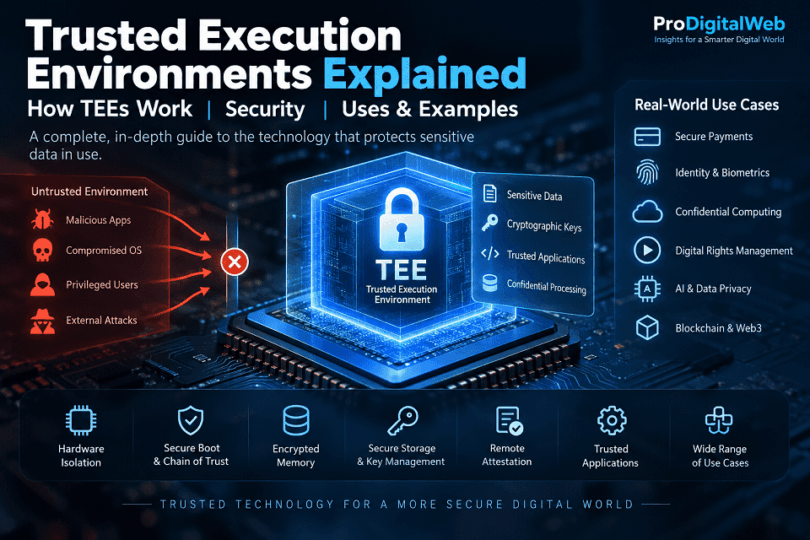
A Trusted Execution Environment (TEE) addresses this problem by creating an isolated environment for executing sensitive code and processing confidential data. Hardware-based security mechanisms help separate trusted operations from the device’s normal operating environment.
TEEs can protect cryptographic keys, credentials, financial operations, digital content, biometric-related security functions, and other security-sensitive workloads. Their implementations appear across mobile devices, embedded systems, payment platforms, cloud infrastructure, and other environments where privileged software cannot be treated as fully trustworthy.
But what exactly makes a TEE trusted? How does it isolate sensitive operations from the operating system, what hardware does it require, and how secure is it in practice?
This guide explains Trusted Execution Environments from the fundamentals to their architecture, hardware requirements, encryption and secure storage, real-world applications, security risks, and differences from technologies such as secure enclaves, sandboxing, zero-knowledge proofs, and fully homomorphic encryption.
What Is a Trusted Execution Environment?
Trusted Execution Environment Explained in Simple Terms
A Trusted Execution Environment (TEE) is a hardware-backed execution environment that isolates selected sensitive code and data from the normal operating environment. The exact protected boundary varies by architecture: a TEE may protect a trusted application, enclave, virtual machine, or another security-critical workload.
The key idea is isolation. A TEE creates a security boundary around selected applications, instructions, and data. The regular operating system and applications outside that boundary have restricted access to what happens inside it.
This protection usually depends on hardware-supported security features. These features help prevent unauthorized software from reading or modifying sensitive information inside the TEE.
For example, a smartphone may use a TEE to protect authentication credentials or cryptographic keys. Even if a vulnerability compromises an ordinary application or parts of the operating system, the protected information can remain isolated.
A TEE therefore provides something traditional software security cannot easily guarantee: protection for sensitive operations even when the surrounding software environment cannot be fully trusted.
What Does “Trusted” Mean in TEE?
The word “trusted” does not mean that a TEE is completely secure or impossible to attack.
Instead, it refers to a limited computing environment that is specifically designed to be trusted for certain security-critical operations.
The trust typically begins with hardware. A device establishes a chain of trust from hardware through secure boot components and the TEE’s trusted software. Only approved components should be allowed to participate in this trusted environment.
A TEE also attempts to keep its Trusted Computing Base (TCB) relatively small. Fewer trusted components can make the security system easier to verify and protect.
Another important mechanism is remote attestation. It can allow a remote party to verify that a particular trusted environment is running approved software before sharing sensitive information with it.
Therefore, a better interpretation is:
A TEE is “trusted” because its security boundary and trusted components are established through hardware-backed mechanisms and a controlled chain of trust.
Why Do We Need Trusted Execution Environments?
Traditional computing environments assume that the operating system is trustworthy. Applications normally depend on the operating system to control memory, processes, permissions, and access to sensitive information.
That assumption becomes a problem when the operating system itself is compromised.
A successful attack could give an attacker privileged access to application memory, credentials, encryption keys, or other sensitive resources. Conventional software isolation can reduce this risk, but it still depends heavily on the operating system and its security mechanisms.
TEEs were developed to create a stronger isolation boundary for the most sensitive operations.
Instead of trusting the entire operating system, developers can place selected code and data inside a protected environment. The rest of the system can remain outside that trusted boundary.
What Problems Do TEEs Solve?
TEEs primarily address the challenge of protecting sensitive data and code while they are being used.
They can help address problems such as:
- A compromised operating system accessing sensitive application data.
- Malicious applications attempting to obtain cryptographic keys.
- Unauthorized access to authentication credentials.
- Exposure of sensitive computations during processing.
- Lack of confidence that a remote environment is running approved software.
TEEs do not eliminate these risks completely. Their protection depends on the underlying hardware, firmware, trusted software, implementation, and security model.
TEE vs. Traditional Software Security
The main difference is where the security boundary is enforced.
Traditional software security relies heavily on the operating system, application permissions, process isolation, access controls, and software-based security mechanisms.
A TEE adds a hardware-backed isolation boundary around selected code and data.
| Feature | Traditional Software Security | TEE |
| Main isolation mechanism | Operating system and software | Hardware-supported isolation |
| Protected code | Normal application environment | Trusted environment |
| Protected data | OS-controlled memory | Isolated memory |
| Dependence on OS security | High | Reduced for protected operations |
| Hardware support | Not always required | Typically required |
| Remote attestation | Usually unavailable | Often supported |
| Protection against compromised OS | Limited | Stronger for protected workloads |
The important point is not that a TEE replaces normal security mechanisms. It adds another security boundary for operations that require stronger protection.
What Happens When the Operating System Is Compromised?
The operating system normally has extensive control over applications and system resources. An attacker who gains privileged OS access may therefore be able to inspect processes, access memory, or interfere with application execution.
A TEE changes the security model for selected workloads.
Sensitive code can execute inside the trusted environment, while the normal operating system remains outside its security boundary. Hardware-supported isolation can restrict the OS from directly accessing protected memory and resources.
This does not mean the TEE automatically remains secure after every type of attack. Vulnerabilities in the TEE’s hardware, firmware, trusted applications, or implementation can still create risks.
The advantage is that compromising the normal operating system does not necessarily expose everything protected inside the TEE.
Protecting Data While It Is Being Processed
Data generally exists in three important states:
- Data at rest — information stored on a device or server.
- Data in transit — information moving across a network.
- Data in use — information being processed by software.
Encryption is highly effective for data at rest and data in transit. But software normally needs access to decrypted information during processing.
For example, a payment application may need to process authentication credentials or transaction information. A cloud application may need to process confidential customer data.
A TEE can place sensitive processing inside an isolated environment.
This creates a protected execution boundary around the workload while the data is being used.
That is one of the fundamental reasons TEEs are important for modern confidential computing.
Reducing the Trusted Computing Base
Another reason for using TEEs is to reduce the amount of software that must be trusted.
In a conventional system, many components may have privileged access to sensitive resources. A vulnerability in one of these components could potentially affect the security of the application.
A TEE allows developers to place only the most security-sensitive code and data inside the trusted environment.
This can reduce the Trusted Computing Base (TCB)—the collection of hardware, firmware, software, and other components that must be trusted for a security property to hold.
A smaller TCB can make security analysis and auditing more manageable.
However, smaller does not automatically mean safer. The components that remain inside the TCB become extremely important. A vulnerability in trusted software can still undermine the protection provided by the TEE.
Where TEEs Fit Into Modern Cybersecurity
TEEs are not replacements for encryption, authentication, access controls, endpoint security, or other cybersecurity technologies.
Instead, they provide an additional hardware-backed security boundary for sensitive operations.
Their role becomes particularly important when systems need to protect:
- Data in use from privileged software.
- Cryptographic keys from unauthorized access.
- Sensitive applications from a compromised operating system.
- Confidential workloads in cloud environments.
- Security-critical operations on smartphones and other devices.
This makes TEEs relevant to areas such as mobile payments, digital rights management, cloud computing, digital identity, blockchain, confidential AI, and enterprise security.
The broader security model can therefore be viewed as:
Encryption protects data at rest and in transit → TEEs can help protect sensitive data and code during execution.
That distinction is central to understanding why Trusted Execution Environments have become an important part of modern hardware-assisted security.
How Does a Trusted Execution Environment Work?
A Trusted Execution Environment works by creating a protected execution area for sensitive code and data. Hardware-backed security mechanisms separate this environment from the device’s normal operating system and applications.
The exact implementation differs between platforms. Arm TrustZone, Intel SGX, AMD SEV, and other technologies use different architectures and security mechanisms.
The basic process is similar:
Hardware establishes trust → trusted software starts → sensitive code enters the protected environment → data is processed in isolation → results are returned to the normal environment.

TEE and the Normal Operating System
A TEE generally operates alongside the device’s normal operating environment.
The normal operating system handles everyday tasks. It runs applications, manages files, connects to networks, and controls ordinary system resources.
The TEE handles selected security-sensitive operations.
This creates two logical environments:
- Normal World: Runs the regular operating system and applications.
- Trusted or Secure World: Runs trusted code and handles protected operations.
The normal operating system may request a TEE operation. However, it should not receive unrestricted access to the TEE’s protected memory or sensitive internal data.
This separation is fundamental to the TEE security model.
Isolated Execution
The first major function of a TEE is isolated execution.
Sensitive code can run inside the protected environment rather than directly inside the normal operating system.
Hardware security mechanisms enforce this separation. Depending on the TEE architecture, they can control access to memory, CPU resources, interrupts, and other system components.
For example, a mobile device could place a cryptographic operation inside the TEE. An ordinary application can request the operation without gaining direct access to the underlying private key.
The application receives the required result rather than the protected secret.
This principle is sometimes described as “use the secret without exposing the secret.”
Protected Memory
A TEE needs memory that is protected from unauthorized access.
Hardware mechanisms can mark specific memory regions as belonging to the trusted environment. Software operating outside that environment should not be able to read or modify those regions directly.
This protection is particularly important when the normal operating system is compromised.
For example, suppose an application sends sensitive information to a trusted application. The data can be processed inside protected memory while remaining inaccessible to ordinary applications.
However, memory isolation is not absolute protection. Vulnerabilities in hardware implementations, firmware, trusted applications, or side-channel defenses can still create attack opportunities.
Trusted Applications
A TEE does not normally place every application inside its protected environment.
Instead, developers can create Trusted Applications (TAs) for specific security-sensitive functions.
A trusted application might handle:
- Cryptographic operations
- Authentication
- Digital rights management
- Payment processing
- Credential protection
- Biometric-related operations
The trusted application runs within the TEE and has access to protected resources that ordinary applications do not.
This design also helps keep the Trusted Computing Base smaller. Only security-critical components need to become part of the trusted environment.
Communication Between the TEE and Normal World
The TEE still needs to communicate with applications running outside it.
A normal application can send a request to a trusted application through a controlled interface. The TEE processes the request and returns an appropriate result.
A simplified flow looks like this:
Normal Application → TEE Interface → Trusted Application → Protected Operation → Result → Normal Application
The important point is that the normal application does not automatically gain access to the trusted application’s internal memory or secrets.
For example, a payment application could request a cryptographic signature from a trusted application. The private key remains inside the protected environment while only the resulting signature is returned.
The exact communication mechanism depends on the TEE architecture and platform.
A Simple Example of TEE Operation
Consider a smartphone that needs to protect a private cryptographic key.
Without a TEE, an application may depend heavily on the operating system to protect the key. A sufficiently privileged attacker could potentially attempt to access the application’s memory or extract sensitive information.
With a TEE, the key can be stored and used within a protected environment.
The process might work like this:
- The device establishes a trusted environment.
Secure boot helps establish a chain of trust for trusted components. - The trusted application starts.
The application responsible for key operations runs inside the TEE. - The normal application sends a request.
For example, it asks the TEE to sign a transaction. - The TEE performs the operation.
The private key remains inside the protected environment. - The result is returned.
The normal application receives the signature but does not receive the private key.
This illustrates the fundamental advantage of a TEE:
Sensitive operations can be performed without exposing the underlying secrets to the normal operating environment.
The same basic principle can be applied to authentication, payment processing, DRM, confidential computing, and other security-sensitive workloads.
Why Is a Trusted Execution Environment Trustworthy?
A Trusted Execution Environment is considered trustworthy because it establishes a protected security boundary backed by hardware and a controlled chain of trust.
The goal is not to make every part of a device trustworthy. Instead, a TEE limits the components that must be trusted to protect a particular workload.
Hardware mechanisms enforce isolation, secure boot helps establish trusted software, and remote attestation can provide evidence about the environment. Together, these mechanisms can protect sensitive operations even when parts of the surrounding system are compromised.
However, a TEE is not automatically secure simply because it is called “trusted.” Its security ultimately depends on the hardware, firmware, TEE operating system, trusted applications, cryptographic mechanisms, and implementation.
Hardware-Enforced Isolation
The most important reason a TEE can provide stronger protection is hardware-enforced isolation.
Traditional application security relies heavily on software controls. The operating system decides which processes can access particular memory regions and resources.
A TEE adds hardware mechanisms that enforce a stronger separation between trusted and untrusted environments.
Depending on the architecture, these mechanisms can control access to:
- Memory
- CPU execution
- System resources
- Peripheral devices
- Security-sensitive instructions
The normal operating system may continue running outside the TEE while sensitive operations execute inside the protected environment.
This means that even a privileged software component may be restricted from directly accessing protected resources.
The exact isolation mechanism varies between TEE technologies. Arm TrustZone, Intel SGX, AMD SEV, and other approaches implement hardware-assisted isolation differently.
Hardware Root of Trust
A TEE needs a reliable starting point for its security model.
This is where a hardware root of trust becomes important.
A hardware root of trust consists of hardware-based components or mechanisms that provide foundational security functions. These may support secure boot, cryptographic key protection, device identity, attestation, or other security operations.
The important idea is simple:
Trust should begin with a component that software cannot easily modify or bypass.
From this foundation, the system can establish trust in subsequent firmware and software components.
A compromised application should not be able to redefine the hardware security boundary.
However, hardware itself is not beyond criticism. Hardware design flaws, manufacturing risks, implementation vulnerabilities, and sophisticated attacks can affect the overall trust model.
Secure Boot and Chain of Trust
A TEE must also ensure that the software running inside its protected environment is authorized.
Secure boot helps establish this process.
During startup, the device verifies one component before allowing the next trusted component to execute. Each verified component can establish trust in the next stage.
A simplified chain looks like this:
Hardware Root of Trust → Bootloader → TEE Firmware → TEE Operating System → Trusted Application
Cryptographic signatures or other verification mechanisms can be used to determine whether software is authentic and has not been modified.
If an unauthorized component cannot pass the verification process, the device can prevent it from becoming part of the trusted execution chain.
This creates an important security principle:
The TEE does not simply trust software because it is present; trusted software must be established through a chain of trust.
Trusted Computing Base
Another important concept is the Trusted Computing Base (TCB).
The TCB consists of the hardware, firmware, software, and other components that must be trusted for a particular security property to hold.
A major goal of TEE design is to keep this trusted base as small and manageable as possible.
For example, a system might not need to trust the entire operating system to protect a cryptographic key. Instead, only the hardware security mechanisms, TEE components, and trusted application responsible for that key need to be trusted.
A smaller TCB can reduce the number of components that require security review and protection.
However, this creates an important trade-off.
If a component is inside the TCB, its security becomes critical.
A vulnerability in a trusted application or TEE component can potentially undermine the protection that the TEE is intended to provide.
Remote Attestation
Remote attestation provides another important part of the TEE trust model.
Suppose a remote server needs to send confidential information to a device or cloud environment. The server cannot simply assume that the correct trusted software is running.
Attestation can provide cryptographically verifiable information about the environment.
A simplified process looks like this:
TEE starts → Trusted software is measured → TEE generates attestation evidence → Remote party verifies it → Sensitive data is released
The remote party can use this evidence to determine whether the environment meets predefined security requirements.
This is particularly useful for:
- Cloud confidential computing
- Secure key provisioning
- Digital rights management
- Financial applications
- Confidential workloads
- Machine-to-machine security
Attestation therefore extends the concept of trust beyond the local device.
TEE Architecture Explained
A Trusted Execution Environment is built around a security boundary that separates trusted operations from the normal computing environment.
The exact architecture varies between TEE technologies. Arm TrustZone, Intel SGX, AMD SEV, and other implementations use different approaches to achieve isolation.
Despite these differences, most TEE architectures share several fundamental concepts. Sensitive code runs in a protected environment, trusted applications handle security-critical operations, and hardware mechanisms restrict access to protected resources.
Understanding this architecture helps explain where sensitive code runs, how data remains isolated, and why the normal operating system cannot freely access TEE-protected resources.
Normal World vs. Trusted World
Many TEE architectures divide computing activities into two logical environments.
The Normal World runs the regular operating system and everyday applications. The Trusted World handles security-sensitive operations that require stronger isolation.
A simplified architecture looks like this:
Normal World → Operating System → Applications
Security Boundary
Trusted World → TEE → Trusted Applications → Protected Data
The terminology varies between implementations. Arm TrustZone, for example, commonly refers to the Normal World and Secure World. Other technologies use different architectural models.
The underlying principle remains the same. Trusted and untrusted operations are separated by a security boundary that is enforced using hardware-supported mechanisms.
This separation means an application running in the normal environment does not automatically gain access to the memory, keys, or internal state of trusted applications.
The Secure World
In architectures such as Arm TrustZone, the Secure World provides the protected environment for security-sensitive operations.
The regular operating system continues running in the Normal World. At the same time, trusted software can operate within the Secure World and access protected resources.
The two environments do not have equal privileges over protected resources. Hardware mechanisms control transitions between them and restrict unauthorized access.
A smartphone might use this environment for cryptographic key operations, authentication, digital rights management, or payment-related functions.
However, the term Secure World should not be treated as a universal definition of a TEE. Different TEE architectures implement isolation differently. Intel SGX, for example, uses protected enclaves rather than reproducing the exact TrustZone model.
Therefore, Secure World is best understood as one architectural implementation of trusted execution, rather than another name for every TEE.
Trusted Applications
Trusted Applications (TAs) are programs designed to run inside a TEE.
Developers typically do not move an entire application into the trusted environment. Instead, they isolate the portions that require stronger protection.
For example, a mobile banking application could keep its ordinary user interface and network functions in the Normal World. A trusted application could handle a sensitive cryptographic operation inside the TEE.
The normal application sends a request to the trusted application. The trusted application performs the protected operation and returns the required result.
The private key itself can remain inside the protected environment.
This approach reduces the amount of code that needs to operate inside the TEE. It can therefore help reduce the size of the Trusted Computing Base, although the trusted applications themselves become critical security components.
A vulnerability in a trusted application can potentially weaken the security guarantees that the TEE is expected to provide.
Normal Applications
Normal applications operate outside the TEE under the control of the regular operating system.
These include everyday smartphone apps, browsers, desktop applications, cloud workloads, and other software that does not require direct access to the trusted environment.
A normal application can still use TEE-protected functionality through controlled interfaces.
Consider a banking application that needs to sign a transaction. The application does not necessarily need direct access to the private cryptographic key.
Instead, it can send the transaction data to a trusted application. The TEE performs the signing operation and returns the resulting signature.
The private key remains inside the protected environment.
This creates an important security principle: applications can use sensitive security functions without necessarily possessing the secrets required to perform those functions themselves.
TEE Operating System
A TEE generally requires trusted software to manage its protected environment.
Depending on the architecture, this may be a dedicated TEE operating system, runtime, or collection of trusted components.
The TEE software manages trusted applications and coordinates access to protected resources. It can also provide mechanisms for secure storage, cryptographic operations, communication with the normal environment, and other security functions.
Because this software forms part of the trusted computing base, its security is extremely important.
A vulnerability in the TEE operating system can potentially affect multiple trusted applications rather than just one application.
For this reason, keeping the TEE software relatively small and carefully designed is an important architectural principle.
TEE Monitor and Security Components
A TEE also requires mechanisms that maintain the separation between trusted and untrusted environments.
Depending on the technology, these mechanisms may include a secure monitor, firmware, hypervisor components, enclave management mechanisms, or other privileged security components.
Their responsibilities depend on the architecture, but they generally help control transitions between environments and enforce access restrictions.
They may also participate in secure boot, memory protection, trusted application management, attestation, and communication between trusted and normal software.
These components are particularly important because they sit close to the security boundary.
If an attacker can bypass or compromise the mechanism enforcing that boundary, the security guarantees of the TEE may be significantly weakened.
Memory and Resource Isolation
Memory isolation is fundamental to TEE security.
Sensitive code and data need protection from applications running outside the trusted environment. Hardware-supported mechanisms can restrict access to memory regions assigned to trusted workloads.
A simplified flow looks like this:
Normal Application → Normal Operating System → Security Boundary → TEE → Trusted Application → Protected Data
The normal operating system may request a service from the TEE, but it should not have unrestricted access to the TEE’s protected memory.
A TEE may also isolate other resources depending on its architecture. These can include CPU execution contexts, secure storage, cryptographic hardware, interrupts, and selected peripherals.
The precise mechanisms differ considerably between implementations.
Memory isolation also does not make a TEE invulnerable. Hardware vulnerabilities, implementation flaws, side-channel attacks, compromised firmware, and weaknesses in trusted applications can still create security risks.
What Hardware Does a TEE Require?
A Trusted Execution Environment depends on hardware to establish and enforce its security boundary. Unlike a conventional software sandbox, a TEE cannot rely entirely on the operating system to isolate sensitive code and data.
The exact hardware requirements vary by implementation. A smartphone using Arm TrustZone does not have exactly the same architecture as a server using Intel SGX or AMD SEV.
A TEE generally depends on hardware-supported isolation and a hardware root of trust. Depending on the implementation, it may also use protected or encrypted memory, secure boot, hardware-backed cryptography, secure storage, and remote attestation. These capabilities are not universal requirements of every TEE.
The hardware provides the foundation. Trusted firmware and software then build the TEE on top of it.
CPU Support and Hardware Isolation
The processor is at the heart of a TEE.
A TEE needs CPU features that can distinguish between trusted and untrusted execution. These features prevent ordinary software from freely accessing protected resources belonging to the trusted environment.
Different processor architectures implement this differently.
Arm TrustZone separates execution into security domains commonly called the Normal World and Secure World. Intel SGX uses hardware-protected enclaves to isolate selected application code and data. AMD SEV focuses primarily on protecting virtual machines and their memory from unauthorized access.
The implementation differs, but the objective is similar: the processor must enforce a security boundary that ordinary software cannot simply bypass.
This hardware enforcement is one of the main differences between a TEE and conventional software-only isolation.
Secure Memory
A TEE needs a way to protect the memory containing its sensitive code and data.
Hardware-supported memory protection prevents software outside the trusted environment from directly accessing protected memory regions.
For example, a trusted application may process an encryption key inside protected memory. An application running in the normal environment should not be able to read that memory simply because it has high operating-system privileges.
The precise memory protection mechanism depends on the TEE architecture.
Some designs provide dedicated secure memory regions. Others use hardware memory encryption, access controls, or enclave-specific protection mechanisms.
Memory protection is particularly important because sensitive information must remain protected while it is being actively processed.
Hardware Cryptographic Support
Cryptography is closely connected to TEE security.
A TEE may use hardware-supported cryptographic functions to generate, store, or use sensitive keys without exposing them to ordinary applications.
Hardware cryptographic capabilities can improve both security and performance. They may support operations such as encryption, decryption, hashing, digital signatures, and secure key generation.
The exact capabilities depend on the processor and platform.
The important principle is that cryptographic secrets can be kept within the trusted security boundary while the TEE performs operations using them.
For example, a trusted application could request a digital signature without exposing the private signing key to the normal operating system.
Secure Storage
A TEE may also require protected storage for sensitive information.
Secure storage allows information such as cryptographic keys, credentials, certificates, and other security-sensitive data to remain protected when it is not actively being processed.
The TEE can use hardware-backed mechanisms to restrict access to this information.
Some systems also provide sealed storage, where data is cryptographically bound to a particular device, trusted environment, or software state.
This can help prevent an attacker from simply copying protected data from one environment and using it elsewhere.
Secure storage is particularly important for mobile payments, authentication, digital identity, DRM, and other applications that depend on long-lived secrets.
It is important to distinguish secure storage from memory protection. Memory protection protects data during execution, while secure storage protects information when it is stored.
Does Every Device Support a TEE?
No. TEE support is not universal.
Modern smartphones, tablets, servers, connected devices, and many embedded systems can include hardware capable of supporting trusted execution. However, the availability and capabilities of the TEE depend on the processor, device design, firmware, operating system, and manufacturer.
Even when a processor includes hardware security features, that does not necessarily mean every device exposes a general-purpose TEE to developers.
Some platforms provide dedicated trusted environments for specific functions. Others provide more flexible environments for running trusted applications or confidential workloads.
For example, Arm-based devices may use TrustZone-based architectures, while certain Intel and AMD processors provide different hardware technologies for protected execution or confidential virtual machines.
Therefore, “Does the device have hardware security?” and “Does the device provide a usable TEE?” are not necessarily the same question.
TEE Encryption and Secure Storage
Encryption is one of the most important functions associated with Trusted Execution Environments. However, a TEE does more than simply encrypt files or network traffic.
Its primary security advantage is that it can help protect cryptographic keys and sensitive data while trusted code is using them.
This addresses an important weakness in conventional encryption. Data can be strongly encrypted while stored or transmitted, but an application eventually needs to decrypt it to perform a computation.
A TEE can provide an isolated environment where that sensitive operation takes place.
The exact encryption and storage mechanisms differ between TEE technologies. Some rely on dedicated hardware security components, while others combine processor-level isolation with memory encryption, secure key storage, or cryptographic services.
How TEEs Protect Encryption Keys
Encryption is only as strong as the protection given to its keys.
If an attacker obtains an encryption key, access to the encrypted information may be lost regardless of how strong the encryption algorithm is.
A TEE can help keep sensitive keys inside a protected security boundary. A trusted application can use the key for an operation without exposing the key directly to the normal operating system or application.
For example, a banking application might need to digitally sign a transaction. Instead of giving the private key to the normal application, it can request the TEE to perform the signing operation.
The private key remains inside the protected environment.
This creates an important security principle:
The application can use a secret without directly possessing or exposing the secret.
The protection of the key still depends on the TEE’s hardware, firmware, trusted software, and implementation.
Encryption Inside a TEE
A TEE can perform cryptographic operations inside its protected environment.
Sensitive information can enter the trusted environment, undergo encryption or decryption, and then leave only in an authorized form.
For example:
Encrypted Data → TEE → Decryption → Protected Processing → Result
The normal operating system may initiate the operation, but it does not necessarily receive access to the underlying cryptographic key.
A trusted application could perform encryption, decryption, hashing, signing, or other cryptographic operations depending on the platform.
This approach can reduce the exposure of sensitive cryptographic material.
However, a TEE does not eliminate the need for good cryptographic design. Weak algorithms, poor key management, insecure interfaces, or vulnerable trusted applications can still compromise the overall system.
Secure Data Storage
TEE-based systems can provide mechanisms for protecting sensitive information when it is stored.
This is commonly called secure storage or trusted storage.
Information stored through these mechanisms may include cryptographic keys, authentication credentials, certificates, tokens, configuration data, and other sensitive application information.
The TEE can use hardware-backed cryptographic mechanisms to protect stored information. Access can then be restricted to authorized trusted applications or security components.
This is particularly useful when sensitive information needs to survive device restarts while remaining protected from ordinary applications.
Secure storage and protected memory serve different purposes.
Protected memory safeguards information during execution. Secure storage safeguards information when it is stored.
Together, they can provide protection across different stages of a data lifecycle.
Sealed and Protected Storage
Some TEE architectures support a concept commonly known as sealed storage.
Sealed data is cryptographically protected so that it can be accessed only under defined conditions. Depending on the implementation, the protection may be tied to a particular device, trusted application, security state, or other platform-specific characteristics.
This can help prevent an attacker from copying protected data and simply moving it to another environment.
For example, a trusted application could store a sensitive credential in sealed form. Later, the TEE can verify the appropriate security conditions before allowing the trusted application to use it.
The exact meaning of sealing differs between technologies, so we should avoid suggesting that every TEE provides identical sealed-storage functionality.
The broader principle is binding sensitive stored information to an authorized trusted environment or security state.
Key Generation and Key Management
A TEE can also play an important role in the generation and management of cryptographic keys.
Keys can be generated using trusted or hardware-backed mechanisms and kept within the protected environment.
A typical lifecycle may involve:
Key Generation → Protected Storage → Authorized Use → Key Rotation or Revocation
Keeping the key lifecycle inside a protected environment can reduce the number of times sensitive key material needs to enter the normal operating system.
Some platforms also provide hardware-backed device keys or platform-specific key hierarchies. These can help establish trust between the hardware, trusted software, applications, and protected data.
However, key management is broader than simply storing a key securely. Applications must also handle key creation, permissions, rotation, backup, revocation, and destruction correctly.
A technically strong TEE cannot compensate for poor key-management policies.
Protecting Data During Processing
This is perhaps the most important security benefit to understand.
Traditional encryption primarily protects data at rest and in transit. But applications normally need decrypted data to perform calculations, authenticate users, execute transactions, or make decisions.
During this stage, the information becomes data in use.
A TEE can place sensitive computation inside an isolated execution environment.
For example, consider a cloud service processing confidential customer information.
Without protected execution, the cloud infrastructure and privileged software may have significant visibility into the workload. With a suitable confidential-computing architecture, sensitive processing can occur inside a hardware-protected environment.
The basic model becomes:
Data at Rest → Encryption
Data in Transit → Encryption
Data in Use → TEE-Based Protected Execution
This is why TEEs are closely associated with confidential computing.
The TEE does not necessarily keep every piece of data encrypted throughout computation. Instead, it provides a protected environment where sensitive data can be processed while limiting access from software outside the trusted boundary.
That distinction is important.
What Can a Trusted Execution Environment Protect?
A Trusted Execution Environment can protect sensitive code, data, and security-critical operations that require stronger isolation than the normal operating system can provide.
The exact capabilities depend on the TEE architecture and the platform. A smartphone TEE may protect authentication credentials and cryptographic keys, while a cloud-based confidential-computing environment may protect an entire workload and its memory.
The important distinction is that a TEE does not automatically protect everything on a device. Protection applies to the code, data, and resources placed within its trusted security boundary.
Sensitive Data
TEEs can protect sensitive information while trusted applications process it.
This may include personal information, confidential business data, application secrets, or other information that should not be accessible to ordinary applications or privileged software outside the TEE.
The data can be transferred into the trusted environment for a specific operation and then returned in a controlled form.
This becomes particularly valuable when the surrounding operating environment cannot be fully trusted.
However, the TEE cannot protect information after a trusted application deliberately exposes it outside the protected boundary.
Encryption Keys
Cryptographic keys are among the most important assets protected by TEEs.
If an attacker obtains a private encryption or signing key, strong cryptographic algorithms cannot prevent misuse of that key.
A TEE can keep keys within its protected environment and allow trusted applications to use them without directly exposing the key to the normal operating system.
For example, a device could perform a digital signature inside the TEE while returning only the resulting signature to the requesting application.
This approach significantly reduces the exposure of high-value cryptographic secrets.
Authentication Credentials
TEEs can protect credentials used to authenticate users, devices, or applications.
Instead of allowing sensitive credentials to remain directly accessible to ordinary software, a trusted application can perform authentication-related operations inside the protected environment.
This can help protect secrets such as authentication keys, security tokens, or other credentials from unauthorized access.
The exact credentials protected by a TEE depend on the platform and its security architecture.
Digital Identity
Digital identity systems can use TEEs to protect the secrets that establish or authenticate an identity.
For example, a device may use a hardware-backed private key to prove that it is an authorized device or application.
The private key can remain inside the trusted environment while the TEE performs the required cryptographic operation.
This can strengthen systems that depend on device identity, digital certificates, authentication, and secure credentials.
It also enables a useful model where the identity secret does not need to be exposed to the ordinary operating system.
Biometric Information
Biometric systems can use trusted environments to protect sensitive biometric-related operations.
A smartphone, for example, may need to process information associated with fingerprint or facial authentication without exposing sensitive data to ordinary applications.
A TEE can provide an isolated environment for portions of this process, depending on the device’s architecture.
However, it is important not to assume that all biometric data is stored directly inside a TEE. Modern devices may use a combination of secure hardware, dedicated security processors, trusted software, and encrypted storage.
The security objective is to ensure that sensitive biometric information and authentication secrets are not unnecessarily exposed to the normal operating environment.
Financial Transactions
Financial services are one of the strongest real-world applications for trusted execution.
A TEE can protect sensitive operations involved in mobile banking, payment applications, digital wallets, and transaction authentication.
For example, a trusted application could use a protected private key to authorize a transaction without exposing the key to the normal operating system.
This can help protect against attacks attempting to steal payment credentials or manipulate security-sensitive operations.
TEEs do not replace other financial security mechanisms. Secure communication, authentication, fraud detection, transaction monitoring, and application security remain necessary.
Instead, the TEE provides an additional hardware-backed security boundary for particularly sensitive operations.
Digital Content
TEEs can protect digital content and the cryptographic keys used to access it.
This is particularly important for Digital Rights Management (DRM) systems.
A streaming service may need to decrypt protected media before it can be displayed or played. A TEE can help keep the relevant decryption keys and sensitive operations isolated from ordinary applications.
This makes it harder for unauthorized software to obtain the keys directly.
TEE-based protection can therefore play an important role in protecting premium video, music, games, e-books, and other digital content.
Security-Critical Applications
A TEE can protect applications or specific components that perform particularly sensitive operations.
The entire application does not necessarily need to run inside the TEE.
Instead, developers can isolate security-critical functions and implement them as trusted applications.
For example, an application might keep its user interface, networking, and general business logic in the normal environment while moving cryptographic operations into the TEE.
This approach reduces the amount of code that needs to operate inside the trusted environment.
It can also help reduce the Trusted Computing Base, provided the trusted components remain small, carefully designed, and properly secured.
Trusted Execution Environment Use Cases
Trusted Execution Environments are useful when software needs to process sensitive information without exposing that information to the broader computing environment.
The security model is particularly valuable when the operating system, hypervisor, cloud host, application processes, or other privileged software cannot be fully trusted.
A TEE can isolate selected code and data using hardware-supported mechanisms. Depending on the implementation, it can also provide secure storage, cryptographic services, measured boot, and remote attestation.
The result is not simply encrypted storage. The TEE can create a protected execution boundary where sensitive operations take place while restricting access from software outside that boundary.
The exact capabilities differ considerably between architectures. Arm TrustZone, Intel SGX, AMD SEV-SNP, and platform-specific secure processors do not provide identical security properties.
TEEs in Digital Rights Management (DRM)
Digital Rights Management is one of the clearest examples of why isolated execution matters.
A streaming service can encrypt its video or audio content before distribution. However, the device must eventually decrypt the content before it can be displayed or played.
That creates a security challenge.
If the decryption key and sensitive DRM operations remain accessible to ordinary application software, malware could attempt to extract the key and bypass the protection.
A TEE provides a more isolated environment for handling those operations.
Protecting Digital Content
Modern streaming systems typically encrypt media before distributing it to users.
When an authorized user requests content, the device receives information that allows the media to be decrypted. The challenge is ensuring that the associated keys do not become freely accessible to ordinary software.
A TEE can isolate the sensitive portion of this workflow.
The application running in the normal environment can request access to protected content. The trusted environment can authenticate the request, handle protected keys, and perform security-sensitive operations.
The normal application does not necessarily receive unrestricted access to the cryptographic material.
This creates a security boundary between content consumption and content protection mechanisms.
The actual DRM architecture can be more complex and may involve a combination of secure boot, hardware-backed keys, trusted applications, secure video paths, and output protection.
Protecting Content Decryption Keys
The content encryption key is one of the most sensitive assets in a DRM system.
If an attacker obtains the key, encrypted media may become accessible outside the authorized playback environment.
A TEE can keep the key inside protected memory or secure key storage.
The normal-world application may submit an authorized request such as:
Playback Request → DRM Interface → Trusted DRM Component → Protected Key → Decryption Operation
The key does not have to be returned to the application.
This is an important property of TEE-based security:
A trusted environment can perform an operation using a secret without exposing the secret itself.
The strength of this protection depends on the complete DRM implementation, including the hardware, trusted software, key provisioning system, and media output path.
Hardware-Backed DRM
Hardware-backed DRM extends software DRM by using processor or security-hardware capabilities to enforce stronger isolation.
A typical architecture may combine:
Secure Boot → Hardware Root of Trust → TEE → DRM Trusted Application → Protected Keys
The hardware establishes the initial trust boundary. Trusted firmware establishes the secure environment, and the DRM component operates inside that environment.
Some systems can also provide protected media paths that prevent decrypted high-value content from becoming accessible to ordinary software before reaching the display or audio subsystem.
This is particularly important for premium content.
TEEs in Video and Music Streaming
Streaming platforms need to support legitimate playback while making unauthorized extraction difficult.
A TEE can help protect the key-management and decryption components used during playback.
For example, a trusted DRM application might receive an authorized content key, use it to process encrypted media, and provide the resulting content through a protected path.
The normal operating system can continue handling user interaction, networking, and application logic without receiving direct access to the protected key.
This approach is widely relevant to premium video, music, games, and other commercially valuable digital content.
TEEs in Mobile Financial Services
Financial applications require strong protection because they handle credentials and operations that can directly control money.
Mobile banking and payment applications must defend against malware, compromised applications, credential theft, and attempts to manipulate security-sensitive transactions.
A TEE can provide an isolated environment for selected cryptographic and authentication operations.
Mobile Banking
A banking application may use cryptographic keys to authenticate the device or establish trusted communication with a financial service.
Instead of storing and using those keys entirely within ordinary application memory, the system can place sensitive key operations inside a hardware-backed trusted environment.
The normal application requests an operation from the trusted component.
For example:
Banking App → TEE Request → Trusted Application → Private Key Operation → Result
The private key remains inside the trusted environment.
This reduces the opportunity for ordinary malware to directly extract the key.
A TEE does not, however, protect the entire banking application. Vulnerabilities in the normal application, network layer, authentication workflow, or transaction logic can still create security problems.
Mobile Payments
Mobile payment systems require protection for payment credentials and transaction authorization.
A TEE can isolate security-sensitive functions such as cryptographic authentication and credential management.
For example, a device may store a payment-related key within hardware-backed protected storage. When the user initiates an authorized operation, the trusted environment can perform the required cryptographic calculation.
The normal application receives the result rather than the protected key.
This makes the TEE particularly useful for protecting high-value secrets that should never be exposed to general-purpose application code.
Digital Wallets
A digital wallet can contain payment credentials, loyalty information, identity credentials, transit passes, tickets, and other sensitive assets.
A TEE can provide protected storage and execution for selected wallet functions.
The wallet application may operate in the normal environment while sensitive credential operations occur inside trusted software.
This creates a separation between the wallet interface and the security-critical credential operations.
The TEE can also enforce access policies that determine which operations are permitted and under what conditions.
Payment Credentials
Payment credentials require special protection because their compromise can lead to unauthorized transactions.
A hardware-backed trusted environment can store sensitive cryptographic material and restrict how that material is used.
Instead of exposing a credential to the application, the TEE can expose an operation.
For example:
“Sign this authorized transaction.”
The trusted environment verifies the request according to its security policy, performs the cryptographic operation, and returns the result.
The private key remains inside the protected environment.
This is fundamentally different from simply encrypting the key in an ordinary application file. The protection extends to how the key is accessed and used.
Transaction Authentication
TEEs can also help protect transaction authentication.
A trusted application can verify security-sensitive transaction information and use protected cryptographic credentials to generate an authentication response or signature.
This can reduce the risk of malware attempting to extract authentication secrets.
However, the trusted environment must receive trustworthy transaction information. If an attacker can manipulate the information before it enters the TEE, the TEE may faithfully authenticate the wrong transaction.
This is why secure UI paths, trusted input, user confirmation, and transaction-binding mechanisms can become important in high-security payment architectures.
TEEs and Blockchain
Blockchain systems introduce an interesting security trade-off.
Blockchains reduce dependence on centralized authorities through distributed consensus and cryptographic verification. However, blockchain applications still need to protect private keys and sometimes require confidential computation.
TEEs can address these problems by providing hardware-isolated execution.
At the same time, they introduce a new trust assumption: the security of the underlying trusted hardware and its attestation infrastructure.
Protecting Blockchain Private Keys
Private keys are fundamental to blockchain security.
Anyone who controls a private key may be able to authorize transactions associated with that key.
A TEE can store a private key within protected storage and perform signing operations internally.
The application supplies transaction data, and the trusted environment produces the signature.
The private key never needs to enter ordinary application memory.
This can make the TEE useful for wallets, custodial systems, validators, and other blockchain infrastructure.
Secure Transaction Signing
A blockchain wallet can use a TEE to isolate the transaction-signing operation.
A simplified flow is:
Transaction → TEE → Transaction Verification → Protected Private Key → Signature
The application outside the TEE receives the signature but not the private key.
The architecture becomes stronger when the trusted environment can verify exactly what is being signed and, where supported, obtain trusted user input.
Otherwise, malware could potentially manipulate the transaction before asking the TEE to sign it.
This demonstrates an important principle:
Protecting the private key is not enough; the TEE must also protect the integrity of the operation using that key.
Confidential Smart Contracts
Most public blockchains emphasize transparency. Smart-contract inputs, outputs, and state may be visible to network participants depending on the blockchain design.
Some applications require the opposite.
They may need to process confidential business information while still benefiting from blockchain-based coordination.
A TEE can execute sensitive logic inside an isolated environment and restrict direct access to the underlying data.
This can enable applications involving confidential financial calculations, private business rules, proprietary algorithms, or sensitive user information.
The trade-off is that participants may need to trust the TEE’s hardware and attestation mechanisms.
Blockchain Oracles
Oracles provide external information to blockchain applications.
A TEE can protect portions of an oracle’s data acquisition or processing logic.
For example, sensitive information can be processed inside a trusted environment before the relevant result is provided to a blockchain system.
This can help protect proprietary data sources and prevent unauthorized software from inspecting intermediate information.
However, the TEE cannot automatically establish that an external data source itself is truthful.
It can protect how the data is processed, but it cannot magically make unreliable external information accurate.
TEEs in Web3 Applications
TEEs can support several Web3 security functions beyond private-key storage.
They can be used for confidential computation, secure wallets, private data processing, oracle infrastructure, and applications that need controlled execution alongside blockchain verification.
Their value is greatest where blockchain transparency conflicts with application-level confidentiality.
Limitations of TEEs in Blockchain
TEEs introduce a trust assumption that blockchain developers must consider carefully.
A decentralized network may reduce dependence on centralized authorities, but a TEE-based application may still depend on the processor manufacturer, firmware, trusted software, attestation infrastructure, and hardware security model.
A vulnerability in the TEE could therefore become a systemic risk.
This is why privacy-preserving blockchain systems may combine TEEs with zero-knowledge proofs, cryptographic verification, multiparty computation, or other techniques.
The goal is often to avoid relying on one security mechanism for every requirement.
TEEs in Cloud Computing
Cloud computing creates a particularly important TEE use case.
When an organization sends sensitive workloads to a cloud provider, the organization traditionally has to trust parts of the provider’s infrastructure.
Privileged administrators, hypervisors, host operating systems, and infrastructure components may have significant access to the computing environment.
Confidential computing attempts to reduce this trust requirement by protecting data while it is being processed.
TEEs are an important technical foundation for many confidential-computing systems.
Confidential Workloads
A confidential workload contains code or data that should remain protected even from privileged infrastructure software.
A hardware-isolated execution environment can protect the workload’s memory and execution state.
This can allow organizations to process sensitive information in shared cloud infrastructure while reducing the ability of the host environment to inspect that information directly.
The protection depends on the specific hardware architecture and confidential-computing implementation.
Confidential Virtual Machines
Some processors provide hardware-assisted protection for entire virtual machines.
Instead of isolating only a small application component, the technology can protect the memory of a virtual machine from unauthorized access by the host.
AMD SEV-SNP is an example of a technology designed to provide stronger isolation for virtual machines.
This approach is particularly useful for cloud workloads that are too large or complex to redesign around application-level enclaves.
Protecting Data From Cloud Administrators
One of the major goals of confidential computing is to reduce the level of trust placed in cloud infrastructure administrators.
Traditional cloud security assumes that the provider’s privileged infrastructure is part of the trusted computing environment.
A confidential-computing architecture attempts to establish a stronger boundary between the workload and the infrastructure hosting it.
However, this does not mean the cloud provider becomes completely irrelevant.
Organizations still need to trust aspects of the hardware, firmware, attestation service, configuration, and workload software.
Remote Attestation in Cloud Environments
Remote attestation is especially important for cloud-based TEEs.
A customer may want to verify that a workload is running inside an approved protected environment before releasing confidential information.
The TEE can produce cryptographic evidence describing relevant aspects of its trusted state.
The customer or another verification service can then evaluate that evidence against its security requirements.
A simplified process is:
Workload Starts → Environment Is Measured → Attestation Evidence Is Generated → Customer Verifies Evidence → Sensitive Data Is Released
This creates a stronger security relationship between the workload owner and the remote execution environment.
Other TEE Applications
The same principles apply to many other environments where sensitive data or security-critical operations need stronger isolation.
TEEs in Artificial Intelligence
Artificial intelligence systems increasingly process confidential business information, personal data, proprietary models, and sensitive prompts.
This creates concerns about protecting both AI inputs and intellectual property.
A TEE can provide an isolated environment for selected AI workloads.
For example, sensitive inference data could be processed inside a hardware-protected environment while limiting access from the host operating system.
TEEs can also potentially protect proprietary model components from unauthorized inspection.
This is becoming particularly relevant to confidential AI, where organizations want to use AI services without unnecessarily exposing sensitive data or models to infrastructure operators.
However, AI workloads can be large and computationally demanding. Performance, accelerator support, memory capacity, and attestation therefore become important engineering considerations.
Digital Identity
Digital identity systems rely heavily on cryptographic credentials.
A TEE can protect the private keys and trusted operations used to establish or authenticate an identity.
For example, a device could generate or store an identity key inside protected hardware and use the TEE to sign authentication challenges.
The private key does not need to be exposed to the normal application.
This can strengthen device authentication and credential-based identity systems.
Password and Credential Protection
Passwords, authentication tokens, certificates, and API credentials are attractive targets for malware.
A TEE can protect selected credential-management operations and provide hardware-backed storage for high-value secrets.
Instead of giving ordinary software unrestricted access to the secret, the TEE can expose controlled operations.
This reduces the attack surface around sensitive credentials.
However, TEEs should not be treated as a replacement for strong authentication architecture. Multi-factor authentication, secure protocols, credential rotation, and proper access control remain essential.
IoT and Embedded Devices
IoT devices frequently operate in hostile or physically accessible environments.
They may need to protect device identities, cryptographic keys, firmware, configuration data, and security-critical operations despite having relatively limited resources.
A hardware-backed trusted environment can provide isolation for these functions.
For example, secure boot can verify firmware before execution, while the TEE can protect device credentials and cryptographic operations after startup.
This can help establish a trusted device lifecycle:
Secure Boot → Trusted Firmware → TEE → Device Identity → Secure Operations
Such architectures are useful for connected sensors, industrial equipment, automotive systems, smart appliances, and other embedded devices.
Enterprise Security
Enterprises can use TEE-based technologies to protect confidential workloads, proprietary algorithms, authentication credentials, and sensitive business information.
The strongest enterprise use case is often confidential computing.
Organizations can process sensitive workloads in cloud or shared infrastructure while reducing exposure to privileged host software.
TEEs can also support secure collaboration between organizations that do not want to expose their underlying data to one another.
For example, multiple parties may want to perform a computation over sensitive information without giving the hosting infrastructure unrestricted visibility into the raw data.
The appropriate architecture depends on the threat model. A TEE may be sufficient for some workloads, while others may benefit from combining TEEs with encryption, secure multiparty computation, zero-knowledge proofs, or other privacy technologies.
Major TEE Technologies and Real-World Examples
Trusted Execution Environments are implemented in different ways across processors, operating systems, smartphones, servers, and embedded devices.
There is no single TEE architecture used everywhere. Some technologies isolate trusted applications inside a secure execution environment. Others protect application enclaves, virtual machines, or security-critical keys and operations.
The underlying security mechanisms also differ. Some rely primarily on processor privilege and memory isolation, while others combine hardware isolation with encrypted memory, secure boot, attestation, and dedicated security processors.
The following technologies illustrate some of the most important approaches to trusted execution.
Arm TrustZone
Arm TrustZone is one of the most widely deployed hardware security architectures associated with trusted execution, particularly in smartphones, embedded systems, and other Arm-based devices.
TrustZone divides the processor environment into two security domains commonly called the Normal World and Secure World.
The Normal World runs the general-purpose operating system and applications. The Secure World hosts security-sensitive software and can access resources protected from the Normal World.
How Arm TrustZone Works
TrustZone extends the processor’s security architecture so that hardware can distinguish between secure and non-secure execution.
A security monitor controls transitions between the two environments. Secure resources can be configured so that software running in the Normal World cannot directly access them.
For example, a smartphone may run Android or another general-purpose operating system in the Normal World while trusted security functions operate in the Secure World.
The transition between the environments occurs through controlled mechanisms rather than unrestricted application access.
A simplified model is:
Normal World → Secure Monitor → Secure World
The Secure World can contain a TEE operating system and trusted applications.
This architecture allows sensitive functions such as key management, authentication, DRM, and other security services to operate separately from the general-purpose operating system.
The exact implementation varies by processor generation and device manufacturer.
TrustZone in Smartphones and Embedded Devices
TrustZone has become particularly important in mobile and embedded computing because these devices routinely handle sensitive credentials and cryptographic keys.
A smartphone may use a TrustZone-based TEE to support hardware-backed authentication, secure key storage, payment operations, DRM, biometric-related security functions, and trusted applications.
Embedded systems can use similar concepts to protect device identity, firmware, cryptographic keys, and security-critical operations.
One important point is that TrustZone itself is a hardware security architecture rather than a complete TEE operating system.
A device manufacturer normally combines TrustZone hardware capabilities with trusted firmware and a TEE software environment.
Intel SGX
Intel Software Guard Extensions (SGX) uses a different approach to trusted execution.
Instead of dividing the entire processor environment into Normal and Secure Worlds, SGX allows selected application code and data to execute inside protected memory regions called enclaves.
This creates a more application-centric model of trusted execution.
How Intel SGX Works
An application can place sensitive code and data inside an SGX enclave.
The processor establishes hardware protections around the enclave’s memory. Software outside the enclave, including privileged system software, is restricted from directly reading or modifying protected enclave memory.
This is an important distinction from conventional application isolation.
The operating system can continue managing the system and scheduling processes, but it should not automatically gain access to the enclave’s protected contents.
SGX also introduced mechanisms for measurement and remote attestation.
An enclave can have its initial trusted state measured, allowing a remote party to verify that a particular expected enclave configuration is running before releasing sensitive information.
SGX Enclaves
An SGX enclave contains the security-sensitive portion of an application.
For example, an application might perform ordinary networking and user-interface operations outside the enclave while placing encryption keys or confidential computations inside it.
The architecture can therefore look like:
Application → SGX Enclave → Protected Code + Data
The enclave’s memory is protected using processor-supported mechanisms.
SGX became important for confidential computing research and applications because it demonstrated how hardware could protect application-level workloads from privileged system software.
However, SGX also demonstrated that TEEs introduce complex security challenges. Researchers have identified various side-channel and implementation vulnerabilities affecting enclave-based systems.
For that reason, SGX should not be described as an unbreakable security container.
Arm CCA is particularly relevant to cloud and infrastructure workloads that need hardware-backed isolation at the VM or workload level. It complements, rather than replaces, Arm TrustZone, which serves a different security architecture role.
Arm Confidential Compute Architecture (Arm CCA) extends Arm architecture with hardware mechanisms for isolating confidential workloads called Realms. It is designed to reduce the privileges of software such as hypervisors over protected workload memory while supporting attestation and confidential virtualization.
Intel TDX is most relevant when the desired trust boundary is an entire confidential virtual machine rather than a small application enclave. It therefore belongs alongside AMD SEV-SNP in the confidential-VM part of the TEE and confidential-computing landscape.
Intel Trust Domain Extensions (Intel TDX) extends confidential computing to virtual machines. It creates hardware-isolated Trust Domains designed to protect guest VM memory and execution from the host VMM and other software outside the protected domain.
Intel TDX
Where Intel TDX Fits
Arm Confidential Compute Architecture
Where Arm CCA Fits
AMD SEV
AMD Secure Encrypted Virtualization (SEV) is a family of hardware-based confidential-computing technologies for protecting virtual-machine memory. SEV-SNP adds stronger integrity protections and defenses against certain malicious hypervisor memory-manipulation attacks.
Rather than primarily protecting individual application processes, SEV focuses on virtual machines.
This makes it particularly relevant to cloud computing and confidential computing.
How AMD SEV Works
SEV-family technologies use hardware-based memory encryption to protect the memory of virtual machines from unauthorized access by software outside the protected VM boundary.
The objective is to prevent privileged software outside the protected virtual machine from simply reading its memory contents.
This creates a stronger isolation boundary between a virtual machine and the underlying host environment.
The approach is particularly useful in cloud environments because customers traditionally need to trust the host operating system and hypervisor.
With confidential VM technologies, the goal is to reduce that trust requirement.
A simplified architecture is:
Cloud Workload → Virtual Machine → Protected VM Memory
The host continues managing the virtual machine, but hardware controls access to protected memory.
SEV-SNP and Memory Protection
SEV-SNP (Secure Nested Paging) extends the security capabilities of earlier SEV generations.
One important goal is to strengthen memory-integrity protection and help prevent certain attacks involving unauthorized manipulation of virtual-machine memory mappings.
This is significant because confidentiality alone is not enough.
A system could potentially prevent an attacker from reading encrypted memory while still allowing unauthorized modification of that memory.
SEV-SNP therefore adds mechanisms intended to strengthen both confidentiality and integrity for protected virtual machines.
SEV and SEV-SNP are especially relevant to confidential cloud computing, where organizations want to protect workloads from privileged infrastructure software.
Apple Secure Enclave
Apple’s Secure Enclave is a dedicated security subsystem used in Apple’s hardware platforms.
It is designed to protect highly sensitive information and perform security-critical operations separately from the main application processor.
It should not simply be treated as a synonym for a generic TEE.
Instead, it is better understood as a specialized hardware security architecture that provides trusted execution and protected key-management capabilities.
How the Secure Enclave Protects Sensitive Operations
Apple’s Secure Enclave is a dedicated security subsystem with its own processor and security boundary. It is designed to isolate security-sensitive operations and key material from the main application processor environment.
It can be involved in protecting cryptographic keys, authentication-related information, and other security-sensitive operations.
For example, sensitive cryptographic material can be generated and stored within the security subsystem and used without exposing the underlying private key to ordinary applications.
The main operating system can request an authorized operation, while the Secure Enclave performs the sensitive portion.
This follows the same fundamental principle we have discussed throughout the article:
Expose the operation, not the secret.
The Secure Enclave also participates in Apple’s broader hardware security architecture, which includes secure boot, hardware-backed cryptography, key management, and platform security mechanisms.
Secure Enclave vs. General-Purpose TEE
The terms TEE and Secure Enclave should not be used interchangeably.
A TEE is a broader architectural concept involving isolated trusted execution.
A Secure Enclave is a specific security subsystem implemented by Apple.
A general-purpose TEE may host multiple trusted applications and provide a broader execution environment. A dedicated secure enclave may instead focus heavily on key protection, authentication, and security-critical operations.
The exact capabilities depend on the hardware generation and platform implementation.
This distinction will become particularly useful in our later TEE vs. Secure Enclave vs. Sandboxing comparison.
Android Hardware-Backed Security
Android devices use several layers of hardware-backed security.
These can include a TEE, secure elements, hardware-backed keystores, verified boot, and other platform-specific security mechanisms.
The exact architecture differs between manufacturers and devices.
A modern Android device should therefore not be described as having one universal TEE implementation.
Android Keystore
Android Keystore provides APIs that allow applications to generate and use cryptographic keys while limiting direct access to the key material.
Depending on the device, keys can be protected using hardware-backed security mechanisms.
Applications can request cryptographic operations through the Keystore system without necessarily obtaining the underlying private key.
For example:
Application → Android Keystore → Hardware-Backed Security → Cryptographic Operation → Result
This design helps applications use protected cryptographic credentials without placing the raw key material in ordinary application memory.
Hardware-Backed Key Protection
Hardware-backed key protection can use a device’s secure hardware or TEE to protect cryptographic keys.
The hardware can enforce restrictions around how and when a key may be used.
For example, a key may be restricted to specific cryptographic operations or usage conditions.
This is especially useful for authentication, device identity, secure communications, and application credentials.
The actual security level depends on the device’s hardware and implementation.
Some Android devices provide stronger hardware-backed protection than others, so applications should use Android’s security APIs to determine what protection is actually available rather than assuming every device provides identical capabilities.
Android and TEE Technology
Android’s security architecture can use a TEE as part of its hardware-backed security model.
Trusted components can operate outside the normal Android environment while ordinary applications continue running in Android’s normal execution environment.
This separation can help protect cryptographic keys, authentication functions, DRM components, and other security-sensitive operations.
Android’s architecture therefore illustrates an important point about TEEs:
A TEE is usually one component within a larger platform security architecture, not the entire security system.
| Technology | Primary protection model | Typical environment |
| ARM TrustZone | Secure/Non-secure execution domains | Smartphones, embedded systems |
| Intel SGX | Application enclaves | Servers, confidential workloads |
| AMD SEV-SNP | Protected virtual machines | Cloud computing |
| Apple Secure Enclave | Dedicated secure subsystem | Apple devices |
| Android hardware-backed security | Hardware-backed key and security services | Android devices |
How Secure Are Trusted Execution Environments?
Trusted Execution Environments can provide a strong security boundary for sensitive code and data, particularly when the surrounding operating system or privileged software cannot be fully trusted.
However, a TEE is not an impenetrable security layer.
Its security depends on several factors, including the processor’s hardware protections, trusted firmware, TEE operating system, trusted applications, cryptographic implementation, attestation mechanisms, and the way developers design the boundary between trusted and untrusted code.
A better way to evaluate a TEE is to ask what it protects, what it assumes, and what remains outside its security boundary.
Protection From a Compromised Operating System
One of the strongest security properties of a TEE is its ability to protect selected workloads from a compromised operating system.
In a conventional application environment, the operating system has significant privileges over application processes and memory. If an attacker gains sufficiently high privileges, they may be able to inspect or manipulate application data.
A TEE changes this relationship for protected workloads.
Hardware mechanisms can prevent the normal operating system from directly accessing protected memory or executing privileged operations inside the trusted environment.
For example, a trusted application could perform a cryptographic operation using a private key stored inside the TEE.
Even if malware gains privileged access to the normal operating system, it should not automatically be able to extract that private key.
The protection is therefore stronger than ordinary process isolation.
However, this does not mean that a compromised operating system becomes irrelevant.
The OS may still control networking, user interfaces, scheduling, input, and other resources outside the TEE. If the TEE receives manipulated input or returns sensitive information to compromised software, the security benefit can be reduced.
The TEE protects its defined security boundary—not the entire system.
Protection From Other Applications
TEEs can also protect sensitive operations from ordinary applications running on the same device or host.
In a conventional environment, applications are isolated primarily through operating-system permissions and process-level memory protection.
A TEE establishes an additional hardware-backed boundary.
An ordinary application may be allowed to request a service from a trusted application, but it should not receive unrestricted access to the trusted application’s memory or secrets.
For example, a normal application could request:
“Sign this data using the protected private key.”
The TEE performs the operation and returns the signature.
The application never needs direct access to the private key.
This model is especially useful for cryptographic credentials, authentication secrets, DRM keys, payment credentials, and device identity.
The strength of the protection depends on how carefully the interface between the normal and trusted environments is designed.
So, How Secure Is a TEE?
A TEE can provide substantially stronger isolation than ordinary software security mechanisms when its hardware and trusted software are correctly implemented.
Its strongest advantages are the ability to isolate sensitive execution, protect cryptographic keys, reduce dependence on a potentially compromised operating system, and provide evidence through remote attestation.
But the security guarantee has boundaries.
A TEE does not automatically protect against every attack. Side-channel attacks, hardware vulnerabilities, compromised firmware, vulnerable trusted applications, malicious inputs, implementation flaws, and weaknesses in the surrounding system can still matter.
The correct way to think about a TEE is therefore:
A TEE does not make the entire system trusted. It creates a smaller, hardware-backed environment in which specific security-critical operations can be trusted more strongly.
TEE Security Risks and Limitations
Trusted Execution Environments provide strong hardware-backed isolation, but they are not completely secure by default.
A TEE can protect sensitive workloads from many threats outside its security boundary. However, attackers can still target the hardware, firmware, trusted applications, interfaces, memory behavior, and implementation itself.
This is an important distinction when evaluating TEE security.
A TEE reduces certain risks rather than eliminating all possible attacks. Its security ultimately depends on the complete trusted computing chain, from hardware and firmware to the TEE operating system and trusted applications.
TEE Vulnerabilities
Like any security technology, TEEs can contain vulnerabilities.
A vulnerability in the trusted environment can be more serious than an ordinary application vulnerability. The TEE is specifically designed to protect highly sensitive operations, so compromising its components can expose valuable keys, credentials, or confidential data.
Attackers may target the TEE operating system, secure monitor, trusted firmware, communication interfaces, or other components inside the trusted computing base.
The impact depends on the vulnerability and the architecture involved.
Some flaws may allow denial of service. Others could allow unauthorized access to protected memory or trusted functionality.
TEE vulnerabilities can also be difficult to detect because the protected environment is intentionally separated from the normal operating system.
This makes security testing, debugging, monitoring, and patching particularly important.
A TEE should therefore be treated as security-critical software running on security-critical hardware, not as an automatically secure container.
Side-Channel Attacks
Side-channel attacks are one of the most important limitations of trusted execution environments.
A side-channel attack does not necessarily break the TEE’s primary isolation mechanism. Instead, it attempts to learn secrets by observing indirect information produced while the system operates.
Potential signals include execution timing, processor-cache behavior, memory-access patterns, power consumption, electromagnetic activity, or other observable characteristics.
For example, if a cryptographic operation behaves differently depending on secret data, an attacker may analyze timing or other system behavior to infer information about the secret.
This is particularly challenging because the attacker may not need direct access to protected memory.
A TEE can therefore provide strong memory isolation while still requiring additional defenses against side-channel leakage.
Developers may use constant-time algorithms, careful memory-access patterns, cache protections, partitioning, and other architectural techniques depending on the threat model.
Side-channel resistance is especially important when TEEs process cryptographic keys or other high-value secrets.
Memory Attacks
Memory is a critical part of the TEE security boundary.
A TEE must prevent unauthorized software from reading or modifying protected memory. However, attackers can target weaknesses in the way memory is isolated, mapped, encrypted, or accessed.
The exact risks depend heavily on the TEE architecture.
Some technologies primarily focus on protecting application memory. Others protect entire virtual machines using memory encryption and integrity mechanisms.
Memory attacks can involve attempts to read protected memory, manipulate memory mappings, inject malicious data, or exploit weaknesses in memory protection mechanisms.
Modern confidential-computing technologies increasingly combine memory confidentiality with memory integrity.
This distinction matters.
Encryption can prevent an attacker from understanding protected memory contents. Integrity protection helps detect unauthorized modification.
A system that protects confidentiality but fails to protect integrity could still be vulnerable to certain manipulation attacks.
Rollback and Replay Attacks
A trusted environment may correctly protect current data while still being vulnerable to older, previously valid data being presented again.
This is the basic idea behind rollback and replay attacks.
Suppose a trusted application stores a security-sensitive state representing the latest transaction counter.
An attacker who can restore an older valid state may attempt to make the application behave as though previous operations never occurred.
Similarly, an attacker might capture a valid message or operation and submit it again.
Cryptographic authentication alone does not necessarily prevent these attacks.
Systems may require counters, version numbers, monotonic state, freshness mechanisms, secure storage, or other protections to determine whether information is current.
The exact mechanism varies between TEE architectures.
This is particularly important for applications involving payments, credentials, authorization, counters, and stateful financial or blockchain operations.
Physical Attacks
TEEs can provide strong protection against software-based attacks, but physical access introduces a different threat model.
An attacker with physical access to a device may attempt to analyze hardware behavior, probe components, extract secrets, manipulate power or clocks, or exploit weaknesses in the processor or supporting security hardware.
Some attacks require sophisticated laboratory equipment and specialized expertise.
Others may target exposed interfaces or poorly protected device components.
The level of physical protection varies considerably between devices and TEE implementations.
A smartphone designed to resist certain hardware attacks may have very different protections from a low-cost embedded device.
Therefore, a TEE should not automatically be considered resistant to all forms of physical tampering.
Security architects must define whether the threat model includes casual physical access, advanced hardware attackers, or highly capable laboratory-level adversaries.
Compromised Firmware
Firmware sits very close to the hardware security boundary.
If trusted firmware is compromised, an attacker may be able to undermine security mechanisms before the TEE operating environment is fully established.
This is why secure boot and a hardware root of trust are important parts of many TEE architectures.
Secure boot creates a chain in which each stage verifies the next trusted component before executing it.
A simplified chain might look like:
Hardware Root of Trust → Boot Firmware → Trusted Firmware → TEE OS → Trusted Applications
If an attacker can replace a trusted component without detection, the rest of the security chain may no longer provide the expected guarantees.
Firmware vulnerabilities can therefore have consequences far beyond an ordinary application bug.
They can potentially affect the foundation on which the trusted environment depends.
This also explains why firmware updates, cryptographic verification, rollback protection, and secure update mechanisms are important for long-term TEE security.
Vulnerable Trusted Applications
A TEE can isolate trusted applications from the normal operating environment.
But isolation does not make those applications automatically secure.
A trusted application can contain ordinary programming vulnerabilities such as buffer overflows, improper input validation, authentication mistakes, memory-safety problems, or insecure cryptographic implementations.
The consequences can be particularly severe because trusted applications often handle highly sensitive assets.
Consider a trusted application that exposes an interface allowing a normal application to request cryptographic operations.
If that interface accepts malformed or unexpected input, an attacker may attempt to exploit the trusted application itself.
This creates an important security principle:
The TEE protects trusted applications from the outside environment, but developers must still secure the trusted applications themselves.
Interfaces between the normal world and trusted world deserve particular attention because they form an attack surface between trusted and untrusted components.
Only the minimum functionality required should generally be exposed through these interfaces.
TEE Implementation Bugs
Security architecture and security implementation are not the same thing.
A TEE may have an excellent design on paper but still contain implementation flaws.
Potential problems include incorrect memory isolation, privilege-escalation vulnerabilities, insecure communication mechanisms, faulty cryptographic code, improper access controls, or mistakes in secure-storage handling.
Complexity can increase this risk.
TEE implementations may involve hardware security mechanisms, boot firmware, secure monitors, operating-system components, trusted applications, cryptographic libraries, drivers, and vendor-specific integrations.
A weakness in one component can affect the overall security model.
This is why security evaluation should consider the entire trusted computing base, rather than focusing only on the TEE hardware feature.
Regular patching is also important.
A TEE vulnerability that remains unpatched can continue to undermine otherwise strong hardware-backed protections.
Trust in Hardware Manufacturers
Using a TEE ultimately requires placing some degree of trust in the hardware platform and its manufacturer.
The hardware establishes or enforces critical parts of the security boundary.
This creates an unavoidable question:
Who do you trust to build and maintain the hardware that establishes your trusted environment?
The answer may include the processor manufacturer, device manufacturer, firmware supplier, TEE software provider, and other parties involved in the security chain.
This is particularly important in cloud and confidential-computing environments.
A customer may want to protect data from a cloud provider’s ordinary administrators or host software. However, the security model still depends on the underlying processor, firmware, attestation infrastructure, and other trusted components.
Remote attestation can provide evidence that a particular trusted configuration is running.
It does not eliminate the need to trust the hardware and the mechanisms that generate and validate that evidence.
Hardware supply-chain risks, undisclosed vulnerabilities, flawed implementations, compromised firmware, and vendor-specific security decisions can therefore become part of the overall threat model.
This does not make TEEs ineffective.
It simply establishes an important boundary around their security guarantees.
Risk-Mitigation Summary
| TEE Security Risk | What Can Go Wrong? | Common Mitigation |
| TEE vulnerabilities | Attackers exploit flaws in the TEE OS, secure monitor, or trusted components. | Security audits, vulnerability testing, timely firmware and TEE updates |
| Side-channel attacks | Attackers infer secrets from timing, cache behavior, memory access, power, or other indirect signals. | Constant-time cryptography, side-channel-resistant designs, isolation, careful memory-access patterns |
| Memory attacks | Attackers attempt to read, modify, inject, or replay protected memory contents. | Hardware memory isolation, encryption, memory-integrity protection, access controls |
| Rollback attacks | An attacker restores an older trusted state to bypass newer security decisions. | Version counters, monotonic counters, secure storage, rollback protection |
| Replay attacks | Previously valid messages or transactions are submitted again. | Nonces, sequence numbers, freshness checks, transaction counters |
| Physical attacks | An attacker with device access attempts hardware probing, fault injection, or secret extraction. | Tamper resistance, secure hardware design, protected interfaces, hardware attack detection |
| Compromised firmware | Malicious or vulnerable firmware undermines the trusted execution chain. | Secure boot, hardware root of trust, signed firmware, verified updates |
| Vulnerable trusted applications | Bugs in trusted applications expose keys, data, or privileged functionality. | Secure coding, memory-safe languages where practical, code review, fuzzing, minimal interfaces |
| TEE implementation bugs | Design or coding errors weaken isolation or security controls. | Independent security reviews, formal verification where practical, penetration testing, rapid patching |
| Excessive TCB | Too many trusted components increase the attack surface. | Minimize trusted code, isolate only security-critical functions, reduce privileges |
| Weak normal-to-TEE interfaces | Malicious applications exploit poorly designed calls into trusted applications. | Strict input validation, least privilege, minimal APIs, defensive error handling |
| Hardware vulnerabilities | Processor-level flaws undermine the TEE security boundary. | Hardware security updates, vendor mitigations, architecture-specific defenses |
| Hardware supply-chain risks | Compromised or defective components undermine the root of trust. | Trusted suppliers, hardware validation, secure manufacturing, independent evaluation |
| Attestation weaknesses | A remote service accepts an untrusted or incorrectly configured environment. | Strong attestation policies, verified measurements, certificate validation, freshness checks |
| Vendor trust | Security depends on processor, firmware, TEE, and attestation providers. | Vendor assessment, independent certifications, transparent security documentation, defense in depth |
TEE vs. Other Security and Privacy Technologies
Trusted Execution Environments do not exist in isolation from other security technologies. Modern systems frequently combine TEEs with TPMs, secure enclaves, application sandboxing, confidential-computing platforms, cryptographic proofs, and encryption technologies.
These technologies can appear similar because they all attempt to reduce exposure of sensitive information. However, their security boundaries, trust assumptions, threat models, and cryptographic guarantees are fundamentally different.
For security architects, the important question is not simply which technology is “more secure.”
The correct question is:
Which security property does each technology provide, against which adversary, and what must be trusted for that property to hold?
A TEE primarily provides isolated execution and protected data handling.
A TPM primarily provides hardware-backed key protection, platform measurement, and roots of trust.
Sandboxing provides software-enforced isolation.
Confidential computing describes a broader model for protecting data in use.
Zero-knowledge proofs provide cryptographic verifiability without necessarily revealing private information.
Fully Homomorphic Encryption allows computation over ciphertext without requiring plaintext exposure to the computing environment.
These distinctions become critical when designing systems that must resist privileged software, malicious cloud infrastructure, compromised applications, or untrusted computation providers.
TEE vs. TPM
Trusted Execution Environments and Trusted Platform Modules are frequently mentioned together because both rely on hardware-backed security.
They nevertheless solve different problems.
A TEE is primarily an isolated execution environment.
A TPM is primarily a hardware root of trust and cryptographic security component.
A TPM generally does not provide a general-purpose environment for executing arbitrary trusted applications. A TEE can execute security-sensitive code within a protected execution domain.
How a TEE Differs From a TPM
A TPM is designed to establish and maintain trust in the platform.
It can provide capabilities such as:
- protected cryptographic key generation and storage
- platform measurements
- integrity-related attestation
- secure key operations
- device identity
- sealed storage mechanisms
The TPM’s security boundary is centered around the TPM itself.
Applications normally interact with it through defined interfaces rather than executing inside the TPM.
A TEE takes a different approach.
It creates an execution domain in which trusted software can run while being isolated from the normal operating environment.
Depending on the architecture, this may involve:
- isolated processor execution
- protected memory
- privileged security monitors
- trusted operating systems
- trusted applications
- hardware-backed cryptographic services
- secure storage
- remote attestation
This distinction can be illustrated with cryptographic key management.
A TPM can generate a private key and prevent ordinary software from extracting it.
A TEE can additionally execute application logic that uses protected keys and sensitive data inside the trusted environment.
For example, a TEE could receive an authenticated transaction, validate security policy, access a protected key, sign the transaction, and return only the resulting signature.
The normal operating system never receives the private key.
A TPM generally provides the protected cryptographic primitive or key-management function rather than acting as the execution environment for that application logic.
TPM Measurements vs. TEE Execution
Another important distinction is the difference between measurement and execution isolation.
A TPM can record measurements of firmware, boot components, or software during the platform’s boot process.
These measurements can contribute to a chain of trust and support attestation.
The TPM does not necessarily prevent the measured software from later accessing system resources.
A TEE, by contrast, is intended to establish an execution boundary around trusted code and associated data.
Therefore:
TPM → Establish and attest platform state
TEE → Execute sensitive workloads inside an isolated environment
Modern systems can combine both.
A TPM may establish platform-level trust while a TEE protects security-sensitive runtime operations.
When Should You Use a TEE or TPM?
A TPM is appropriate when the primary requirement involves:
- hardware-backed key storage
- device identity
- measured boot
- platform integrity
- boot-time trust establishment
- platform attestation
A TEE is more appropriate when the system must protect runtime computation and sensitive application state from the normal operating environment.
Use both when the security architecture requires trust from boot through runtime.
For example:
TPM → Platform measurement → Secure boot → TEE initialization → Trusted application → Protected operation
This layered architecture creates a stronger chain than treating either technology as a complete security solution.
TEE vs. Secure Enclave vs. Sandboxing
TEE, secure enclave, and application sandboxing all provide some form of isolation, but their isolation mechanisms are different.
A TEE describes a class of trusted execution architecture.
A secure enclave generally refers to a dedicated hardware-backed security subsystem.
Sandboxing is primarily an operating-system or software-enforced isolation mechanism.
The terms can overlap in practice, but they should not be treated as interchangeable technical concepts.
What Is a Secure Enclave?
A secure enclave is a physically or logically isolated security subsystem designed to perform security-sensitive operations independently from the main application environment.
Its implementation varies by platform.
Apple’s Secure Enclave, for example, is a dedicated security subsystem that handles sensitive operations involving cryptographic keys, authentication, and related security functions.
The main processor communicates with the subsystem through controlled interfaces.
A secure enclave may therefore provide functionality that overlaps with the goals of a TEE.
However, “secure enclave” is not a universal architecture specification equivalent to “TEE.”
TEE is the broader architectural concept.
A particular secure enclave may implement some TEE-like properties while exposing a specialized interface and security model defined by its platform vendor.
The distinction is important when evaluating portability, attestation, execution capabilities, trusted software, and threat models.
A general-purpose TEE may allow developers to deploy trusted applications.
A specialized secure enclave may expose only a limited set of security operations.
The security architect must therefore evaluate the actual implementation rather than relying on terminology.
What Is Application Sandboxing?
Application sandboxing restricts an application’s ability to interact with other applications, system resources, files, devices, processes, and privileged interfaces.
Modern operating systems use sandboxing extensively.
Typical enforcement mechanisms include:
- process isolation
- memory protection
- access-control policies
- capability restrictions
- namespace isolation
- mandatory access controls
- system-call filtering
- application permissions
The objective is generally containment.
If an application becomes compromised, the sandbox should limit what the attacker can subsequently access.
Sandboxing therefore reduces the attack surface and limits lateral movement.
However, the sandbox normally depends on the operating system enforcing the security boundary.
A sufficiently powerful compromise of the OS kernel or underlying privileged components can potentially undermine application-level isolation.
A TEE addresses a different threat model.
It attempts to create a security boundary that remains meaningful even when selected components of the normal operating environment are compromised.
Hardware Isolation vs. Software Isolation
The fundamental difference is the enforcement layer.
Software isolation typically depends on privileged operating-system mechanisms.
Hardware isolation uses processor or platform security mechanisms to establish protected execution and memory boundaries.
A simplified model is:
Sandbox
Application → OS security policy → Restricted resources
TEE
Application → TEE interface → Hardware-enforced boundary → Trusted execution
The distinction does not mean that hardware isolation automatically makes a system secure.
Hardware mechanisms still depend on trusted firmware, correct configuration, secure software, and properly implemented interfaces.
However, hardware enforcement can reduce the amount of privileged software that must be trusted.
This is particularly valuable against a threat model involving a compromised kernel, hypervisor, or cloud host.
TEE vs. Secure Enclave vs. Sandboxing: Key Differences
| Property | TEE | Secure Enclave | Application Sandboxing |
| Primary objective | Protected execution and data isolation | Dedicated protection of sensitive security functions | Application containment |
| Typical enforcement | Hardware + trusted firmware/software | Dedicated hardware/security subsystem | OS and software controls |
| Trusted code execution | Yes | Usually specialized | No separate trusted execution domain |
| Protected memory | Yes, depending on architecture | Yes | OS-controlled |
| Protection from compromised OS | Often a core design goal | Often strong for protected functions | Limited by OS integrity |
| Protected keys | Common | Core use case | Not inherently |
| Remote attestation | Common in some architectures | Platform dependent | Generally not inherent |
| Developer flexibility | Architecture dependent | Usually more restricted | High |
| Portability | Depends on hardware/TEE API | Highly platform-specific | Generally broader |
| Primary security model | Hardware-backed trusted execution | Hardware-isolated security subsystem | Software containment |
The important distinction is that a secure enclave can be considered a specialized implementation or subsystem with TEE-like properties, while sandboxing generally operates at a different security layer.
When Should You Use Each Approach?
Use sandboxing when the primary objective is application containment.
It is appropriate for limiting the privileges of applications, browser processes, plugins, containers, and other potentially exposed software.
Use a TEE when the system must protect specific computation, secrets, or sensitive data from a potentially compromised privileged environment.
Use a secure enclave when the platform provides a specialized hardware security subsystem that satisfies the required security properties.
In many architectures, these technologies are complementary.
For example:
Application sandbox → isolates application
TEE → protects sensitive computation
Secure enclave → protects hardware-backed credentials
TPM → establishes platform trust
A layered architecture can therefore use different isolation mechanisms for different assets.
TEE vs. Confidential Computing
TEE and confidential computing are closely related, but confusing them leads to imprecise security architecture.
A TEE is a technical mechanism or architectural primitive.
Confidential computing is a broader architectural approach to protecting data in use, commonly using hardware-based, attested TEEs and related mechanisms.
TEEs are a foundational mechanism used by many confidential-computing architectures.
How TEEs Enable Confidential Computing
Traditional encryption addresses two major states of data:
Data at rest is protected using storage encryption.
Data in transit is protected using network encryption such as TLS.
The remaining problem is data in use.
Applications normally need plaintext access to perform computation.
For example:
Encrypted database → Decrypt → Process → Encrypt
During processing, the plaintext exists in system memory.
A privileged attacker controlling the operating system, hypervisor, or host infrastructure may potentially attempt to inspect that memory.
Confidential computing introduces hardware-backed mechanisms designed to protect this processing stage.
A TEE can establish a protected execution boundary around the workload.
Depending on the architecture, the protected unit may be:
- an application enclave
- a trusted application
- a confidential virtual machine
- a protected virtual-machine memory space
- another hardware-isolated workload domain
Memory encryption can further prevent unauthorized parties from directly interpreting protected memory contents.
Memory integrity mechanisms can detect certain forms of unauthorized modification.
Remote attestation can allow a remote party to establish whether a particular trusted environment and software configuration is running before releasing secrets.
This creates a security workflow such as:
Workload Initialization → Measurement → Attestation → Verification → Key Release → Confidential Processing
The combination of these mechanisms is central to many confidential-computing architectures.
TEE vs. Confidential Computing: Key Differences
| Property | TEE | Confidential Computing |
| Definition | Trusted execution architecture | Broader security model |
| Primary objective | Isolate trusted execution and data | Protect data during processing |
| Protected unit | Application, trusted app, enclave, or similar | Application, VM, workload, or enclave |
| Hardware isolation | Usually fundamental | Common implementation mechanism |
| Memory encryption | Architecture dependent | Common in modern confidential platforms |
| Memory integrity | Architecture dependent | Increasingly important |
| Remote attestation | Often supported | Frequently central to deployment |
| Scope | Specific trusted execution boundary | Broader data-in-use protection strategy |
Therefore, confidential computing is broader than simply deploying a TEE.
A complete confidential-computing architecture can involve hardware isolation, memory encryption, attestation, key management, secure boot, workload identity, orchestration, and policy enforcement.
The TEE is one critical component within that architecture.
TEE vs. ZKP vs. FHE
Trusted Execution Environments, Zero-Knowledge Proofs, and Fully Homomorphic Encryption address privacy and trust through fundamentally different mechanisms.
The distinction becomes clearer when looking at what each technology assumes about the computing environment.
A TEE essentially says:
“Trust this isolated hardware-backed execution environment.”
A ZKP says:
“You do not need to trust me with your secret; verify my cryptographic proof.”
FHE says:
“You do not need to see the plaintext to compute on the data.”
These represent three very different approaches to reducing trust.
What Is a Zero-Knowledge Proof?
A Zero-Knowledge Proof (ZKP) is a cryptographic protocol that allows a prover to demonstrate the validity of a statement without revealing the underlying witness or secret information beyond what the proof itself necessarily establishes.
Modern ZK systems can prove statements about computations.
Instead of trusting an execution environment, a verifier can verify a cryptographic proof that a computation satisfied a specified set of constraints.
This produces an important architectural difference.
With a TEE:
Trust → Hardware → Isolated execution → Result
With a ZKP:
Computation → Cryptographic proof → Independent verification
The verifier does not need to trust the prover’s execution hardware in the same way.
This property makes ZK technology particularly attractive for decentralized systems, blockchain protocols, privacy-preserving identity, and verifiable computation.
However, ZK systems introduce their own engineering challenges.
These can include circuit design, proving complexity, verification cost, trusted setup considerations for certain proof systems, proof size, recursion, and the difficulty of expressing arbitrary computations in proof-friendly forms.
ZKP therefore replaces certain hardware trust assumptions with cryptographic and protocol assumptions.
What Is Fully Homomorphic Encryption?
Fully Homomorphic Encryption allows arbitrary supported computations to be performed over encrypted data.
The computing environment operates on ciphertext rather than plaintext.
Conceptually:
Plaintext → Encrypt → Ciphertext → Compute → Ciphertext Result → Decrypt
The processing environment does not need access to the original plaintext.
This is fundamentally different from a TEE.
A TEE normally permits plaintext processing inside a protected hardware boundary.
FHE attempts to remove the need for plaintext exposure to the computing environment altogether.
The trade-off is computational complexity.
FHE operations can be significantly more expensive than conventional plaintext computation, depending on the scheme and workload.
Practical FHE systems therefore require careful consideration of:
- ciphertext expansion
- noise management
- bootstrapping
- parameter selection
- supported operations
- computational overhead
- memory requirements
- accelerator support
- application architecture
FHE is consequently attractive for workloads where minimizing trust in the computing environment is more important than achieving conventional execution performance.
How TEE, ZKP and FHE Protect Sensitive Data
The three technologies protect data through different security properties.
TEE: confidentiality through isolation
Sensitive information can be decrypted inside a hardware-protected execution environment.
The threat model assumes that the hardware and defined trusted components remain trustworthy.
ZKP: privacy and verifiability through cryptographic proof
Sensitive information can remain hidden while a verifier confirms that a statement or computation is valid.
The security model relies primarily on cryptographic soundness rather than hardware isolation.
FHE: confidentiality through encrypted computation
Data remains encrypted while the external computing environment performs supported operations.
The security model relies on the underlying encryption scheme rather than trusted execution hardware.
This produces a useful conceptual comparison:
| Technology | What Is Trusted? | What Is Protected? | How Is Trust Reduced? |
| TEE | Hardware, firmware, TEE software, trusted applications | Code, memory, keys, data during execution | Hardware isolation |
| ZKP | Cryptographic primitives and proof system | Secret inputs and computational claims | Verifiable proof |
| FHE | Cryptographic scheme and implementation | Plaintext data during computation | Encrypted computation |
TEE vs. ZKP vs. FHE: Key Differences
| Property | TEE | ZKP | FHE |
| Primary mechanism | Hardware-backed isolation | Cryptographic proof | Homomorphic encryption |
| Plaintext available during computation? | Yes, inside the protected boundary | Not required by verifier | No, computation operates on ciphertext |
| Requires trusted hardware? | Generally yes | No | No |
| Protects data in use? | Yes, through isolation | Indirectly, through proof/verification | Yes, through encrypted computation |
| Provides verifiable computation? | Attestation can establish environment identity/state | Core capability | Not inherently |
| Main trust assumption | Hardware and TCB | Cryptographic security and protocol correctness | Cryptographic security and implementation |
| Typical performance | Relatively efficient | Proof generation can be expensive | Often substantially more expensive |
| Cloud use | Strong fit | Useful for verifiable computation | Useful when plaintext must remain hidden |
| Blockchain use | Key protection, private computation, oracles | Privacy and verifiability | Privacy-preserving computation |
| Primary trade-off | Hardware/vendor trust | Computational and protocol complexity | Computational overhead |
When Should You Use TEE, ZKP or FHE?
The correct technology depends on the adversary and the security property being requested.
Use a TEE when you need efficient confidential execution and can accept trust in the underlying hardware platform.
This is often appropriate for cloud confidential computing, protected key operations, secure authentication, confidential workloads, DRM, payment systems, and security-sensitive application modules.
Use a ZKP when a verifier needs evidence that a statement or computation is correct without receiving the underlying sensitive information.
This is especially useful when verification must occur independently of the system that performed the computation.
Use FHE when the computing environment itself should not obtain plaintext data during computation.
This is particularly attractive when the threat model treats the computation provider as untrusted and the workload can tolerate the additional computational overhead.
The decision can be framed around the trust model:
Trust hardware, but not the host software → TEE
Do not trust the computation provider, but require verifiable results → ZKP
Do not trust the computing environment with plaintext → FHE
These are not absolute rules.
A real architecture may require more than one property.
Can TEE, ZKP and FHE Work Together?
Yes.
In advanced privacy architectures, TEE, ZKP, and FHE can be complementary rather than mutually exclusive.
A TEE can provide efficient confidential execution for the parts of a workload that require high performance.
A ZKP can provide independently verifiable evidence about selected computations.
FHE can keep particularly sensitive inputs encrypted during portions of the processing pipeline.
For example, a decentralized application could use a TEE to protect private keys and execute sensitive off-chain logic. A zero-knowledge proof could then provide evidence that a particular computation followed the required rules.
Another architecture might use FHE for highly sensitive inputs and a TEE for performance-critical post-processing after the data has been transformed into a suitable representation.
The important architectural principle is not to assume that combining technologies automatically produces stronger security.
Each mechanism introduces its own assumptions and attack surface.
A system using all three may need to reason about:
- hardware trust
- cryptographic assumptions
- proof-system soundness
- key-management architecture
- side-channel resistance
- trusted code
- implementation correctness
- attestation infrastructure
- data-flow boundaries
The resulting system should therefore be analyzed as a complete security architecture rather than as a collection of independent security technologies.
Choosing Between These Technologies
For security architects, the most useful comparison is not simply feature-by-feature.
It is based on the adversary you are trying to defeat.
| Threat or Requirement | Most Relevant Technology | Reason |
| Compromised application | Sandboxing | Limits application privileges and lateral access |
| Compromised OS or privileged host software | TEE | Creates a stronger hardware-backed execution boundary |
| Hardware-backed platform identity | TPM | Provides protected keys and platform measurements |
| Protected cryptographic operations | TEE / Secure Enclave / TPM | Keeps sensitive keys within hardware-backed security boundaries |
| Confidential cloud workload | TEE / Confidential Computing | Protects data during processing |
| Prove computation without revealing private inputs | ZKP | Provides cryptographic verification |
| Compute while keeping data encrypted | FHE | Keeps plaintext hidden from the computing environment |
| Strong platform security from boot to runtime | TPM + Secure Boot + TEE | Combines platform trust with protected execution |
| Defense in depth | Combination | Different mechanisms address different attack surfaces |
The central lesson is that these technologies operate at different layers of the security stack.
A TPM can establish a hardware-backed root of trust.
A TEE can use hardware isolation to protect runtime execution.
A sandbox can contain applications.
Confidential computing can provide an architectural framework for protecting data in use.
ZK proofs can make computation independently verifiable.
FHE can keep data encrypted during computation.
None of these technologies eliminates the need for sound system architecture.
The strongest design is usually the one that matches each security mechanism to the specific trust boundary and threat model it is intended to address.
For this reason, a TEE should not be described simply as “more secure” than a TPM, sandbox, ZKP, or FHE.
They provide different security guarantees under different assumptions.
Understanding those assumptions is essential when designing systems that handle cryptographic keys, confidential workloads, financial transactions, personal data, machine-learning models, blockchain state, or other high-value information.
Advantages of Trusted Execution Environments
Trusted Execution Environments provide a hardware-backed security boundary for executing sensitive code and processing protected data.
Their primary advantage is that they reduce the amount of the system that must be trusted. Instead of requiring the entire operating system, application stack, and host environment to remain uncompromised, security architects can place selected assets and operations inside a smaller trusted domain.
This model is particularly valuable when applications handle cryptographic keys, authentication credentials, financial transactions, confidential workloads, proprietary algorithms, or other high-value information.
The advantages below describe the major security and architectural benefits of TEEs.
Advantages Summary
| TEE Advantage | Security Benefit | Typical Technical Mechanism |
| Hardware-Based Isolation | Separates sensitive execution from the normal software environment. | CPU-enforced memory and execution isolation |
| Protection During Data Processing | Protects selected plaintext data while it is being processed. | Isolated execution, protected memory, memory encryption where supported |
| Secure Key Management | Keeps cryptographic keys inside a protected security boundary. | Hardware-backed key storage, non-extractable keys, controlled cryptographic operations |
| Remote Attestation | Allows remote parties to verify aspects of the trusted environment before releasing secrets. | Measurements, attestation evidence, cryptographic verification |
| Protection From a Compromised OS | Reduces reliance on the normal OS for protecting TEE-resident assets. | Hardware-enforced trusted execution boundary |
| Support for Confidential Computing | Enables protection of sensitive workloads and data during execution. | TEEs, confidential VMs/enclaves, memory encryption, integrity protection, attestation |
Limitations of Trusted Execution Environments
Trusted Execution Environments provide a powerful security boundary, but they also introduce important architectural and operational limitations.
A TEE does not eliminate trust.
Instead, it moves trust into a smaller set of hardware, firmware, and software components.
That change can substantially improve security, but it also creates new dependencies. Developers must work within hardware-specific constraints, maintain trusted code, address implementation vulnerabilities, and understand the limitations of the underlying TEE architecture.
For security architects, the important question is therefore not whether a TEE is secure in isolation.
It is whether the security guarantees provided by a particular TEE justify its hardware dependencies, performance costs, complexity, and trust assumptions for the intended threat model.
Hardware Dependency
The strongest TEE security properties depend on processor and platform hardware.
Unlike conventional software isolation, a TEE cannot normally be implemented entirely as an ordinary application. Its security boundary requires hardware mechanisms capable of controlling access to protected execution states, memory, registers, interrupts, cryptographic resources, or virtual-machine resources.
This creates an immediate limitation:
The application becomes dependent on the security capabilities of the underlying hardware platform.
Different processors provide different TEE architectures.
Arm TrustZone, Intel SGX, and AMD SEV-SNP do not provide identical security boundaries or programming models.
A trusted application designed around one architecture may therefore require significant modification to run on another.
Hardware dependency also creates a lifecycle problem.
Organizations may need to maintain separate security architectures for different processor generations, device families, or cloud platforms.
Hardware vulnerabilities can create another challenge.
If the processor’s security mechanism contains a fundamental design flaw, software updates may not completely restore the intended security boundary.
Some vulnerabilities can be mitigated through firmware or microcode updates.
Others may require architectural changes or replacement hardware.
This makes TEE security partly dependent on the security lifecycle of the underlying silicon.
Limited Resources
Many TEEs operate under tighter resource constraints than the normal execution environment.
The limitations vary significantly by architecture.
Some TEEs are designed for relatively small trusted applications. Others can protect much larger workloads, including confidential virtual machines.
Resource constraints can affect:
- available protected memory
- persistent secure storage
- CPU resources
- trusted application size
- communication bandwidth
- debugging facilities
- available system services
A security-sensitive application may therefore need to be decomposed into trusted and untrusted components.
Only the security-critical functionality is placed inside the TEE.
For example, an application might leave networking, user-interface rendering, and general business logic in the normal environment while moving only key management and sensitive computation into the TEE.
This reduces the trusted computing base, but it creates additional interfaces between trusted and untrusted components.
There is also a performance consideration.
Crossing the TEE boundary can introduce communication and context-switching overhead.
Moving large amounts of data into and out of protected memory can further reduce performance.
For this reason, a good TEE architecture usually avoids treating the trusted environment as a replacement for the entire application.
The TEE should contain only the functionality that actually requires its security guarantees.
Implementation Complexity
TEE-based systems can be considerably more complex than conventional applications.
A production deployment may involve several security layers:
Hardware → Secure Boot → Firmware → TEE Monitor/Hypervisor → TEE OS → Trusted Applications → TEE Interface → Normal Application
Every layer introduces assumptions, interfaces, configuration requirements, and potential failure modes.
Developers must understand not only the application itself but also the TEE programming model and security boundary.
Particular attention is required at the interface between trusted and untrusted code.
Data crossing this boundary must be validated carefully.
An apparently harmless API can become a significant attack surface if it allows malformed input, excessive privileges, or unintended access to trusted functionality.
Debugging can also be more difficult.
Security-sensitive environments frequently restrict debugging and inspection because unrestricted debugging capabilities could undermine the very isolation the TEE is designed to provide.
Testing therefore requires specialized tools and methodologies.
The result is a higher engineering burden compared with ordinary application development.
Dependence on Hardware Vendors
A TEE creates a significant relationship between the application and the hardware vendor.
The vendor controls critical aspects of the security architecture, including processor security features, firmware, documentation, update mechanisms, attestation infrastructure, and sometimes the TEE software stack.
This introduces a vendor trust dependency.
Organizations must trust the vendor to implement the hardware security boundary correctly and respond appropriately when vulnerabilities are discovered.
This can become particularly important in cloud environments.
A cloud customer may use confidential computing specifically to reduce trust in the cloud host.
However, the customer still needs to trust the underlying processor technology, firmware, attestation mechanisms, and relevant portions of the platform supply chain.
Vendor dependence also affects long-term maintenance.
A platform may have excellent TEE support today but become difficult to maintain if the vendor changes its APIs, discontinues a processor generation, changes attestation services, or stops supporting a particular security feature.
Security teams should therefore evaluate vendor lifecycle commitments and update mechanisms, not just the initial security specifications.
Challenges With Portability
TEE applications are often less portable than conventional software.
The fundamental reason is architectural diversity.
Different TEE implementations can expose substantially different execution models, APIs, memory models, attestation formats, storage mechanisms, cryptographic services, and development environments.
An application designed around an enclave architecture may not map directly onto a secure-world architecture.
Likewise, a trusted application built for a mobile TEE may not be suitable for a confidential VM environment.
This can create vendor lock-in.
Organizations attempting to support multiple hardware platforms may need abstraction layers or separate trusted implementations.
Those abstraction layers can themselves become part of the trusted computing base.
Portability also extends to attestation.
Different platforms can produce different forms of attestation evidence and use different trust chains.
A centralized service that releases secrets based on attestation may therefore need platform-specific verification logic.
Standardization can reduce some of these problems, but it does not eliminate the fundamental differences between TEE architectures.
Additional Trust and Operational Considerations
TEE deployment can also introduce security considerations that are easy to overlook.
The trusted boundary must be carefully defined.
If too much functionality enters the TEE, the trusted computing base becomes unnecessarily large.
If too little functionality enters the TEE, sensitive information may leave the protected boundary before the security operation is complete.
The interface between these two environments therefore becomes critical.
Input validation, authorization, error handling, serialization, memory management, and output handling must all be treated as security-sensitive operations.
There is also an operational challenge around updates.
A normal application can often be updated relatively easily.
Updating security-critical firmware, TEE operating systems, or trusted applications may involve signing requirements, secure boot policies, version management, attestation changes, and rollback protection.
An update can therefore affect not only functionality but also whether remote parties continue to trust the workload.
This makes TEE lifecycle management an important part of the security architecture.
Limitations Summary
| Limitation | Technical Impact | Primary Concern |
| Hardware Dependency | Security guarantees depend on processor security features and hardware implementation. | Hardware flaws may require vendor or platform-level remediation. |
| Limited Resources | Protected memory, execution resources, and secure services may be constrained. | Large workloads may need to remain outside the TEE. |
| Implementation Complexity | Hardware, firmware, TEE OS, trusted applications, and interfaces form a complex security stack. | Larger attack surface and higher engineering burden. |
| Security Vulnerabilities | TEE components can contain exploitable software or design flaws. | TCB compromise can expose highly sensitive assets. |
| Side-Channel Risks | Shared microarchitectural resources can leak information indirectly. | Isolation does not guarantee resistance to every side channel. |
| Hardware Vendor Dependence | Security depends on vendor hardware, firmware, documentation, updates, and attestation infrastructure. | Creates supply-chain and vendor-trust dependencies. |
| Portability Challenges | TEE architectures, APIs, attestation formats, and execution models differ. | Cross-platform deployments can require platform-specific implementations. |
| Trusted Boundary Management | Data crossing between trusted and untrusted environments becomes security-sensitive. | Poorly designed interfaces can undermine isolation. |
| Update and Lifecycle Complexity | Firmware and trusted software updates can affect attestation and trust state. | Security patches must preserve the established trust chain. |
The Bottom Line
The biggest limitation of a Trusted Execution Environment is also one of its defining characteristics:
A TEE reduces the trusted computing base, but it does not eliminate trust.
Trust moves toward the processor, hardware security mechanisms, firmware, TEE software, trusted applications, and attestation infrastructure.
That can be a very favorable trade-off when the alternative is trusting an entire operating system or cloud host.
But the new trust boundary must be carefully engineered and maintained.
A secure TEE deployment therefore requires more than hardware support.
It requires secure hardware, trustworthy firmware, a minimal TCB, robust trusted applications, carefully designed interfaces, side-channel defenses, reliable updates, and an explicit understanding of vendor and platform dependencies.
For this reason, the right question is not:
“Does this system use a TEE?”
The better security question is:
“What exactly does the TEE protect, what does it trust, what does it leave exposed, and what happens when one of those assumptions fails?”
Trusted Execution Environments and Confidential Computing
Trusted Execution Environments are a major building block of confidential computing, but the two terms are not interchangeable. For a broader overview, see Confidential Computing Explained.
A TEE provides a hardware-backed environment for protecting selected code and data during execution.
For a broader treatment of confidential computing, see Confidential Computing Explained. It covers confidential VMs, attestation, confidential AI, and related architectures.
This distinction matters because confidential computing is not simply a different name for a TEE.
It is an architectural approach that can combine hardware-isolated execution with memory encryption, integrity protection, secure boot, remote attestation, and policy-based key release.
What Is Confidential Computing?
Confidential computing is a security model designed to protect sensitive data while software is actively processing it.
Traditional encryption primarily addresses two states:
Data at rest → Storage encryption
Data in transit → Network encryption
Confidential computing addresses the third state:
Data in use → Protected execution
This is necessary because applications normally need access to usable data during computation.
Consider a cloud database containing encrypted customer records.
The records may be encrypted while stored and protected by TLS while transmitted.
When an application processes those records, however, the relevant information must become available to the workload.
That creates an exposure point in memory.
Confidential-computing platforms use hardware-backed mechanisms to reduce this exposure.
Depending on the architecture, they may protect an application enclave, a virtual machine, or another defined workload boundary.
The objective is to prevent privileged software outside that boundary from obtaining unrestricted access to protected workload memory.
Confidential computing therefore extends conventional encryption into the execution stage of the data lifecycle.
Protecting Data at Rest, in Transit and in Use
A complete confidentiality architecture needs to address all three states.
Data at Rest
Data at rest includes information stored in databases, disks, object storage, backups, and persistent volumes.
Encryption protects the stored representation.
Typical mechanisms include full-disk encryption, database encryption, object-storage encryption, and application-level encryption.
The challenge begins when encrypted information must be retrieved for processing.
Data in Transit
Data in transit moves between users, applications, servers, services, or cloud environments.
Protocols such as TLS protect communication against interception and tampering within their security model.
However, encryption terminates at an endpoint.
The receiving workload still needs access to the data.
Data in Use
Data in use exists inside active computation.
This is where confidential computing adds another protection layer.
Instead of allowing plaintext workload memory to remain fully exposed to the host infrastructure, hardware-backed mechanisms establish a protected execution domain.
The conceptual flow becomes:
Encrypted Input → Confidential Workload → Processing → Protected Output
The exact implementation depends on the platform.
Some technologies isolate selected application components.
Others protect an entire virtual machine.
This difference in workload granularity is one of the most important architectural distinctions within confidential computing.
Confidential VMs and Enclaves
Confidential-computing architectures generally differ in the granularity of the protected workload.
Two important models are application enclaves and confidential virtual machines.
Application Enclaves
An enclave protects a selected portion of an application.
The developer identifies the code and data requiring stronger isolation.
The remaining application components can execute outside the enclave.
For example:
Web Application → Enclave Interface → Sensitive Processing → Result
The enclave might contain private-key operations, confidential algorithms, authentication logic, or sensitive data processing.
This model can produce a relatively small trusted code base.
However, it creates a clear interface between trusted and untrusted components.
Every transition across that interface must be designed carefully.
Data serialization, input validation, authorization, error handling, and output processing can all become security-sensitive.
Enclaves can therefore provide fine-grained protection but may require application redesign.
Confidential Virtual Machines
Confidential VMs protect a much larger execution boundary.
Instead of moving selected functions into an enclave, the platform protects the memory and execution state of an entire virtual machine.
The architecture can be represented as:
Application → Guest OS → Confidential VM → Hardware Protection → Cloud Host
This approach can provide stronger compatibility with existing applications.
The application and guest operating system can often operate using conventional software stacks without requiring developers to redesign every sensitive function around enclave interfaces.
Technologies such as AMD SEV-SNP are designed around this type of protected virtual-machine model.
The trade-off is workload granularity.
An enclave may protect a small security-sensitive component.
A confidential VM can protect an entire guest workload.
The appropriate model depends on whether the security requirement is component-level isolation or workload-level confidentiality.
Confidential VMs vs. Traditional VMs
Traditional virtualization already provides isolation between virtual machines.
However, the hypervisor normally occupies a privileged position.
It manages VM memory, CPU resources, and other virtualized hardware.
Confidential VMs introduce additional hardware-backed protections intended to restrict the host’s ability to inspect protected guest memory.
This changes the security boundary.
In a conventional architecture:
Guest VM → Hypervisor → Physical Hardware
The hypervisor has extensive visibility into the VM.
In a confidential VM architecture:
Guest VM → Hardware-Protected Memory → Hypervisor/Host
The hardware helps prevent ordinary host-level software from directly inspecting protected VM memory.
Modern confidential VM technologies can also provide memory-integrity protections.
This is important because confidentiality alone is insufficient.
An attacker who cannot read guest memory might still attempt to modify memory mappings or inject unauthorized state.
Confidential VM architectures therefore increasingly combine memory encryption with integrity and isolation mechanisms.
Cloud-Based Confidential Computing
Cloud computing is one of the most important deployment environments for confidential computing.
Organizations routinely process sensitive information on infrastructure they do not physically operate.
Examples include:
- financial transactions
- customer records
- proprietary algorithms
- intellectual property
- machine-learning models
- confidential analytics
- regulated workloads
Traditional cloud security uses multiple controls, including encryption, identity management, network segmentation, access controls, virtualization, and provider security mechanisms.
Confidential computing adds hardware-backed protection around workload execution.
The cloud provider can continue managing the physical infrastructure while the confidential workload operates inside a protected execution boundary.
This is particularly useful when organizations want to reduce exposure to privileged host software.
The architecture can be viewed as:
Customer Data
↓
Encrypted Workload
↓
Confidential VM / Enclave
↓
Hardware-Enforced Protection
↓
Cloud Infrastructure
The objective is not to make the cloud provider irrelevant.
Instead, it changes which components require direct access to workload plaintext.
Remote Attestation in Confidential Computing
Remote attestation becomes particularly useful when confidential workloads receive sensitive secrets from an external system.
Consider a cloud workload that requires a database encryption key.
Simply placing the key inside the workload would provide little additional protection if the key could be delivered to an arbitrary or incorrectly configured environment.
A confidential-computing architecture can use attestation as part of the key-release process.
A simplified sequence is:
Workload Launch
→ Platform Measurement
→ Attestation Evidence
→ Verification
→ Security Policy Evaluation
→ Key Release
The key-management service can establish conditions that must be satisfied before releasing the secret.
Those conditions might include the expected platform, workload identity, software measurements, security configuration, or other attestation attributes.
This makes attestation an important control in automated confidential-computing deployments.
It can also support workload migration and orchestration scenarios where the system needs to determine whether a new execution environment meets security requirements before receiving sensitive material.
Confidential Computing in Cloud-Native Environments
Confidential computing is increasingly relevant to cloud-native architectures as workloads move toward containers, Kubernetes, microservices, and distributed processing.
Containers traditionally share the host kernel.
That makes the host operating system an important part of the security boundary.
Confidential-computing architectures can introduce stronger protection by placing sensitive container workloads inside hardware-protected environments, including confidential VMs.
This allows organizations to retain familiar container orchestration models while adding hardware-backed workload protection.
However, the protection boundary must be clearly understood.
Confidential computing does not automatically secure container images, application code, service-to-service communication, identity systems, or Kubernetes configuration.
It primarily strengthens protection around the defined workload execution environment.
Consequently, confidential containers still require:
- image integrity and provenance controls
- workload identity
- secure secret delivery
- network security
- application security
- orchestration security
- appropriate attestation policies
Confidential computing should therefore complement, rather than replace, conventional cloud-native security controls.
What Confidential Computing Protects
The primary value of confidential computing is reducing unauthorized visibility into sensitive workload state.
Depending on the implementation, it can help protect:
Application memory
Sensitive variables, credentials, intermediate computation results, and other runtime data can remain inside protected memory.
Virtual-machine memory
Confidential VM technologies can protect guest memory from unauthorized host-level access.
Cryptographic material
Keys can be released only to an attested workload and then kept within the protected environment.
Proprietary computation
Sensitive algorithms or business logic can execute within a protected workload boundary.
Machine-learning workloads
Confidential computing can help protect sensitive model parameters, inference inputs, and intermediate data, depending on the architecture.
The protection is always tied to the defined boundary.
Data deliberately transmitted outside that boundary requires separate protection.
Confidential Computing and the Data Lifecycle
The real value of confidential computing becomes clearer when viewed across the entire data lifecycle.
A sensitive dataset may pass through several stages:
Collection → Storage → Transmission → Processing → Result → Storage
Traditional encryption protects important portions of this lifecycle.
Confidential computing adds protection specifically around the processing stage.
A mature architecture can therefore combine:
Encryption at Rest
Encryption in Transit
Confidential Processing
Hardware-Backed Key Management
Remote Attestation
This layered model provides substantially broader protection than relying on any one mechanism.
Where TEEs Fit Into the Confidential-Computing Ecosystem
TEEs are best understood as one layer within a larger ecosystem.
At the hardware level, processors provide mechanisms for establishing protected execution and memory boundaries.
Firmware and secure-boot mechanisms establish the initial security state.
TEE or confidential-computing software manages protected workloads.
Attestation provides evidence that can be consumed by external systems.
Key-management services control access to sensitive secrets.
Cloud orchestration platforms deploy and manage confidential workloads.
The resulting architecture can therefore span the entire stack:
Hardware
→ Firmware
→ TEE / Confidential-Computing Layer
→ Guest OS or Trusted Application
→ Workload
→ Attestation
→ Key Management
→ Cloud Orchestration
This is why confidential computing should be viewed as an ecosystem and deployment architecture, rather than a single security feature.
TEE Comparison Table
| Technology / Model | Protected Unit | Primary Mechanism | Typical Use |
| TEE | Trusted application or execution domain | Hardware-enforced isolation | Secure keys, sensitive code, protected computation |
| Application Enclave | Selected application code and memory | Hardware-isolated enclave | Fine-grained confidential processing |
| Confidential VM | Entire virtual machine | Hardware memory encryption and isolation | Cloud workloads and legacy applications |
| Confidential Container | Container workload | Hardware-protected VM or execution environment | Kubernetes and cloud-native workloads |
| Confidential Computing | Broader workload/data lifecycle | Isolation + memory protection + attestation | Protecting data in use across cloud infrastructure |
| Remote Attestation | Trusted workload state | Cryptographic measurement and verification | Conditional key/secret release |
| Secure Key Release | Cryptographic secrets | Attestation-driven policy enforcement | Releasing keys only to approved workloads |
Key distinction: A TEE is the protected execution mechanism, while confidential computing is the broader architecture that uses TEEs and related hardware capabilities to protect workloads and data in use.
The Future of Trusted Execution Environments
The future of Trusted Execution Environments will be defined less by individual security features and more by their role as a fundamental architecture for protecting code, data, and execution state.
Traditional security models assume that privileged software such as the operating system, hypervisor, or cloud infrastructure can ultimately access application memory.
TEE-based architectures challenge that assumption.
They introduce a hardware-enforced security boundary below privileged software.
This creates an important architectural shift:
Instead of trusting the entire computing stack, protect the workload from the surrounding stack.
That model becomes increasingly important as computing moves toward cloud infrastructure, artificial intelligence, distributed applications, edge computing, and heterogeneous processors.
Future TEE architectures are therefore likely to evolve in several important directions.
TEEs and Artificial Intelligence
Artificial intelligence is likely to become one of the strongest drivers of TEE evolution.
AI systems process increasingly valuable data and proprietary computation.
The protected assets may include:
- training datasets
- model weights
- inference inputs
- prompts
- embeddings
- intermediate model state
- inference results
Protecting only the CPU is insufficient for many modern AI workloads.
Large models frequently use GPUs and other accelerators.
Sensitive data can therefore exist across CPU memory, GPU memory, system buses, device interfaces, and storage.
Future TEE architectures will need to extend the confidential boundary across these components.
The architectural direction is:
CPU + Memory + GPU/Accelerator + Workload
↓
Unified Confidential Computing Boundary
This could make hardware-backed confidentiality a fundamental component of confidential AI.
A confidential AI workload could follow this model:
Encrypted Input
↓
Attested Confidential Environment
↓
Protected Model
↓
Confidential CPU/GPU Processing
↓
Protected Output
↓
Authorized Client
Remote attestation can allow the system to verify that the expected AI environment is running.
A key-management service can then release model or data-encryption keys only to an approved environment.
This creates a powerful combination:
TEE + Attestation + Encryption + Key Management
However, TEE technology will not solve every AI security problem.
It cannot by itself prevent prompt injection, poisoned training data, insecure application logic, model abuse, or malicious users.
Its role is more specific:
protecting sensitive AI computation from unauthorized access to the underlying infrastructure.
The major architectural challenge will be performance.
AI workloads depend heavily on high-bandwidth accelerators.
Moving sensitive data unnecessarily between protected and unprotected memory can introduce significant overhead.
Future TEE architectures will therefore need hardware support for protected accelerator memory, secure CPU-to-device communication, DMA isolation, device attestation, and confidential virtualization.
This represents an important evolution in TEE design.
The protected boundary will increasingly need to encompass heterogeneous computing resources rather than CPUs alone.
TEEs and Distributed Workloads
Future applications will rarely exist inside a single execution environment.
Modern systems consist of multiple services, containers, databases, APIs, and processing components.
TEE architecture will therefore need to evolve from protecting an individual enclave toward protecting distributed confidential workloads.
A future system could have several confidential components:
Service A → Confidential Service B → Confidential Database → Confidential AI Service
Each component could establish its own protected execution environment.
Attestation and workload identity could then determine whether one confidential component is allowed to communicate with another.
This introduces an important architectural concept:
attested workload-to-workload trust.
Instead of simply trusting a network location or server identity, a service could require evidence that another service is running approved software inside an appropriate protected environment.
This could become an important security model for distributed cloud applications.
TEEs and Blockchain
TEE architecture can also play a supporting role in blockchain systems.
One established application is protecting private keys.
A blockchain application can keep a signing key inside a protected execution environment while exposing only the signing operation.
The architecture becomes:
Blockchain Application
↓
TEE
↓
Protected Private Key
↓
Signature
TEEs can also support confidential off-chain computation.
Sensitive computation can execute inside a protected environment while the blockchain receives only the required result.
Remote attestation can provide evidence about the software executing the computation.
However, blockchain systems introduce an important limitation.
A TEE adds hardware and vendor trust assumptions to an otherwise decentralized architecture.
Future blockchain systems may therefore combine TEEs with zero-knowledge proofs, multiparty computation, or other cryptographic verification mechanisms.
The TEE provides efficient confidential execution.
Cryptographic techniques can provide additional independent verification.
Hardware-Based Confidential Computing
The architecture of TEEs is moving toward larger and more flexible protection boundaries.
The progression can be viewed as:
Secure Key Storage
→ Trusted Functions
→ Application Enclaves
→ Confidential Virtual Machines
→ Confidential Workloads
The important change is the size of the protected computing domain.
Earlier systems often protected specific security-sensitive operations.
Modern confidential-computing systems can protect entire workloads.
Future architectures will increasingly need to protect heterogeneous computing resources as well.
These may include:
- CPUs
- GPUs
- NPUs
- DPUs
- SmartNICs
- accelerator memory
- DMA-capable devices
The challenge is establishing one coherent security boundary across these components.
A future confidential workload may therefore require hardware cooperation across the entire computing platform rather than a single processor feature.
TEEs and Edge Computing
TEE architecture will also become important as sensitive processing moves closer to users and devices.
Edge environments may have limited physical protection and may operate outside traditional enterprise data centers.
Examples include connected vehicles, industrial systems, telecommunications infrastructure, IoT gateways, and edge AI devices.
A TEE can provide a protected execution boundary even when the surrounding software stack is large or potentially exposed.
This can help protect device credentials, proprietary algorithms, sensor data, AI models, and sensitive edge applications.
The challenge is resource constraints.
Edge devices often have less memory and processing capacity than cloud servers.
Future TEE designs will therefore need to provide strong isolation with relatively low overhead.
Emerging TEE Security Challenges
TEE architecture will become more capable, but its security challenges will also become more complex.
The most important future challenges are likely to include side channels, larger trusted computing bases, accelerator security, firmware vulnerabilities, supply-chain risks, and attestation complexity.
Side-Channel Resistance
Future processors will remain vulnerable to information leakage through shared hardware resources.
Cache behavior, timing, speculative execution, memory-access patterns, and other microarchitectural effects can create channels outside the basic TEE isolation model.
TEE architecture will therefore need stronger defenses against leakage through shared resources.
Larger Trusted Computing Bases
Protecting larger workloads can increase the trusted computing base.
A larger TCB means more code, configuration, and interfaces require security assurance.
Future architectures will need to balance:
Compatibility + Functionality + Isolation + Small TCB
This is one reason fine-grained isolation will remain valuable even as confidential VMs become more common.
Accelerator Security
AI and high-performance computing will make accelerator security increasingly important.
A protected CPU environment is not enough if a GPU or other accelerator can access sensitive data outside the intended security boundary.
Future TEE architectures must therefore address:
accelerator memory + DMA + device firmware + device communication + virtualization.
Firmware and Supply-Chain Security
The TEE security boundary ultimately depends on more than processor hardware.
Firmware, boot components, trusted software, libraries, drivers, and workload images can all affect the security state.
Future TEE platforms will therefore require stronger software provenance, secure update mechanisms, vulnerability management, and measurable platform state.
The Future TEE Architecture
The long-term direction can be summarized by one architectural model:
Hardware Root of Trust
↓
Secure Boot and Measured State
↓
Hardware-Enforced Isolation
↓
Confidential Memory
↓
Protected CPU and Accelerator Execution
↓
Remote Attestation
↓
Policy-Based Identity and Key Release
↓
Confidential Workload
↓
Verified Workload-to-Workload Communication
This architecture represents a significant evolution from the original concept of a protected execution environment.
The TEE becomes more than an isolated component.
It becomes a security foundation underneath modern computing workloads.
Its role will increasingly be to establish a verifiable boundary between sensitive computation and the infrastructure that hosts it.
That boundary can support confidential cloud workloads, confidential AI, secure edge computing, protected blockchain services, and other applications where data and code cannot safely be exposed to the surrounding software stack.
The future of TEEs will therefore depend on three fundamental properties:
Isolation — hardware must enforce the protected boundary.
Verifiability — external systems must be able to establish what is running inside it.
Scalability — the architecture must protect increasingly large and heterogeneous workloads without excessive complexity or performance overhead.
If these requirements can be achieved, TEE architecture could become one of the foundational security models of future computing.
Rather than asking whether an application uses a TEE, security architectures may increasingly ask a broader question:
Which parts of this workload must remain confidential, and what hardware-backed boundary can enforce and verify that requirement?
Trusted Execution Environment FAQs
What is a Trusted Execution Environment?
A Trusted Execution Environment (TEE) is a hardware-backed execution environment that isolates sensitive code and data from the normal operating system and other untrusted software.
The processor enforces the protected boundary, allowing sensitive operations to execute with stronger isolation than conventional application processes.
How does a Trusted Execution Environment work?
A TEE establishes an isolated execution and memory region protected by hardware.
Trusted code runs inside this boundary while the normal operating system remains outside it.
Depending on the platform, the TEE can also use secure boot, hardware-backed keys, memory encryption, integrity protection, and remote attestation.
Why are Trusted Execution Environments important?
TEEs protect data in use, which is difficult to secure with encryption alone.
They can reduce exposure to compromised operating systems, hypervisors, other applications, and cloud infrastructure.
This makes them useful for cryptographic keys, confidential workloads, authentication, secure computation, and confidential cloud applications.
Can a TEE protect data from a compromised operating system?
Yes, within its defined security boundary.
A properly implemented TEE can prevent the normal operating system from directly accessing protected memory or extracting protected keys.
However, the TEE does not automatically protect data that leaves the protected environment.
What is remote attestation in a TEE?
Remote attestation is a mechanism that allows an external party to verify properties of a trusted environment.
The platform generates cryptographic evidence about the measured state of relevant hardware, firmware, and software. The exact evidence and measurement scope depend on the attestation architecture.
A verifier can use that evidence to determine whether the environment satisfies a required security policy.
What is the difference between a TEE and a TPM?
A TPM primarily provides hardware-backed security functions such as key protection, secure measurements, and platform integrity verification.
A TEE provides an isolated environment for executing sensitive code and processing sensitive data.
They can work together.
A TPM can establish or support the platform’s root of trust, while a TEE protects execution.
Is Arm TrustZone a TEE?
Arm TrustZone is a hardware security architecture that separates a system into security domains.
It provides hardware mechanisms that can be used to build a TEE, but TrustZone itself is not a complete TEE operating system or trusted application environment.
Is a Secure Enclave the same as a TEE?
Not necessarily.
A Secure Enclave is generally a platform-specific security subsystem designed to isolate sensitive operations and secrets.
It can provide TEE-like functionality, but TEE is the broader architectural concept.
The exact capabilities depend on the hardware and platform implementation.
What is the difference between a TEE and sandboxing?
A sandbox primarily uses software and operating-system controls to restrict an application’s access to system resources.
A TEE establishes a stronger hardware-enforced execution boundary.
Sandboxing can therefore protect applications from each other, while a TEE can provide protection even against privileged software outside the protected environment.
Are Trusted Execution Environments completely secure?
No.
TEEs significantly strengthen isolation but are not inherently invulnerable.
Their security depends on hardware design, firmware, trusted software, implementation quality, attestation, key management, and resistance to side-channel and physical attacks.
What are the main security risks of TEEs?
Important risks include:
- TEE implementation vulnerabilities
- side-channel and microarchitectural attacks
- memory and rollback attacks
- compromised firmware
- vulnerable trusted applications
- physical attacks
- hardware and supply-chain vulnerabilities
The size of the trusted computing base also affects the overall security posture.
What can a TEE protect?
A TEE can protect selected code, application data, cryptographic keys, credentials, algorithms, and intermediate computation results.
The exact protection depends on the TEE architecture.
Some implementations protect small trusted applications, while confidential VM technologies can protect much larger workloads.
What are common uses of Trusted Execution Environments?
Common applications include secure key management, authentication, mobile payment systems, digital rights management, confidential cloud workloads, protected virtual machines, secure enclaves, confidential AI, and sensitive edge computing.
How are TEEs used in confidential computing?
TEEs provide the hardware-isolated execution mechanism used by many confidential-computing architectures.
Confidential computing extends this concept to protect data in use across larger workloads, including confidential VMs and cloud-native applications.
TEEs are therefore an important building block, while confidential computing represents the broader architecture.
Can TEEs protect AI workloads?
Yes.
TEEs and confidential-computing technologies can protect sensitive AI inputs, model parameters, inference processing, and intermediate data.
Future architectures will increasingly need to extend protection beyond CPUs to GPUs and other accelerators.
TEE protection does not, however, solve application-level AI security problems such as prompt injection or poisoned training data.
What is the difference between a TEE and confidential computing?
A TEE is a protected execution mechanism.
Confidential computing is a broader approach to protecting data in use using technologies such as TEEs, confidential VMs, memory encryption, integrity protection, attestation, and policy-based key release.
In simple terms:
TEE = protected execution boundary
Confidential computing = broader confidential-workload architecture
What is the difference between TEE, ZKP, and FHE?
These technologies solve different security problems.
TEE: Protects computation using hardware-isolated execution.
ZKP: Allows one party to prove a statement without revealing the underlying secret or witness.
FHE: Allows computation directly on encrypted data without first exposing the plaintext.
They can also be combined in advanced privacy-preserving architectures.
What is the future of Trusted Execution Environments?
TEE architecture is likely to become increasingly important in confidential cloud computing, confidential AI, edge computing, distributed workloads, and heterogeneous systems.
Future designs will need to protect CPUs, GPUs, accelerators, memory, firmware, and workload interfaces while providing scalable remote attestation.
The broader direction is toward verifiable confidential computing, where hardware establishes the security boundary and external systems can cryptographically verify the environment before releasing sensitive data or keys.
Trusted Execution Environments provide a hardware-enforced boundary for protecting sensitive code and data during execution.
The most important points from this guide are:
- A TEE can protect selected data in use. Unlike encryption at rest or in transit, hardware-isolated execution can reduce exposure of sensitive plaintext while trusted code processes it.
- Hardware enforces the security boundary. CPU security mechanisms isolate protected memory and execution from the normal operating system and other untrusted software.
- The TCB determines the security scope. A smaller trusted computing base generally reduces the amount of code and components that must be trusted.
- Secure boot establishes the initial trust foundation. It helps ensure that security-critical components begin execution from an expected state.
- Remote attestation makes the environment verifiable. External systems can evaluate cryptographic evidence about the platform and workload before releasing sensitive secrets.
- TEEs can protect cryptographic keys. Hardware-backed isolation can keep sensitive keys away from ordinary application and operating-system memory.
- Different TEE architectures protect different workloads. Application enclaves provide fine-grained isolation, while confidential VMs can protect much larger execution environments.
- TEE is broader than any single technology. Arm TrustZone, Intel SGX, AMD confidential-computing technologies, and platform-specific secure subsystems implement different forms of hardware-backed protection.
- A TEE is not the same as a TPM or sandbox. TPMs primarily provide hardware-backed measurement and key protection, while sandboxes rely mainly on software isolation.
- Confidential computing builds on TEE concepts. It combines protected execution with mechanisms such as memory encryption, integrity protection, attestation, and controlled key release.
- TEEs are not completely secure. Side channels, implementation vulnerabilities, compromised firmware, physical attacks, rollback attacks, and hardware weaknesses can still threaten protected workloads.
- The protected boundary matters. A TEE cannot protect information after it deliberately leaves the trusted environment or secure interfaces.
- TEE security depends on the complete implementation. Hardware, firmware, trusted software, interfaces, cryptographic mechanisms, attestation, and key management all contribute to the security model.
- AI will increase the importance of TEEs. Confidential AI will require protection for sensitive models, data, inference operations, and increasingly GPU and accelerator memory.
- Cloud computing is a major TEE use case. Confidential VMs and related technologies can reduce the ability of privileged cloud infrastructure software to inspect protected workload memory.
- TEEs can complement cryptographic privacy technologies. Zero-knowledge proofs, fully homomorphic encryption, and multiparty computation address different problems and can be combined with hardware-isolated execution.
- The future is moving toward confidential workloads. TEE architecture is evolving from protecting isolated functions toward protecting complete workloads across cloud, AI, edge, and heterogeneous computing environments.
Authoritative References and Technical Standards:
Confidential Computing Consortium — Scope and definition: https://github.com/confidential-computing/governance/blob/main/scoping.md
Android Open Source Project — Key and ID Attestation: https://source.android.com/docs/security/features/keystore/attestation
Android Open Source Project — Hardware-backed Keystore: https://source.android.com/docs/security/features/keystore
Intel — SGX Attestation Services: https://www.intel.com/content/www/us/en/developer/tools/software-guard-extensions/attestation-services.html
Intel — SGX Remote Attestation: https://www.intel.com/content/www/us/en/security-center/technical-details/sgx-attestation-technical-details.html
Arm — Confidential Compute Architecture: https://developer.arm.com/documentation/den0125/0400-01
Arm — TrustZone for Cortex-A: https://www.arm.com/technologies/trustzone-for-cortex-a
NIST IR 8320E (2026 Initial Public Draft) — Confidential Computing of Data in Cloud Workloads: https://csrc.nist.gov/pubs/ir/8320/e/ipd
NIST IR 8320 — Hardware-Enabled Security: https://csrc.nist.gov/pubs/ir/8320/final
GlobalPlatform — TEE Protection Profile v1.3: https://globalplatform.org/specs-library/tee-protection-profile-v1-3/
GlobalPlatform — TEE Internal Core API Specification v1.4: https://globalplatform.org/specs-library/tee-internal-core-api-specification/
GlobalPlatform — TEE System Architecture v1.3: https://globalplatform.org/specs-library/tee-system-architecture/
The following primary and standards-oriented sources were used to verify the technical terminology, architecture descriptions, and current technology examples in this guide.
Authoritative References and Technical Standards
Conclusion
Trusted Execution Environments change the security boundary around sensitive computation. Instead of relying entirely on privileged software, a TEE uses hardware-backed isolation to protect selected code, data, and security-critical operations.
The security guarantee is conditional. It depends on the processor architecture, firmware, trusted computing base, trusted applications, interfaces, attestation, key-management design, and resistance to implementation and side-channel attacks.
For security architects, the useful question is not whether a TEE is simply “secure.” It is whether its protected boundary matches the threat model, whether the attested state is acceptable, and whether the residual trust assumptions are justified.
As confidential computing expands across cloud, AI, edge, and heterogeneous systems, TEE architecture is increasingly becoming a foundation for verifiable confidential workloads.
About the Author — Rajkumar RR
Last modified: September 9, 2026