
Introduction
Confidential computing protects sensitive data while it is being processed. Traditional encryption protects data at rest and in transit, but applications still need usable data to perform calculations.
Confidential computing addresses this gap by placing sensitive workloads inside hardware-backed protected environments. These environments can restrict access from certain privileged software and underlying infrastructure.
This guide explains how confidential computing works, including Trusted Execution Environments (TEEs), secure enclaves, remote attestation, confidential VMs, cloud platforms, and confidential AI. It also covers benefits, limitations, real-world use cases, and future developments.
What Is Confidential Computing?
Confidential Computing Explained in Simple Terms
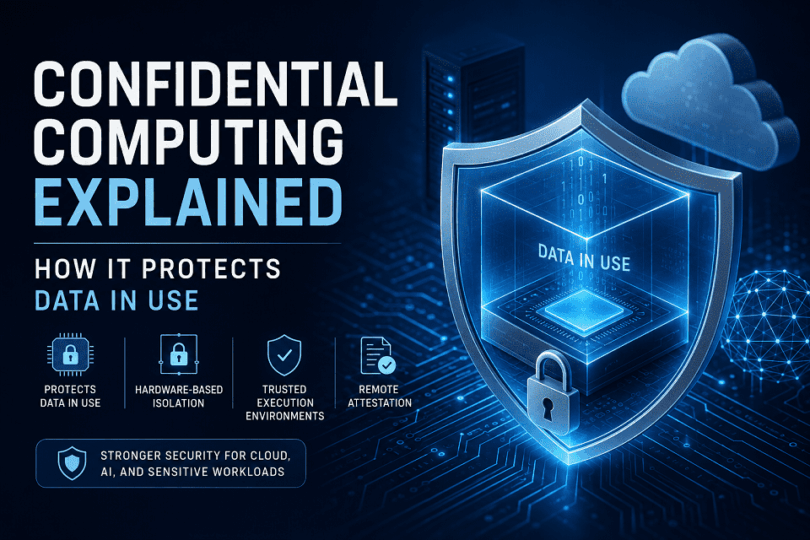
Confidential computing is a security approach that protects sensitive data while it is being processed. It uses specialized hardware and protected computing environments to isolate data and applications from unauthorized access.
Think about a cloud application processing customer information. Encryption can protect that information while it travels across a network or sits in storage. But the application must eventually decrypt the data to use it.
That creates a potential exposure point.
Confidential computing protects this processing stage. It places sensitive workloads inside a protected environment called a Trusted Execution Environment (TEE). The TEE helps prevent unauthorized access to the data while the application is running.
In simple terms:
Confidential computing protects data while the computer is using it.
This makes it especially useful for cloud computing, financial services, healthcare, artificial intelligence, and other workloads involving sensitive information.
What Problem Does Confidential Computing Solve?
Modern systems protect data in several ways. Encryption protects stored information and network communications. Access controls restrict who can use applications and databases.
However, applications still need access to unencrypted data while processing it.
This creates a security gap.
An administrator, compromised operating system, malicious process, or vulnerable software component could potentially access sensitive information during processing. Confidential computing is designed to reduce this risk by isolating sensitive workloads from the surrounding infrastructure.
The approach can be particularly valuable in cloud environments. Organizations may not want cloud infrastructure operators or other privileged components to access sensitive workloads.
Confidential computing therefore introduces an additional security boundary around data in use.
Why Data in Use Is Difficult to Protect
Protecting stored data is relatively straightforward. A database can encrypt information before writing it to storage.
Protecting data during transmission is also well established. Protocols such as TLS encrypt information moving between systems.
Processing creates a different challenge.
A processor needs usable information to perform calculations. At some point, encrypted data must become accessible to the application or processor.
This creates a potential attack surface.
Confidential computing attempts to reduce that exposure by processing sensitive information inside a hardware-isolated environment. The surrounding system can continue operating, while access to the protected workload is restricted.
This distinction is important because data in use has traditionally been one of the harder stages of the data lifecycle to protect.
The Three States of Data: At Rest, In Transit, and In Use
Data generally exists in three important states.
| Data state | What it means | Typical protection |
| Data at rest | Data stored on disks, databases, or other storage | Encryption at rest |
| Data in transit | Data moving between systems or networks | TLS and other encryption protocols |
| Data in use | Data actively processed by an application or processor | Confidential computing |
Data at rest includes files, database records, backups, and other stored information. Encryption helps prevent unauthorized users from reading that information if storage is compromised.
Data in transit refers to information moving between devices, applications, servers, or cloud services. Network encryption helps protect it from interception.
Data in use is different. The application needs access to the information to perform calculations or complete a task.
Confidential computing focuses primarily on this third state.
Together, these approaches can provide protection across the broader data lifecycle.
How Does Confidential Computing Work?

The process typically involves several stages, from entering the protected environment to verifying its integrity and releasing results.
Step 1: Data Enters a Protected Computing Environment
The process begins when an application sends sensitive data to a protected environment.
This environment is commonly provided by a Trusted Execution Environment (TEE). The TEE creates an isolated area where approved code can execute and access protected information.
The exact implementation depends on the hardware and platform. Some systems use confidential virtual machines, while others use secure enclaves.
The important point is that the workload receives an additional security boundary. The underlying operating system, hypervisor, or other privileged components may have restricted visibility into the protected workload.
Step 2: Sensitive Data Is Processed Inside the Secure Environment
Once inside the protected environment, the application processes the data normally.
For example, a healthcare application could analyze sensitive patient information. A financial service could calculate results using confidential transaction data.
The application still needs usable data to perform these operations. Confidential computing therefore does not mean that the processor never sees the data.
Instead, the goal is to restrict who and what can access the workload during processing.
This isolation is one of the central ideas behind confidential computing.
Step 3: Memory Is Protected During Processing
Applications need memory to temporarily hold data while they run. This memory can become an important security target.
Confidential computing technologies can use hardware-based protections to help isolate sensitive memory from unauthorized access.
Depending on the technology, memory may also be encrypted and integrity-protected. These protections can help prevent unauthorized parties from reading or modifying protected workload data.
This matters particularly in cloud environments.
A cloud provider manages the underlying infrastructure, but confidential computing can create a stronger boundary between that infrastructure and the protected workload.
Step 4: Remote Attestation Verifies the Environment
Protection is not enough by itself. Before sending highly sensitive information, a system may need to verify that the protected environment is genuine and running approved software.
This is where remote attestation becomes important.
Remote attestation allows a system to obtain cryptographic evidence about the environment running the workload. A trusted party can then check whether the expected hardware, configuration, and software measurements are present.
If the verification succeeds, the application can release sensitive information to the protected environment.
In simple terms:
Remote attestation helps answer the question: “Can I trust this computing environment?”
This makes attestation an important component of confidential computing architectures.
Step 5: Authorized Users or Applications Access the Results
After processing is complete, the application produces its results.
Only authorized users, applications, or services should receive those results. The protected environment can therefore become part of a broader access-control and security architecture.
For example, a confidential AI workload could process private business information and return an analysis. The underlying infrastructure does not need unrestricted access to the sensitive information used during that process.
The exact protection depends on the implementation and surrounding security controls.
Confidential computing is not a complete security solution by itself. Strong identity management, secure applications, encryption, monitoring, and proper access controls remain important.
What Is a Trusted Execution Environment (TEE)?
A Trusted Execution Environment (TEE) is a protected area where sensitive code and data can run with additional hardware-backed isolation.
TEEs are a core building block of confidential computing. They create a boundary around a workload and restrict unauthorized access from other software running on the same system.
The exact design differs between technologies and processors. However, the underlying goal remains similar: protect sensitive workloads during execution.
How a TEE Protects Sensitive Workloads
A TEE separates sensitive workloads from the normal computing environment.
An application can place confidential code and data inside the TEE. The processor then applies hardware-based protections to help prevent unauthorized software from accessing that protected environment.
This protection can cover both code and data.
For example, a cloud application might process confidential customer information inside a TEE. The application can perform its required calculations while the protected environment limits access from other components.
TEEs can also work with mechanisms such as remote attestation. This allows another system to verify important characteristics of the protected environment before providing sensitive data.
However, a TEE does not automatically make an application secure. Vulnerable code, poor authentication, insecure configuration, and compromised trusted components can still create risks.
TEE vs Traditional Computing Environment
A traditional computing environment typically relies on software controls to separate applications and protect sensitive information.
Operating systems, virtual machines, permissions, firewalls, and encryption all contribute to this protection.
A TEE adds another layer by using hardware-supported isolation.
| Feature | Traditional Environment | TEE |
| Application isolation | Primarily software-based | Hardware-assisted |
| Data protection during processing | Limited | Specifically designed for this purpose |
| Protection from privileged software | Depends on the architecture | Stronger isolation may be available |
| Remote attestation | Not typically inherent | Commonly supported |
| Main purpose | General system security | Protect sensitive workloads |
The distinction is important.
A TEE does not replace traditional security controls. Instead, it creates an additional trust boundary around particularly sensitive workloads.
Hardware-Based Isolation Explained
Hardware-based isolation means the processor and platform enforce security boundaries that software alone cannot easily bypass.
A TEE can establish protected memory regions for sensitive workloads. Other applications and system components are restricted from accessing those regions.
Some confidential computing technologies also provide memory encryption and integrity protections. These features can make unauthorized inspection or modification of protected memory more difficult.
The exact protections vary significantly between TEE implementations.
For example, different processor architectures use different approaches to isolate virtual machines, applications, or memory. Therefore, TEE should be understood as a security concept rather than one specific technology.
This distinction becomes important when comparing technologies such as Intel TDX, AMD SEV-SNP, and other confidential computing approaches.
What Is a Secure Enclave?
A secure enclave is an isolated area of a computing system designed to protect sensitive code and data during processing.
The enclave creates a security boundary between protected workloads and the rest of the system. Hardware-based controls help restrict unauthorized access to the information inside it.
Secure enclaves are closely related to Trusted Execution Environments (TEEs). In fact, an enclave can be implemented as a type of TEE, depending on the technology and architecture.
They are particularly useful when applications need to process sensitive information without exposing it to the wider operating system or infrastructure.
How Secure Enclaves Work
A secure enclave creates an isolated execution environment for selected application code and data.
When an application places sensitive information inside the enclave, the processor applies security controls around that protected region. Other applications and system components are prevented from directly accessing the enclave’s protected contents.
A typical process looks like this:
Application → Secure enclave → Protected processing → Verified result
The enclave may also use cryptographic mechanisms to establish its identity and prove that approved software is running inside the protected environment.
This can involve remote attestation.
For example, a service could verify an enclave before sending it confidential information. The service can then release the data only when the required security conditions are satisfied.
The exact implementation varies between technologies. Some enclaves protect individual applications, while other confidential computing approaches protect larger workloads such as virtual machines.
Secure Enclave vs Trusted Execution Environment
The terms secure enclave and Trusted Execution Environment are closely related, but they are not always interchangeable.
A TEE is a broader concept. It describes a protected environment that provides isolation for sensitive code and data.
A secure enclave is generally a more specific implementation of that concept.
| Feature | Secure Enclave | TEE |
| Meaning | Specific protected execution area | Broader protected execution environment |
| Scope | Often focused on applications or sensitive components | Can protect applications, VMs, or larger workloads |
| Isolation | Hardware-supported | Hardware-supported |
| Sensitive data protection | Yes | Yes |
| Remote attestation | May be supported | Commonly supported |
The terminology can vary between vendors and platforms.
For this reason, it is better to focus on what the technology protects and how it creates isolation, rather than assuming every enclave works in exactly the same way.
What Happens Inside an Enclave?
Once sensitive code enters an enclave, it executes within the protected environment.
The enclave can process confidential information without giving ordinary applications unrestricted access to its contents.
For example, an application might send sensitive customer information into an enclave. The enclave processes that information and returns only the required result.
Depending on the technology, the protected environment may provide several security mechanisms.
These can include:
- Hardware-enforced isolation
- Protected memory
- Memory encryption
- Integrity protection
- Cryptographic identity
- Remote attestation
The enclave itself still needs trustworthy software.
A vulnerability inside the protected application can create security problems. Confidential computing therefore reduces certain attack surfaces but does not eliminate every security risk.
What Is Remote Attestation?
Remote attestation is a security mechanism that allows one system to verify the integrity and identity of another computing environment.
It is especially important in confidential computing because sensitive data should not enter a protected environment blindly.
Before releasing confidential information, a system can request cryptographic evidence about the environment. That evidence can help confirm that the expected hardware, firmware, configuration, and software are running.
In simple terms, remote attestation answers an important question:
“Can I verify that this protected environment is trustworthy?”
Remote attestation does not guarantee that every application inside the environment is secure. Instead, it provides evidence that specific security conditions are present.
How Remote Attestation Works
Remote attestation typically involves several steps.
First, a workload starts inside a Trusted Execution Environment (TEE) or another protected computing environment.
The platform creates measurements of important components. These measurements can include information about the software, configuration, and other components that affect the trusted environment.
The environment then produces a cryptographically protected attestation report or evidence.
A remote verifier receives this evidence and checks whether it meets predefined security requirements.
If the verification succeeds, the verifier can establish a secure connection or release sensitive information to the workload.
The basic process looks like this:
Protected workload → Measurements → Attestation evidence → Verification → Data or access granted
This process helps establish trust without requiring the verifier to physically inspect the remote server.
Why Remote Attestation Matters for Security
Confidential computing depends on isolation, but isolation alone does not answer every trust question.
Imagine an organization wants to send sensitive customer information to a cloud-based confidential workload.
The organization needs confidence that the workload is running inside the expected protected environment. It may also need to verify that the correct software and configuration are being used.
Remote attestation provides cryptographic evidence that can support this decision.
This creates a verifiable trust relationship between the data owner and the protected workload.
It is particularly useful when infrastructure is operated by another organization.
Instead of simply trusting a cloud provider’s statement that a workload is protected, an organization can use attestation mechanisms to verify relevant properties itself.
However, the verifier must define what evidence is acceptable. A valid attestation does not automatically mean that the entire application is free from vulnerabilities.
Attestation Keys and Trusted Measurements
Remote attestation relies on cryptographic mechanisms to establish the authenticity of the evidence.
An important component is the attestation key. It allows the platform or trusted hardware to sign evidence about the protected environment.
The verifier can then use the relevant cryptographic credentials to determine whether the evidence originated from an authentic attestation mechanism.
Another important concept is measurement.
A measurement is typically a cryptographic representation of a component or state that the system wants to verify. Depending on the technology, measurements can cover items such as firmware, software, configuration, or other trusted components.
If the measured environment changes unexpectedly, its resulting evidence can differ.
This allows a verifier to establish policies such as:
“Release the secret only if the workload is running on approved hardware with an approved software configuration.”
The exact attestation architecture varies between hardware platforms and confidential computing technologies.
Confidential Computing vs Encryption: What Is the Difference?
Encryption and confidential computing both protect sensitive information, but they solve different security problems.
Encryption transforms readable data into an unreadable form using cryptographic algorithms. Only someone with the appropriate key can normally decrypt the information and use it.
Confidential computing takes a different approach. It creates a protected environment where sensitive data can be processed while reducing unauthorized access to that data.
The simplest distinction is:
Encryption protects data by making it unreadable. Confidential computing protects data by isolating it while it is being processed.
Understanding this difference is important because modern systems often need both.
What Is Encryption?
Encryption is a method of protecting information by converting plaintext into ciphertext.
Plaintext is the original readable information. Encryption uses an algorithm and a cryptographic key to transform that information into ciphertext.
Without the appropriate key, the ciphertext should be extremely difficult to understand.
For example, a database may contain sensitive customer information. Encryption can protect that information while it is stored on a server.
Encryption can also protect information while it travels between systems.
When an authorized application needs the information, it uses the appropriate key to decrypt it.
Encryption is therefore one of the fundamental technologies used in modern cybersecurity.
What Is the Basic Difference Between Encryption and Confidential Computing?
The main difference is what they protect and when they protect it.
Encryption primarily protects data by controlling whether unauthorized parties can read it.
Confidential computing focuses on protecting sensitive workloads and data while they are being processed.
Consider a simple example.
A company stores customer records in an encrypted database. The information is protected while sitting on the storage system.
When an application needs to analyze those records, the application must access usable data. This creates a processing stage where traditional encryption alone may not provide the same protection.
Confidential computing addresses this stage by placing the workload inside a hardware-protected environment.
| Technology | Primary purpose | Data state |
| Encryption at rest | Protect stored information | Data at rest |
| TLS encryption | Protect information moving between systems | Data in transit |
| Confidential computing | Protect sensitive workloads during processing | Data in use |
This is why confidential computing is often described as a way to protect data in use.
Confidential Computing Protects Data During Processing
Confidential computing focuses on the third state of the data lifecycle: data in use.
It uses technologies such as Trusted Execution Environments (TEEs) to isolate sensitive workloads.
Inside the protected environment, applications can process sensitive information while hardware-backed security mechanisms restrict unauthorized access.
Depending on the implementation, protections can include isolated memory, memory encryption, integrity protection, and remote attestation.
This can be particularly valuable when workloads run on third-party infrastructure.
For example, a company could process sensitive financial information in a confidential cloud workload. The data remains protected while the workload performs its calculations.
The goal is not to replace encryption.
The goal is to protect a part of the data lifecycle that traditional encryption does not fully address.
Confidential Computing and Encryption Work Together
Organizations usually do not have to choose between encryption and confidential computing.
They can use both technologies as complementary security layers.
A typical secure architecture might look like this:
Encrypted storage → Encrypted network connection → Confidential computing environment → Protected processing → Encrypted results
Encryption can protect information while it is stored and transmitted.
Confidential computing can then provide additional protection while the application processes that information.
This layered approach is especially useful for sensitive workloads involving financial data, healthcare information, proprietary business data, encryption keys, and AI workloads.
Confidential Computing vs Encryption: Quick Comparison
| Feature | Encryption | Confidential Computing |
| Main purpose | Protect information from unauthorized reading | Protect workloads and data during processing |
| Data at rest | ✓ | Not its primary purpose |
| Data in transit | ✓ | Not its primary purpose |
| Data in use | Limited with conventional encryption | ✓ |
| Hardware isolation | Not necessarily | Usually central to the approach |
| Protects against infrastructure access | Depends on implementation | Designed to reduce certain infrastructure trust |
| Replaces the other technology? | No | No |
Confidential Computing vs Zero-Knowledge Proofs
Confidential computing and Zero-Knowledge Proofs (ZKPs) both support privacy and security, but they solve very different problems.
Confidential computing protects data and workloads while they are being processed. Zero-Knowledge Proofs allow one party to prove that a statement is true without revealing the underlying information.
The distinction becomes important when designing privacy-focused systems. These technologies can sometimes complement each other rather than compete.
What Are Zero-Knowledge Proofs?
A Zero-Knowledge Proof (ZKP) is a cryptographic method that allows one party to prove something is true without revealing the underlying secret.
The party providing the proof is called the prover. The party checking it is called the verifier.
For example, imagine you need to prove that you meet an age requirement. A conventional system might require you to reveal your date of birth.
A zero-knowledge system could instead allow you to prove:
“I meet the required age.”
without revealing your exact birth date.
This is the basic idea behind zero-knowledge cryptography.
ZKPs can therefore reduce the amount of sensitive information that needs to be disclosed.
What Does Confidential Computing Do?
Confidential computing takes a different approach.
Instead of proving something without revealing the underlying information, it creates a protected environment for processing sensitive information.
A Trusted Execution Environment (TEE) can isolate code and data from unauthorized access. Hardware-backed security mechanisms help protect the workload while it runs.
For example, a company could process confidential customer information inside a protected cloud environment.
The data is still being used by the application. Confidential computing aims to protect that data during the processing itself.
So the basic idea is:
ZKP: Prove something without revealing the secret.
Confidential computing: Process sensitive information inside a protected environment.
Key Differences Between ZKPs and Confidential Computing
Although both technologies can support privacy, their mechanisms are fundamentally different.
| Feature | Zero-Knowledge Proofs | Confidential Computing |
| Primary purpose | Prove information without revealing the secret | Protect data during processing |
| Main technology | Cryptography | Hardware-backed isolation |
| Requires protected execution environment | Not necessarily | Usually |
| Reveals underlying secret | Designed to avoid unnecessary disclosure | Data can be available to the protected workload |
| Protects data in use | Not its primary purpose | Yes |
| Proves a statement | Yes | Not the primary purpose |
| Typical applications | Privacy-preserving verification, blockchain, identity | Cloud security, sensitive workloads, confidential AI |
The difference can be summarized in one question.
ZKPs ask:
“Can I prove this without revealing the information?”
Confidential computing asks:
“Can I process this information while keeping it protected?”
Can Confidential Computing and ZKPs Work Together?
Yes. Confidential computing and ZKPs can complement each other in some architectures.
Each technology can address a different part of a privacy problem.
Consider a system processing sensitive information inside a confidential computing environment. The protected workload can keep the underlying data private during computation.
A ZKP could then be used to prove that a particular computation or result satisfies specific conditions without revealing the underlying sensitive information.
This creates a potentially powerful combination:
Confidential data → Protected computation → Verified result → Zero-knowledge proof
For example, a privacy-focused financial application could process sensitive information inside a protected environment. It could then generate a proof showing that a particular condition was satisfied without exposing the underlying financial records.
However, combining these technologies can increase system complexity and computational requirements. The appropriate architecture depends on the security, privacy, performance, and verification requirements of the application.
Confidential Computing vs ZKPs: Which One Should You Use?
There is no universal winner.
Use confidential computing when the main requirement is protecting sensitive workloads and data during processing.
Use ZKPs when the main requirement is proving a claim without revealing the underlying information.
Use both when an application needs protected computation and privacy-preserving verification.
The two technologies therefore belong to the broader family of privacy-enhancing technologies, but they approach privacy from different directions.
Confidential Computing Types: From VM Isolation to Confidential AI
Confidential computing can protect workloads at different levels of a computing system.
Some approaches isolate an entire virtual machine. Others protect containers, applications, or specific pieces of code and data.
The common principle is isolation.
A confidential computing environment creates a protected boundary around a workload. Hardware-backed security mechanisms then help prevent unauthorized access from software or infrastructure outside that boundary.
The size of that boundary depends on the implementation.
A useful way to understand the major approaches is to ask:
What exactly is being isolated and protected?
Confidential Virtual Machines
A Confidential Virtual Machine (CVM) protects an entire virtual machine inside a hardware-backed security boundary.
This means the guest operating system, applications, and memory belonging to the VM are treated as a protected workload.
The isolation boundary generally sits around the virtual machine rather than around one individual application.
This can provide an important security advantage in cloud environments. A cloud provider controls the underlying infrastructure, including components such as the hypervisor. Confidential VM technologies are designed to reduce the ability of privileged infrastructure software to inspect or interfere with protected VM memory.
Depending on the platform, confidential VMs can use technologies such as:
- Memory encryption
- Memory integrity protection
- Hardware-enforced isolation
- Remote attestation
For example, a company could run an entire database server inside a confidential VM. The database, operating system, and associated workload remain within the protected boundary.
Isolation level: Entire virtual machine.
Best suited for: Existing cloud workloads that need stronger protection without major application redesign.
Confidential Containers
Confidential containers extend confidential computing to containerized workloads.
Traditional containers provide process and application isolation, but that isolation primarily depends on the operating system and container runtime.
Confidential containers add a hardware-backed confidential computing boundary around the workload.
The exact architecture varies.
Some implementations run containers inside confidential virtual machines. Other approaches use different mechanisms to establish a protected execution environment.
The important idea is that sensitive container workloads can receive protection from unauthorized access by components outside the confidential boundary.
For example, a company running a sensitive microservice could deploy that service as a confidential container.
The container can process sensitive information while the underlying confidential computing infrastructure helps protect its workload and memory.
Isolation level: Container workload or its protected execution environment.
Best suited for: Cloud-native applications, microservices, Kubernetes workloads, and sensitive containerized services.
Confidential Applications
Confidential applications protect sensitive application code and data inside a hardware-backed protected environment.
Unlike a confidential VM, the goal does not necessarily involve isolating an entire operating system or virtual machine.
Instead, developers can place selected application components inside the protected boundary.
This approach can be useful when only certain operations require strong confidentiality.
For example, a financial application could run its normal user interface and business logic outside the protected environment. It could place sensitive cryptographic operations or customer-data processing inside a protected execution environment.
This creates a smaller isolation boundary.
A smaller boundary can reduce the amount of code that must be trusted. However, it can also require more application-level design and development work.
Isolation level: Selected application code and data.
Best suited for: Applications with specific sensitive operations that require stronger isolation.
Secure Enclaves
A secure enclave is a protected execution area designed to isolate sensitive code and data from the surrounding system.
Enclaves are closely related to application-level confidential computing and are often discussed as a form of Trusted Execution Environment (TEE).
The enclave creates a security boundary around selected workloads.
For example, an application might send encryption keys, private information, or sensitive calculations into an enclave. The protected code processes that information without giving the wider operating system unrestricted access to the enclave’s contents.
Enclaves can also support remote attestation.
This allows another system to verify important characteristics of the protected environment before releasing sensitive information.
The main advantage of an enclave is fine-grained isolation.
Instead of protecting an entire VM, developers can protect only the most sensitive parts of an application.
Isolation level: Specific code, data, or application components.
Best suited for: Cryptographic operations, sensitive algorithms, authentication services, and applications requiring fine-grained protection.
Confidential AI Workloads
Confidential AI applies confidential computing to artificial intelligence workloads.
AI systems can process extremely sensitive information.
This may include private customer data, proprietary documents, confidential prompts, financial information, medical records, or valuable AI models.
Confidential computing can create a protected environment for these workloads.
For example, an organization could run AI inference inside a confidential VM. Sensitive business information could enter the protected environment, be processed by the AI model, and produce a result without exposing the workload to all layers of the underlying infrastructure.
Confidential computing can potentially protect several parts of an AI workload:
Sensitive input data: Private information provided to an AI model.
AI models: Proprietary model weights and algorithms.
Inference workloads: Processing performed when generating AI results.
AI agents: Sensitive context, credentials, and data used by autonomous AI systems.
Confidential AI is therefore particularly important as businesses move more sensitive workloads to cloud-based AI platforms.
Isolation level: AI data, models, inference processes, or complete AI workloads.
Best suited for: Generative AI, enterprise AI, AI agents, confidential inference, and sensitive machine-learning workloads.
How the Different Confidential Computing Approaches Compare
The easiest way to understand these approaches is to compare their isolation boundaries.
| Approach | What is isolated? | Main purpose |
| Confidential VM | Entire virtual machine | Protect complete cloud workloads |
| Confidential container | Containerized workload | Protect cloud-native applications |
| Confidential application | Selected application components | Protect sensitive application operations |
| Secure enclave | Specific code and data | Provide fine-grained isolation |
| Confidential database | Database or processing workload | Protect sensitive data during processing |
| Hardware-based computing | Hardware-enforced boundary | Provide the foundation for protection |
| Confidential AI | AI data, models, or workloads | Protect sensitive AI processing |
| Edge confidential computing | Edge workload | Protect distributed processing |
| Multi-party confidential computing | Shared computation | Protect collaborative data processing |
There is an important detail here.
These approaches can overlap.
A confidential AI workload could run inside a confidential VM. A confidential container could run inside a hardware-protected environment. A confidential application could use a secure enclave inside a larger protected workload.
So confidential computing should not be viewed as a collection of completely separate technologies.
Instead, think of it as a set of security architectures built around hardware-backed isolation.
Major Confidential Computing Technologies
Confidential computing is supported by several hardware and platform technologies. They use different approaches to isolate workloads, protect memory, establish trust, and verify protected environments.
Some technologies focus on individual applications or enclaves. Others protect entire virtual machines. Newer approaches also extend confidential computing to GPUs and AI workloads.
The technologies below are among the most important approaches to understand.
Intel SGX
Intel Software Guard Extensions (SGX) is an Intel technology designed to create protected application enclaves.
Instead of isolating an entire virtual machine, SGX allows developers to place selected application code and data inside an enclave.
The processor helps isolate the enclave’s protected memory from other software running on the system.
This makes SGX particularly suited to fine-grained application-level isolation.
For example, an application could place sensitive cryptographic operations inside an SGX enclave while leaving less sensitive parts of the application outside it.
SGX also supports remote attestation, allowing a remote party to verify important characteristics of the enclave before providing sensitive information.
The key idea is:
Intel SGX protects selected application code and data inside an isolated enclave.
SGX is therefore conceptually different from technologies designed primarily to protect entire virtual machines.
Intel TDX
Intel Trust Domain Extensions (Intel TDX) is designed to protect confidential virtual machines.
TDX introduces a protected abstraction called a Trust Domain (TD). A Trust Domain can contain a guest operating system and its applications while remaining isolated from much of the underlying infrastructure.
This makes TDX particularly relevant to cloud computing.
The hardware helps protect the memory belonging to the confidential VM and supports mechanisms for establishing trust in the protected environment.
TDX also supports attestation, allowing a relying party to obtain evidence about the protected environment.
Unlike SGX, which focuses on selected application enclaves, TDX is designed around a larger workload boundary.
The key idea is:
Intel TDX protects entire confidential virtual machines rather than requiring developers to isolate individual application components.
This can make it easier to move existing workloads into a confidential computing environment.
AMD SEV and SEV-SNP
AMD Secure Encrypted Virtualization (SEV) is a family of technologies designed to protect virtual machine memory from unauthorized access by the underlying infrastructure.
The approach uses hardware-based memory encryption to help isolate guest VMs from the hypervisor and other privileged components.
AMD has introduced several generations of SEV technology.
SEV-SNP, or Secure Encrypted Virtualization–Secure Nested Paging, adds stronger protections for VM memory integrity and helps defend against certain forms of malicious manipulation of guest memory.
SEV-SNP is therefore important for modern confidential VM deployments.
It can provide protections that help prevent unauthorized modification of protected VM memory, in addition to confidentiality protections.
SEV-SNP also supports attestation, allowing a workload to obtain cryptographic evidence about its protected environment.
The key idea is:
AMD SEV-SNP protects confidential virtual machines using hardware-enforced memory protection and stronger integrity mechanisms.
ARM Confidential Computing
ARM has developed confidential computing capabilities through its broader Confidential Compute Architecture (CCA).
CCA introduces hardware-supported isolation mechanisms designed to protect sensitive workloads from other software running on the system.
One of its key concepts is the Realm.
A Realm provides an isolated execution environment for confidential workloads. The architecture is designed to separate protected workloads from the normal operating environment while maintaining controlled communication between them.
This makes ARM CCA particularly interesting for future cloud, edge, mobile, and specialized computing environments.
The important point is that ARM CCA is an architecture, rather than a single processor feature equivalent to one specific Intel or AMD technology.
The key idea is:
ARM CCA provides hardware-backed isolation for confidential workloads through protected execution environments called Realms.
NVIDIA Confidential Computing
Confidential computing is increasingly moving beyond CPUs.
Modern AI workloads rely heavily on GPUs, creating a need to protect sensitive data and computations while they are processed on GPU hardware.
NVIDIA Confidential Computing extends confidential computing concepts to GPU-based workloads.
This is particularly relevant to confidential AI.
Organizations may want to protect sensitive prompts, proprietary datasets, model information, and inference workloads while using cloud-based GPU infrastructure.
NVIDIA’s confidential computing technologies are designed to create protected communication and execution paths between CPUs and GPUs and to help protect sensitive GPU workloads.
This is important because protecting only the CPU side of an application may not be enough when the sensitive computation actually occurs on a GPU.
The key idea is:
NVIDIA Confidential Computing extends hardware-backed protection to GPU and AI workloads.
This makes it one of the more important emerging areas of confidential computing.
How These Technologies Differ
The biggest difference is what each technology isolates.
| Technology | Primary isolation model | Typical workload | Key focus |
| Intel SGX | Application enclave | Selected application code and data | Fine-grained isolation |
| Intel TDX | Confidential VM | Entire virtual machine | VM-level isolation |
| AMD SEV-SNP | Confidential VM | Entire virtual machine | Memory confidentiality and integrity |
| ARM CCA | Realm-based isolation | Confidential workloads | Hardware-backed workload isolation |
| NVIDIA Confidential Computing | GPU/CPU protected workloads | AI and GPU workloads | Confidential AI and accelerated computing |
The differences become clearer when we look at the size of the trusted boundary.
Intel SGX can protect a relatively small portion of an application.
Intel TDX and AMD SEV-SNP can protect an entire virtual machine.
ARM CCA provides a broader architecture for creating protected workloads through hardware-enforced isolation.
NVIDIA Confidential Computing addresses an increasingly important problem: protecting sensitive workloads when computation moves onto GPUs.
Which Technology Is Used for What?
There is no single technology that is best for every workload.
Application-level protection: Intel SGX and similar enclave technologies are useful when developers need fine-grained isolation.
Confidential cloud VMs: Intel TDX and AMD SEV-SNP are designed for protecting complete virtual-machine workloads.
ARM-based infrastructure: ARM CCA provides a hardware architecture for confidential workloads across supported ARM platforms.
Confidential AI: GPU-focused technologies such as NVIDIA Confidential Computing become increasingly important when sensitive AI processing runs on accelerators.
The choice depends on the workload, hardware platform, performance requirements, isolation boundary, and security model.
Confidential Computing for Artificial Intelligence
Artificial intelligence is becoming one of the most important applications for confidential computing. AI workloads can process sensitive business data, private user information, proprietary models, prompts, and other valuable intellectual property.
The security challenge becomes more complex when AI workloads run on shared or third-party infrastructure. Organizations need to protect information not only when it is stored or transmitted, but also while models and data are actively being processed.
Confidential computing addresses this challenge by using hardware-backed Trusted Execution Environments (TEEs), memory protection, and attestation mechanisms. Major cloud and hardware providers are now extending these capabilities to AI inference, training, and other AI workloads.
Why AI Workloads Need Confidential Computing
AI systems can require access to some of an organization’s most sensitive information.
An enterprise AI assistant might process internal documents. A healthcare model might process patient information. A financial model could analyze confidential transactions.
That information must be available to the AI system during computation.
Traditional encryption protects data at rest and in transit. However, conventional encryption does not by itself solve the problem of protecting plaintext data while an AI workload is processing it.
There is another concern: AI models themselves can be valuable intellectual property.
Companies may want to protect proprietary model weights, algorithms, prompts, and inference processes from unauthorized access.
Confidential computing can create a hardware-backed security boundary around these workloads. It can therefore reduce the amount of infrastructure that organizations need to trust when running sensitive AI applications.
This is becoming particularly relevant as organizations move from simple AI queries toward enterprise AI, generative AI, and autonomous AI agents.
Protecting Sensitive AI Data
AI systems often require large amounts of data.
That data can include customer records, medical information, financial documents, employee information, proprietary research, and confidential corporate files.
Simply encrypting the data while stored is not enough. The AI workload eventually needs access to usable data to perform inference or training.
Confidential computing can place that processing inside a protected environment.
For example:
Private data → Protected AI environment → AI processing → Protected result
Hardware-backed isolation helps restrict unauthorized access to the workload and its protected memory.
Remote attestation can provide another layer of assurance. Before releasing sensitive data or encryption keys, a system can verify that the AI workload is running in an expected protected environment.
This creates a more verifiable security model for cloud-based AI.
Google Cloud, Microsoft Azure, and NVIDIA are all developing confidential AI capabilities aimed at protecting sensitive data and AI workloads during processing.
Protecting AI Models During Inference
AI security is not only about protecting user data.
The model itself can be valuable intellectual property.
A proprietary model may represent years of research, expensive training, and unique business knowledge. Unauthorized access to model weights could therefore have significant commercial consequences.
During inference, the model must interact with inputs and perform computations.
Confidential computing can help place the model and its inference workload inside a protected environment.
This can help protect:
- Model weights
- Inference inputs
- Intermediate computations
- Sensitive prompts
- Generated outputs
GPU-based confidential computing is particularly important here because modern AI inference frequently runs on accelerators rather than CPUs alone.
NVIDIA’s current confidential computing platform is designed to protect AI models, training data, inference prompts, GPU execution, and GPU memory across supported platforms.
This means confidential AI increasingly needs to protect the entire AI computation path, not simply the CPU-side application.
What Is Confidential AI?
Confidential AI is the application of confidential computing techniques to artificial intelligence workloads.
It aims to provide hardware-backed and cryptographically verifiable protection for sensitive AI data and models while they are being processed.
Confidential AI can cover multiple stages of the AI lifecycle.
These can include:
Data preparation: Protecting sensitive information before it reaches the model.
Training: Protecting training data, model architecture, and model weights.
Inference: Protecting prompts, input data, model execution, and results.
Deployment: Protecting models and workloads running on cloud or shared infrastructure.
Microsoft describes Confidential AI as using hardware-based technologies to provide verifiable protection for data and models throughout the AI lifecycle.
The concept is therefore broader than simply running an AI model inside a confidential VM.
It can involve CPUs, GPUs, TEEs, attestation, secure key release, and protected data pipelines working together.
Confidential Computing for Generative AI
Generative AI creates new confidentiality challenges.
Users may provide an AI system with private documents, proprietary code, financial information, internal reports, or other sensitive prompts.
The model then processes that information to generate a response.
This creates several security questions:
Who can access the prompts?
Who can access the model?
Who can inspect the data during inference?
Can the underlying infrastructure access sensitive memory?
Confidential computing can address part of this problem by creating a protected execution environment for the AI workload.
For example, an enterprise could run generative AI inference inside a confidential environment. Sensitive prompts and documents can be processed inside that boundary while hardware-backed protections restrict unauthorized access.
Confidential computing does not automatically solve every generative AI privacy problem.
Organizations still need appropriate data governance, access controls, model security, logging policies, and application-level protections.
But it can provide an important additional security layer for sensitive generative AI workloads.
Can Confidential Computing Protect AI Models?
Yes, but the level of protection depends on the architecture.
Confidential computing can protect AI model weights and associated computations when the model runs inside an appropriately protected environment.
For example, a confidential GPU environment can help protect model execution and GPU memory during inference.
This is especially important for proprietary models running on shared cloud infrastructure.
However, confidential computing should not be described as an absolute guarantee that an AI model can never be extracted.
The actual protection depends on several factors:
- The hardware and TEE architecture
- The trusted computing base
- Attestation and key-management mechanisms
- Application and model design
- Protection of inputs and outputs
- The specific threat model
Modern confidential GPU technologies are extending the protection boundary beyond CPU memory. NVIDIA’s current platforms, for example, are designed to protect GPU execution and memory alongside AI models and inference data.
Confidential AI: What Does It Actually Protect?
It is useful to separate the different assets involved in an AI workload.
| AI asset | What confidential computing can help protect |
| Training data | Data during protected processing |
| Model weights | Model memory and execution |
| Prompts | Sensitive input during inference |
| Inference data | Data while being processed |
| Intermediate computations | Protected workload state |
| AI agent context | Sensitive information inside the protected workload |
| GPU memory | Protected AI computation on supported hardware |
This distinction matters because confidential AI is not simply “encrypted AI.”
It is about creating a verifiable security boundary around AI computation.
Real-World Confidential Computing Use Cases
Confidential computing becomes easier to understand when we look at where it solves practical security problems.
The technology is particularly useful when organizations need to process sensitive information on shared, cloud, or third-party infrastructure.
The common requirement is simple: use sensitive data without unnecessarily exposing it during processing.
Healthcare and Sensitive Patient Data
Healthcare organizations handle some of the most sensitive information available.
Electronic health records, diagnostic information, genomic data, medical images, and research datasets all require strong protection.
Encryption can protect this information while stored and transmitted. Confidential computing adds another layer when applications need to process the information.
For example, a healthcare provider could process patient data inside a confidential computing environment. Researchers could also analyze sensitive datasets within a protected workload.
Remote attestation can provide additional assurance before sensitive data or encryption keys are released to the workload.
Potential applications include:
- Protected medical analytics
- Genomic research
- AI-assisted diagnosis
- Collaborative healthcare research
Confidential computing does not replace healthcare privacy regulations or access controls. It provides an additional technical protection for data during computation.
Banking and Financial Services
Financial organizations process highly sensitive information every day.
This includes account information, payment data, transaction records, credit information, fraud signals, and proprietary financial models.
Confidential computing can help protect this information while applications perform calculations.
For example, a fraud-detection system could analyze sensitive transaction information inside a protected environment.
Banks and financial institutions can also use confidential computing for workloads involving multiple parties. Different organizations may want to collaborate without exposing their underlying datasets to each other.
Other potential applications include:
- Fraud detection
- Risk analysis
- Secure financial analytics
- Confidential transactions
- Collaborative financial research
The technology is particularly relevant when sensitive financial workloads move to cloud infrastructure.
Government and Public-Sector Workloads
Government systems often process highly sensitive information.
Examples include citizen records, tax information, defense-related data, public-sector research, and other restricted datasets.
Confidential computing can provide an additional security boundary for workloads running on cloud or shared infrastructure.
A government organization could, for example, process sensitive datasets inside a confidential VM and use remote attestation before releasing encryption keys.
This approach can help reduce reliance on privileged infrastructure access.
However, confidential computing does not replace government security requirements. Identity management, access controls, encryption, monitoring, and secure application design remain essential.
Supply Chain and Business Data
Modern supply chains involve many organizations.
Manufacturers, suppliers, logistics providers, distributors, and retailers may need to share information to improve forecasting and operations.
The problem is that companies may not want to expose commercially sensitive data.
Confidential computing can provide a protected environment for collaborative processing.
For example, several companies could contribute data to a protected analytics workload. The system could calculate combined results without requiring every participant to receive the raw datasets.
Potential applications include:
- Demand forecasting
- Inventory optimization
- Logistics analysis
- Supplier risk assessment
- Manufacturing analytics
This creates an interesting advantage: organizations can collaborate on sensitive data without necessarily creating unrestricted access to each other’s underlying information.
Multi-Party Data Processing
Some problems require multiple organizations to process data together.
A bank and a financial technology company might need to analyze transaction patterns. Healthcare organizations might want to collaborate on medical research.
The challenge is establishing trust.
Each participant may be willing to contribute data but unwilling to give another participant direct access to the raw information.
Confidential computing can place the shared computation inside a protected environment.
A simplified model looks like this:
Organization A data + Organization B data → Protected computation → Approved results
Remote attestation can help participants verify the environment before releasing sensitive information.
Additional controls can restrict what the workload is allowed to do and what results can leave the protected environment.
Confidential computing therefore becomes particularly useful for privacy-sensitive collaboration.
It is important to distinguish this from Zero-Knowledge Proofs or other privacy-enhancing technologies. Different technologies can solve different parts of the same problem, and they can sometimes be combined.
Privacy-Preserving AI
AI is becoming one of the most important use cases for confidential computing.
Organizations increasingly want to use AI with sensitive data without exposing that data to every layer of the underlying infrastructure.
Consider an enterprise AI assistant that needs access to confidential company documents.
The documents must be available to the model during inference. Confidential computing can place the AI workload inside a protected environment and help restrict unauthorized access to its memory and execution state.
The same approach can potentially protect proprietary models and sensitive AI-agent workloads.
Applications include:
- Confidential AI inference
- Private enterprise assistants
- Sensitive machine-learning workloads
- Protected AI model serving
- AI agents handling confidential information
GPU-based confidential computing is becoming particularly important here because modern AI workloads increasingly rely on accelerators.
This makes confidential computing an important part of the emerging confidential AI security model.
Benefits of Confidential Computing
Confidential computing adds a security layer that traditional encryption does not fully provide.
Its main advantage is protecting sensitive workloads during processing. This becomes especially valuable when applications run on cloud infrastructure, shared systems, or other environments that organizations do not completely control.
However, confidential computing should be viewed as one layer of a broader security architecture, not a replacement for encryption, access controls, or secure application design.
Protects Data While It Is Being Processed
The primary benefit of confidential computing is protecting data in use.
Traditional encryption can protect data while it is stored and while it travels between systems. Applications still need access to usable data when performing calculations.
That creates a potential exposure point.
Confidential computing places sensitive workloads inside a hardware-protected environment. Hardware-backed isolation can restrict unauthorized access to the workload and its memory while processing takes place.
This is particularly valuable for workloads involving:
- Personal information
- Financial records
- Healthcare data
- Proprietary business information
- Sensitive AI workloads
The goal is not to make the data invisible to the application. The application must still process it.
Instead, confidential computing helps prevent unauthorized components outside the protected boundary from accessing that information.
Reduces Trust in Cloud Infrastructure
Cloud computing requires organizations to place some level of trust in the underlying infrastructure.
Cloud providers manage servers, virtualization layers, and other components that customers do not directly control.
Confidential computing can reduce this trust requirement.
A confidential VM or enclave creates a hardware-backed security boundary around the protected workload. Components outside that boundary receive restricted access to protected memory.
Remote attestation can provide additional assurance.
Before releasing sensitive data or cryptographic keys, an organization can verify important characteristics of the protected environment.
This changes the security model from:
“Trust the infrastructure.”
to:
“Verify the protected environment and limit what the infrastructure can access.”
It does not eliminate the need to trust the cloud provider completely. It reduces specific areas of infrastructure trust.
Strengthens Data Privacy
Confidential computing can strengthen privacy by reducing unnecessary exposure of sensitive information during processing.
This is important when organizations need to use data without broadly exposing it to infrastructure operators or other privileged components.
For example, a healthcare organization could process sensitive patient information inside a confidential environment.
A financial institution could analyze transaction data within a protected workload.
An enterprise could use private documents with an AI system while limiting exposure during inference.
Confidential computing therefore supports the principle of using sensitive data while minimizing unnecessary access to it.
However, privacy depends on the complete system architecture. Confidential computing does not automatically prevent an application from exposing information through its outputs, logs, APIs, or other channels.
Helps Protect Intellectual Property
Organizations increasingly depend on valuable digital intellectual property.
This can include:
- AI model weights
- Proprietary algorithms
- Business logic
- Research data
- Trade secrets
- Confidential datasets
Protecting this information becomes more difficult when workloads run on third-party infrastructure.
Confidential computing can place sensitive code, data, and model execution inside a protected environment.
For AI workloads, this can be especially important.
A proprietary model may run on cloud GPU infrastructure while confidential computing mechanisms help protect model data and execution from unauthorized access.
The protection depends on the specific hardware, workload architecture, and threat model.
Confidential computing therefore provides an additional barrier around valuable intellectual property during computation.
Supports Regulatory and Compliance Requirements
Organizations in regulated industries must often demonstrate that sensitive information is appropriately protected.
Confidential computing can support these security objectives by adding hardware-backed isolation and stronger controls around sensitive workloads.
Potentially relevant areas include:
- Healthcare data
- Financial information
- Personal data
- Government workloads
- Cross-organization data processing
Confidential computing can also support a least-trust approach by reducing unnecessary access to sensitive information.
However, it is important not to overstate this benefit.
Confidential computing does not automatically make an organization compliant with a regulation.
Compliance depends on the complete technical, organizational, and operational environment.
Confidential computing can instead serve as one technical control within a broader compliance and security strategy.
Limitations and Challenges of Confidential Computing
Confidential computing provides an important security boundary, but it is not a perfect security solution.
It introduces new protections around data and workloads during processing. At the same time, organizations must consider performance, hardware availability, architecture complexity, and new security risks.
Understanding these limitations is important before adopting the technology. Confidential computing reduces certain risks; it does not eliminate every attack surface.
Performance Overhead
Confidential computing can introduce some performance overhead.
Memory encryption, integrity protection, attestation, secure communication, and other security mechanisms require additional processing.
The actual impact varies considerably between technologies and workloads.
A lightweight application may experience little noticeable impact. A memory-intensive workload may experience a larger performance cost.
AI workloads can present additional challenges because they often require substantial memory bandwidth and specialized accelerators.
Therefore, organizations should benchmark their specific workloads rather than assume a fixed performance penalty.
The trade-off is often between additional protection and additional computational overhead.
Hardware and Infrastructure Requirements
Confidential computing depends on supported hardware and infrastructure.
Organizations cannot simply enable confidential computing on every existing server or cloud VM.
The processor, firmware, virtualization platform, operating system, cloud service, and workload may all need appropriate support.
Some advanced use cases may also require compatible GPUs or other accelerators.
This can make adoption more complicated than conventional software-based security controls.
Cloud providers can simplify some of these requirements by offering ready-to-use confidential computing services. However, organizations running their own infrastructure may need to plan hardware and platform support carefully.
Increased System Complexity
Confidential computing introduces additional security components.
These can include:
- Trusted Execution Environments
- Attestation services
- Key management
- Protected communication
- Workload configuration
- Confidential computing policies
Developers may also need to understand the boundary between trusted and untrusted components.
This can affect application architecture and operational processes.
For example, an application may need to determine which data enters the protected environment and which information can safely leave it.
Poorly designed boundaries can reduce the security benefits.
Therefore, confidential computing can increase both development and operational complexity, especially for applications designed around fine-grained enclaves.
Limited Hardware Support
Confidential computing capabilities depend on specific hardware generations and platform support.
Not every processor supports the same features.
Even when a processor supports confidential computing, the available capabilities can differ significantly.
One platform may focus on confidential VMs. Another may support application enclaves. A newer platform may provide confidential GPU capabilities for AI workloads.
This fragmentation can complicate deployment across different environments.
Organizations should therefore verify:
Which hardware is supported?
Which confidential computing features are available?
Which cloud or virtualization platforms support them?
Can the workload run without major changes?
Hardware support is improving, but compatibility remains an important consideration.
Side-Channel Attacks
Confidential computing does not automatically eliminate side-channel attacks.
A side-channel attack attempts to obtain information indirectly from observable characteristics of a system.
Potential signals can include timing, memory-access patterns, cache behavior, or other characteristics of computation.
An attacker may not need direct access to protected memory if information can be inferred through another channel.
This is an important distinction.
Hardware isolation can make direct access to protected data significantly more difficult. It does not guarantee that every possible information leak has been eliminated.
Confidential computing technologies therefore require careful hardware design, software engineering, configuration, and threat modeling.
Developers should also understand the specific side-channel protections and limitations of the technology they choose.
Trust in Hardware and Firmware
Confidential computing reduces some trust requirements, but it does not remove trust completely.
The protected environment ultimately depends on hardware, firmware, security mechanisms, and other trusted components.
If a fundamental hardware or firmware vulnerability exists, the security guarantees may be affected.
This creates an important question:
Who and what do you still need to trust?
The answer depends on the technology.
For example, a confidential VM may reduce the need to trust the hypervisor with access to protected memory. But the CPU hardware, firmware, attestation mechanism, and other components remain part of the trusted computing base.
This is why confidential computing should be viewed as trust reduction, rather than “zero trust in hardware.”
Confidential Computing Is Not a Complete Security Solution
Perhaps the most important limitation is that confidential computing does not protect against every security problem.
It primarily addresses unauthorized access to protected workloads and data during computation.
It does not automatically prevent:
- Vulnerable application code
- Stolen user credentials
- Malicious authorized users
- Insecure APIs
- Data leakage through application outputs
- Poor access controls
- Compromised dependencies
An attacker could potentially compromise an application running inside a TEE without breaking the TEE itself.
Similarly, an application could legitimately access sensitive data and then accidentally expose it through logs or an API.
Confidential computing cannot solve these problems on its own.
It should therefore work alongside encryption, identity management, access controls, secure software development, network security, monitoring, and application-level protections.
Confidential computing should therefore be treated as one layer of defense in depth. Strong identity, access control, encryption, secure software, monitoring, key management, and an appropriate threat model remain essential.
Why Secure Architecture Still Matters
It does not automatically secure vulnerable applications, stolen credentials, malicious authorized users, insecure configurations, or unsafe outputs. Side-channel attacks and weaknesses in trusted components can also remain relevant.
What Confidential Computing Does Not Protect
Confidential computing can provide strong protection for data and workloads during processing. Hardware-backed isolation can restrict access from software and infrastructure outside the protected boundary, while remote attestation can provide evidence about the environment before sensitive data or keys are released.
What Confidential Computing Protects
Is Confidential Computing Really Secure?
What Confidential Computing Protects
Confidential computing can provide strong protection for data and workloads during processing. Hardware-backed isolation can restrict access from software and infrastructure outside the protected boundary. Remote attestation can also provide evidence about the protected environment before sensitive data or keys are released.
What Confidential Computing Does Not Protect
It does not automatically secure vulnerable applications, stolen credentials, malicious authorized users, insecure configurations, or unsafe outputs. Side-channel attacks and weaknesses in trusted components can also remain relevant.
Why Secure Architecture Still Matters
Confidential computing is therefore one layer of defense in depth. Strong identity, access control, encryption, secure software, monitoring, key management, and an appropriate threat model remain essential.
Confidential Computing vs Traditional Cloud Security
Traditional cloud security already provides multiple layers of protection. These include encryption, identity management, network controls, access policies, monitoring, and workload isolation.
Confidential computing does not replace these controls. Instead, it adds another security boundary around sensitive workloads while they are being processed.
The key difference is the trust model.
Traditional cloud security often relies on protecting the infrastructure and controlling who can access it. Confidential computing adds hardware-backed isolation that can reduce the need to trust certain privileged infrastructure components with access to workload data.
Traditional Cloud Security Model
Traditional cloud security uses several security layers to protect cloud workloads.
Encryption protects data stored in databases, disks, backups, and object storage. TLS protects information moving between users, applications, and services.
Identity and access management determines who can access resources.
Network security controls restrict communication between systems. Monitoring and logging help organizations detect suspicious activity.
Virtualization also provides isolation between different cloud customers and workloads.
A simplified model looks like this:
User → Identity controls → Network security → Cloud infrastructure → Application → Data
These controls remain essential.
However, sensitive data eventually needs to be processed by the application. At that point, the application and parts of the underlying infrastructure may need access to usable data.
This creates the data-in-use protection challenge that confidential computing addresses.
Confidential Cloud Security Model
Confidential cloud security adds a hardware-backed protection boundary around sensitive workloads.
A confidential VM, enclave, or another TEE-based environment can isolate the workload from parts of the surrounding infrastructure.
The simplified model becomes:
User → Identity controls → Network security → Confidential environment → Protected workload → Data
The important change is the additional confidential computing boundary.
Inside that boundary, sensitive code and data can be processed while hardware mechanisms help restrict unauthorized access from outside the protected environment.
Remote attestation can add another layer of trust.
Before releasing sensitive data or encryption keys, an organization can verify important properties of the protected environment.
This creates a model based on both isolation and verification.
What Changes When Data Is Processed Inside a TEE?
The biggest change is the security boundary around data in use.
In a conventional cloud environment, an application processes data within the normal operating environment.
The operating system, hypervisor, and other privileged infrastructure components are part of the broader trust model.
A TEE changes that relationship.
Sensitive data and code can execute inside a hardware-protected environment. Components outside the TEE may continue managing the infrastructure, but they have restricted access to the protected workload.
This can significantly reduce the amount of infrastructure that needs unrestricted access to sensitive information.
Remote attestation can make the model stronger by allowing a remote system to verify the protected environment before releasing secrets.
For example:
Without confidential computing:
Encrypted data → Application → Processing → Result
With confidential computing:
Encrypted data → Verified TEE → Protected processing → Result
The second model does not eliminate the need for encryption.
It adds protection specifically around the processing stage.
Traditional Cloud Security vs Confidential Cloud Security
| Security area | Traditional cloud security | Confidential cloud security |
| Data at rest | Encryption | Encryption |
| Data in transit | TLS and other encryption | TLS and other encryption |
| Identity | IAM and authentication | IAM and authentication |
| Network protection | Firewalls and segmentation | Firewalls and segmentation |
| VM isolation | Virtualization | Virtualization + confidential isolation |
| Data in use | Conventional workload protection | Hardware-backed protection |
| Infrastructure trust | Greater reliance on infrastructure controls | Reduced trust in certain privileged components |
| Remote attestation | Not normally central | Important capability |
| Application security | Required | Still required |
The important conclusion is that confidential cloud security is an extension of traditional cloud security, not an alternative to it.
Can Confidential Computing Replace Existing Cloud Security?
No. Confidential computing should not replace existing cloud security controls.
It addresses a specific security problem: protecting sensitive workloads and data during processing.
It does not replace identity management, encryption, network security, secure software development, vulnerability management, monitoring, or access controls.
For example, confidential computing cannot prevent an attacker from stealing a user’s password.
It cannot automatically fix a vulnerable API.
It cannot prevent an authorized application from intentionally sending sensitive information to an unauthorized destination.
And it cannot guarantee that an AI application will never reveal confidential information through its output.
Instead, confidential computing should be added to an existing defense-in-depth architecture.
A modern sensitive cloud workload might therefore use:
Encryption + IAM + network security + application security + confidential computing + monitoring
Each layer addresses a different part of the threat model.
Confidential Computing Architecture Explained
Confidential computing is easier to understand when viewed as a layered security architecture.
Different technologies use different isolation boundaries, but the basic architecture usually combines the application, protected workload, Trusted Execution Environment (TEE), hardware security, and attestation mechanisms.
The most important idea is that each layer has a different responsibility.
User and Application Layer
This is where users, applications, APIs, and services interact with the confidential workload.
A user may submit sensitive information through an application. The application then determines what information needs to enter the protected environment.
For example, an enterprise AI application might receive a confidential document from an authorized employee.
The application does not necessarily place its entire workload inside the TEE. It can send only the sensitive data and operations that require protection.
This creates an important security boundary:
Application layer → Confidential workload
Strong identity management and access controls remain necessary at this layer.
Confidential computing does not determine whether a user should be allowed to access the application.
Confidential Workload Layer
The confidential workload contains the code and data that require protection.
It could be:
- A confidential VM
- A confidential container
- An application component
- A secure enclave
- An AI inference workload
The workload executes normally from the application’s perspective, but it operates within a protected environment.
Sensitive information can therefore be processed without giving unrestricted access to components outside the confidential boundary.
The size of this workload varies.
A confidential VM may contain an entire operating system and application stack. An enclave may contain only a small portion of an application.
Trusted Execution Environment
The Trusted Execution Environment (TEE) provides the protected execution boundary.
It isolates the confidential workload from other software and infrastructure components.
Depending on the technology, the TEE can provide protections such as:
- Hardware-enforced isolation
- Protected memory
- Memory encryption
- Memory integrity
- Controlled communication with the outside environment
The TEE is therefore the central protection layer for many confidential computing architectures.
However, the exact security guarantees depend on the underlying implementation.
A TEE is not simply a magic “secure box.” Its protection depends on the hardware, firmware, trusted software, configuration, and application architecture.
Hardware Security Layer
The hardware provides the foundation that makes the isolation possible.
Modern confidential computing technologies use processor and platform features to establish protected memory regions and enforce access restrictions.
Depending on the technology, hardware can provide:
Memory confidentiality: Helps prevent unauthorized parties from reading protected memory.
Memory integrity: Helps detect or prevent unauthorized modification of protected memory.
Hardware isolation: Establishes boundaries between protected and unprotected workloads.
Cryptographic protection: Supports keys and other mechanisms required to protect confidential workloads.
This layer is especially important because the security boundary is enforced below many traditional software layers.
Technologies such as Intel TDX, AMD SEV-SNP, ARM CCA, and NVIDIA confidential computing use different hardware approaches to provide these capabilities.
Remote Attestation Layer
Remote attestation provides a way to verify the protected environment.
Isolation alone is not always enough.
Before sending sensitive data or encryption keys to a confidential workload, a remote system may want evidence that the expected hardware, software, and configuration are running.
The protected environment can generate cryptographic attestation evidence.
A verifier checks that evidence against its security policy.
If the environment meets the required conditions, the verifier can release sensitive information or allow the workload to proceed.
A simplified process is:
Workload → Measurement → Attestation evidence → Verification → Secret released
This creates an important relationship between isolation and verification.
The TEE provides the protected environment.
Remote attestation helps establish confidence that the environment is the one the organization intended to use.
Data Flow Through a Confidential Computing Environment
The complete process can be simplified into several stages.
- User provides sensitive data
The application receives information that requires protection.
- Application identifies the protected workload
Only the required data and processing operations are sent into the confidential environment.
- Protected environment is established
The workload runs inside a TEE or another hardware-backed confidential computing environment.
- Environment is verified
Remote attestation can establish that the expected environment and configuration are running.
- Sensitive data is processed
The workload processes the information inside the protected boundary.
- Results are returned
Only authorized outputs leave the protected environment.
A simplified architecture looks like this:
User / Application
↓
Confidential Workload
↓
Trusted Execution Environment
↓
Hardware Security
↕
Remote Attestation & Key Management
↓
Verified Processing
↓
Authorized Result
The arrows are conceptual rather than a strict implementation requirement. Different confidential computing technologies place these components together in different ways.
The same pattern can apply to healthcare analytics and financial processing: sensitive data enters a protected workload, the environment is verified, computation occurs inside the security boundary, and only authorized results leave it.
After verification, the AI model processes the document inside the protected boundary. The application receives the authorized result without requiring unrestricted access to the protected memory.
The workload runs inside a hardware-backed protected environment. Before releasing sensitive data or cryptographic keys, a key-management service can verify the environment through remote attestation.
Consider an enterprise AI application that needs to analyze a confidential company document in the cloud. The document reaches the application through an authenticated connection and is then sent to a confidential workload.
Confidential Computing Example
Consider an enterprise AI application that needs to analyze a confidential company document in the cloud. The document reaches the application through an authenticated connection and is then sent to a confidential workload.
The workload runs inside a hardware-backed protected environment. Before releasing sensitive data or cryptographic keys, a key-management service can verify the environment through remote attestation.
After verification, the AI model processes the document inside the protected boundary. The application receives the authorized result without requiring unrestricted access to the protected memory.
The same pattern applies to healthcare analytics and financial processing: sensitive data enters a protected workload, the environment is verified, computation occurs inside the security boundary, and only authorized results leave it.
How Confidential Computing Fits Into a Zero-Trust Security Strategy
Confidential computing and Zero Trust address different security problems, but they can work well together.
Zero Trust focuses on a simple principle: never automatically trust a user, device, workload, or connection simply because it is inside a trusted network.
Confidential computing extends this idea to the computing environment itself.
It can reduce the amount of trust placed in privileged infrastructure by creating hardware-backed boundaries around sensitive workloads.
Zero Trust and Confidential Computing
A Zero Trust architecture continuously verifies access instead of assuming that a user or system should be trusted.
Identity, authentication, authorization, device security, network controls, and workload policies all play important roles.
Confidential computing adds another layer.
A Zero Trust architecture might verify:
Who is requesting access?
What resource are they accessing?
Is the request authorized?
Confidential computing adds another question:
Can the computing environment itself be verified before sensitive data is released?
Remote attestation can help answer this question.
A system can verify important properties of a confidential workload before providing sensitive information or cryptographic keys.
This makes confidential computing a useful complement to Zero Trust architecture.
Reducing Infrastructure Trust
Cloud environments require organizations to trust some infrastructure components.
A cloud provider may control the physical servers, virtualization layer, and other infrastructure.
Traditional security controls can restrict access to workloads, but privileged infrastructure may still be part of the broader trust model.
Confidential computing changes this assumption.
A confidential VM or enclave creates a hardware-backed security boundary around the workload.
Components outside that boundary can continue managing the infrastructure, but they have restricted access to protected workload memory.
This does not eliminate trust in the cloud provider.
Instead, it reduces the amount of infrastructure that needs unrestricted access to sensitive data.
Remote attestation strengthens this model by providing cryptographic evidence about the protected environment.
Protecting Workloads From Privileged Access
Privileged access presents an important security challenge.
Administrators and infrastructure components often have extensive permissions because they need to manage systems.
However, those privileges do not necessarily need to include unrestricted access to sensitive workload data.
Confidential computing can create a separation between infrastructure management and workload confidentiality.
For example, an administrator may be able to manage the underlying cloud infrastructure without being able to directly inspect the protected memory of a confidential workload.
This is particularly valuable for sensitive workloads involving:
- Financial information
- Healthcare data
- Encryption keys
- Proprietary algorithms
- AI models and prompts
The exact protection depends on the confidential computing technology and its threat model.
Confidential computing therefore helps implement a least-trust approach to infrastructure access.
Confidential Computing as a Privacy-Enhancing Technology
Confidential computing is commonly considered part of the broader privacy-enhancing technology (PET) ecosystem.
Privacy-enhancing technologies aim to reduce unnecessary exposure of sensitive information while still allowing useful processing or analysis.
Confidential computing contributes to this goal by protecting data during computation.
Other privacy-enhancing approaches solve different problems.
For example:
Encryption protects data from unauthorized reading while stored or transmitted.
Zero-Knowledge Proofs can prove information without revealing the underlying secret.
Differential Privacy can reduce the privacy risks associated with releasing statistical information.
Federated Learning can allow models to learn from distributed datasets without centralizing all training data.
Confidential computing takes a different approach:
It creates a protected environment where sensitive data can be processed without giving unrestricted access to the surrounding infrastructure.
These technologies can sometimes be combined.
For example, a confidential AI workload could process sensitive data inside a TEE while Zero-Knowledge Proofs provide privacy-preserving verification for selected results.
Confidential Computing and Privacy-Enhancing Technologies
Confidential computing is part of a much broader family of Privacy-Enhancing Technologies (PETs).
These technologies aim to reduce unnecessary exposure of sensitive information while still allowing organizations to analyze, share, or process that information.
However, they do not all solve the same problem.
Confidential computing protects data and workloads during computation. Other PETs may minimize the information that gets revealed, keep data distributed, or allow computation on encrypted information.
Understanding these differences helps explain where confidential computing fits within the larger privacy and security landscape.
What Are Privacy-Enhancing Technologies?
Privacy-Enhancing Technologies are technologies designed to protect personal or sensitive information while allowing useful processing or data sharing.
They can address different stages of the data lifecycle.
Some PETs protect the data itself. Others reduce the amount of information that needs to be revealed.
Examples include:
- Confidential computing
- Differential privacy
- Federated learning
- Homomorphic encryption
- Zero-Knowledge Proofs
- Secure multi-party computation
These technologies use very different techniques.
Confidential computing relies heavily on hardware-backed isolation.
Differential privacy adds mathematical privacy guarantees to released information.
Federated learning keeps training data distributed across participating devices or organizations.
Homomorphic encryption allows certain computations to be performed directly on encrypted data.
Zero-Knowledge Proofs allow one party to prove a statement without revealing the underlying secret.
The important point is that privacy-enhancing technologies are complementary rather than interchangeable.
Confidential Computing vs Differential Privacy
Differential privacy protects individuals by limiting what can be learned from released statistical information.
It does this by introducing carefully controlled randomness into computations or outputs.
For example, a company might want to publish statistics about a large dataset without allowing someone to determine whether a particular individual contributed to that dataset.
Differential privacy helps address that problem.
Confidential computing addresses a different stage.
It protects sensitive data while the computation is taking place inside a protected environment.
| Feature | Confidential Computing | Differential Privacy |
| Primary focus | Protect computation | Protect released information |
| Main technique | Hardware-backed isolation | Mathematical privacy mechanism |
| Protects data during processing | Yes | Not its primary purpose |
| Limits individual information leakage | Not its primary purpose | Yes |
| Typical applications | Cloud workloads, confidential AI | Statistics, analytics, machine learning |
These technologies can work together.
For example, an organization could process sensitive information inside a confidential environment and then apply differential privacy before releasing aggregated results.
Confidential Computing vs Federated Learning
Federated learning allows machine-learning models to learn from distributed data without requiring all training data to be centralized.
Instead of sending raw datasets to one central server, participating devices or organizations can keep their data locally.
They contribute model updates or other information needed for collaborative training.
Confidential computing solves a different problem.
It protects a workload and its data inside a hardware-backed execution environment.
Federated learning therefore focuses primarily on where data resides and how training is distributed.
Confidential computing focuses on protecting computation and data during processing.
| Feature | Confidential Computing | Federated Learning |
| Primary focus | Protected computation | Distributed model training |
| Data location | Can be centralized or distributed | Remains with participants |
| Hardware isolation | Central to the approach | Not required |
| Raw data centralization | Possible | Generally avoided |
| Typical applications | Confidential AI, cloud workloads | Collaborative machine learning |
The two approaches can also complement each other.
Federated learning can keep sensitive datasets distributed, while confidential computing can protect the training or aggregation processes that handle sensitive model information.
Confidential Computing vs Homomorphic Encryption
Homomorphic encryption allows certain computations to be performed on encrypted data without first decrypting it.
This is one of the most significant differences between homomorphic encryption and confidential computing.
With conventional confidential computing, the protected workload eventually processes usable data inside the secure environment.
With homomorphic encryption, the data can remain encrypted during the computation itself.
The computational models are therefore fundamentally different.
| Feature | Confidential Computing | Homomorphic Encryption |
| Data during computation | Protected inside a TEE | Remains encrypted |
| Main technology | Hardware isolation | Cryptography |
| Special hardware required | Generally required | Not necessarily |
| Performance | Often closer to conventional computing | Can have substantial computational overhead |
| Main advantage | Efficient protected execution | Computation without exposing plaintext |
Confidential computing can therefore be attractive when performance is important and appropriate trusted hardware is available.
Homomorphic encryption can provide stronger cryptographic privacy properties in situations where the data owner does not want the computation environment to access plaintext.
Neither approach is universally better.
The choice depends on the threat model, performance requirements, application architecture, and privacy requirements.
Combining Multiple Privacy Technologies
The most interesting applications may combine several PETs rather than relying on one technology.
For example, consider a healthcare AI system.
Federated learning could keep patient datasets distributed across participating institutions.
Confidential computing could protect sensitive model training or aggregation workloads.
Homomorphic encryption could protect selected computations where plaintext access should be avoided.
Differential privacy could reduce privacy risks when statistical results are released.
Zero-Knowledge Proofs could provide privacy-preserving verification for specific claims or computations.
A conceptual architecture might look like this:
Distributed data
↓
Federated learning
↓
Confidential computation
↓
Encrypted or protected processing
↓
Privacy-preserving output
↓
Differential privacy / ZKP where appropriate
This does not mean every system needs all these technologies.
Combining them can also increase computational cost, architectural complexity, and operational overhead.
The right approach is to identify the specific privacy threat first and then choose the technology that addresses it.
Confidential Computing’s Place in the PET Landscape
A useful way to remember the differences is:
| Technology | Main privacy question it addresses |
| Confidential computing | Can we protect data while it is being processed? |
| Differential privacy | Can we limit what released results reveal about individuals? |
| Federated learning | Can we train models without centralizing raw data? |
| Homomorphic encryption | Can we compute without decrypting the data? |
| Zero-Knowledge Proofs | Can we prove something without revealing the secret? |
These approaches can overlap, but their fundamental mechanisms remain different.
Confidential Computing Standards and Industry Ecosystem
Confidential computing is no longer limited to individual processor technologies.
It has developed into a broader ecosystem involving hardware manufacturers, cloud providers, software developers, open-source projects, researchers, and industry organizations.
This ecosystem matters because confidential computing involves more than creating a secure enclave or encrypting memory. Organizations also need common approaches for attestation, workload identity, interoperability, software development, deployment, and security assurance.
Confidential Computing Consortium
The Confidential Computing Consortium (CCC) is a Linux Foundation project focused on advancing confidential computing through open collaboration.
Its work brings together organizations across the hardware, cloud, software, and services ecosystem. The consortium supports open-source projects, technical collaboration, specifications, and industry education.
The CCC’s technical activities include areas such as:
- Attestation
- Interoperability
- Linux integration
- Trusted workload identity
- Governance, risk, and compliance
Its Technical Advisory Council coordinates the technical direction of community projects, while specialized groups work on areas such as attestation and regulatory standards.
This makes the CCC important because confidential computing needs common technical foundations across different hardware and cloud environments.
The consortium is also becoming increasingly relevant to confidential AI, multi-party computing, and privacy-preserving workloads. Its 2026 activities include research and ecosystem work around confidential GPU-based AI and other emerging applications.
Open-Source Confidential Computing Projects
Open-source software plays an important role in making confidential computing easier to develop and deploy.
Hardware isolation by itself is not enough. Developers need frameworks, SDKs, attestation tools, runtimes, and orchestration systems that can work with different confidential computing environments.
The CCC currently hosts or supports projects covering several parts of this ecosystem. Examples include Open Enclave SDK, Gramine, Enarx, Veraison, Certifier Framework, COCONUT-SVSM, Islet, ManaTEE, and dstack.
These projects address different problems.
Open Enclave SDK provides a framework for building TEE applications using a common enclaving abstraction.
Gramine helps applications run inside TEEs without requiring every application to be redesigned specifically for a particular enclave environment.
Veraison focuses on components that can be used to build attestation verification services.
Islet explores confidential computing on ARM platforms using ARM Confidential Compute Architecture.
ManaTEE focuses on confidential data collaboration using trusted execution environments.
The important point is that these projects do not represent one standardized confidential computing platform.
Instead, they help create the software ecosystem needed to make heterogeneous confidential computing hardware usable by developers and organizations.
Hardware and Cloud Provider Ecosystem
The confidential computing ecosystem spans several layers.
At the hardware layer, companies such as Intel, AMD, Arm, and NVIDIA provide technologies for protected execution, memory security, attestation, and confidential workloads.
At the cloud layer, providers such as AWS, Microsoft Azure, and Google Cloud expose confidential computing capabilities through services and infrastructure.
At the software layer, open-source projects and commercial platforms help developers deploy workloads into protected environments.
This creates a stack that can be viewed roughly as:
Hardware security → TEE → Firmware → Cloud infrastructure → Confidential workload → Application
Attestation and key-management systems can operate across these layers.
This ecosystem is important because the technologies are not identical.
Intel TDX, AMD SEV-SNP, ARM CCA, Intel SGX, and NVIDIA’s confidential computing capabilities use different architectures and protect different types of workloads.
Open-source frameworks and common interfaces can therefore help developers avoid becoming completely dependent on one hardware implementation.
Why Industry Standards Matter
Confidential computing becomes much more useful when different technologies can work together.
Imagine an organization running workloads across multiple cloud providers. If every provider uses completely different attestation formats, identity mechanisms, and management interfaces, moving workloads between environments becomes difficult.
Interoperability can reduce this fragmentation.
Standards and open specifications can help organizations establish common approaches for:
- Verifying confidential environments
- Managing workload identities
- Performing remote attestation
- Establishing trust policies
- Moving workloads across supported platforms
- Evaluating security guarantees
Standards also matter for security assurance.
Organizations need to understand what a confidential computing technology actually guarantees and what remains outside its protection boundary.
This becomes particularly important for regulated industries and sensitive AI workloads.
The CCC has explicitly identified interoperability and validation as important challenges for wider adoption, while its standards and regulatory work focuses on helping organizations and policymakers understand confidential computing capabilities and assurance considerations.
The Future of Confidential Computing
Confidential computing is moving beyond its original focus on protecting virtual machines.
The next phase is broader. Confidential computing is increasingly being applied to AI, GPUs, autonomous agents, edge systems, and cloud-native workloads. The Confidential Computing Consortium’s 2026 outlook highlights AI, hardware availability, digital sovereignty, and data-in-use protection as major forces shaping the technology’s development.
The important shift is from protecting an isolated workload to building confidential systems in which protection can extend across CPUs, GPUs, networking, storage, and distributed infrastructure.
Confidential Computing for AI Agents
AI agents could become one of the most important future use cases for confidential computing.
Unlike a simple chatbot, an AI agent may operate autonomously and interact with databases, APIs, files, enterprise applications, and other agents.
That creates a much larger security problem.
An agent may hold sensitive context, access credentials, retrieve confidential information, and make decisions without a human reviewing every operation.
The Confidential Computing Consortium has identified agentic AI as a major driver for confidential computing in 2026. It highlights hardware-backed TEEs, remote attestation, workload identity, and conditional key release as important mechanisms for securing autonomous AI workloads.
Confidential computing could therefore help protect:
Agent memory: Sensitive context and intermediate state.
Credentials: Secrets and credentials needed to access enterprise systems.
Tool interactions: Sensitive information exchanged with APIs and applications.
Model execution: Protected model and inference operations.
Agent identity: Cryptographically verifiable workload identity.
However, confidential computing will not make AI agents automatically safe.
Agents still need authorization, policy enforcement, output controls, monitoring, and application security.
Confidential Computing at the Edge
Confidential computing is also moving closer to where data is generated.
Edge systems may process sensitive information in factories, vehicles, telecommunications infrastructure, medical devices, retail environments, and other distributed locations.
These environments can be harder to physically secure than centralized data centers.
Hardware-backed confidential computing can provide an additional protection boundary for sensitive edge workloads.
This becomes particularly relevant as AI inference moves closer to users and devices.
For example, an industrial AI system could analyze proprietary manufacturing data locally without sending every piece of sensitive information to a central cloud.
The broader trend toward distributed AI infrastructure makes this increasingly relevant. Recent enterprise AI discussions are already emphasizing deployment across public cloud, private infrastructure, and edge environments.
Confidential Computing and Cloud-Native Applications
Cloud-native applications are increasingly built from containers, microservices, Kubernetes workloads, APIs, and distributed services.
Confidential computing will need to fit naturally into these environments.
That means developers should not have to redesign every application simply to obtain confidential-computing protections.
The industry is therefore working toward better support for:
- Confidential containers
- Kubernetes workloads
- Attested workload identity
- Automated key release
- Policy-based deployment
- Portable confidential workloads
This is an important evolution.
Early confidential computing often required developers to think carefully about individual enclaves and specialized application architectures.
The future is likely to involve confidential computing becoming part of ordinary cloud-native deployment workflows.
The Confidential Computing Consortium’s 2026 work specifically identifies workload identity, containerization, composite TEEs, GPUs, and evolving workload models as areas requiring continued technical development.
Will Confidential Computing Become Standard Cloud Infrastructure?
I think it is likely to become increasingly common, but it will not replace conventional cloud computing.
The strongest argument for wider adoption is that the workloads themselves are changing.
Cloud applications increasingly process:
- Sensitive enterprise data
- AI models
- Private user information
- Cryptographic keys
- Autonomous agent workloads
- Regulated information
At the same time, organizations increasingly want to reduce dependence on infrastructure operators and strengthen digital sovereignty.
The Confidential Computing Consortium’s 2026 outlook points to growing hardware availability, regulatory interest, AI adoption, and digital sovereignty as important factors driving the technology forward.
However, adoption will not happen everywhere at the same pace.
Confidential computing still involves hardware dependencies, performance considerations, architecture changes, operational complexity, and residual security risks.
For low-risk workloads, conventional cloud security may remain sufficient.
For highly sensitive workloads, the calculation is different.
The question may increasingly become:
Why expose sensitive data to infrastructure when hardware-backed confidential computing can reduce that exposure?
The Future Is Moving From Confidential VMs to Confidential Systems
The most important development may be the shift in how we define confidential computing itself.
The industry is moving from:
Confidential VM → Confidential workload → Confidential AI → Confidential system
A future confidential system could protect an entire chain:
Application → CPU → GPU → Network → Storage → Cloud infrastructure
Each component could contribute to the overall trust and attestation model.
That would make confidential computing less of a specialized security feature and more of a fundamental property of secure computing infrastructure.
Confidential Computing in a Post-Quantum World
- Quantum computing creates a separate future challenge for cryptography. Powerful quantum computers could eventually threaten some widely used public-key algorithms.
- Confidential computing does not make cryptographic algorithms quantum-resistant. Its primary purpose remains protecting data and workloads during processing.
- However, confidential computing architectures also rely on cryptographic mechanisms such as remote attestation, certificates, key exchange, and secure key release. These mechanisms may need to adopt post-quantum cryptography as standards and implementations mature.
- The likely long-term model is therefore layered: hardware-backed isolation for data in use, strong attestation for workload verification, and post-quantum cryptography for cryptographic operations exposed to quantum threats.
Frequently Asked Questions About Confidential Computing
This FAQ section answers the most common beginner and decision-stage questions about confidential computing. The answers are intentionally concise so they can work well for featured snippets, People Also Ask results, and voice search, while linking naturally to the deeper explanations earlier in the article.
What is confidential computing?
Confidential computing is a security approach that protects sensitive data and workloads while they are being processed. It typically uses hardware-backed isolation, such as a Trusted Execution Environment (TEE), to restrict unauthorized access to protected workloads.
Unlike traditional encryption, which primarily protects data at rest or in transit, confidential computing focuses on data in use.
How does confidential computing work?
Confidential computing places sensitive code and data inside a hardware-protected execution environment.
The environment isolates the workload from certain components outside the security boundary. Technologies such as memory encryption and integrity protection can provide additional safeguards.
Remote attestation can then help verify the protected environment before sensitive data or cryptographic keys are released.
What is data in use?
Data in use is information that an application is actively processing.
For example, customer records stored in a database are data at rest. The same records become data in use when an application loads them into memory and performs calculations.
Confidential computing specifically addresses the security challenges associated with protecting data during this processing stage.
What is a Trusted Execution Environment?
A Trusted Execution Environment (TEE) is a protected computing environment that uses hardware-backed isolation to protect sensitive code and data.
A TEE can restrict unauthorized access from software or infrastructure outside its security boundary.
TEEs are a fundamental building block of many confidential computing technologies.
Is confidential computing the same as encryption?
No. Confidential computing and encryption protect different aspects of the data lifecycle.
Encryption protects information by transforming it into an unreadable form without the appropriate key.
Confidential computing protects sensitive workloads while they process data, typically through hardware-backed isolation.
The two technologies are complementary and are often used together.
What is a confidential VM?
A Confidential Virtual Machine (CVM) is a virtual machine that uses hardware-backed security mechanisms to protect its workload and memory from unauthorized access.
Confidential VMs are particularly useful in cloud environments because they can reduce the amount of trust placed in underlying infrastructure.
Technologies such as Intel TDX and AMD SEV-SNP support confidential VM architectures.
What is remote attestation?
Remote attestation is a mechanism for verifying the identity and security state of a protected computing environment.
A confidential workload can generate cryptographically protected evidence about its hardware, software, and configuration.
A remote verifier can check that evidence before releasing sensitive data or cryptographic keys.
This allows organizations to verify a workload rather than relying entirely on trust.
Is confidential computing secure?
Confidential computing can provide strong protection, but it is not completely risk-free.
It can protect workloads from certain unauthorized access by infrastructure and other components outside the protected boundary.
However, it does not automatically prevent application vulnerabilities, stolen credentials, malicious authorized users, side-channel attacks, insecure configurations, or data leakage through application outputs.
It should therefore be used as one layer of a broader defense-in-depth security strategy.
What are the disadvantages of confidential computing?
The main challenges include performance overhead, hardware dependencies, increased complexity, limited platform support, and residual security risks.
Organizations may also need compatible processors, cloud services, operating systems, applications, and attestation infrastructure.
The actual cost and performance impact depend heavily on the technology and workload.
Is confidential computing used in AI?
Yes. Confidential computing is increasingly being used to protect sensitive AI workloads.
It can help protect private prompts, enterprise data, proprietary models, model execution, and inference workloads while they are being processed.
Confidential GPU technologies are also emerging to protect AI workloads that depend on GPU acceleration.
This makes confidential computing particularly relevant to confidential AI and enterprise AI security.
Who uses confidential computing?
Confidential computing can be useful for organizations that process sensitive information on cloud or shared infrastructure.
Potential users include banks, healthcare organizations, governments, technology companies, enterprises, research institutions, and AI providers.
It is especially valuable when an organization needs to process sensitive data but wants to reduce the amount of trust placed in the underlying infrastructure.
Can confidential computing protect AI models?
Yes, confidential computing can help protect AI models during processing, including model weights and inference workloads on supported hardware.
However, it does not guarantee that a model can never be extracted or attacked.
The actual protection depends on the hardware, TEE architecture, attestation, key management, application design, and threat model.
Final Verdict: Is Confidential Computing Worth Using?
Yes, confidential computing is worth using when sensitive workloads need protection during processing. It is especially valuable when those workloads run on cloud, shared, or third-party infrastructure.
But it is not something every application needs.
The right decision depends on the sensitivity of the data, the threat model, the infrastructure being used, and the cost of implementing an additional security boundary.
Who Benefits Most From Confidential Computing?
Confidential computing provides the greatest value to organizations that process highly sensitive information.
This includes:
- Financial institutions
- Healthcare organizations
- Government agencies
- Large enterprises
- AI companies
- Research organizations
- Organizations sharing data across multiple parties
It is particularly useful when an organization needs to use sensitive data but does not want to give unrestricted access to the infrastructure processing that data.
AI workloads are becoming another major use case.
Companies may need to protect private prompts, proprietary models, customer information, and confidential enterprise data while AI systems process them.
When Does Confidential Computing Make Sense?
Confidential computing makes sense when the data-in-use threat is significant.
It is a strong candidate when:
Sensitive workloads run in the cloud.
Organizations can reduce certain infrastructure trust assumptions.
Privileged infrastructure access is a concern.
Hardware-backed isolation can restrict access to protected workload memory.
Multiple organizations need to collaborate on sensitive data.
Protected environments can provide a controlled place for joint computation.
AI workloads process confidential information.
Confidential computing can protect data and model execution during inference and other operations.
Regulated or commercially sensitive data is involved.
An additional technical security boundary can support broader security and privacy requirements.
When Might Confidential Computing Be Unnecessary?
Confidential computing is not automatically the right choice for every workload.
It may provide limited additional value when:
- The data is already public or low sensitivity.
- The workload does not operate on confidential information.
- Existing infrastructure is fully controlled and the threat model does not require additional isolation.
- The performance or operational cost outweighs the security benefit.
- The required hardware or platform support is unavailable.
For a simple public website, for example, confidential computing may add unnecessary complexity.
The goal should not be to use confidential computing everywhere.
The goal is to use it where its security benefits justify the additional complexity.
Why Is Confidential Computing Becoming More Important?
The nature of computing is changing.
Organizations increasingly process sensitive information on infrastructure they do not physically control.
At the same time, AI workloads are consuming more private data and valuable intellectual property.
Cloud computing, generative AI, AI agents, edge computing, and multi-party data processing are all increasing the importance of protecting data during computation.
Confidential computing addresses this specific problem.
Its evolution is also moving beyond CPU-based workloads. Confidential GPU technologies are making protected AI processing increasingly practical.
This could make confidential computing an important part of the security architecture behind future AI infrastructure.
What Role Will It Play in Future Cloud and AI Security?
Confidential computing is unlikely to replace conventional cloud security.
Instead, it will become another layer in a broader security architecture.
Future systems may combine:
Encryption → Identity → Access control → Network security → Confidential computing → Attestation → Secure application design
For AI, the architecture could become even more sophisticated:
Private data → Confidential CPU/GPU environment → Attested AI workload → Protected inference → Controlled output
AI agents could add another layer involving protected credentials, private context, workload identity, and policy-based access.
The long-term direction is therefore toward confidential systems rather than simply confidential virtual machines.
Author Bio
Rajkumar RR is a technology writer, SEO strategist, digital marketer, and educator with a strong interest in emerging technologies. He writes practical, research-driven guides that explain complex technology topics in simple language. His work covers AI, cybersecurity, cloud computing, privacy, emerging technologies, and digital trends, helping readers understand how new technologies work and why they matter.
Last Updated: August 23, 2026