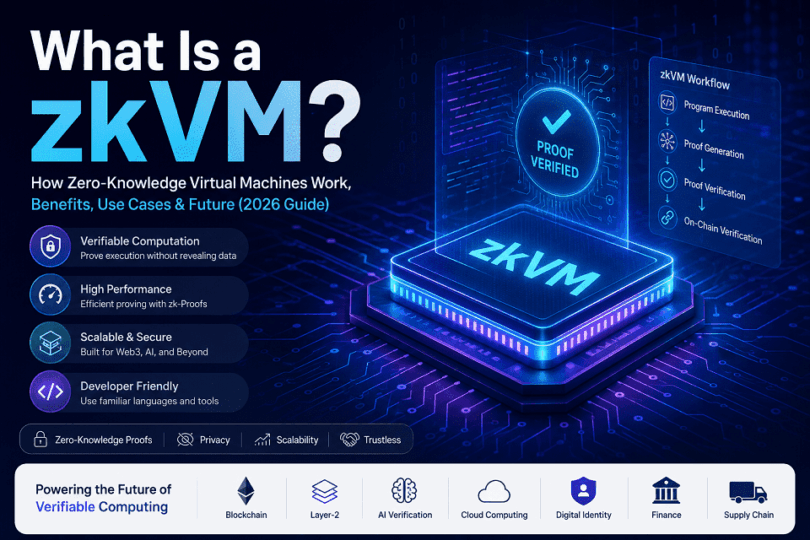

What is a zkVM? Discover how Zero-Knowledge Virtual Machines execute programs, generate cryptographic proofs, and enable secure, scalable, and privacy-preserving computing.
Introduction
Zero-Knowledge technology is changing modern computing. It helps systems prove information without revealing sensitive data. This approach improves privacy, security, and trust.
Early Zero-Knowledge systems verified individual transactions. Today’s applications are far more complex. They execute complete programs, smart contracts, and AI workloads. Verifying these computations efficiently has become a major challenge.
This is where Zero-Knowledge Virtual Machines (zkVMs) come in.
A zkVM executes a program and creates a cryptographic proof. The proof shows the program ran correctly. Anyone can verify the result without repeating the computation. They also do not need to trust the person who executed it.
This capability is transforming blockchain development. It also benefits cloud computing, digital identity, financial services, and artificial intelligence. Developers can build secure applications without designing custom Zero-Knowledge circuits for every project.
Projects such as RISC Zero, SP1, OpenVM, Jolt, and zkSync VM are driving this innovation. They make Zero-Knowledge development more practical. As a result, zkVMs are becoming a key building block for the next generation of Web3 and verifiable computing.
Why zkVMs Are Becoming Important
Modern applications process massive amounts of data every day. Users expect these systems to be secure, private, and trustworthy. At the same time, they also expect them to be fast.
Traditional virtual machines execute programs efficiently. However, they cannot prove that the execution was correct. Other systems must simply trust the result or run the same computation again.
zkVMs solve this problem. They generate mathematical proofs during program execution. These proofs confirm the computation was correct without exposing sensitive information.
This approach reduces trust assumptions. It also improves scalability and lowers verification costs. For these reasons, many blockchain projects are investing heavily in zkVM technology.
The Problem zkVMs Solve
Imagine running a complex program that takes several minutes or even hours to finish. Now imagine asking thousands of computers to verify that the result is correct. Running the entire program again would waste time and computing resources.
zkVMs offer a better solution.
Instead of repeating the computation, they generate a compact cryptographic proof. Other systems only verify the proof. This process is much faster than executing the original program again.
The result is faster verification, lower costs, and greater trust. This makes zkVMs valuable for blockchain networks, AI systems, cloud platforms, and enterprise applications.
What You Will Learn in This Guide
This guide explains zkVMs in simple language. It starts with the basics and gradually explores advanced concepts. Whether you are new to Zero-Knowledge technology or an experienced developer, you will find practical insights throughout the guide.
By the end of this article, you will understand:
- What a zkVM is and how it works.
- Why zkVMs are becoming important.
- How they differ from traditional virtual machines and the Ethereum Virtual Machine (EVM).
- How zkVMs generate and verify cryptographic proofs.
- The leading zkVM projects and development tools.
- Real-world applications across blockchain, AI, cloud computing, and enterprise systems.
- The advantages, limitations, and future of zkVM technology.
- A practical learning roadmap for developers interested in building zkVM-based applications.
By the end of this guide, you will understand why zkVMs are expected to become one of the most important technologies for secure, scalable, and verifiable computing.
TL;DR (Quick Answer)
A Zero-Knowledge Virtual Machine (zkVM) is a virtual machine that executes programs and generates cryptographic proofs. These proofs confirm the computation was correct without revealing sensitive data or repeating the execution.
zkVMs are transforming blockchain and verifiable computing. They make Zero-Knowledge technology easier to use and more practical for developers. Instead of creating custom cryptographic circuits, developers can write programs using familiar programming languages.
The biggest advantage of a zkVM is trustless verification. Anyone can verify the result quickly without rerunning the original program. This improves scalability, reduces verification costs, and strengthens security.
Today, zkVMs power blockchain applications, Layer-2 scaling solutions, artificial intelligence, digital identity, cloud computing, and enterprise systems. They help organizations build secure, privacy-preserving, and verifiable applications.
This guide is ideal for blockchain developers, software engineers, cybersecurity professionals, students, researchers, and anyone interested in Zero-Knowledge technology. By the end of this article, you will understand how zkVMs work, why they matter, and how they are shaping the future of secure computing.
Quick Answer: A zkVM is a Zero-Knowledge Virtual Machine that runs programs and produces cryptographic proofs of correct execution. It enables fast, trustless verification without revealing sensitive information or repeating the computation, making it a key technology for blockchain, AI, and verifiable computing.
This is a great addition near the beginning of your article. It helps readers immediately identify whether the guide matches their needs and can improve engagement.
Who Should Read This Guide?
This guide is designed for anyone who wants to understand Zero-Knowledge Virtual Machines (zkVMs) without getting lost in complex mathematics. Whether you are new to Zero-Knowledge technology or looking to deepen your knowledge, this guide explains each concept in a clear and practical way.
You will benefit from this guide if you belong to any of the following groups.
Blockchain Developers
Learn how zkVMs improve blockchain scalability, privacy, and smart contract verification. Discover how leading platforms use Zero-Knowledge Proofs to build more efficient decentralized applications.
Smart Contract Developers
Understand how zkVMs work with Ethereum-compatible environments, Layer-2 networks, and modern blockchain ecosystems. Learn when to choose a zkVM over a traditional execution environment.
Software Developers
Explore how verifiable computing extends beyond blockchain. Learn how zkVMs can be applied to cloud computing, enterprise software, and secure application development.
AI and Machine Learning Engineers
Discover how zkVMs can verify AI computations without exposing sensitive models or training data. Learn why verifiable AI is becoming an important area of research and development.
Cybersecurity Professionals
Learn how cryptographic proofs strengthen security, improve trust, and verify computations without revealing confidential information.
Students and Researchers
Build a solid understanding of Zero-Knowledge Proofs, zk-SNARKs, zk-STARKs, recursive proofs, and modern zkVM architectures. This guide also introduces the key research concepts shaping the future of verifiable computing.
Technology Enthusiasts
If you are curious about emerging technologies, this guide explains zkVMs in simple language without assuming advanced cryptography knowledge.
Enterprise Architects and Technical Decision-Makers
Understand how zkVMs can improve privacy, compliance, and trusted computation in enterprise environments. Learn where the technology delivers value and where traditional solutions may still be more appropriate.
Who Will Benefit Most?
| Reader | What You’ll Learn |
| Blockchain Developers | zkVM architecture, Layer-2 scaling, and blockchain integration |
| Smart Contract Developers | Ethereum compatibility and Zero-Knowledge execution |
| Software Developers | Verifiable computing and secure application design |
| AI Engineers | AI verification and privacy-preserving computation |
| Cybersecurity Professionals | Cryptographic verification and trusted computing |
| Students and Researchers | Zero-Knowledge fundamentals and advanced concepts |
| Technology Enthusiasts | Beginner-friendly explanation of zkVMs |
| Enterprise Architects | Business use cases, compliance, and adoption strategies |
Key Takeaway
Whether you are building blockchain applications, exploring artificial intelligence, researching cryptography, or simply curious about emerging technologies, this guide provides a step-by-step introduction to zkVMs. It starts with the fundamentals, progresses through architecture and development, and concludes with practical applications, helping readers of all experience levels understand how Zero-Knowledge Virtual Machines are shaping the future of secure and verifiable computing.
zkVM at a Glance
If you are new to Zero-Knowledge Virtual Machines (zkVMs), this table provides a quick overview. It summarizes the most important facts before exploring the technology in detail.
| Feature | Details |
| Full Form | Zero-Knowledge Virtual Machine (zkVM) |
| Purpose | Execute programs and generate cryptographic proofs of correct execution |
| Built On | Zero-Knowledge Proofs (ZKPs), cryptography, and virtual machine architecture |
| Uses Zero-Knowledge Proofs | Yes. Most zkVMs use zk-SNARKs, zk-STARKs, or other advanced proving systems. |
| Programming Languages | Rust, Cairo, C/C++, Noir, Go, Solidity (through integrations), and other supported languages depending on the zkVM |
| Main Applications | Blockchain, Layer-2 rollups, AI verification, cloud computing, digital identity, financial services, gaming, and enterprise applications |
| Popular Projects | RISC Zero, SP1, OpenVM, Jolt, Nexus, zkSync VM, Polygon zkEVM, Valida |
| Core Components | Virtual Machine, Prover, Verifier, Execution Trace, Proof System |
| Key Benefits | Trustless verification, privacy, scalability, lower verification costs, and developer-friendly programming |
| Best For | Blockchain developers, Web3 applications, AI systems, enterprise software, cloud platforms, and verifiable computing |
Quick Summary
A zkVM combines the flexibility of a traditional virtual machine with the security of Zero-Knowledge Proofs. It allows developers to execute programs, generate cryptographic proofs, and verify results without rerunning the original computation. This makes zkVMs a key technology for scalable blockchain networks, privacy-preserving applications, and the future of verifiable computing.
What Is a zkVM?
A Zero-Knowledge Virtual Machine (zkVM) is a virtual machine that executes computer programs and produces cryptographic proofs of correct execution. These proofs allow anyone to verify the result without rerunning the program or trusting the computer that executed it.
Unlike traditional virtual machines, a zkVM does more than process instructions. It also proves that every step of the computation followed the correct rules. This combination of execution and verification makes zkVMs a major breakthrough in modern cryptography.
Today, zkVMs are used in blockchain, Layer-2 scaling, artificial intelligence, cloud computing, and enterprise systems. They help developers build secure, scalable, and privacy-preserving applications while simplifying Zero-Knowledge development.
Simple Definition of zkVM
In simple terms, a zkVM is a computer that can prove its work.
Imagine solving a difficult math problem. Instead of asking someone to solve it again, you show them a certificate proving your answer is correct. They can verify the certificate in seconds without repeating the calculation.
A zkVM works in a similar way.
It runs a program, performs the required computation, and creates a cryptographic proof. Anyone can verify this proof quickly. They do not need to rerun the program or trust the original computer.
This ability saves time, reduces computing costs, and improves trust between systems.
Definition in Blockchain
In blockchain, a zkVM is a specialized virtual machine that executes smart contracts or programs and generates a Zero-Knowledge Proof of correct execution.
Traditional blockchain networks require many nodes to repeat the same computation. This process ensures trust but consumes significant computing power and network resources.
A zkVM changes this model.
Only one system executes the program. It then generates a cryptographic proof that confirms the execution was correct. Other nodes verify the proof instead of repeating the entire computation.
This approach reduces network workload, lowers transaction costs, and improves blockchain scalability. It is one of the key technologies behind modern Layer-2 scaling solutions and verifiable blockchain applications.
Definition in Cryptography
In cryptography, a zkVM is a proving system that combines program execution with Zero-Knowledge Proofs.
It allows a prover to demonstrate that a computation followed the correct steps without revealing sensitive data or repeating the computation.
The proof confirms the integrity of the execution while protecting confidential information. The verifier learns only that the program produced a valid result. No additional information about the underlying data is exposed.
Because of this property, zkVMs are becoming an important building block for privacy-preserving computing, secure verification, and trustless systems.
Why Is It Called a Zero-Knowledge Virtual Machine?
The name Zero-Knowledge Virtual Machine describes exactly what the technology does.
The “Virtual Machine” part refers to a software environment that executes computer programs. Like other virtual machines, a zkVM processes instructions, manages memory, and produces program outputs.
The “Zero-Knowledge” part comes from Zero-Knowledge Proofs. After executing a program, the zkVM generates a proof showing the computation was correct. This proof does not reveal the program’s private data, intermediate calculations, or confidential inputs.
Together, these two technologies create a system that can both execute and prove computations.
This is what makes zkVMs different from traditional virtual machines. They do not simply run programs. They also produce mathematical proof that anyone can verify quickly and securely.
Key Takeaway
A zkVM combines the flexibility of a traditional virtual machine with the security of Zero-Knowledge Proofs. It executes programs, generates cryptographic proofs, and enables fast verification without exposing sensitive information or repeating the original computation. This capability is driving the next generation of blockchain, AI, and verifiable computing applications.
Why Do We Need zkVMs?
Modern applications handle massive amounts of data every second. They process financial transactions, execute smart contracts, train AI models, and manage digital identities. Users expect these systems to be fast, secure, and trustworthy.
Traditional computing performs these tasks efficiently. However, it cannot easily prove that every computation was executed correctly. In many cases, users must simply trust the computer or verify the work themselves.
As digital systems become more complex, trust alone is no longer enough. Organizations need a reliable way to verify computations without exposing sensitive data or repeating expensive processing.
This is the challenge that Zero-Knowledge Virtual Machines (zkVMs) are designed to solve.
Limitations of Traditional Virtual Machines
Traditional virtual machines execute programs accurately and efficiently. They power cloud platforms, enterprise software, and blockchain networks. However, they were never designed to generate cryptographic proof of correct execution.
When a virtual machine finishes a program, it produces only the final result. It cannot mathematically prove that every instruction was executed correctly.
If another system wants to verify the result, it often has only two choices. It must either trust the original computer or execute the same program again.
Both approaches have drawbacks. Blind trust creates security risks. Repeating complex computations wastes time, computing power, and energy.
These limitations become more serious as applications grow larger and more distributed.
The Verification Problem
Verification is one of the biggest challenges in modern computing.
Imagine a blockchain transaction that requires thousands of calculations. Every participating node may need to execute the same computation before accepting the result. This process ensures trust, but it also slows the network.
The same challenge appears in cloud computing and artificial intelligence. Verifying large computations often requires significant processing power and time.
As applications continue to grow, repeating every computation becomes increasingly inefficient. The cost of verification can eventually exceed the cost of the original computation.
Modern systems need a faster and more scalable approach.
How zkVMs Solve Trust Issues
A zkVM changes the way verification works.
Instead of asking every system to rerun a program, the zkVM executes it only once. It then generates a cryptographic proof of correct execution.
Other systems verify the proof instead of repeating the computation. This process takes only a fraction of the time and computing resources.
The proof also removes the need to trust the original computer. If the proof is valid, the computation was performed correctly. Sensitive data remains private throughout the verification process.
This trustless model makes zkVMs ideal for blockchain networks, cloud platforms, enterprise applications, and other distributed systems.
Why Developers Are Adopting zkVMs
Developers want to build secure applications without unnecessary complexity.
Traditional Zero-Knowledge development often requires creating custom cryptographic circuits. This process demands specialized knowledge and can significantly increase development time.
zkVMs simplify this workflow. Developers can write programs using familiar programming languages while the zkVM automatically generates the required cryptographic proofs.
This approach improves productivity and reduces development costs. It also lowers the barrier to building privacy-preserving applications.
As a result, many organizations are adopting zkVMs for blockchain scaling, AI verification, cloud computing, digital identity, financial services, and enterprise software.
The growing ecosystem of projects such as RISC Zero, SP1, OpenVM, Jolt, and zkSync VM demonstrates that zkVMs are becoming a practical foundation for the next generation of verifiable computing.
Key Takeaway
Traditional virtual machines execute programs but cannot prove their correctness. zkVMs solve this limitation by combining program execution with cryptographic proof generation. They enable fast, trustless verification while reducing computation costs and protecting sensitive information. This makes them a critical technology for modern blockchain, AI, cloud, and enterprise applications.
History of zkVMs
The idea behind zkVMs did not appear overnight. It evolved through decades of research in computer science, cryptography, and blockchain technology.
Traditional virtual machines made software portable and efficient. Zero-Knowledge Proofs later introduced a new way to verify computations without revealing private information. As blockchain networks grew, developers combined these ideas to create Zero-Knowledge Virtual Machines.
Today, zkVMs are helping developers build secure, scalable, and verifiable applications. Understanding their history makes it easier to appreciate why they have become one of the most exciting innovations in modern computing.
Early Virtual Machines
Virtual machines have existed for several decades. They were created to run software independently of the underlying hardware. This allowed developers to write a program once and run it on different computers.
Some of the earliest virtual machines appeared in the 1960s. Later, technologies such as the Java Virtual Machine (JVM) and the .NET Common Language Runtime (CLR) made virtual machines popular for modern software development.
Blockchain introduced another important virtual machine. The Ethereum Virtual Machine (EVM) enabled developers to execute smart contracts on decentralized networks. However, these virtual machines focused on execution. They did not generate cryptographic proofs of correct execution.
This limitation eventually inspired a new generation of virtual machines.
Rise of Zero-Knowledge Proofs
A major breakthrough came in 1985, when researchers introduced the concept of Zero-Knowledge Proofs (ZKPs). This cryptographic technique allowed one party to prove a statement without revealing the underlying information.
For many years, Zero-Knowledge Proofs remained largely academic. They were mathematically powerful but difficult to use in real-world applications.
The situation changed as blockchain technology matured. Researchers developed practical proving systems such as zk-SNARKs and zk-STARKs. These advances made Zero-Knowledge technology faster, more efficient, and suitable for large-scale applications.
Developers soon realized that these proof systems could verify not only transactions but also complete program executions.
Evolution of zkVMs
The next challenge was simplifying Zero-Knowledge development.
Early applications often required developers to build custom arithmetic circuits for every program. This approach worked, but it demanded deep cryptographic expertise and significant development time.
zkVMs changed this workflow.
Instead of designing custom circuits, developers could write ordinary programs using familiar programming languages. The zkVM handled execution, generated the execution trace, and automatically produced the required cryptographic proof.
This innovation made Zero-Knowledge development more practical and accessible. It also encouraged wider adoption across blockchain, cloud computing, artificial intelligence, and enterprise software.
Modern zkVM Ecosystem
The zkVM ecosystem is growing rapidly. Several projects are building virtual machines for different performance goals, programming models, and blockchain environments.
Projects such as RISC Zero, SP1, OpenVM, Jolt, Valida, Nexus, zkSync VM, and Polygon zkEVM continue to expand the ecosystem. Each project explores different approaches to performance, proof generation, developer experience, and scalability.
Today, zkVMs are no longer limited to blockchain research. They support Layer-2 scaling, verifiable cloud computing, artificial intelligence, digital identity, and enterprise applications.
As Zero-Knowledge technology continues to evolve, zkVMs are expected to become a core component of secure and trustworthy computing. Their growing adoption shows that the industry is moving toward systems where computations are not only executed but also mathematically verified.
Key Takeaway
The history of zkVMs reflects the convergence of three major technologies: virtual machines, Zero-Knowledge Proofs, and blockchain. Traditional virtual machines made software portable, Zero-Knowledge Proofs enabled trustless verification, and blockchain created the demand for scalable verification. Together, they gave rise to zkVMs, which are now shaping the future of verifiable computing.
Quick Timeline
The journey to Zero-Knowledge Virtual Machines (zkVMs) spans several decades. Each milestone solved a different challenge in computing, cryptography, or blockchain. Together, these innovations made modern zkVMs possible.
| Year | Milestone | Why It Matters |
| 1985 | Zero-Knowledge Proofs Introduced | Researchers proposed Zero-Knowledge Proofs, allowing one party to prove information without revealing it. This became the foundation of modern zkVMs. |
| 2009 | Bitcoin Launched | Bitcoin introduced decentralized digital money and proved that trustless systems could work at a global scale. |
| 2015 | Ethereum and the EVM | Ethereum introduced the Ethereum Virtual Machine (EVM), enabling smart contracts and decentralized applications. |
| 2016 | zk-SNARKs Enter Production | Projects like Zcash demonstrated that practical Zero-Knowledge Proofs could protect privacy while verifying transactions efficiently. |
| 2018 | zk-STARKs Introduced | zk-STARKs improved scalability, transparency, and resistance to future quantum attacks without requiring a trusted setup. |
| 2019–2022 | Rise of zk-Rollups | Ethereum Layer-2 solutions adopted Zero-Knowledge technology to increase transaction throughput and reduce fees. |
| 2022–2024 | Modern zkVMs Emerge | Projects such as RISC Zero, zkSync VM, SP1, OpenVM, and Jolt introduced general-purpose Zero-Knowledge Virtual Machines for broader software development. |
| Present | Rapid Ecosystem Growth | zkVMs are expanding into blockchain, artificial intelligence, cloud computing, enterprise software, and verifiable computing. |
Timeline Summary
The evolution of zkVMs did not happen in a single step. It began with Zero-Knowledge Proofs in 1985 and gained momentum through Bitcoin, Ethereum, zk-SNARKs, and zk-STARKs. The success of zk-Rollups then created demand for more flexible proving systems. Today, zkVMs combine these innovations to deliver secure, scalable, and verifiable computing across many industries.
Key Insight: Every milestone solved a different problem. Together, they laid the foundation for today’s Zero-Knowledge Virtual Machines, one of the fastest-growing technologies in blockchain and verifiable computing.
How Does a zkVM Work?
A Zero-Knowledge Virtual Machine (zkVM) follows a different workflow from a traditional virtual machine. It does more than execute a program. It also creates mathematical proof that the execution was correct.

This process makes verification fast, secure, and trustless.
Program Execution
Every zkVM begins by executing a program.
The program receives one or more inputs. These inputs may include transaction data, user information, or smart contract instructions. The zkVM processes the program just like a traditional virtual machine.
During execution, the zkVM performs arithmetic operations, memory access, logical decisions, and other instructions. The program eventually produces one or more outputs.
Unlike a traditional virtual machine, the zkVM does not stop here. It also records how every instruction was executed.
This execution record becomes the foundation for the next stage.
Instruction Processing
Every program contains thousands or even millions of instructions.
The zkVM processes these instructions one by one. It updates registers, memory, and program state after each operation. Every change is carefully recorded.
This detailed record is known as the execution trace.
The execution trace describes exactly how the program reached its final result. It acts like a digital logbook of the entire computation.
Instead of trusting the computer, other systems can later verify this execution using cryptographic proof.
Proof Generation
After execution finishes, the zkVM begins creating a cryptographic proof.
It converts the execution trace into mathematical constraints. These constraints describe the rules that every instruction must follow.
The proving system then checks that every constraint is satisfied.
If everything is correct, the zkVM generates a compact Zero-Knowledge Proof.
This proof confirms that the computation followed the correct rules. It does not reveal private inputs or intermediate calculations.
Different zkVMs may use different proving systems. Some use zk-SNARKs, while others use zk-STARKs or newer proving technologies.
Proof Verification
Once the proof is generated, anyone can verify it.
The verifier does not execute the original program. Instead, it checks the mathematical proof produced by the zkVM.
Verification is usually much faster than running the program again. It also requires fewer computing resources.
If the proof is valid, the verifier accepts the result with high confidence. If the proof fails, the computation is rejected.
This process removes the need to trust the computer that generated the proof.
Final Verification on Blockchain
Many zkVMs are designed for blockchain applications.
After generating the proof, the zkVM submits it to a blockchain network. A smart contract or verification program checks the proof before accepting the computation.
The blockchain does not execute the original program again. It only verifies the proof.
This approach significantly reduces network workload. It also lowers transaction costs and improves scalability.
Because the proof is compact, verification remains fast even for complex computations.
This capability makes zkVMs ideal for Layer-2 rollups, decentralized applications, cross-chain systems, and other blockchain solutions that require secure and efficient verification.
Key Takeaway
A zkVM follows a five-step workflow. It executes a program, processes every instruction, records an execution trace, generates a cryptographic proof, and verifies that proof on or off the blockchain. This process enables fast, trustless verification while protecting sensitive information and reducing computational costs.
zkVM Architecture
A zkVM combines several components to execute programs and generate cryptographic proofs. Each component has a specific role. Together, they create a secure and verifiable computing environment.
Unlike a traditional virtual machine, a zkVM includes proving and verification mechanisms. These components ensure that every computation can be verified without repeating the original execution.
Understanding the architecture helps developers see how zkVMs deliver both execution and trustless verification.
Execution Layer
The Execution Layer is the engine of a zkVM. It runs the program exactly as a traditional virtual machine would.
The execution layer receives the program and its inputs. It processes every instruction in the correct order. During execution, it updates memory, registers, and the program state.
At the same time, the execution layer records every important operation. These records form the execution trace, which becomes the basis for proof generation.
Because the execution layer behaves like a normal computer, developers can write programs using familiar programming languages. The zkVM handles the proving process behind the scenes.
Prover
The Prover is one of the most important parts of a zkVM.
Its job is to generate a cryptographic proof after the program finishes running. Instead of proving only the final result, the prover demonstrates that every instruction followed the correct rules.
To create the proof, the prover analyzes the execution trace. It converts the recorded operations into mathematical constraints. It then produces a compact proof that represents the entire computation.
Proof generation usually requires more computing power than verification. However, it only happens once for each execution.
The resulting proof is much smaller than the original computation. This makes it efficient to share and verify.
Verifier
The Verifier checks whether the proof is valid.
Unlike the prover, the verifier does not execute the program again. It only examines the cryptographic proof produced by the prover.
If the proof satisfies all verification rules, the verifier accepts the computation as correct. If the proof is invalid, the computation is rejected.
Verification is usually very fast. Even large computations can often be verified in seconds. This efficiency makes zkVMs practical for blockchain networks and distributed systems.
Proof System
The Proof System is the cryptographic foundation of a zkVM.
It defines how proofs are generated and verified. Different zkVMs use different proving technologies depending on their design goals.
Some zkVMs rely on zk-SNARKs because they produce compact proofs and support fast verification. Others use zk-STARKs, which remove the need for a trusted setup and offer strong scalability. Newer systems may use advanced proving techniques such as PLONK, Halo2, or folding schemes.
The proof system directly affects performance, proof size, security, and verification speed. Choosing the right proving system is one of the most important design decisions for any zkVM.
Storage Layer
The Storage Layer manages the information required during program execution.
It stores program code, input data, memory values, execution states, and other resources needed by the zkVM.
During execution, the storage layer records state changes without exposing sensitive information. This information supports the execution trace while maintaining data integrity.
Some zkVMs also optimize storage to reduce proof generation costs and improve overall performance. Efficient storage management becomes especially important when processing large datasets or complex blockchain applications.
Together with the execution layer, prover, verifier, and proof system, the storage layer completes the zkVM architecture.
Key Takeaway
A zkVM consists of five core components: the Execution Layer, Prover, Verifier, Proof System, and Storage Layer. The execution layer runs programs, the prover generates cryptographic proofs, the verifier checks those proofs, the proof system defines the verification method, and the storage layer manages execution data. Together, these components enable secure, scalable, and trustless computing.
zkVM Workflow Explained
A zkVM follows a structured workflow to execute and verify computations. Each stage builds on the previous one. Together, they create a secure and trustless verification process.

Let us examine each stage in detail.
Input
Every computation begins with an input.
The input may include user data, transaction details, smart contract instructions, or application data. It also includes the program that the zkVM must execute.
The zkVM loads both the program and its inputs into memory. It then prepares the execution environment.
Once everything is ready, the computation begins.
Execution
The zkVM executes the program instruction by instruction.
It performs arithmetic operations, logical decisions, memory updates, and data processing. Every instruction follows predefined execution rules.
During execution, the zkVM continuously updates the program state. It also records important information needed for later verification.
Unlike a traditional virtual machine, execution is only the first step.
Trace Generation
As the program runs, the zkVM creates an execution trace.
The execution trace records every important state change. It captures memory updates, register values, executed instructions, and intermediate results.
Think of the execution trace as a detailed activity log. It shows exactly how the program reached its final output.
This trace becomes the foundation for cryptographic proof generation.
Proof Creation
After execution finishes, the zkVM creates a mathematical proof.
The proving system analyzes the execution trace. It checks that every instruction followed the correct rules.
If the computation is valid, the prover generates a compact Zero-Knowledge Proof.
The proof confirms that the program executed correctly. It does not reveal private inputs or confidential information.
Instead of sharing the complete execution trace, the zkVM only shares the proof.
Proof Verification
The proof is then sent to a verifier.
The verifier checks the mathematical validity of the proof. It does not execute the original program again.
Verification usually takes much less time than execution. This makes the process highly efficient.
If the proof passes verification, the computation is accepted. Otherwise, it is rejected.
This trustless approach removes the need to rely on the original computer.
Result
After successful verification, the result becomes trustworthy.
The blockchain, application, or external system accepts the output. Other participants can rely on the verified result without repeating the computation.
This process reduces computing costs and improves scalability. It also strengthens security because every accepted result has cryptographic proof.
The same workflow supports blockchain transactions, AI computations, cloud services, digital identity, and enterprise applications.
Workflow Summary
The complete zkVM workflow follows these six stages:
Input → Execution → Trace Generation → Proof Creation → Proof Verification → Verified Result
Each stage plays an important role. Together, they enable secure, scalable, and verifiable computing without exposing sensitive information.
Key Takeaway
A zkVM transforms a normal program into a verifiable computation. It accepts program inputs, executes the code, records an execution trace, generates a cryptographic proof, verifies that proof, and delivers a trusted result. This workflow makes zkVMs ideal for blockchain, cloud computing, artificial intelligence, and other systems that require efficient and trustless verification.
Traditional VM vs zkVM
A traditional virtual machine (VM) executes programs and produces results. A Zero-Knowledge Virtual Machine (zkVM) does much more. It executes the same programs while also generating cryptographic proof of correct execution.
Both technologies run software in a virtual environment. However, they solve different problems. Traditional VMs focus on execution. zkVMs focus on execution and trustless verification.
The following comparison highlights the major differences.
| Feature | Traditional VM | zkVM |
| Primary Purpose | Execute programs | Execute programs and generate cryptographic proofs |
| Trust Model | Trust the executing system | Verify mathematically without trust |
| Proof Generation | Not supported | Built into the execution process |
| Verification | Requires rerunning the program or trusting the result | Verifies using a compact cryptographic proof |
| Privacy | Does not protect computation details | Supports privacy through Zero-Knowledge Proofs |
| Scalability | Limited by repeated execution | Improved through efficient verification |
| Blockchain Support | Limited | Designed for blockchain and verifiable computing |
| Typical Use Cases | Desktop software, cloud services, enterprise applications | Blockchain, Layer-2 rollups, AI, cloud verification, digital identity |
Trust Model
Traditional virtual machines depend on trust.
When a VM finishes a program, other systems usually trust the result. If they need certainty, they must execute the same program again.
A zkVM removes this trust requirement.
It generates a mathematical proof for every computation. Anyone can verify the proof without relying on the original computer.
This trustless model is one of the biggest advantages of zkVM technology.
Verification
Verification works very differently in the two systems.
A traditional VM produces only the final output. It does not explain how the result was obtained.
A zkVM produces both the result and a cryptographic proof. The proof confirms that every instruction followed the correct execution rules.
Instead of repeating the computation, other systems simply verify the proof.
This approach saves both time and computing resources.
Performance
Traditional virtual machines execute programs efficiently. However, verification becomes expensive when many systems repeat the same computation.
A zkVM introduces additional work during proof generation. Creating a cryptographic proof requires extra processing power.
Once the proof is created, verification becomes extremely fast.
For distributed systems such as blockchains, this trade-off often improves overall performance and scalability.
Security
Security depends on different principles.
Traditional VMs rely on operating system security, application security, and access controls. These protections are important but cannot mathematically prove that a computation was correct.
zkVMs add an additional security layer.
Every accepted computation includes a cryptographic proof. If someone modifies the execution or changes the result, verification fails.
This mathematical verification significantly reduces the need for trust.
Privacy
Traditional virtual machines execute programs without protecting computation details.
If another system wants to verify the execution, it may need access to program data or internal processing steps.
A zkVM works differently.
It proves the computation was correct without revealing sensitive inputs or confidential information.
This privacy-preserving capability makes zkVMs suitable for financial systems, healthcare, digital identity, blockchain, and enterprise applications.
Key Takeaway
Traditional virtual machines focus on executing programs. zkVMs execute programs and generate cryptographic proofs of correct execution. This additional capability enables trustless verification, stronger security, better privacy, and improved scalability for modern distributed applications.
zkVM vs Ethereum Virtual Machine (EVM)
The Ethereum Virtual Machine (EVM) is the execution engine behind Ethereum. It processes smart contracts and keeps every node synchronized. For years, it has been the foundation of decentralized applications.
A Zero-Knowledge Virtual Machine (zkVM) builds on a different idea. It executes programs and generates cryptographic proofs of correct execution. These proofs allow other systems to verify the computation without repeating it.
Although both technologies execute code, they serve different purposes. The EVM focuses on decentralized execution, while a zkVM focuses on execution and verifiable computation.
The table below highlights their main differences.
| Feature | Ethereum Virtual Machine (EVM) | zkVM |
| Primary Purpose | Execute Ethereum smart contracts | Execute programs and generate cryptographic proofs |
| Verification | Every node re-executes transactions | Proof verifies the computation |
| Trust Model | Network consensus | Cryptographic verification |
| Programming Support | Solidity, Vyper | Rust, Cairo, C/C++, Noir and others |
| Gas Consumption | Higher due to repeated execution | Lower verification costs after proof generation |
| Privacy | Public by default | Supports privacy-preserving computation |
| Scalability | Limited by network execution | Designed for efficient verification |
| Typical Use Cases | Smart contracts and dApps | Rollups, AI, cloud verification, enterprise applications |
Architecture
The EVM is designed specifically for Ethereum. It executes smart contracts inside every Ethereum node. Every node follows the same execution rules to maintain network consensus.
A zkVM has a broader architecture. It includes an execution engine, a prover, a verifier, and a proof system. These components work together to execute programs and generate cryptographic proofs.
The EVM focuses on decentralized execution. A zkVM focuses on decentralized verification.
Execution
The EVM executes every transaction on multiple blockchain nodes. This repeated execution helps maintain trust across the network.
A zkVM usually executes the program once. After execution, it generates a cryptographic proof.
Other systems verify the proof instead of repeating the computation. This approach reduces unnecessary processing while preserving trust.
Security
The EVM relies on blockchain consensus for security. Every node independently verifies the transaction by executing it.
A zkVM adds another layer of protection. It uses mathematical proofs to confirm that the computation followed the correct rules.
Even if the executing system is untrusted, a valid proof guarantees the computation was performed correctly.
This cryptographic approach strengthens trust while reducing verification work.
Gas Costs
Gas fees are an important part of Ethereum.
Every instruction executed by the EVM consumes gas. Complex smart contracts require more computation and therefore higher transaction fees.
A zkVM also requires computation to generate proofs. However, verification is much cheaper than executing the entire program repeatedly.
Many Layer-2 solutions use zkVM technology to reduce overall transaction costs while maintaining Ethereum’s security.
Scalability
Scalability remains one of Ethereum’s biggest challenges.
As network activity grows, every node must execute more transactions. This limits throughput and increases congestion.
zkVMs improve scalability by separating execution from verification.
The computation runs once. The resulting proof is then verified by other participants. This approach significantly reduces network workload and enables much higher transaction throughput.
Developer Experience
The EVM primarily supports Solidity and Vyper for smart contract development. Developers often need to optimize code carefully to reduce gas costs.
Many zkVMs support familiar programming languages such as Rust, C/C++, Cairo, and Noir. Some platforms also provide tools for integrating existing applications.
Developers can often write standard programs while the zkVM handles proof generation automatically.
This reduces development complexity and makes Zero-Knowledge technology more accessible.
Key Takeaway
The Ethereum Virtual Machine and zkVM both execute programs, but they solve different problems. The EVM enables decentralized smart contracts through repeated execution, while a zkVM combines execution with cryptographic proof generation. This allows fast, trustless verification, improved scalability, lower verification costs, and stronger privacy for modern blockchain applications.
zkVM vs zk-Rollups
The terms zkVM and zk-Rollup are often used together. However, they are not the same technology.
A zkVM is a computing platform. It executes programs and generates cryptographic proofs of correct execution.
A zk-Rollup is a blockchain scaling solution. It processes many transactions off-chain and submits a cryptographic proof to the blockchain.
In simple words, a zkVM is a technology, while a zk-Rollup is an application that may use zkVM technology.
The comparison below explains the differences.
| Feature | zkVM | zk-Rollup |
| Primary Purpose | Execute programs and generate proofs | Scale blockchain transactions |
| Core Function | Verifiable program execution | Batch and verify transactions |
| Built On | Zero-Knowledge Proofs | Zero-Knowledge Proofs, blockchain, and rollup architecture |
| Focus | Computing and proof generation | Blockchain scalability |
| Proof Generation | Yes | Yes |
| Transaction Processing | Optional | Core functionality |
| Typical Users | Developers building applications | Blockchain networks and Layer-2 platforms |
| Examples | RISC Zero, SP1, OpenVM, Jolt | zkSync Era, Polygon zkEVM, Scroll, Linea |
Purpose
A zkVM focuses on executing programs correctly.
It runs software and produces a cryptographic proof for every computation. The proof confirms that the execution followed the correct rules.
A zk-Rollup has a different purpose.
Its main goal is to improve blockchain scalability. It processes many transactions outside the main blockchain and combines them into a single proof.
Although both use Zero-Knowledge Proofs, they solve different problems.
Architecture
A zkVM contains an execution engine, a prover, a verifier, and a proof system. These components work together to execute programs and create mathematical proofs.
A zk-Rollup includes additional blockchain components. It manages transaction batching, state updates, data availability, proof submission, and communication with the Layer-1 blockchain.
Many modern zk-Rollups use zkVM technology as part of their architecture. However, the rollup also includes several blockchain-specific systems that a standalone zkVM does not require.
Performance
A zkVM improves verification efficiency.
It executes a program once and produces a compact proof. Other systems verify the proof instead of repeating the computation.
A zk-Rollup improves blockchain throughput.
It combines hundreds or even thousands of transactions into one proof. This reduces congestion and lowers transaction costs on the main blockchain.
Together, these technologies improve both computation and scalability.
Use Cases
A zkVM supports many types of applications.
Developers use it for blockchain software, artificial intelligence, cloud computing, digital identity, gaming, and enterprise systems.
A zk-Rollup focuses mainly on blockchain scaling.
It powers decentralized exchanges, payment systems, NFT platforms, gaming networks, and other high-transaction blockchain applications.
As Zero-Knowledge technology continues to evolve, zkVMs and zk-Rollups increasingly work together. zkVMs provide efficient proof generation, while zk-Rollups use those proofs to scale blockchain networks.
Key Takeaway
A zkVM and a zk-Rollup are complementary technologies, not competing ones. A zkVM executes programs and generates cryptographic proofs, while a zk-Rollup uses those proofs to process large numbers of blockchain transactions efficiently. Many modern Layer-2 solutions combine both technologies to achieve better scalability, lower costs, and stronger security.
Core Components of a zkVM
A Zero-Knowledge Virtual Machine (zkVM) is more than a program execution engine. It combines several components that work together to execute code and generate cryptographic proofs.
Each component performs a specific task. Some execute instructions, while others store data or track the program’s state. Together, they ensure that every computation is accurate, verifiable, and secure.
Understanding these core components makes it easier to see how a zkVM produces trusted results.
CPU Model
The CPU Model acts as the brain of a zkVM. It defines how the virtual machine processes instructions during program execution.
Like a physical processor, the CPU model performs arithmetic operations, logical calculations, comparisons, and data movement. It follows a predefined instruction set to ensure every operation behaves consistently.
Every instruction executed by the CPU model becomes part of the execution trace. This trace later helps generate a cryptographic proof of correct execution.
Different zkVMs may use different CPU models. Many modern projects are based on the RISC-V instruction set because it is simple, open, and well suited for verifiable computing. Other zkVMs may use custom architectures designed for specific performance or scalability goals.
The CPU model provides predictable execution, making it easier to verify every computation mathematically.
Memory
The Memory component stores the information a program needs while it runs.
It holds program instructions, input data, temporary values, and execution results. As the program progresses, the zkVM continuously reads from memory and writes new values back to it.
Every memory update becomes part of the execution trace. The proving system later checks these changes to ensure they followed the correct rules.
Unlike traditional computers, a zkVM must not only manage memory efficiently but also prove that every memory operation was valid. This requirement makes memory management a critical part of the proving process.
Efficient memory handling improves proof generation speed and reduces computational overhead, especially for large programs.
Registers
Registers are small, high-speed storage locations inside the zkVM’s CPU model.
They temporarily hold values that the processor uses during execution. Storing frequently used data in registers allows instructions to execute much faster than repeatedly accessing memory.
A zkVM updates register values as each instruction runs. These updates are also recorded in the execution trace.
During proof generation, the proving system verifies that every register change followed the correct execution rules. If an invalid update occurs, the proof cannot be generated successfully.
Although registers store only a small amount of data, they play an essential role in maintaining fast and accurate program execution.
Perfect. These are the remaining core components of a zkVM. We’ll continue with the same writing style and avoid repeating concepts we’ve already explained.
Instruction Set
An Instruction Set is the collection of operations that a zkVM can execute.
Every program is made up of instructions. These instructions tell the virtual machine what to do. They may perform arithmetic calculations, move data, compare values, or control the flow of the program.
The zkVM reads each instruction one by one. It then executes the required operation according to predefined rules.
Most modern zkVMs use the RISC-V instruction set because it is open, simple, and efficient. Its clean design makes it easier to generate and verify cryptographic proofs.
Some zkVMs also use custom instruction sets. These are optimized for specific applications or performance goals.
Regardless of the instruction set, every executed instruction becomes part of the computation that the proving system later verifies.
Execution Trace
The Execution Trace is a complete record of how a program runs inside a zkVM.
It captures every important step of the computation. This includes executed instructions, memory updates, register values, and changes to the program state.
Think of the execution trace as a detailed logbook. It records exactly how the program reached its final result.
The proving system uses this trace to generate a cryptographic proof. If the trace contains an invalid operation, the proof cannot be created successfully.
The execution trace is one of the most important components of a zkVM. Without it, the system cannot prove that the computation was performed correctly.
Constraint System
A Constraint System converts program execution into mathematical rules.
Every instruction executed by the zkVM must satisfy these rules. They describe what a valid computation should look like.
During proof generation, the proving system checks every constraint against the execution trace.
If all constraints are satisfied, the computation is considered valid. If even one constraint fails, proof generation stops.
This mathematical approach removes ambiguity from verification. Instead of trusting software, the verifier relies on mathematical correctness.
Constraint systems form the foundation of many Zero-Knowledge proving technologies, including zk-SNARKs and zk-STARKs.
Proof System
The Proof System is the cryptographic engine of a zkVM.
It takes the execution trace and constraint system as inputs. It then generates a compact proof that represents the entire computation.
Different zkVMs use different proof systems. The choice depends on factors such as proof size, proving speed, verification time, scalability, and security.
Many zkVMs use zk-SNARKs because they produce small proofs and support fast verification. Others use zk-STARKs, which eliminate the need for a trusted setup and provide strong scalability. Some newer zkVMs also use advanced proving systems such as PLONK, Halo2, or folding schemes.
Regardless of the proving technology, the goal remains the same. The proof system enables anyone to verify a computation quickly without repeating the original program.
The Instruction Set, Execution Trace, Constraint System, and Proof System complete the internal architecture of a zkVM. The instruction set defines how programs execute, the execution trace records every step, the constraint system converts execution into mathematical rules, and the proof system generates the cryptographic proof. Together, these components make secure and trustless verification possible.
Proof Generation Explained
One of the biggest strengths of a zkVM is its ability to generate cryptographic proofs automatically. Instead of asking others to rerun a program, the zkVM creates proof that the computation was performed correctly.
Proof generation happens after program execution. It uses information collected during execution and converts it into mathematical evidence. This evidence allows anyone to verify the computation without repeating the original work.
The process involves several important stages. Each stage contributes to creating a secure and verifiable proof.
Execution Trace
The first step is creating the execution trace.
As the program runs, the zkVM records every important operation. It logs executed instructions, memory changes, register updates, and program state transitions.
This record provides a complete history of the computation. It shows exactly how the program reached its final output.
The execution trace serves as the primary input for the proving system. Without it, the zkVM cannot prove that the computation followed the correct rules.
You can think of the execution trace as a detailed audit log. Every important action is recorded and becomes available for verification.
Witness Generation
The next step is witness generation.
A witness contains the internal values produced during program execution. These values include intermediate calculations, temporary variables, and other information needed to prove correctness.
Unlike the final output, the witness is not shared with the verifier. It remains private during the proving process.
The proving system uses the witness together with the execution trace. These two inputs provide enough information to construct a valid cryptographic proof.
The witness plays a critical role because it demonstrates that every computation satisfies the required mathematical rules.
Constraint Satisfaction
Once the witness is prepared, the zkVM checks the computation against a constraint system.
A constraint is a mathematical rule that every valid computation must satisfy. These rules describe how instructions should behave and how data should change during execution.
The proving system evaluates every step recorded in the execution trace. It confirms that all constraints are satisfied.
If every rule is met, the computation is considered valid.
If even one constraint fails, proof generation stops. No valid proof can be produced for an incorrect computation.
This strict verification process ensures the integrity of every executed program.
Proof Construction
The final stage is proof construction.
After validating the execution trace and witness, the proving system generates a compact cryptographic proof.
The proof represents the entire computation in a small mathematical object. Although the original program may contain millions of instructions, the proof remains relatively compact.
This proof does not reveal confidential information or intermediate calculations. It only demonstrates that the computation was performed correctly.
The completed proof is then sent to a verifier. The verifier can confirm its validity within seconds without rerunning the original program.
This capability makes zkVMs highly efficient for blockchain, cloud computing, artificial intelligence, and other applications that require trustworthy verification.
Key Takeaway
Proof generation transforms a program execution into a cryptographic proof. The zkVM records an execution trace, generates a witness, checks mathematical constraints, and constructs a compact proof. This proof allows anyone to verify the computation quickly without accessing sensitive information or repeating the original execution.
Proof Verification Explained
Generating a proof is only half the process. The next step is proof verification.
Verification confirms that the proof is valid. It ensures the program executed correctly and followed every required rule.
Unlike traditional verification, a zkVM does not rerun the original program. Instead, it checks the cryptographic proof generated during execution.
This approach saves time, reduces computing costs, and improves scalability.
What Gets Verified?
The verifier does not inspect the entire program.
Instead, it verifies the cryptographic proof produced by the zkVM. This proof represents the complete computation in a compact mathematical form.
During verification, the verifier checks whether the proof satisfies the required cryptographic rules. It also confirms that the proof matches the expected program and its public inputs.
If every check succeeds, the computation is accepted as valid.
The verifier never sees confidential inputs, intermediate calculations, or private program data. It only confirms that the computation was performed correctly.
This makes verification both secure and privacy-preserving.
Why Verification Is Fast
One of the biggest advantages of a zkVM is fast verification.
Running a large program may take several seconds or even minutes. Verifying the proof usually takes only a fraction of that time.
The verifier does not repeat every instruction. It simply checks the mathematical proof generated by the proving system.
Because the proof is compact, verification requires very little computing power. This efficiency makes zkVMs practical for blockchain networks and distributed applications.
Although proof generation can be computationally intensive, verification remains lightweight. This balance allows complex computations to be verified quickly by many participants.
On-Chain Verification
Many zkVMs are designed for blockchain applications.
After generating the proof, the prover submits it to a smart contract on the blockchain. The smart contract acts as the verifier.
Instead of executing the original program, the blockchain verifies only the proof.
If the proof is valid, the blockchain accepts the result and updates its state. If the proof is invalid, the transaction is rejected.
This process reduces network workload because every node verifies the same compact proof instead of repeating the full computation.
On-chain verification also lowers transaction costs and increases throughput. These advantages make zkVMs a powerful foundation for Layer-2 rollups, decentralized applications, and cross-chain systems.
Key Takeaway
Proof verification allows a zkVM to confirm program execution without repeating the original computation. The verifier checks a compact cryptographic proof instead of processing every instruction again. This approach provides fast, secure, and trustless verification while protecting sensitive information. It also enables scalable blockchain networks and efficient distributed computing.
Recursive Proofs in zkVMs
As programs become larger, generating and verifying proofs becomes more challenging. A single application may execute millions of instructions or process thousands of blockchain transactions. Verifying each proof separately would increase both time and computing costs.
Recursive proofs solve this challenge.
Instead of verifying many individual proofs, a recursive proof combines them into a single proof. This final proof represents all previous computations while remaining compact and easy to verify.
Many modern zkVMs use recursive proofs to improve scalability. They reduce verification work, lower costs, and support large-scale applications.
What Are Recursive Proofs?
A recursive proof is a cryptographic proof that can verify one or more existing proofs.
Think of it as a chain of trust.
Imagine a teacher grading homework for thirty students. Instead of checking every assignment individually, another teacher verifies a single report confirming that all papers were graded correctly. The report represents the work of every individual assignment.
Recursive proofs work in a similar way.
A zkVM generates a proof for a computation. Another proving system can verify that proof and include it inside a new proof. This process can continue several times until many proofs are combined into one.
The final proof represents the correctness of all previous computations.
This approach significantly reduces the amount of verification work required.
Why zkVMs Use Them
Modern zkVMs often execute complex programs and large workloads. Verifying every proof separately would consume considerable computing resources.
Recursive proofs provide a more efficient solution.
Instead of sending many proofs to the verifier, the zkVM combines them into a single proof. The verifier checks only the final proof.
This approach offers several important benefits.
It reduces verification time because fewer proofs need to be checked. It also lowers blockchain transaction costs by submitting only one proof instead of many.
Recursive proofs improve scalability as applications grow. They allow zkVMs to support long-running programs, large datasets, and high-volume blockchain transactions without overwhelming the verifier.
For these reasons, many leading zkVM projects, including RISC Zero, SP1, and OpenVM, support or actively develop recursive proving techniques. As Zero-Knowledge technology continues to evolve, recursive proofs are expected to become a standard feature of next-generation zkVMs.
Recursive proofs allow one proof to verify other proofs. Instead of checking many computations individually, a zkVM combines them into a single compact proof. This reduces verification time, lowers costs, and improves scalability, making recursive proofs an essential technology for modern zkVMs and advanced blockchain applications.
Proof Aggregation
Proof aggregation combines multiple cryptographic proofs into a single proof.
Normally, a zkVM generates one proof for each computation. If thousands of computations are performed, thousands of proofs may also be created. Verifying every proof individually would require additional time and computing resources.
Proof aggregation offers a better approach.
Instead of verifying each proof separately, the zkVM combines many proofs into one compact proof. The verifier then checks only the aggregated proof.
Think of it like sending one package instead of hundreds of small parcels. Delivering a single package is usually faster, cheaper, and easier to manage.
The same principle applies to Zero-Knowledge Proofs.
Proof aggregation reduces the amount of data sent across the network. It also decreases verification work while maintaining the same level of security.
Many Layer-2 blockchain solutions rely on proof aggregation to process thousands of transactions efficiently. Modern zkVMs also use this technique to improve performance and scalability.
Performance Benefits
Recursive proofs provide several important performance advantages for zkVMs.
The biggest benefit is faster verification. Instead of checking many individual proofs, the verifier checks only one aggregated proof.
Recursive proofs also improve scalability. As applications process larger workloads, verification time grows much more slowly than the number of computations.
Another important benefit is lower blockchain costs. Submitting one proof instead of many reduces on-chain verification work. This helps lower transaction fees for Layer-2 networks.
Network efficiency also improves. Smaller proof data requires less bandwidth and storage. This makes communication between systems faster and more efficient.
Developers benefit as well. Recursive proofs allow applications to execute complex programs without overwhelming the verifier. Large AI models, enterprise workloads, blockchain transactions, and cloud computations become easier to verify.
As zkVM technology continues to evolve, recursive proofs are expected to become a standard optimization for high-performance verifiable computing.
Key Takeaway
Proof aggregation combines many proofs into one compact proof, while recursive proofs allow proofs to verify other proofs. Together, they reduce verification work, lower blockchain costs, improve scalability, and enable zkVMs to handle complex computations efficiently. These technologies are becoming essential for modern Layer-2 networks, AI applications, and large-scale verifiable computing.
Popular zkVM Projects
The zkVM ecosystem has grown rapidly over the past few years. Several organizations now develop Zero-Knowledge Virtual Machines for different goals. Some focus on blockchain scalability, while others improve developer experience or support general-purpose computing.
Although every zkVM generates cryptographic proofs, their designs are not identical. They use different instruction sets, proving systems, programming languages, and optimization techniques. As a result, each project serves a different audience and solves different technical challenges.

The table below compares some of the most popular zkVM projects available today.
Popular zkVM Projects at a Glance
| Project | Primary Language | Main Focus | Typical Use Cases |
| RISC Zero | Rust | General-purpose zkVM based on RISC-V | Verifiable computing, blockchain, AI, cloud applications |
| SP1 | Rust | High-performance proving | Layer-2 scaling, blockchain applications, general computation |
| Jolt | Rust | Fast and efficient proof generation | Research, scalable applications, developer tools |
| OpenVM | Multiple languages | Modular zkVM architecture | Custom zk applications, enterprise software, blockchain |
| Nexus | Rust | Parallel and scalable proving | Large computations, distributed systems, cloud verification |
| Valida | Custom architecture | Lightweight proving | Embedded systems, efficient computation, blockchain |
| zkSync VM | Solidity, Zinc and LLVM-supported languages | Ethereum-compatible execution | Smart contracts, Layer-2 scaling, decentralized applications |
| Polygon zkEVM | Solidity | Ethereum-compatible zkEVM | Existing Ethereum dApps, enterprise blockchain, Layer-2 networks |
Why These Projects Matter
Each project pushes zkVM technology in a different direction.
Some improve proving speed. Others simplify development or reduce blockchain costs. Several projects also explore new applications in artificial intelligence, cloud computing, gaming, and enterprise software.
Together, these zkVMs are expanding the possibilities of verifiable computing. They are making Zero-Knowledge technology more practical, scalable, and accessible for developers worldwide.
The modern zkVM ecosystem includes several innovative projects, each designed for specific performance goals and development needs. While they share the common objective of generating cryptographic proofs, they differ in architecture, programming language support, scalability, and target applications. Understanding these differences helps developers choose the most suitable zkVM for their use case.
RISC Zero
RISC Zero is one of the most popular and widely adopted Zero-Knowledge Virtual Machines (zkVMs). It allows developers to write standard Rust programs and generate cryptographic proofs that verify the program executed correctly.
Unlike traditional Zero-Knowledge systems, RISC Zero does not require developers to design custom arithmetic circuits. Instead, it executes programs using the open-source RISC-V instruction set and automatically creates a Zero-Knowledge Proof of correct execution.
This approach makes Zero-Knowledge development more accessible while maintaining strong security and scalability.
Key Features
RISC Zero is built around the RISC-V processor architecture. Because RISC-V is simple and open, developers can write ordinary Rust applications with minimal changes.
The platform automatically converts program execution into cryptographic proofs. Developers focus on application logic while the zkVM handles proof generation behind the scenes.
RISC Zero also supports recursive proofs. Multiple proofs can be combined into a single proof, improving scalability for complex applications.
How RISC Zero Works
The workflow begins when a developer writes a program in Rust.
The zkVM executes the program using its RISC-V virtual processor. During execution, it records every important operation and creates an execution trace.
After execution finishes, the proving system generates a cryptographic proof. Anyone can verify this proof without rerunning the original program.
The verifier only checks the proof. It never needs access to the complete execution process.
Advantages
RISC Zero offers several important benefits.
It provides a familiar Rust development environment, reducing the learning curve for software developers. Its RISC-V architecture makes program execution predictable and easier to verify mathematically.
The platform also supports recursive proofs, enabling efficient verification of large computations. These capabilities make RISC Zero suitable for blockchain applications, cloud computing, artificial intelligence, and verifiable software.
Limitations
Proof generation can require significant computing resources, especially for large programs.
Although development is simpler than designing custom circuits, developers still need to understand Zero-Knowledge concepts to build efficient applications.
The ecosystem continues to evolve, with new tools and optimizations appearing regularly.
Common Use Cases
RISC Zero is widely used for:
- Blockchain applications
- Layer-2 scaling
- Verifiable cloud computing
- Artificial intelligence verification
- Digital identity systems
- Enterprise software requiring trusted computation
RISC Zero has become one of the leading platforms for developers who want general-purpose verifiable computing without building custom Zero-Knowledge circuits.
SP1
SP1 is a high-performance zkVM developed by Succinct Labs. It focuses on making Zero-Knowledge proving faster, simpler, and more practical for real-world applications.
Like RISC Zero, SP1 uses the RISC-V instruction set. Developers can write Rust programs and generate cryptographic proofs without creating custom circuits.
SP1 places strong emphasis on proving performance. Its architecture is designed to reduce proving time while maintaining high security and scalability.
Key Features
SP1 provides a developer-friendly environment based on Rust.
Its proving system is optimized for speed and efficiency. This makes it well suited for blockchain applications that process large numbers of transactions.
SP1 also supports recursive proving techniques. These techniques allow multiple proofs to be combined into one, improving verification efficiency for large workloads.
The platform integrates well with Ethereum and modern Layer-2 ecosystems.
How SP1 Works
Developers write applications using Rust.
The SP1 zkVM executes the program through its RISC-V virtual processor. During execution, it records the complete computation and generates an execution trace.
The proving engine converts this trace into a compact cryptographic proof.
Validators or smart contracts verify the proof instead of executing the original program again. This significantly reduces verification work while maintaining trust.
Advantages
SP1 is designed for high-performance proving.
Its optimized proving engine reduces proof generation time for many workloads. The platform also offers strong scalability and supports modern recursive proving techniques.
Because it uses Rust and RISC-V, many developers find it easier to adopt than traditional Zero-Knowledge frameworks.
Limitations
Like other zkVMs, proof generation still requires substantial computational resources.
Developers new to Zero-Knowledge technology may need time to understand proving systems and optimization techniques.
The ecosystem is growing rapidly, but some tooling remains less mature than long-established software development platforms.
Common Use Cases
SP1 is commonly used for:
- Ethereum Layer-2 applications
- Blockchain infrastructure
- Decentralized applications
- Cross-chain verification
- AI and verifiable computation
- Enterprise-scale verification systems
SP1 has quickly become one of the most promising zkVM projects because it combines developer-friendly programming with high-performance proof generation.
Quick Comparison: RISC Zero vs SP1
| Feature | RISC Zero | SP1 |
| Developer | RISC Zero | Succinct Labs |
| Primary Language | Rust | Rust |
| Instruction Set | RISC-V | RISC-V |
| Main Focus | General-purpose verifiable computing | High-performance proof generation |
| Recursive Proof Support | Yes | Yes |
| Best For | AI, cloud computing, blockchain | Layer-2 scaling, blockchain, large workloads |
RISC Zero and SP1 are two of the most advanced zkVM projects available today. Both use the RISC-V architecture, support Rust development, and generate cryptographic proofs automatically. RISC Zero emphasizes general-purpose verifiable computing, while SP1 focuses on high-performance proving for blockchain and large-scale applications. Together, they demonstrate how zkVMs are making Zero-Knowledge technology more practical for developers and enterprises.
Jolt
Jolt is a modern Zero-Knowledge Virtual Machine (zkVM) designed to make proof generation faster and more efficient. It was introduced by researchers to simplify Zero-Knowledge proving while maintaining strong security guarantees.
Like several modern zkVMs, Jolt is built around the RISC-V instruction set. Developers can write programs using familiar languages and generate cryptographic proofs without creating custom arithmetic circuits.
Jolt focuses on reducing proving overhead. Its design makes Zero-Knowledge technology more practical for real-world applications.
Key Features
Jolt uses an optimized proving architecture to improve efficiency.
Instead of relying on complex proving techniques for every instruction, it introduces new methods that reduce computational overhead. This helps accelerate proof generation for many workloads.
The platform also benefits from the simplicity of the RISC-V architecture. Developers can build applications using standard programming practices while the zkVM handles proof creation automatically.
Jolt continues to evolve through active academic research and community contributions.
How Jolt Works
A developer writes a program using a supported programming language.
The zkVM executes the program through its RISC-V processor model. During execution, it records every important operation and creates an execution trace.
The proving engine converts this trace into a cryptographic proof. The verifier then checks the proof instead of rerunning the original program.
This approach reduces verification time while maintaining strong security guarantees.
Advantages
Jolt is designed with performance in mind.
Its optimized architecture reduces proving complexity for many applications. It also provides a familiar development model for programmers who already understand Rust and RISC-V.
Because of its research-driven design, Jolt continues to introduce innovative techniques that improve proving efficiency.
Limitations
Jolt is still an evolving project.
Compared with more mature zkVM platforms, its ecosystem is smaller. Some development tools and production integrations are still expanding.
Organizations evaluating Jolt should consider its current maturity alongside its long-term potential.
Common Use Cases
Jolt is suitable for:
- Blockchain applications
- Verifiable computing
- Academic research
- Layer-2 infrastructure
- High-performance proof generation
- Experimental Zero-Knowledge systems
Jolt demonstrates how new proving techniques can make zkVMs faster and more efficient without sacrificing security.
OpenVM
OpenVM is a modular Zero-Knowledge Virtual Machine designed for flexibility and extensibility. Instead of providing a fixed architecture, it allows developers to customize different parts of the virtual machine to match their application requirements.
This modular approach makes OpenVM suitable for a wide range of workloads, from blockchain applications to enterprise software and scientific computing.
OpenVM aims to simplify Zero-Knowledge development while giving developers greater control over performance and system design.
Key Features
One of OpenVM’s biggest strengths is its modular architecture.
Developers can extend the instruction set, customize execution environments, and optimize components for specific applications. This flexibility allows the platform to support diverse computing workloads.
OpenVM also supports modern proving systems and integrates with contemporary Zero-Knowledge development tools.
Its open architecture encourages community contributions and ongoing innovation.
How OpenVM Works
Programs execute inside the OpenVM runtime.
During execution, the system records the computation and produces an execution trace. The proving engine converts this trace into a cryptographic proof.
The verifier checks the proof instead of executing the original program again.
Because the architecture is modular, developers can optimize different components without redesigning the entire virtual machine.
Advantages
OpenVM offers exceptional flexibility.
Its modular design allows developers to tailor the virtual machine for different workloads. This approach supports experimentation and encourages innovation across the Zero-Knowledge ecosystem.
The platform is also suitable for organizations that require specialized execution environments or custom instruction sets.
Limitations
OpenVM’s flexibility introduces additional complexity.
Developers may need a deeper understanding of zkVM architecture to take full advantage of its customization features.
As the ecosystem continues to grow, some advanced capabilities may require additional tooling and documentation.
Common Use Cases
OpenVM is commonly used for:
- Custom blockchain platforms
- Enterprise software
- Verifiable cloud computing
- Research projects
- Specialized zk applications
- Modular Zero-Knowledge development
Its adaptable architecture makes OpenVM an attractive choice for developers who need greater control over their computing environment.
Quick Comparison: Jolt vs OpenVM
| Feature | Jolt | OpenVM |
| Primary Focus | Fast and efficient proof generation | Modular and extensible zkVM architecture |
| Architecture | RISC-V based | Modular and customizable |
| Main Strength | Optimized proving performance | Flexible system design |
| Best For | Research, blockchain, high-performance applications | Enterprise software, custom zk systems, blockchain |
| Developer Experience | Familiar programming model | High flexibility with greater customization |
Jolt and OpenVM take different approaches to zkVM design. Jolt focuses on improving proof generation speed through optimized techniques, while OpenVM emphasizes flexibility with a modular architecture. Both projects expand the capabilities of Zero-Knowledge Virtual Machines and support the growing demand for scalable, verifiable computing.
Nexus
Nexus is a next-generation Zero-Knowledge Virtual Machine (zkVM) designed for scalable and distributed verifiable computing. Its goal is to make Zero-Knowledge Proofs practical for large computations while improving performance across decentralized systems.
Unlike many zkVMs that focus primarily on blockchain transactions, Nexus also targets general-purpose computing. It aims to verify complex workloads without requiring every participant to repeat the computation.
The project combines modern proving techniques with a scalable architecture, making it suitable for applications that demand high performance and strong security.
Key Features
Nexus is designed to support large-scale computation.
Its architecture emphasizes parallel processing and efficient proof generation. This allows multiple computational tasks to be handled more effectively than traditional sequential approaches.
The platform also supports recursive proving techniques. Multiple proofs can be combined into a single proof, reducing verification work and improving scalability.
Nexus continues to evolve through active research and open-source development.
How Nexus Works
A program begins by executing inside the Nexus zkVM.
During execution, the system records the complete computation. It creates an execution trace containing instruction flow, memory updates, and state changes.
The proving engine processes this execution trace and generates a cryptographic proof. Instead of rerunning the computation, the verifier checks this proof to confirm the result.
This workflow enables secure and efficient verification, even for complex applications.
Advantages
Nexus is designed for scalability.
Its support for parallel computation improves performance for large workloads. Recursive proving further reduces verification overhead, making the platform suitable for high-volume applications.
The project also extends Zero-Knowledge technology beyond blockchain, opening opportunities in cloud computing, artificial intelligence, and distributed systems.
Limitations
Nexus is still under active development.
Some features continue to evolve as research progresses. Developers should expect regular improvements and expanding tooling as the ecosystem matures.
Organizations evaluating Nexus should consider both its current capabilities and its long-term roadmap.
Common Use Cases
Nexus is well suited for:
- Blockchain infrastructure
- Verifiable cloud computing
- Artificial intelligence
- Distributed computing
- Enterprise verification systems
- Large-scale computational workloads
Nexus demonstrates how zkVMs can support secure verification across a wide range of computing environments.
Valida
Valida is a lightweight Zero-Knowledge Virtual Machine built for efficient proof generation. Its architecture focuses on simplicity, making it suitable for applications where performance and resource efficiency are important.
Unlike general-purpose zkVMs that support broad computing workloads, Valida aims to minimize computational overhead while maintaining reliable cryptographic verification.
Its streamlined design makes it an attractive option for developers building lightweight verifiable applications.
Key Features
Valida uses a compact virtual machine architecture.
The platform is designed to reduce proving costs while maintaining security. Its efficient instruction model simplifies execution and helps improve proof generation performance.
Valida also supports modern Zero-Knowledge proving techniques. These allow applications to generate verifiable proofs without exposing sensitive information.
Its lightweight design makes it suitable for environments with limited computing resources.
How Valida Works
Programs execute inside the Valida virtual machine.
The execution engine records every important operation and produces an execution trace. The proving system converts this trace into a compact cryptographic proof.
The verifier checks the proof instead of executing the original program again.
This workflow provides fast and efficient verification while keeping computational overhead low.
Advantages
Valida is optimized for efficiency.
Its lightweight architecture reduces resource consumption during execution and proof generation. This makes it suitable for applications where computing power or storage is limited.
The platform also provides a straightforward design that is easier to understand than many larger zkVM architectures.
Limitations
Valida focuses on efficiency rather than broad functionality.
Some advanced workloads may require features offered by more comprehensive zkVM platforms. The ecosystem is also smaller than those of more established projects.
As development continues, additional tools and integrations are expected to expand its capabilities.
Common Use Cases
Valida is commonly used for:
- Lightweight blockchain applications
- Embedded systems
- Resource-constrained environments
- Efficient proof generation
- Privacy-preserving applications
- Research and experimental projects
Its streamlined architecture makes Valida a practical choice for developers who value simplicity and efficiency.
Quick Comparison: Nexus vs Valida
| Feature | Nexus | Valida |
| Primary Focus | Scalable and distributed verifiable computing | Lightweight and efficient proof generation |
| Architecture | Parallel and scalable | Compact and resource-efficient |
| Main Strength | Large-scale computation | Low computational overhead |
| Best For | AI, cloud computing, enterprise systems | Embedded systems, lightweight blockchain applications |
| Developer Experience | Designed for complex workloads | Simple and efficient architecture |
Nexus and Valida address different challenges in the zkVM ecosystem. Nexus is designed for scalable, high-performance computing across distributed environments, while Valida emphasizes lightweight execution and efficient proof generation. Together, they show how zkVM technology can be adapted for both large enterprise workloads and resource-constrained applications.
zkSync VM
zkSync VM is the execution engine behind the zkSync Layer-2 network. It is designed to improve Ethereum’s scalability while maintaining security and compatibility with existing decentralized applications.
Unlike a traditional Ethereum Virtual Machine (EVM), zkSync VM executes transactions and generates Zero-Knowledge Proofs. These proofs allow Ethereum to verify thousands of transactions without processing each one individually.
Its primary goal is to deliver faster transactions, lower fees, and a better user experience without compromising Ethereum’s security.
Key Features
zkSync VM is built for Ethereum scaling.
It supports Ethereum-compatible smart contracts and integrates with modern development tools. Developers can migrate many existing applications with minimal changes.
The platform automatically generates cryptographic proofs for executed transactions. These proofs are submitted to Ethereum for verification.
zkSync VM also supports account abstraction, making wallet management more flexible and improving the overall user experience.
How zkSync VM Works
Users submit transactions to the zkSync network.
The zkSync VM executes these transactions off-chain. It records the execution process and generates a Zero-Knowledge Proof that represents the validity of the entire transaction batch.
Instead of sending every transaction to Ethereum, the network submits only the proof and the required state updates.
Ethereum verifies the proof and accepts the updated blockchain state. This process significantly reduces network congestion while preserving Ethereum’s security guarantees.
Advantages
zkSync VM offers excellent Ethereum compatibility.
It processes transactions much faster than Ethereum Layer 1 while reducing gas fees. Proof generation also strengthens security by providing mathematical verification of every transaction batch.
The platform supports a growing ecosystem of decentralized applications, wallets, and developer tools.
Limitations
zkSync VM is primarily designed for Ethereum.
Although it supports general computation within its environment, its main focus remains blockchain applications and Layer-2 scaling.
Developers should also understand Ethereum’s architecture when building applications on the platform.
Common Use Cases
zkSync VM is widely used for:
- Ethereum Layer-2 scaling
- Smart contract execution
- Decentralized finance (DeFi)
- NFT marketplaces
- Blockchain gaming
- Payment applications
zkSync VM has become one of the leading Layer-2 execution environments for Ethereum because it combines scalability, security, and developer-friendly tooling.
Polygon zkEVM
Polygon zkEVM is an Ethereum-compatible Zero-Knowledge Virtual Machine developed by Polygon Labs. It allows existing Ethereum applications to run with minimal or no code changes while benefiting from faster transactions and lower costs.
Its biggest strength is EVM equivalence. Developers can deploy many existing Ethereum smart contracts without rewriting them for a different virtual machine.
By combining Ethereum compatibility with Zero-Knowledge Proofs, Polygon zkEVM helps scale decentralized applications while preserving Ethereum’s security model.
Key Features
Polygon zkEVM is fully focused on Ethereum compatibility.
It supports Solidity smart contracts and works with many existing Ethereum development tools. This reduces migration effort for developers and organizations.
The platform batches transactions, generates cryptographic proofs, and submits those proofs to Ethereum.
Its architecture enables lower gas fees while maintaining strong security guarantees through mathematical verification.
How Polygon zkEVM Works
Transactions execute on the Polygon zkEVM network instead of Ethereum Layer 1.
The execution engine processes smart contracts and records the complete transaction history. The proving system then generates a Zero-Knowledge Proof representing the entire batch.
Only the proof and updated blockchain state are submitted to Ethereum.
Ethereum verifies the proof and finalizes the transaction batch without executing every individual transaction again.
This workflow improves throughput while reducing congestion on the Ethereum network.
Advantages
Polygon zkEVM offers outstanding compatibility with Ethereum.
Developers can continue using familiar tools, programming languages, and smart contracts. The platform also reduces transaction costs and increases processing capacity.
Its close alignment with Ethereum makes migration easier for existing decentralized applications.
Limitations
Polygon zkEVM is optimized specifically for Ethereum-based applications.
It is not intended to replace general-purpose zkVMs used for cloud computing, artificial intelligence, or enterprise verification.
Developers should also understand Ethereum’s execution model to take full advantage of the platform.
Common Use Cases
Polygon zkEVM is commonly used for:
- Ethereum smart contracts
- Decentralized finance (DeFi)
- NFT platforms
- Blockchain gaming
- Enterprise blockchain solutions
- Layer-2 scaling
Polygon zkEVM has become one of the most important Zero-Knowledge scaling solutions because it combines strong Ethereum compatibility with efficient proof generation.
Quick Comparison: zkSync VM vs Polygon zkEVM
| Feature | zkSync VM | Polygon zkEVM |
| Developer | Matter Labs | Polygon Labs |
| Primary Focus | Ethereum Layer-2 execution | Ethereum-compatible Layer-2 scaling |
| Smart Contract Support | Ethereum-compatible | EVM-equivalent Solidity support |
| Main Strength | Fast transactions and account abstraction | Seamless migration of Ethereum applications |
| Best For | DeFi, payments, blockchain applications | Existing Ethereum dApps, enterprise blockchain, DeFi |
Key Takeaway
zkSync VM and Polygon zkEVM demonstrate how Zero-Knowledge technology is transforming Ethereum. Both platforms improve scalability, reduce transaction costs, and generate cryptographic proofs for secure verification. While zkSync VM emphasizes performance and modern account features, Polygon zkEVM focuses on seamless Ethereum compatibility and easy migration for existing decentralized applications.
Overall Summary of Popular zkVM Projects
The zkVM ecosystem now includes platforms designed for different goals. RISC Zero, SP1, Jolt, OpenVM, Nexus, and Valida focus on general-purpose verifiable computing with different performance and architectural trade-offs. zkSync VM and Polygon zkEVM extend Zero-Knowledge technology into Ethereum, helping scale smart contracts and decentralized applications without sacrificing security.
As the ecosystem grows, developers can choose a zkVM based on their priorities, whether they need maximum performance, modular architecture, lightweight execution, or deep Ethereum integration.
Which zkVM Should You Choose?
Choosing the right Zero-Knowledge Virtual Machine (zkVM) depends on your project goals. Some zkVMs prioritize developer experience, while others focus on Ethereum compatibility, proving speed, or flexible architecture.
The table below compares the leading zkVM projects based on their strengths, programming support, maturity, and ideal use cases.
| zkVM Project | Primary Language | Architecture | Main Strength | Ethereum Compatible | Best For | Project Maturity |
| RISC Zero | Rust | RISC-V | General-purpose verifiable computing | Partial (through integrations) | AI, blockchain, cloud computing, enterprise applications | High |
| SP1 | Rust | RISC-V | High-performance proof generation | Partial (through integrations) | Layer-2 networks, blockchain infrastructure, large computations | High |
| Jolt | Rust | RISC-V | Fast and efficient proving | No | Research, experimental applications, scalable verification | Medium |
| OpenVM | Multiple languages | Modular | Flexible and extensible architecture | Partial | Custom zk applications, enterprise software, research | Medium |
| Nexus | Rust | Distributed zkVM | Parallel proving and scalability | Partial | Distributed computing, AI, cloud verification | Medium |
| Valida | Custom VM | Lightweight | Efficient execution and low resource usage | No | Embedded systems, lightweight blockchain applications | Emerging |
| zkSync VM | Solidity, Zinc and LLVM-supported languages | Ethereum Layer-2 VM | Ethereum scalability and account abstraction | Yes | DeFi, gaming, payments, Ethereum dApps | High |
| Polygon zkEVM | Solidity | Ethereum zkEVM | EVM-equivalent execution | Yes | Existing Ethereum applications, enterprise blockchain, Layer-2 scaling | High |
Which zkVM Fits Your Needs?
| If You Need… | Recommended zkVM |
| General-purpose verifiable computing | RISC Zero |
| High-speed proof generation | SP1 |
| Cutting-edge zkVM research | Jolt |
| Modular and customizable architecture | OpenVM |
| Large-scale distributed computing | Nexus |
| Lightweight execution | Valida |
| Ethereum Layer-2 development | zkSync VM |
| Maximum Ethereum compatibility | Polygon zkEVM |
Final Recommendation
There is no single best zkVM for every project.
If you want a mature, general-purpose platform, RISC Zero is an excellent choice. If proving performance is your priority, SP1 is a strong option. Developers building Ethereum applications should consider zkSync VM or Polygon zkEVM because of their excellent ecosystem support and compatibility.
Projects such as Jolt, OpenVM, Nexus, and Valida continue to push zkVM innovation forward. They explore new approaches to performance, flexibility, and scalability that will shape the future of verifiable computing.
⭐ Reader’s Choice Guide
| Goal | Best Choice |
| Best Overall zkVM | ⭐ RISC Zero |
| Best for Beginners | ⭐ RISC Zero |
| Best Performance | ⭐ SP1 |
| Best for Ethereum Developers | ⭐ Polygon zkEVM |
| Best Layer-2 Platform | ⭐ zkSync VM |
| Best Modular Design | ⭐ OpenVM |
| Best Research Project | ⭐ Jolt |
| Best for Large-Scale Computing | ⭐ Nexus |
| Best Lightweight zkVM | ⭐ Valida |
Programming Languages Used in zkVMs
Programming languages play an important role in zkVM development. They determine how developers write applications, build smart contracts, and generate Zero-Knowledge Proofs.
Not every zkVM uses the same language. Some platforms support general-purpose languages, while others introduce specialized languages designed for Zero-Knowledge programming.
Choosing the right language depends on your project, the zkVM you use, and your development experience.
Let’s explore the most popular programming languages used in today’s zkVM ecosystem.
Rust
Rust is the most widely used programming language for modern zkVM development.
It is known for speed, memory safety, and strong performance. These qualities make it ideal for building systems that require efficient computation and secure execution.
Several leading zkVM projects, including RISC Zero, SP1, Jolt, and Nexus, rely on Rust.
Rust also works well with the RISC-V instruction set, making it easier to execute programs and generate cryptographic proofs.
Although Rust has a steeper learning curve than some languages, its reliability and performance make it a favorite among blockchain and systems developers.
Best suited for:
- General-purpose zkVMs
- Blockchain infrastructure
- Verifiable computing
- High-performance applications
Cairo
Cairo is a programming language created specifically for Starknet.
Unlike general-purpose languages, Cairo is designed to produce computations that can be efficiently proven using zk-STARKs.
Developers use Cairo to write smart contracts and decentralized applications that run on the Starknet network.
Recent versions of Cairo have introduced improved syntax, better tooling, and a more familiar developer experience.
If your goal is to build applications for Starknet, Cairo is the recommended language to learn.
Noir
Noir is a high-level language for writing Zero-Knowledge applications.
It focuses on simplicity and developer productivity. Instead of dealing with complex cryptographic details, developers describe the logic they want to prove.
The Noir compiler converts this logic into circuits that can generate Zero-Knowledge Proofs.
Noir works with several proving systems and continues to gain popularity across the Zero-Knowledge ecosystem.
Its clean syntax makes it an excellent choice for developers who are new to Zero-Knowledge programming.
Circom
Circom is a domain-specific language for designing Zero-Knowledge circuits.
Unlike Rust or Cairo, Circom does not execute general-purpose programs. Instead, developers use it to define arithmetic circuits that represent mathematical computations.
These circuits become the foundation for generating zk-SNARK proofs.
Circom is widely used in privacy-preserving applications, identity systems, and cryptographic protocols.
Although it requires a deeper understanding of circuit design, it remains one of the most important tools in the Zero-Knowledge ecosystem.
Solidity Integration
Solidity remains the primary language for Ethereum smart contracts.
Although Solidity is not a zkVM language, many zkVM platforms integrate with Ethereum and support Solidity-based applications.
Projects such as zkSync VM and Polygon zkEVM allow developers to deploy Solidity smart contracts while benefiting from Zero-Knowledge Proofs.
In many cases, developers can migrate existing Ethereum applications with minimal code changes.
This compatibility makes adopting Zero-Knowledge technology much easier for Ethereum developers.
Language Comparison
| Language | Primary Purpose | Common Ecosystem | Best For |
| Rust | General-purpose programming | RISC Zero, SP1, Jolt, Nexus | High-performance zkVM development |
| Cairo | Smart contracts | Starknet | zk-STARK applications |
| Noir | Zero-Knowledge application development | Aztec and multi-backend ecosystems | Beginner-friendly ZK development |
| Circom | Circuit design | zk-SNARK ecosystems | Custom Zero-Knowledge circuits |
| Solidity | Ethereum smart contracts | zkSync VM, Polygon zkEVM | Ethereum-compatible Layer-2 applications |
Which Language Should You Learn?
If you want to build general-purpose zkVM applications, start with Rust. It powers many leading zkVM projects and has a strong developer ecosystem.
If your focus is Starknet, learn Cairo. It is purpose-built for zk-STARK-based smart contracts.
If you are new to Zero-Knowledge development, Noir offers a simpler introduction to writing verifiable programs.
Choose Circom if you want to design custom Zero-Knowledge circuits or work directly with zk-SNARK proving systems.
If you already develop Ethereum smart contracts, continue using Solidity while exploring zkVM platforms such as zkSync VM and Polygon zkEVM.
Key Takeaway
Different programming languages serve different roles in the zkVM ecosystem. Rust dominates general-purpose zkVM development, Cairo powers Starknet, Noir simplifies Zero-Knowledge programming, Circom specializes in circuit design, and Solidity connects Ethereum applications with Zero-Knowledge scaling solutions. Choosing the right language depends on your development goals and the zkVM platform you plan to use.
Real-World Applications
Zero-Knowledge Virtual Machines are no longer limited to research laboratories. They are solving real problems across many industries. Organizations now use zkVMs to improve privacy, strengthen security, and verify complex computations.
Their ability to generate cryptographic proofs makes them useful wherever trust and verification matter. From blockchain networks to healthcare systems, zkVMs help organizations prove computations without exposing sensitive information.
As Zero-Knowledge technology matures, its real-world applications continue to grow.
Blockchain
Blockchain is the most popular application of zkVM technology.
Traditional blockchains require many nodes to execute the same transactions. This approach provides security but reduces scalability.
A zkVM changes this process.
It executes transactions once and generates a cryptographic proof. Other nodes verify the proof instead of repeating the computation.
This approach reduces network workload while maintaining strong security. It also helps blockchain networks process more transactions without sacrificing trust.
Many modern blockchain projects now use zkVMs to improve efficiency and reduce operating costs.
Layer-2 Scaling
Layer-2 networks use zkVMs to increase blockchain performance.
Instead of processing every transaction on the main blockchain, Layer-2 systems execute transactions off-chain. The zkVM then generates a proof representing the entire transaction batch.
Only this proof is submitted to the main blockchain.
This approach increases transaction throughput while reducing congestion and gas fees.
Platforms such as zkSync and Polygon zkEVM demonstrate how zkVMs make Ethereum faster and more scalable without compromising security.
AI Verification
Artificial intelligence often performs large and complex computations.
Verifying AI results can be expensive because repeating every calculation requires significant computing resources.
zkVMs provide a more efficient solution.
They generate cryptographic proofs showing that an AI model executed correctly. The verifier checks the proof instead of rerunning the complete model.
This approach improves trust in AI systems while reducing verification costs.
As AI adoption grows, zkVMs are expected to play an important role in verifiable machine learning and trustworthy AI.
Cloud Computing
Cloud computing depends on trust between service providers and customers.
Organizations often rely on external servers to process sensitive workloads. Verifying that these computations were performed correctly can be difficult.
zkVMs solve this challenge.
Cloud servers execute the workload and generate a cryptographic proof. Customers verify the proof without repeating the computation.
This improves transparency while reducing the need to trust the cloud provider completely.
The result is more secure and verifiable cloud services.
Digital Identity
Digital identity systems must protect personal information while proving a user’s identity.
Traditional identity verification often requires sharing sensitive documents. This increases privacy risks and creates opportunities for data breaches.
zkVMs support privacy-preserving identity verification.
Users can prove specific facts about themselves without revealing unnecessary personal information. For example, they can prove they are over a certain age without disclosing their exact birth date.
This approach improves privacy while maintaining reliable identity verification.
Supply Chain
Modern supply chains involve many organizations working together.
Tracking products across manufacturers, distributors, and retailers requires accurate and trustworthy records.
zkVMs help verify supply chain data.
Every participant can prove that information is accurate without exposing confidential business details.
This improves transparency while protecting sensitive commercial information.
Supply chain verification also helps reduce fraud and strengthen product traceability.
Finance
Financial institutions process millions of transactions every day.
These transactions must be accurate, secure, and easy to audit.
zkVMs help financial organizations verify transactions without revealing confidential customer information.
They also support faster settlement, fraud detection, regulatory compliance, and secure cross-border payments.
Because verification is efficient, financial systems can process higher transaction volumes while maintaining strong security.
Healthcare
Healthcare organizations manage large amounts of confidential patient data.
Protecting this information is essential for both privacy and regulatory compliance.
zkVMs allow hospitals and healthcare providers to verify medical records without exposing sensitive patient information.
Researchers can also prove that medical computations were performed correctly while protecting confidential datasets.
This technology supports secure data sharing, medical research, and trusted healthcare systems.
Real-World Applications at a Glance
| Industry | How zkVMs Help | Primary Benefit |
| Blockchain | Verify transactions efficiently | Better scalability and security |
| Layer-2 Scaling | Batch transactions with cryptographic proofs | Lower fees and higher throughput |
| Artificial Intelligence | Verify AI computations | Trustworthy AI results |
| Cloud Computing | Prove cloud execution | Greater transparency and trust |
| Digital Identity | Verify identity without revealing personal data | Improved privacy |
| Supply Chain | Verify product movement and records | Better traceability and reduced fraud |
| Finance | Secure transaction verification | Faster settlement and stronger security |
| Healthcare | Verify medical data securely | Privacy-preserving healthcare systems |
Key Takeaway
zkVMs are transforming far more than blockchain. They provide secure and efficient verification for Layer-2 networks, artificial intelligence, cloud computing, digital identity, supply chains, finance, and healthcare. Their ability to prove computations without exposing sensitive information makes them one of the most versatile technologies in modern computing.
Enterprise Applications
Enterprises handle vast amounts of sensitive data every day. They must protect this information while proving that their systems operate correctly. Traditional verification methods often require sharing confidential records or repeating expensive computations.
Zero-Knowledge Virtual Machines (zkVMs) offer a better solution.
They allow organizations to verify computations without exposing sensitive information. This improves security, strengthens trust, and reduces operational costs.
As a result, enterprises across many industries are beginning to explore zkVM technology for secure and verifiable computing.
Banking
Banks process millions of financial transactions every day.
Every transaction must be accurate, secure, and auditable. Traditional verification methods often require multiple systems to validate the same information, increasing both time and cost.
zkVMs simplify this process.
They generate cryptographic proofs that confirm transactions were processed correctly. Auditors and financial institutions verify the proof instead of repeating every calculation.
This approach improves efficiency while protecting sensitive customer information.
zkVMs also support fraud detection, secure payment processing, and faster financial reconciliation.
Government
Government agencies manage sensitive citizen information and critical public services.
These systems require strong security, transparency, and accountability. At the same time, they must protect personal data from unauthorized access.
zkVMs help governments verify digital services without exposing confidential records.
They can support secure digital identity systems, electronic voting, tax processing, land registration, and public record management.
By providing mathematical proof of correct execution, zkVMs increase public trust while strengthening data privacy.
Cybersecurity
Cybersecurity depends on trust and verification.
Organizations must ensure that software, infrastructure, and digital services operate as expected. Detecting unauthorized changes can be difficult in complex environments.
zkVMs improve cybersecurity through cryptographic verification.
They prove that software executed correctly without revealing proprietary code or sensitive data.
This capability supports secure software distribution, trusted cloud services, secure firmware verification, and tamper-resistant systems.
As cyber threats continue to evolve, zkVMs offer an additional layer of mathematical assurance beyond traditional security controls.
Regulatory Compliance
Many industries must comply with strict legal and regulatory requirements.
Organizations often spend significant time preparing reports and proving compliance during audits.
zkVMs simplify this process.
Instead of sharing confidential records, organizations can provide cryptographic proofs that demonstrate compliance with specific rules or policies.
Auditors verify the proof without accessing sensitive business information.
This approach reduces compliance costs while improving privacy and data security.
Industries such as finance, healthcare, insurance, telecommunications, and government can all benefit from privacy-preserving compliance verification.
Enterprise Applications at a Glance
| Industry | How zkVMs Help | Primary Benefit |
| Banking | Verify financial transactions securely | Faster audits and stronger fraud prevention |
| Government | Secure digital services and public records | Better transparency and citizen privacy |
| Cybersecurity | Verify software and system integrity | Stronger protection against tampering |
| Regulatory Compliance | Prove compliance without exposing sensitive data | Lower audit costs and improved privacy |
Key Takeaway
zkVMs are becoming valuable tools for enterprise organizations. They enable banks, government agencies, cybersecurity teams, and regulated industries to verify computations securely while protecting confidential information. As digital transformation accelerates, zkVMs are expected to play an increasingly important role in enterprise security, compliance, and trusted computing.
Performance Benchmarks
Performance is one of the most important factors when evaluating a Zero-Knowledge Virtual Machine (zkVM). Developers need to understand how quickly programs execute, how long proofs take to generate, and how efficiently those proofs can be verified.
Unlike traditional virtual machines, zkVMs perform two major tasks. They execute the program and generate a cryptographic proof. These additional proving steps increase computational work but provide mathematical verification that traditional systems cannot offer.
Performance varies between zkVM implementations because each project uses different proving systems, optimization techniques, and hardware requirements.
Execution Speed
Execution speed measures how quickly a zkVM runs a program.
Modern zkVMs execute instructions efficiently, but they generally run slower than traditional virtual machines because they must also collect information needed for proof generation.
The execution engine records memory updates, register changes, and instruction flow throughout the computation. These additional tasks introduce some overhead.
Many zkVM projects continue to optimize execution performance through improved architectures, parallel processing, and more efficient proving algorithms.
As hardware and software evolve, execution speed continues to improve.
Proof Generation
Proof generation is usually the most computationally intensive stage.
After execution finishes, the zkVM converts the execution trace into mathematical constraints and generates a cryptographic proof.
The time required depends on several factors:
- Program complexity
- Input size
- Selected proving system
- Hardware resources
- Optimization techniques
Some proofs are generated within seconds, while large computations may require significantly more time.
Modern zkVMs reduce proving time through recursive proofs, proof aggregation, parallel processing, and hardware acceleration.
Verification Time
Verification is much faster than proof generation.
Instead of executing the original program again, the verifier checks only the cryptographic proof.
Because proofs are compact, verification often completes in milliseconds or a few seconds, even when the original computation was much larger.
This efficient verification process is one of the biggest advantages of zkVM technology.
It enables blockchain networks, cloud services, and enterprise systems to verify complex computations without repeating expensive workloads.
Memory Usage
Memory usage depends on the size and complexity of the program.
Simple applications require relatively little memory, while large computations consume more resources because the zkVM must maintain an execution trace and proving data.
Efficient memory management is important for improving overall performance.
Many zkVM projects continue to optimize memory consumption through better execution models, compression techniques, and more efficient proving systems.
These improvements help reduce proving costs and support larger applications.
Scalability
Scalability measures how well a zkVM handles growing workloads.
Modern zkVMs improve scalability through recursive proofs, proof aggregation, parallel computation, and optimized verification.
Instead of verifying thousands of computations individually, they combine multiple proofs into a single proof. This significantly reduces verification work.
Scalability is especially important for blockchain networks, cloud computing, artificial intelligence, and enterprise systems that process large volumes of data.
As proving technology advances, zkVMs are expected to support increasingly complex applications while maintaining efficient verification.
Performance Comparison at a Glance
| Performance Metric | Traditional VM | Modern zkVM |
| Execution Speed | Very fast | Slightly slower due to proof preparation |
| Proof Generation | Not applicable | Computationally intensive |
| Verification Time | Requires re-execution or trust | Fast cryptographic verification |
| Memory Usage | Program execution only | Execution plus proof-related data |
| Scalability | Limited by repeated execution | Improved through recursive proofs and proof aggregation |
What Affects zkVM Performance?
Several factors influence overall zkVM performance:
- Program complexity determines the amount of computation.
- Proving system affects proof size and generation speed.
- Hardware resources influence execution and proving performance.
- Memory optimization reduces computational overhead.
- Recursive proofs and proof aggregation improve scalability.
- Parallel processing accelerates large workloads.
Understanding these factors helps developers select the most suitable zkVM for their applications.
Key Takeaway
zkVM performance involves more than execution speed. It also includes proof generation, verification efficiency, memory usage, and scalability. Although proof generation adds computational overhead, verification remains extremely fast. Continuous improvements in proving algorithms, recursive proofs, and hardware acceleration are making zkVMs increasingly practical for blockchain, artificial intelligence, cloud computing, and enterprise applications.
Advantages of zkVMs
Zero-Knowledge Virtual Machines (zkVMs) offer much more than secure program execution. They combine cryptography with virtual machine technology to create systems that are trustworthy, scalable, and privacy preserving.
Unlike traditional virtual machines, zkVMs generate mathematical proof that every computation was executed correctly. This capability reduces the need for trust while improving security and efficiency.
These advantages make zkVMs valuable for blockchain networks, cloud platforms, artificial intelligence, financial services, and enterprise applications.
Better Security
Security is one of the biggest strengths of a zkVM.
Traditional systems rely on trusted hardware, software, or network participants. If one component fails or is compromised, confidence in the computation can decrease.
A zkVM adds mathematical verification.
Every computation produces a cryptographic proof that confirms the program executed correctly. Any unauthorized modification or invalid execution causes proof verification to fail.
This approach strengthens security without relying solely on trust.
For organizations handling sensitive workloads, zkVMs provide an additional layer of protection against manipulation and unauthorized changes.
Privacy
Many applications process confidential information.
Financial records, medical data, business documents, and personal identities all require strong privacy protection.
zkVMs help preserve confidentiality through Zero-Knowledge Proofs.
They prove that a computation was performed correctly without revealing private inputs or intermediate data.
Only the proof is shared with the verifier.
This privacy-preserving approach reduces data exposure while allowing secure verification across multiple systems.
Scalability
Scalability is essential for modern distributed applications.
Traditional systems often repeat the same computation across multiple machines. This increases processing time and resource consumption.
zkVMs improve scalability by separating execution from verification.
A program runs once, generates a proof, and distributes that proof for verification.
Technologies such as recursive proofs and proof aggregation further improve scalability by combining multiple proofs into a single verification step.
These optimizations help blockchain networks, cloud platforms, and enterprise systems handle growing workloads more efficiently.
Developer Productivity
zkVMs simplify Zero-Knowledge application development.
Earlier Zero-Knowledge systems often required developers to design complex arithmetic circuits manually. This process demanded specialized cryptographic knowledge.
Modern zkVMs remove much of this complexity.
Developers can write applications using familiar programming languages such as Rust, Cairo, Noir, or Solidity, depending on the platform.
The zkVM automatically manages execution tracing, proof generation, and verification.
This allows developers to focus on application logic instead of low-level cryptographic details.
As development tools continue to improve, building Zero-Knowledge applications becomes faster and more accessible.
Lower Verification Costs
Verification is significantly less expensive than repeating large computations.
Once a zkVM generates a proof, other systems only need to verify that proof.
This process requires far fewer computing resources than executing the original program multiple times.
For blockchain networks, this reduces on-chain verification costs and improves transaction throughput.
For cloud services and enterprise platforms, it lowers infrastructure costs while maintaining strong security guarantees.
Efficient verification is one of the primary reasons zkVMs are becoming popular across many industries.
Advantages at a Glance
| Advantage | How zkVMs Help | Primary Benefit |
| Better Security | Mathematical proof of correct execution | Reduced reliance on trust |
| Privacy | Zero-Knowledge Proofs protect sensitive data | Confidential verification |
| Scalability | Efficient proof verification | Higher throughput and lower resource usage |
| Developer Productivity | Familiar programming languages and automated proving | Faster application development |
| Lower Verification Costs | Compact proof verification | Reduced computing and operational costs |
Key Takeaway
zkVMs provide significant advantages over traditional virtual machines. They improve security, protect privacy, increase scalability, simplify application development, and reduce verification costs. These benefits make zkVMs an attractive foundation for blockchain, artificial intelligence, cloud computing, and enterprise systems that require trustworthy and efficient computation.
Limitations of zkVMs
Despite their impressive capabilities, Zero-Knowledge Virtual Machines (zkVMs) are still an evolving technology. They solve many important problems, but they also introduce new technical challenges.
Generating cryptographic proofs requires additional computation, and some development tools are still maturing. As a result, developers must balance security, scalability, and performance when selecting a zkVM.
Understanding these limitations helps organizations make informed decisions and set realistic expectations.
Computational Overhead
A zkVM performs more work than a traditional virtual machine.
Besides executing the program, it must record the execution trace, generate witnesses, satisfy mathematical constraints, and create a cryptographic proof.
These additional tasks increase CPU usage, memory consumption, and overall computation time.
For simple workloads, the overhead may be small. For complex applications, the difference becomes more noticeable.
Researchers continue to improve proving algorithms and execution engines to reduce this overhead without compromising security.
Large Proof Generation Time
Proof generation is usually the slowest stage of the zkVM workflow.
Complex programs contain millions of instructions. Transforming those instructions into a cryptographic proof requires significant processing power.
The exact proving time depends on factors such as program size, proving system, hardware, and optimization techniques.
Modern zkVMs reduce proving time through recursive proofs, proof aggregation, parallel processing, and hardware acceleration.
Although proof generation is becoming faster, it remains one of the primary performance challenges for large-scale applications.
Learning Curve
Developing applications for a zkVM requires new skills.
Developers must understand concepts such as execution traces, witnesses, constraint systems, and cryptographic proofs. These ideas are unfamiliar to many programmers who have only worked with traditional software.
Learning specialized tools, frameworks, and debugging techniques also takes time.
Fortunately, the developer experience is improving.
Modern platforms support familiar programming languages such as Rust, Cairo, Noir, and Solidity. Better documentation, software development kits, and community resources are making zkVM development more accessible every year.
Ecosystem Maturity
The zkVM ecosystem is growing rapidly, but it is still developing.
Many frameworks, libraries, and development tools are relatively new. Compared with long-established software platforms, the available tooling, documentation, and third-party integrations are more limited.
Different zkVM projects also use different architectures and proving systems. This can make it difficult to compare platforms or migrate applications between them.
The good news is that the ecosystem is evolving quickly.
Open-source communities, research organizations, and blockchain projects continue to improve tooling, performance, documentation, and interoperability. As adoption increases, the zkVM ecosystem is expected to become more stable and developer friendly.
Limitations at a Glance
| Limitation | Impact | Current Improvements |
| Computational Overhead | Additional CPU and memory usage | Optimized proving algorithms and execution engines |
| Large Proof Generation Time | Slower proof creation for complex workloads | Recursive proofs, proof aggregation, parallel processing, hardware acceleration |
| Learning Curve | Requires new cryptography and zkVM knowledge | Better documentation, SDKs, tutorials, and developer tools |
| Ecosystem Maturity | Tooling and standards are still evolving | Growing open-source communities and expanding platform support |
Are These Limitations Permanent?
Most of these challenges are engineering problems rather than fundamental limitations.
Each new generation of zkVMs introduces faster proving systems, improved developer tools, and more efficient execution models. Hardware acceleration and recursive proof techniques are also reducing proving costs.
As research continues, many of today’s limitations are expected to become less significant, making zkVMs practical for an even wider range of applications.
Key Takeaway
zkVMs provide powerful benefits, but they also come with trade-offs. Computational overhead, proof generation time, the learning curve, and ecosystem maturity remain the primary challenges. However, ongoing research, better tooling, and continuous performance improvements are steadily reducing these limitations. As the technology matures, zkVMs are expected to become faster, easier to use, and more widely adopted.
When NOT to Use a zkVM
Although Zero-Knowledge Virtual Machines (zkVMs) offer powerful security and verification capabilities, they are not the right choice for every application. The additional proof generation process introduces computational overhead that may not be necessary for simple workloads.
Before choosing a zkVM, consider whether your application truly benefits from verifiable computation.
Simple Applications
Small applications with straightforward logic often do not need Zero-Knowledge Proofs.
If your software performs basic calculations or processes non-sensitive data, a traditional virtual machine or standard backend application is usually simpler and more cost-effective.
Low-Latency Systems
zkVMs prioritize verifiable execution rather than instant response times.
Applications such as high-frequency trading platforms, real-time gaming, or industrial control systems may require extremely low latency. In these cases, proof generation can introduce delays that are difficult to justify.
Limited Computing Resources
Generating cryptographic proofs requires additional CPU, memory, or specialized hardware.
Devices with limited processing power, such as small embedded systems or low-end hardware, may struggle to generate proofs efficiently.
If computational resources are constrained, a traditional execution model may be more practical.
Projects Without Verification Requirements
Not every application needs mathematical proof that computations were performed correctly.
If users already trust the execution environment and privacy is not a concern, adding a zkVM may increase complexity without delivering significant benefits.
Choose a zkVM only when verifiable computation provides clear value.
Teams New to Zero-Knowledge Technology
zkVM development involves concepts such as cryptography, execution traces, witnesses, and proof systems.
Teams with little experience in these areas may face a steep learning curve.
Before adopting a zkVM for production, it is often better to build small proof-of-concept projects and gain practical experience.
Situations Where a zkVM May Not Be the Best Choice
| Scenario | Why Another Solution May Be Better |
| Simple applications | Verification adds unnecessary complexity. |
| Real-time systems | Proof generation may increase latency. |
| Resource-constrained devices | Limited hardware may struggle with proving. |
| Trusted environments | Cryptographic verification may not be required. |
| New development teams | Learning the technology takes time and practice. |
Key Takeaway
A zkVM is most valuable when applications require privacy, trustless verification, or verifiable computation. For simple software, low-latency systems, or projects running in trusted environments, a traditional virtual machine or conventional application architecture may be the better choice. Evaluate your technical requirements carefully before deciding whether a zkVM fits your project.
Common Myths
As Zero-Knowledge Virtual Machines (zkVMs) become more popular, many misconceptions have emerged. Some people believe zkVMs will replace Ethereum, while others think they only work with blockchains or are too slow for practical use.
These ideas often come from misunderstanding how zkVMs actually work.
Let’s separate the myths from the facts.
“zkVMs Replace Ethereum”
Myth: zkVMs will replace Ethereum.
Reality: zkVMs complement Ethereum rather than replace it.
Ethereum provides a decentralized blockchain for executing smart contracts and maintaining network consensus. A zkVM performs a different role. It executes programs and generates cryptographic proofs that verify those computations.
Many zkVMs are designed to work alongside Ethereum.
Platforms such as zkSync VM and Polygon zkEVM use zkVM technology to improve Ethereum’s scalability. They process transactions more efficiently and submit cryptographic proofs back to the Ethereum network.
Instead of competing with Ethereum, zkVMs strengthen its ecosystem by increasing transaction throughput and reducing costs.
“Only Blockchain Uses zkVMs”
Myth: zkVMs are useful only for blockchain applications.
Reality: Blockchain is just one of many use cases.
Although blockchain helped popularize zkVM technology, its applications extend far beyond cryptocurrencies and decentralized finance.
Organizations are exploring zkVMs for cloud computing, artificial intelligence, digital identity, healthcare, finance, supply chain management, and enterprise verification.
Any application that requires trustworthy computation and privacy-preserving verification can benefit from zkVMs.
As research continues, new use cases are emerging across both public and private sectors.
“zkVMs Are Too Slow”
Myth: zkVMs are too slow for real-world applications.
Reality: It depends on which stage of the workflow you measure.
Proof generation can require significant computing resources, especially for large programs. However, proof verification is usually very fast.
Once a proof is generated, other systems verify it without repeating the original computation. This saves time and computing resources, particularly in distributed environments.
Modern zkVMs also continue to improve performance through recursive proofs, proof aggregation, parallel processing, and hardware acceleration.
As these technologies mature, proof generation becomes faster while verification remains highly efficient.
Myths vs Reality
| Common Myth | Reality |
| zkVMs replace Ethereum. | zkVMs enhance Ethereum by improving scalability and verification. |
| Only blockchain uses zkVMs. | zkVMs also support AI, cloud computing, healthcare, finance, digital identity, and enterprise systems. |
| zkVMs are too slow. | Proof generation adds overhead, but verification is fast and continues to improve with new optimization techniques. |
Why These Myths Exist
Most misconceptions arise because zkVMs combine several advanced technologies, including virtual machines, cryptography, and blockchain. Many people encounter only one part of the technology and assume it represents the whole picture.
In reality, zkVMs are flexible computing platforms that extend well beyond blockchain. As developer tools improve and enterprise adoption grows, these misconceptions are likely to fade.
Key Takeaway
zkVMs are not replacing Ethereum, nor are they limited to blockchain applications. They are general-purpose verifiable computing platforms that strengthen security, improve scalability, and protect privacy across many industries. While proof generation introduces additional computation, continuous advances in proving systems and hardware are making zkVMs faster and more practical every year.
Common Beginner Mistakes
Learning Zero-Knowledge Virtual Machines (zkVMs) can feel challenging at first. Many developers focus only on writing code and overlook the concepts that make zkVMs different from traditional virtual machines.
Most mistakes happen because developers are unfamiliar with proof systems, execution models, or performance optimization.
Understanding these common pitfalls can save time and help you build more efficient zkVM applications.
Ignoring Zero-Knowledge Fundamentals
Many beginners jump directly into coding.
They start building applications without understanding how Zero-Knowledge Proofs work.
A zkVM depends on concepts such as execution traces, witnesses, constraint systems, and proof generation. Without understanding these ideas, debugging becomes much more difficult.
Spend time learning the fundamentals before writing large applications. A strong foundation makes every later step easier.
Choosing the Wrong zkVM
Not every zkVM is designed for the same purpose.
Some platforms focus on Ethereum compatibility. Others prioritize high-performance proving, modular design, or general-purpose computing.
Choosing a zkVM without understanding your project requirements can lead to unnecessary complexity.
Before selecting a platform, consider factors such as programming language support, ecosystem maturity, performance, scalability, and deployment goals.
Ignoring Performance Optimization
Many developers optimize only the application code.
They forget that proof generation also affects overall performance.
Large programs, unnecessary computations, and inefficient memory usage can significantly increase proving time.
Keep programs as simple as possible. Reuse logic where appropriate and avoid unnecessary operations.
Efficient code usually produces more efficient proofs.
Expecting Instant Proof Generation
Some beginners assume proof generation is immediate.
In reality, creating a cryptographic proof requires additional computation after program execution.
Large applications naturally require more processing time than small programs.
Instead of expecting instant results, design applications with proof generation in mind. Modern zkVMs continue to improve performance through recursive proofs, proof aggregation, and hardware acceleration.
Overlooking Security Best Practices
A zkVM provides mathematical proof of correct execution, but it does not automatically secure every application.
Developers must still follow secure coding practices.
Poor input validation, insecure smart contracts, weak access controls, or exposed secrets can create vulnerabilities even when cryptographic proofs are correct.
Always combine zkVM technology with established security principles.
Neglecting Documentation and Community Resources
Many beginners try to solve every problem alone.
Modern zkVM projects provide documentation, tutorials, sample applications, and active developer communities.
Using these resources helps developers learn faster and avoid common implementation mistakes.
Reading official documentation also improves understanding of platform-specific features and best practices.
Beginner Mistakes at a Glance
| Common Mistake | Why It Happens | Recommended Solution |
| Ignoring Zero-Knowledge fundamentals | Limited understanding of cryptographic concepts | Learn the basics before building applications |
| Choosing the wrong zkVM | Different platforms serve different purposes | Match the zkVM to your project requirements |
| Ignoring performance optimization | Focus only on application logic | Optimize code and proof generation together |
| Expecting instant proof generation | Underestimating proving complexity | Plan for proof generation time and optimize workloads |
| Overlooking security practices | Assuming proofs solve every security issue | Follow secure coding and deployment practices |
| Neglecting documentation | Skipping official learning resources | Use documentation, tutorials, and community support |
Tips for New zkVM Developers
Start with small projects before building complex applications.
Learn one zkVM platform well before exploring others.
Practice using development tools, debugging techniques, and profiling utilities.
Follow project documentation and participate in developer communities to stay updated with new features and best practices.
Key Takeaway
Most beginner mistakes are easy to avoid with the right preparation. Learn the core concepts of Zero-Knowledge Proofs, choose the appropriate zkVM, write efficient code, follow security best practices, and make full use of official documentation. A strong foundation will help you build faster, more secure, and more scalable zkVM applications.
Learning Roadmap for zkVM Developers
Learning Zero-Knowledge Virtual Machines (zkVMs) may seem overwhelming at first. The field combines cryptography, blockchain, programming, and distributed computing. Trying to learn everything at once often leads to confusion.
A structured roadmap makes the process much easier.
Start with the core concepts before moving to advanced proving systems and development tools. Each stage builds on the knowledge gained in the previous one.
Whether you are a blockchain developer, software engineer, or security researcher, this roadmap will help you build practical zkVM skills step by step.
Learn Cryptography Basics
Every zkVM is built on modern cryptography.
Begin by learning the basic concepts before exploring Zero-Knowledge Proofs.
Focus on topics such as cryptographic hash functions, digital signatures, public-key cryptography, finite fields, elliptic curve cryptography, and Merkle trees.
You do not need to become a cryptographer. However, understanding these building blocks makes advanced zkVM concepts much easier to understand.
A strong cryptography foundation also helps when reading technical documentation and research papers.
Learn Zero-Knowledge Proofs
Once you understand cryptography, study Zero-Knowledge Proofs (ZKPs).
Learn what a prover and verifier do, how witnesses work, and why mathematical proofs can verify computations without revealing private information.
Understand the three key properties of Zero-Knowledge Proofs:
- Completeness
- Soundness
- Zero-Knowledge
These concepts form the foundation of every zkVM.
Learn zk-SNARKs
After mastering the basics, move to zk-SNARKs.
Study how zk-SNARKs generate compact proofs and why they support fast verification.
Understand trusted setup ceremonies, arithmetic circuits, proving keys, verification keys, and recursive proofs.
Many popular zkVMs and blockchain applications use zk-SNARK technology.
Learning these concepts prepares you for modern Ethereum scaling solutions and advanced proof systems.
Learn zk-STARKs
Next, explore zk-STARKs.
Learn how they differ from zk-SNARKs and why they eliminate the need for a trusted setup.
Study topics such as polynomial commitments, FRI, hash-based cryptography, scalability, and post-quantum security.
Understanding both proving systems helps you compare different zkVM architectures and choose the right technology for specific applications.
Learn Rust
Rust is the most popular programming language for general-purpose zkVM development.
Many leading projects, including RISC Zero, SP1, Jolt, and Nexus, rely on Rust.
Start with variables, functions, ownership, borrowing, data structures, error handling, and concurrency.
After learning the basics, build small command-line applications before working with zkVM frameworks.
Rust skills transfer well to blockchain, systems programming, and high-performance computing.
Learn Cairo
If you plan to build applications for Starknet, learn Cairo.
Cairo is designed specifically for zk-STARK-based applications and smart contracts.
Begin with the language syntax, data types, functions, and storage concepts. Then explore Starknet contracts, testing, and deployment.
Understanding Cairo opens the door to one of the largest Zero-Knowledge ecosystems.
Learn Circom
Circom is an excellent next step for developers interested in circuit design.
Instead of writing general-purpose programs, you define arithmetic circuits that represent computations.
Start with simple circuits before creating more advanced designs.
Learn how constraints work, how witnesses are generated, and how circuits become Zero-Knowledge Proofs.
Even if you mainly use zkVMs, understanding Circom helps explain what happens behind the scenes during proof generation.
Build Your First zkVM Project
The best way to learn is by building.
Start with a simple application that demonstrates proof generation and verification.
Examples include a calculator, a file integrity checker, a password verifier, or a basic voting application.
As your confidence grows, build larger projects that integrate smart contracts, blockchain networks, cloud services, or artificial intelligence.
Every project strengthens your understanding of zkVM architecture, proving systems, and secure application design.
Learning Roadmap at a Glance
| Step | What to Learn | Why It Matters |
| 1 | Cryptography Basics | Understand the mathematical foundations of zkVMs |
| 2 | Zero-Knowledge Proofs | Learn how private verification works |
| 3 | zk-SNARKs | Study compact proof systems and trusted setup |
| 4 | zk-STARKs | Learn scalable and post-quantum proof systems |
| 5 | Rust | Build general-purpose zkVM applications |
| 6 | Cairo | Develop Starknet smart contracts |
| 7 | Circom | Design custom Zero-Knowledge circuits |
| 8 | Build Projects | Gain practical experience and strengthen your skills |
Estimated Learning Timeline
| Experience Level | Estimated Time |
| Beginner | 4–6 months |
| Intermediate Developer | 2–4 months |
| Experienced Blockchain Developer | 1–3 months |
The timeline varies depending on your programming experience and the amount of time you can dedicate each week.
Key Takeaway
Learning zkVM development is a journey that builds on strong fundamentals. Begin with cryptography and Zero-Knowledge Proofs, then explore zk-SNARKs and zk-STARKs before learning Rust, Cairo, and Circom. Finally, reinforce your knowledge by building real projects. This structured roadmap helps you progress from beginner concepts to practical zkVM development with confidence.
Popular zkVM Development Tools
Building applications with a Zero-Knowledge Virtual Machine (zkVM) requires more than programming skills. Developers also need software development kits (SDKs), compilers, testing frameworks, and proving tools.
Modern zkVM projects provide these tools to simplify development. They help developers write code, generate proofs, test applications, and deploy projects more efficiently.
The right tool depends on the zkVM platform you choose and the type of application you plan to build.
RISC Zero SDK
The RISC Zero SDK is the official development toolkit for building applications on the RISC Zero zkVM.
It enables developers to write Rust programs and generate Zero-Knowledge Proofs without designing custom cryptographic circuits.
The SDK provides libraries, APIs, debugging utilities, and proof generation tools. It also includes examples and documentation that help developers build verifiable applications more quickly.
Because it is based on Rust and the RISC-V architecture, developers with Rust experience can begin building zkVM applications with a relatively small learning curve.
The RISC Zero SDK is well suited for blockchain applications, cloud computing, artificial intelligence, and enterprise verification systems.
SP1 SDK
The SP1 SDK is the official toolkit for developing applications on the SP1 zkVM.
It allows developers to create Rust applications that automatically generate cryptographic proofs during execution.
The SDK focuses on high-performance proving while providing an easy-to-use development experience. It includes tools for compiling programs, generating proofs, verifying results, and testing applications.
SP1 also supports recursive proof generation, making it suitable for applications that process large workloads.
Developers building Layer-2 blockchain solutions or scalable verification systems often choose the SP1 SDK because of its performance-oriented design.
Cairo Toolchain
The Cairo Toolchain provides everything needed to build applications for Starknet.
It includes the Cairo compiler, testing utilities, package management tools, and deployment utilities for smart contracts.
Developers use the toolchain to write, compile, debug, and deploy Cairo programs that generate zk-STARK proofs.
Recent versions have improved the development experience with better error messages, package management, and project organization.
If you plan to build applications on Starknet, learning the Cairo Toolchain is essential.
Noir
Noir is both a programming language and a development framework for Zero-Knowledge applications.
Its toolchain helps developers write programs that compile into arithmetic circuits used by different proving systems.
Noir hides much of the underlying cryptographic complexity. Developers focus on application logic while the compiler generates the required circuit representation.
The framework also includes testing tools, package management, and integration with multiple proving backends.
Because of its clean syntax and developer-friendly approach, Noir is becoming a popular choice for new Zero-Knowledge developers.
Circom
Circom is one of the most widely used tools for designing Zero-Knowledge circuits.
Instead of building general-purpose applications, developers use Circom to describe mathematical constraints that become cryptographic circuits.
The Circom ecosystem includes a compiler, testing utilities, witness generation tools, and integrations with popular zk-SNARK proving systems.
Although it has a steeper learning curve than Rust or Cairo, Circom remains an essential tool for developers creating custom privacy-preserving applications and cryptographic protocols.
Understanding Circom also helps developers understand how many zkVM proving systems work internally.
Development Tools at a Glance
| Tool | Primary Purpose | Programming Language | Best For |
| RISC Zero SDK | Build applications for the RISC Zero zkVM | Rust | General-purpose verifiable computing |
| SP1 SDK | Develop high-performance zkVM applications | Rust | Layer-2 scaling and scalable proof generation |
| Cairo Toolchain | Build Starknet applications | Cairo | zk-STARK smart contracts |
| Noir | Create Zero-Knowledge applications | Noir | Beginner-friendly ZK development |
| Circom | Design Zero-Knowledge circuits | Circom | Custom zk-SNARK circuits and cryptographic protocols |
Which Tool Should You Learn First?
If your goal is general-purpose zkVM development, start with the RISC Zero SDK or the SP1 SDK. Both use Rust and provide excellent introductions to verifiable computing.
If you want to develop applications for Starknet, learn the Cairo Toolchain.
Choose Noir if you prefer a high-level language that simplifies Zero-Knowledge programming.
Learn Circom when you want to understand circuit design or build custom zk-SNARK applications.
Key Takeaway
Modern zkVM development is supported by a growing ecosystem of powerful tools. The RISC Zero SDK and SP1 SDK simplify general-purpose zkVM development, the Cairo Toolchain powers Starknet applications, Noir makes Zero-Knowledge programming more approachable, and Circom remains a leading choice for designing custom cryptographic circuits. Learning these tools prepares developers to build secure, scalable, and verifiable applications across the Zero-Knowledge ecosystem.
Future of zkVMs
Zero-Knowledge Virtual Machines (zkVMs) are still in the early stages of adoption, but their future looks promising. Advances in cryptography, blockchain, artificial intelligence, and distributed computing are expanding what zkVMs can achieve.
Researchers and developers continue to improve proving systems, reduce computational overhead, and simplify application development. These improvements are making zkVMs faster, more scalable, and easier to integrate into real-world systems.
As the technology matures, zkVMs are expected to become a fundamental building block for secure and verifiable computing across many industries.
AI Integration
Artificial intelligence is becoming one of the most exciting areas for zkVM adoption.
Modern AI models often require enormous computing resources. Verifying their results can be expensive because repeating every computation is impractical.
zkVMs provide a different approach.
They generate cryptographic proofs that confirm an AI model executed correctly. Instead of rerunning the model, users verify the proof.
This capability improves trust in AI systems while protecting proprietary models and sensitive datasets.
As AI becomes more widely deployed, zkVMs are expected to play an important role in building transparent and verifiable machine learning systems.
Recursive Proofs
Recursive proofs will continue to shape the next generation of zkVMs.
Instead of verifying many individual proofs, recursive proving combines multiple proofs into a single proof. This significantly reduces verification work while improving scalability.
Future zkVMs are expected to generate recursive proofs more efficiently through optimized algorithms and better proving systems.
These improvements will support larger blockchain networks, more complex cloud workloads, and high-volume enterprise applications.
Recursive proving is likely to become a standard feature rather than an advanced optimization.
Enterprise Adoption
Enterprises are beginning to recognize the value of verifiable computing.
Banks, healthcare providers, manufacturers, governments, and cloud service providers all require secure ways to verify sensitive computations.
zkVMs allow these organizations to prove that computations were executed correctly without exposing confidential information.
As development tools become easier to use and industry standards mature, enterprise adoption is expected to increase significantly.
Organizations will likely integrate zkVMs into existing systems rather than replacing their entire infrastructure.
Modular Blockchains
Blockchain architecture is moving toward modular designs.
Instead of placing execution, consensus, and data availability inside one system, modern blockchains separate these responsibilities into specialized layers.
zkVMs fit naturally into this architecture.
They provide verifiable execution while allowing other layers to manage consensus and data storage independently.
This separation improves scalability, flexibility, and network efficiency.
As modular blockchain ecosystems continue to expand, zkVMs are expected to become a core execution technology for many Layer-2 and next-generation blockchain platforms.
Verifiable Computing
The future of zkVMs extends well beyond blockchain.
Verifiable computing is emerging as a new computing model where systems prove that every important computation was performed correctly.
This approach benefits cloud services, scientific research, artificial intelligence, financial systems, cybersecurity, and enterprise software.
Instead of relying entirely on trust, organizations can rely on mathematical verification.
As proving technology becomes faster and more affordable, verifiable computing is expected to become a standard feature of modern digital infrastructure.
zkVMs are likely to play a central role in making this vision a reality.
Future Trends at a Glance
| Future Trend | Expected Impact | Why It Matters |
| AI Integration | Verifiable machine learning and trustworthy AI | Improves confidence in AI results |
| Recursive Proofs | Faster verification and better scalability | Supports larger and more complex applications |
| Enterprise Adoption | Secure business applications | Protects sensitive data while enabling trusted verification |
| Modular Blockchains | More scalable blockchain ecosystems | Separates execution, consensus, and data availability |
| Verifiable Computing | Broader adoption beyond blockchain | Expands zkVM use across many industries |
What Will Drive the Next Generation of zkVMs?
Several innovations are expected to accelerate zkVM adoption over the coming years.
- More efficient proving algorithms that reduce computation time.
- Hardware acceleration using GPUs and specialized chips.
- Better developer tools and integrated development environments.
- Standardized APIs that improve interoperability between zkVM platforms.
- Greater enterprise adoption driven by privacy and compliance requirements.
- Stronger integration with artificial intelligence and cloud computing.
Together, these advances will make zkVMs more practical for both developers and organizations.
Key Takeaway
The future of zkVMs extends far beyond blockchain scaling. Advances in AI integration, recursive proofs, enterprise adoption, modular blockchains, and verifiable computing are positioning zkVMs as a foundational technology for secure digital systems. As proving becomes faster, tooling improves, and adoption grows, zkVMs are expected to play a central role in the next generation of privacy-preserving and trustless computing.
Glossary
This glossary explains the most important terms used throughout this guide. If you are new to Zero-Knowledge Virtual Machines (zkVMs), these definitions will help you understand the concepts more easily.
zkVM
A Zero-Knowledge Virtual Machine (zkVM) is a virtual machine that executes programs and generates cryptographic proofs showing the computation was performed correctly.
Unlike a traditional virtual machine, a zkVM allows others to verify the computation without rerunning the original program or accessing sensitive data.
Prover
A Prover is the system that executes a computation and generates a cryptographic proof.
The prover collects the execution trace, creates the witness, satisfies the mathematical constraints, and constructs the final proof.
The generated proof is then sent to the verifier.
Verifier
A Verifier checks the cryptographic proof produced by the prover.
Instead of repeating the original computation, the verifier validates the proof mathematically.
If the proof is valid, the verifier accepts the computation as correct.
Execution Trace
An Execution Trace is a complete record of a program’s execution inside a zkVM.
It contains information about executed instructions, memory updates, register values, and state transitions.
The proving system uses this trace to generate a cryptographic proof.
Witness
A Witness is the collection of private values used during proof generation.
It includes intermediate calculations and internal program data that help prove the computation was correct.
The witness remains private and is not revealed to the verifier.
Circuit
A Circuit is a mathematical representation of a computation.
Instead of describing instructions like traditional software, a circuit represents the logical and arithmetic relationships needed to verify a computation.
Many Zero-Knowledge Proof systems use circuits to generate proofs.
Constraint System
A Constraint System is a set of mathematical rules that defines valid program execution.
Every computation performed by a zkVM must satisfy these constraints.
If all constraints are satisfied, the proving system can generate a valid cryptographic proof.
zk-SNARK
A zk-SNARK (Zero-Knowledge Succinct Non-Interactive Argument of Knowledge) is a proof system that creates compact proofs with very fast verification.
Many zk-SNARK implementations require a trusted setup, making them popular for blockchain scalability and privacy-focused applications.
zk-STARK
A zk-STARK (Zero-Knowledge Scalable Transparent Argument of Knowledge) is a proof system that does not require a trusted setup.
It relies on hash-based cryptography, offers strong scalability, and is considered resistant to quantum computing attacks.
zk-STARKs typically generate larger proofs than zk-SNARKs.
Recursive Proof
A Recursive Proof is a proof that verifies one or more existing proofs.
Instead of checking many proofs individually, recursive proving combines them into a single proof.
This improves scalability and reduces verification work for large applications.
Rollup
A Rollup is a Layer-2 blockchain technology that processes transactions outside the main blockchain.
After processing, it submits a cryptographic proof to the main network instead of every individual transaction.
Rollups improve scalability while maintaining the security of the underlying blockchain.
EVM
The Ethereum Virtual Machine (EVM) is the execution environment for Ethereum smart contracts.
Every Ethereum node uses the EVM to execute contract code and maintain a consistent blockchain state.
Some zkVM projects, such as zkSync VM and Polygon zkEVM, are designed to work with or extend the EVM.
RISC-V
RISC-V is an open-standard processor instruction set architecture.
Many modern zkVMs, including RISC Zero, SP1, and Jolt, use RISC-V because its simple instruction set makes program execution easier to verify mathematically.
Its open design also encourages innovation and broad developer adoption.
Glossary at a Glance
| Term | Simple Meaning |
| zkVM | Executes programs and generates Zero-Knowledge Proofs |
| Prover | Creates the cryptographic proof |
| Verifier | Checks the proof without rerunning the program |
| Execution Trace | Complete record of program execution |
| Witness | Private data used to generate a proof |
| Circuit | Mathematical model of a computation |
| Constraint System | Rules that define valid computation |
| zk-SNARK | Compact proof system with fast verification |
| zk-STARK | Transparent proof system without trusted setup |
| Recursive Proof | One proof that verifies other proofs |
| Rollup | Layer-2 technology that scales blockchains |
| EVM | Ethereum Virtual Machine |
| RISC-V | Open instruction set used by many zkVMs |
Key Takeaway
Understanding these core terms makes it much easier to learn how zkVMs work. Concepts such as the prover, verifier, execution trace, witness, and constraint system form the foundation of Zero-Knowledge computing, while technologies such as zk-SNARKs, zk-STARKs, recursive proofs, and rollups demonstrate how zkVMs enable secure, scalable, and verifiable applications.
Recommended Learning Resources
Learning Zero-Knowledge Virtual Machines (zkVMs) requires more than reading one guide. The ecosystem evolves rapidly, with new proving systems, development tools, and research appearing every year.
The resources below will help you build a strong foundation, improve your practical skills, and stay current with the latest developments. Whether you are a beginner or an experienced developer, these learning materials will support your zkVM journey.
Official Documentation
Official documentation should be your first learning resource.
It provides accurate information, installation guides, tutorials, API references, and sample projects maintained by the development teams.
Recommended documentation includes:
- RISC Zero Documentation – Learn the RISC Zero SDK, Rust development, and proof generation.
- SP1 Documentation – Explore the SP1 SDK, recursive proving, and application development.
- Starknet Cairo Documentation – Learn Cairo programming and Starknet smart contracts.
- Noir Documentation – Build Zero-Knowledge applications using the Noir language.
- Circom Documentation – Understand circuit creation, witness generation, and proof workflows.
- Polygon zkEVM Documentation – Develop Ethereum-compatible applications with Zero-Knowledge Proofs.
- zkSync Documentation – Build and deploy Layer-2 applications on zkSync.
Official documentation is updated regularly, making it one of the most reliable learning sources.
GitHub Repositories
Most leading zkVM projects are open source.
Their GitHub repositories contain source code, examples, issue trackers, documentation, and release notes.
Exploring these repositories helps you understand how real zkVMs are built and maintained.
Useful repositories include:
- RISC Zero
- SP1
- Cairo
- Noir
- Circom
- Polygon zkEVM
- zkSync
- OpenVM
- Jolt
- Nexus
Reading production-quality code is one of the fastest ways to improve your development skills.
Research Papers
Research papers explain the mathematical foundations behind Zero-Knowledge technologies.
Although they can be technical, they provide valuable insights into proving systems, recursive proofs, and cryptographic protocols.
Recommended papers include:
- The Knowledge Complexity of Interactive Proof Systems (1985)
- How to Explain Zero-Knowledge Protocols to Your Children (1989)
- Scalable, Transparent, and Post-Quantum Secure Computational Integrity (zk-STARKs)
- PLONK: Permutations over Lagrange Bases
- Halo 2
- Nova
- SuperNova
Reading these papers helps developers understand how modern zkVMs evolved.
Books
Books provide structured explanations that are easier to follow than research papers.
Several books cover cryptography, blockchain, and secure computing in depth.
Recommended books include:
- Understanding Cryptography – Christof Paar and Jan Pelzl
- Serious Cryptography – Jean-Philippe Aumasson
- Real-World Cryptography – David Wong
- Mastering Ethereum – Andreas M. Antonopoulos and Gavin Wood
- Mastering Bitcoin – Andreas M. Antonopoulos
These books strengthen the knowledge required for advanced zkVM development.
Online Courses
Online courses combine theory with practical exercises.
Many universities, blockchain organizations, and educational platforms now offer courses covering cryptography, blockchain development, and Zero-Knowledge Proofs.
Look for courses that include:
- Cryptography fundamentals
- Zero-Knowledge Proofs
- Rust programming
- Cairo development
- Blockchain development
- Smart contract programming
- zkVM architecture
- Hands-on projects
Practical exercises are just as important as watching video lessons.
Developer Communities
Learning becomes much easier when you join active developer communities.
Many zkVM projects have official forums, Discord servers, GitHub Discussions, Telegram groups, and community events where developers share tutorials, answer questions, and discuss new features.
Community participation helps you:
- Learn best practices
- Solve technical problems
- Discover new tools
- Stay informed about updates
- Connect with experienced developers
Following official project announcements also helps you keep up with the rapidly evolving zkVM ecosystem.
YouTube Channels
Video tutorials make complex topics easier to understand.
Many developers explain cryptography, blockchain architecture, Rust programming, Cairo development, and Zero-Knowledge Proofs through practical demonstrations.
Look for channels that focus on:
- Blockchain development
- Rust programming
- Cryptography
- Ethereum development
- Starknet development
- Zero-Knowledge Proofs
- zkVM tutorials
Combining written guides with video demonstrations often speeds up the learning process.
Learning Resources at a Glance
| Resource | Best For | What You’ll Learn |
| Official Documentation | Beginners and professionals | SDKs, APIs, tutorials, deployment |
| GitHub Repositories | Developers | Source code, examples, and implementation details |
| Research Papers | Advanced learners | Cryptography and proving systems |
| Books | All experience levels | Cryptography, blockchain, and security |
| Online Courses | Structured learning | Practical development and hands-on projects |
| Developer Communities | Continuous learning | Support, discussions, and best practices |
| YouTube Channels | Visual learners | Tutorials, demonstrations, and walkthroughs |
Suggested Learning Order
If you are new to zkVMs, follow this sequence for the best learning experience:
- Learn cryptography fundamentals.
- Read the official documentation for your chosen zkVM.
- Complete an online course with practical exercises.
- Explore GitHub repositories and sample projects.
- Watch tutorial videos to reinforce concepts.
- Study research papers as your understanding grows.
- Join developer communities and contribute to open-source projects.
This gradual approach builds both theoretical knowledge and practical experience.
Key Takeaway
The best way to master zkVM development is to combine multiple learning resources. Start with official documentation, strengthen your knowledge through books and online courses, study research papers, explore GitHub repositories, and participate in developer communities. Together, these resources provide a complete path from beginner concepts to advanced Zero-Knowledge development.
Frequently Asked Questions
What is a zkVM?
A Zero-Knowledge Virtual Machine (zkVM) is a virtual machine that executes programs and generates cryptographic proofs showing the computation was performed correctly. Unlike traditional virtual machines, a zkVM allows others to verify the result without rerunning the program or accessing sensitive information. This makes zkVMs useful for blockchain, cloud computing, artificial intelligence, digital identity, and other applications that require secure and verifiable computation.
How does a zkVM work?
A zkVM executes a program like a traditional virtual machine. During execution, it records an execution trace and generates a witness. The proving system converts this information into a cryptographic proof after checking that all mathematical constraints are satisfied. A verifier then checks the proof instead of rerunning the original program. This process provides fast, secure, and trustless verification.
How is a zkVM different from the EVM?
A zkVM is designed to execute programs and generate Zero-Knowledge Proofs for verifiable computation. The Ethereum Virtual Machine (EVM) executes Ethereum smart contracts but does not generate cryptographic proofs for every computation. Some platforms, such as zkSync VM and Polygon zkEVM, combine Ethereum compatibility with Zero-Knowledge Proofs to improve scalability while preserving Ethereum’s security.
Does a zkVM use zk-SNARKs or zk-STARKs?
A zkVM can use either zk-SNARKs or zk-STARKs, depending on its design.
Some zkVMs prefer zk-SNARKs because they produce compact proofs with fast verification. Others use zk-STARKs because they avoid a trusted setup and provide strong scalability. The choice depends on the project’s security, performance, and scalability requirements.
Which programming language is best for zkVMs?
There is no single best language for every zkVM.
Rust is the most popular choice for general-purpose zkVMs such as RISC Zero, SP1, and Nexus. Cairo is designed for Starknet development, Noir simplifies Zero-Knowledge programming, Circom focuses on circuit design, and Solidity remains important for Ethereum-compatible zkVM platforms.
What are the best zkVM projects?
Several zkVM projects lead the current ecosystem.
Popular examples include RISC Zero, SP1, Jolt, OpenVM, Nexus, Valida, zkSync VM, and Polygon zkEVM. Each project focuses on different goals, including general-purpose computing, Ethereum compatibility, modular architecture, lightweight execution, or high-performance proof generation.
Can beginners learn zkVM development?
Yes. Beginners can learn zkVM development with a structured approach.
Start by understanding basic cryptography and Zero-Knowledge Proofs. Then learn Rust or Cairo, depending on your target platform. Build small projects before moving to advanced topics such as recursive proofs and custom circuits. Official documentation, tutorials, and open-source examples make learning much easier.
Are zkVMs only for blockchain?
No. Blockchain is only one application of zkVM technology.
zkVMs are also used in cloud computing, artificial intelligence, digital identity, healthcare, finance, cybersecurity, supply chain management, and enterprise software. Any application that requires secure and verifiable computation can potentially benefit from a zkVM.
What is the future of zkVMs?
The future of zkVMs looks promising.
Researchers continue to improve proving systems, developer tools, and execution performance. Future developments are expected to include stronger AI integration, faster recursive proofs, wider enterprise adoption, modular blockchain architectures, and broader use of verifiable computing beyond blockchain.
Which companies use zkVMs?
Several organizations actively develop or integrate zkVM technology.
Examples include RISC Zero, Succinct Labs (SP1), Matter Labs (zkSync), Polygon Labs, StarkWare, and Nethermind, along with many blockchain startups and research organizations. Financial institutions, cloud providers, and enterprise technology companies are also exploring zkVMs for secure computation, privacy, and compliance. As the technology matures, adoption is expected to expand across many industries.
FAQ Summary Table
| Question | Short Answer |
| What is a zkVM? | A virtual machine that generates Zero-Knowledge Proofs. |
| How does a zkVM work? | It executes programs and creates verifiable cryptographic proofs. |
| How is it different from the EVM? | A zkVM generates proofs, while the EVM executes Ethereum smart contracts. |
| Does it use zk-SNARKs or zk-STARKs? | Either, depending on the implementation. |
| Which language should I learn? | Rust for general zkVMs, Cairo for Starknet, Noir and Circom for specialized development. |
| What are the leading zkVMs? | RISC Zero, SP1, Jolt, OpenVM, Nexus, Valida, zkSync VM, and Polygon zkEVM. |
| Can beginners learn zkVMs? | Yes, with a structured learning path and practical projects. |
| Are zkVMs only for blockchain? | No. They also support AI, cloud computing, finance, healthcare, and enterprise systems. |
| What is the future of zkVMs? | Faster proving, broader enterprise adoption, AI integration, and verifiable computing. |
| Which companies use zkVMs? | RISC Zero, Succinct Labs, Matter Labs, Polygon Labs, StarkWare, and other blockchain innovators. |
Key Takeaways
If you remember only a few things from this guide, focus on these key points.
Definition
A Zero-Knowledge Virtual Machine (zkVM) executes programs and generates cryptographic proofs that verify the computation was performed correctly. This allows others to confirm the result without rerunning the program or accessing sensitive information.
Architecture
A zkVM consists of several core components, including the CPU model, memory, registers, instruction set, execution trace, constraint system, and proof system. Together, these components execute programs and produce verifiable proofs.
Workflow
The zkVM executes a program, records an execution trace, generates a witness, checks mathematical constraints, and constructs a cryptographic proof. A verifier then validates the proof instead of repeating the original computation, making verification both efficient and secure.
Benefits
zkVMs improve security, privacy, scalability, and developer productivity. They also reduce verification costs by replacing repeated computation with compact cryptographic proofs.
Limitations
Current challenges include computational overhead, proof generation time, the learning curve, and a still-maturing ecosystem. However, ongoing research and better development tools continue to reduce these limitations.
Applications
Although blockchain remains the most common use case, zkVMs also support Layer-2 scaling, artificial intelligence, cloud computing, digital identity, finance, healthcare, cybersecurity, and enterprise software. Their ability to verify computations securely makes them useful across many industries.
Future
The future of zkVMs looks promising. Advances in AI integration, recursive proofs, modular blockchains, enterprise adoption, and verifiable computing are expected to make zkVMs faster, more scalable, and easier to use. As the technology matures, it is likely to become a core component of secure digital infrastructure.
zkVM Summary at a Glance
| Topic | Key Point |
| Definition | Executes programs and generates Zero-Knowledge Proofs |
| Architecture | CPU, memory, registers, execution trace, constraint system, proof system |
| Workflow | Execute → Trace → Witness → Constraints → Proof → Verification |
| Benefits | Better security, privacy, scalability, and lower verification costs |
| Limitations | Computational overhead, proving time, learning curve, ecosystem maturity |
| Applications | Blockchain, AI, cloud computing, finance, healthcare, enterprise systems |
| Future | AI integration, recursive proofs, modular blockchains, verifiable computing |
Final Summary
Zero-Knowledge Virtual Machines (zkVMs) combine virtual machine execution with advanced cryptography to create a new model of trusted computing. By generating mathematical proofs instead of relying on repeated execution, they enable secure, privacy-preserving, and scalable verification across blockchain, artificial intelligence, cloud computing, and enterprise applications. Although the technology is still evolving, zkVMs are rapidly becoming one of the most important foundations of modern verifiable computing.
Final Thoughts
Zero-Knowledge Virtual Machines (zkVMs) represent one of the most significant advances in modern computing. By combining virtual machine execution with advanced cryptography, they enable systems to prove that computations were performed correctly without revealing sensitive data or repeating expensive processing.
Their impact extends far beyond blockchain. Today, zkVMs improve Layer-2 scaling, strengthen digital privacy, support artificial intelligence verification, enhance cloud computing, and enable enterprise-grade verifiable computing. As organizations demand greater security, transparency, and efficiency, zkVMs are becoming a practical solution for building trusted digital systems.
One of the biggest advantages of zkVMs is that developers no longer need to design custom Zero-Knowledge circuits for every application. Instead, they can write programs using familiar languages such as Rust, Cairo, or Noir, while the zkVM automatically handles execution tracing, proof generation, and verification. This greatly reduces development complexity and makes Zero-Knowledge technology accessible to a much wider community.
Although challenges such as proof generation time, computational overhead, and ecosystem maturity remain, rapid progress continues across the industry. Better proving systems, recursive proofs, hardware acceleration, and improved developer tools are making zkVMs faster, easier to use, and more scalable with each new generation.
As blockchain networks evolve, artificial intelligence becomes more widespread, and enterprises seek stronger trust guarantees, the demand for verifiable computing will continue to grow. zkVMs are well positioned to become a core technology for this new era, providing mathematical assurance where traditional trust models are no longer enough.
Whether you are a blockchain developer, software engineer, researcher, or technology enthusiast, now is an excellent time to start learning about zkVMs. Building a solid understanding today will prepare you for the next generation of secure, scalable, and privacy-preserving applications.
The future of computing is not only faster and more decentralized—it is also verifiable. Zero-Knowledge Virtual Machines are helping make that future a reality, one cryptographic proof at a time.
Final Takeaway
zkVMs are transforming the way software is built and verified. By removing the need to create custom Zero-Knowledge circuits for every program, they make verifiable computing more practical for developers and organizations alike. As the technology matures, zkVMs are expected to become a foundational component of blockchain, artificial intelligence, cloud computing, and enterprise applications, enabling a future where trust is established through cryptographic proof rather than assumption.
Author
By Rajkumar R R
Author Bio
Rajkumar R R is the founder of ProDigitalWeb and a technology blogger, SEO strategist, digital marketer, and educator with years of experience covering cybersecurity, artificial intelligence, blockchain, cloud computing, software, and emerging technologies. He writes in-depth, research-driven guides that simplify complex technical topics into practical insights for developers, IT professionals, and technology enthusiasts.
Editor
Edited by Dharini R R
Editor Bio
Dharini R R is the Technical Editor at ProDigitalWeb. She reviews articles for technical accuracy, readability, editorial quality, and SEO best practices, ensuring every guide is clear, reliable, and up to date for readers.
Last Updated
- Published: August 6, 2026
- Last Updated: August 6, 2026