
By Rajkumar RR | Last Updated: May 24, 2026
Google Antigravity 2.0 at a Glance
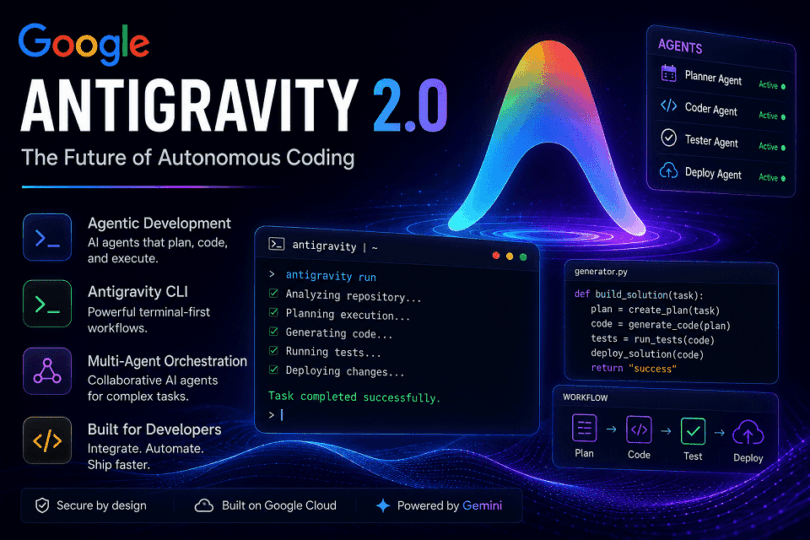
- Google Antigravity 2.0 is an AI-native software engineering platform built around autonomous AI agents.
- The platform combines AI coding agents, repository reasoning, and workflow orchestration.
- Antigravity CLI allows developers to automate terminal-based engineering workflows.
- Google integrates the platform deeply with Gemini AI models and Google Cloud infrastructure.
- Multi-agent collaboration enables planning, debugging, testing, and deployment automation.
- The platform focuses on repository-level understanding instead of simple code autocomplete.
- Google positions Antigravity 2.0 as a competitor to OpenAI Codex and Claude Code.
- The platform reflects the growing shift from AI-assisted coding to autonomous software engineering.
Google Antigravity 2.0 is Google’s next-generation AI coding and autonomous developer platform designed to compete with OpenAI Codex and Claude Code. It combines AI agents, CLI automation, developer workflows, and Gemini-powered coding assistance into a unified system for software engineering tasks.
Introduction
Google launched Antigravity 2.0 because the software industry is moving beyond AI autocomplete tools. Developers now want AI systems that can understand repositories, plan tasks, write code, debug errors, and manage workflows with minimal supervision. Simple code suggestions are no longer enough for modern engineering teams.
The rise of Agentic AI also increased pressure on Google. Companies like OpenAI and Anthropic pushed AI coding systems toward autonomous execution. Google needed a stronger developer-focused platform that could integrate tightly with Gemini models, cloud infrastructure, and terminal-based workflows.
Developers are discussing Google Antigravity 2.0 because it represents a larger shift in software engineering. Instead of acting as a coding assistant, the platform behaves more like an AI engineering collaborator. It can potentially analyze entire codebases, manage multi-step tasks, and automate repetitive development work.
The Antigravity CLI is another major reason behind the growing attention. Many developers prefer terminal-based workflows because they are faster and easier to automate. Google is to be building Antigravity around this workflow instead of limiting it to a traditional IDE experience.
The timing also matters. In 2026, AI coding tools will become part of daily development operations. Startups, DevOps teams, cybersecurity researchers, and enterprise engineers increasingly rely on AI to reduce development time and handle larger projects. This creates strong demand for systems that combine reasoning, automation, and coding in one platform.
Google Antigravity 2.0 matters because it signals a transition from AI-assisted coding to autonomous software engineering. The competition is no longer about who offers the best autocomplete suggestions. It is now about which platform can manage real engineering workflows with the least human effort.
What Is Google Antigravity 2.0?
Google Antigravity 2.0 is an AI-powered software engineering platform designed to automate coding, debugging, planning, and development workflows. It combines AI agents, command-line tools, and Gemini-based reasoning into a system that can handle complex engineering tasks with minimal human input.
Unlike traditional AI coding assistants, Antigravity 2.0 focuses on autonomous execution. Instead of generating single code suggestions, the platform aims to understand full repositories, analyze dependencies, plan multi-step actions, and execute development tasks across an entire project.
The platform is to follow the growing “Agentic AI” model. In this approach, AI systems do more than answer prompts. They can make decisions, manage workflows, and complete chained software engineering tasks automatically.
Google developed Antigravity 2.0 as part of its larger AI ecosystem strategy. Google already has strong infrastructure through Gemini models, Google Cloud, Vertex AI, Android Studio, and Firebase. Antigravity extends these capabilities into developer automation and AI-native programming workflows.
A major part of the platform is the Antigravity CLI. This terminal-focused interface allows developers to interact with AI agents directly from the command line. Developers can potentially use it for the following tasks:
- code generation
- debugging workflows
- repository management
This approach makes the system more flexible for professional engineering environments.
Google Antigravity 2.0 also reflects a broader industry shift. AI coding tools are moving from assistant-style experiences toward systems that can act as autonomous engineering collaborators. Companies now compete on reasoning ability, task execution, and workflow automation rather than basic autocomplete quality alone.
For developers, this means AI tools may soon handle larger parts of the software lifecycle. Tasks like testing, documentation, refactoring, deployment preparation, and bug analysis could become increasingly automated through agent-based systems like Antigravity 2.0.
Why Google Created Antigravity 2.0
Google created Antigravity 2.0 because the AI coding industry is changing rapidly. Developers no longer want tools that only suggest lines of code. They increasingly prefer systems that can understand projects, automate workflows, and complete engineering tasks with minimal supervision.
The rise of AI coding platforms also created intense competition between major AI companies. OpenAI accelerated the market with Codex and advanced developer tools connected to GPT models. Anthropic gained attention with Claude Code because many developers considered it strong at reasoning, debugging, and long-context analysis.
This created direct pressure on Google. The company already had powerful AI models through Gemini, but it needed a stronger developer-focused platform. Antigravity 2.0 is to be Google’s response to this growing AI engineering race.
Another major reason involves the shift toward autonomous software engineering. Traditional AI assistants usually wait for instructions before generating code. Modern agentic systems work differently. They can plan tasks, analyze repositories, execute commands, and iterate through problems more independently.
Google likely recognized that future developer platforms would need the following:
- autonomous AI agents
- terminal-based workflows
- deeper repository understanding
Antigravity 2.0 fits this direction. The platform moves beyond autocomplete and focuses on engineering workflow automation.
The growing popularity of command-line AI tools also influenced Google’s strategy. Many professional developers prefer CLI environments because they support faster workflows, scripting, automation, and DevOps operations. Google is building Antigravity around this real-world engineering behavior instead of limiting it to browser-based chat interfaces.
The timing is important as well. In 2026, companies want AI systems that improve productivity without forcing teams to rebuild their development processes. Antigravity 2.0 allows Google to position Gemini not only as a chatbot model, but also as a full software engineering platform for modern development teams.
How Antigravity 2.0 Fits Into Google’s AI Ecosystem
Google Antigravity 2.0 is not an isolated AI coding tool. It is to be part of Google’s larger AI ecosystem built around Gemini models, cloud infrastructure, and developer platforms. This integration could give Google a major advantage over standalone AI coding systems.
At the center of the ecosystem is Gemini. Antigravity 2.0 likely depends on Gemini’s reasoning, long-context understanding, and multimodal capabilities to analyze repositories, generate code, and manage software engineering tasks.
Gemini provides the intelligence layer, while Antigravity acts as the execution and workflow system. Vertex AI may also play an important role. Many enterprise teams already use Vertex AI to build and deploy machine learning applications on Google Cloud.
Antigravity could eventually connect software engineering workflows with AI model deployment pipelines inside the same infrastructure environment.
Google also has strong advantages in developer tooling. Android Studio already serves millions of developers building Android applications.
Antigravity integration could bring AI agents directly into coding environments where developers write, debug, and test applications daily. Firebase adds another layer to this ecosystem strategy.
Many startups and mobile developers use Firebase for backend services, authentication, databases, and hosting.
Antigravity could potentially automate large parts of Firebase configuration, deployment, and debugging workflows through AI-driven commands and agents. Google Cloud is equally important.
Autonomous coding agents require large-scale computing infrastructure, secure execution environments, and scalable APIs.
Google Cloud gives Antigravity the backend capacity needed for repository analysis, multi-agent coordination, and enterprise deployment workflows.
This connected ecosystem allows Google to position Antigravity 2.0 as more than a coding assistant. The company is building a broader AI-native development platform where coding, deployment, cloud infrastructure, and AI reasoning work together inside one environment.
For developers and businesses, this could reduce workflow fragmentation. Instead of switching between multiple disconnected tools, teams may eventually manage software development, AI operations, deployment, and infrastructure automation through a unified Google ecosystem powered by Antigravity and Gemini.
Is Google Antigravity 2.0 an IDE, Agent, or CLI Tool?
Google Antigravity 2.0 does not appear to fit into a single category. It is not only an IDE extension, and it is also not simply a chatbot for coding. The platform looks more like a hybrid AI engineering system that combines autonomous agents, command-line workflows, and orchestration capabilities inside one environment.
At its core, Antigravity 2.0 seems to function as an AI agent platform. Instead of responding with isolated code suggestions, the system can potentially analyze repositories, understand development goals, break tasks into steps, and execute workflows automatically. This makes it closer to an autonomous engineering collaborator than a traditional coding assistant.
The architecture is heavily connected to terminal-based workflows. The Antigravity CLI allows developers to interact with AI agents directly through the command line. This approach fits modern software engineering practices because many developers already manage testing, deployment, debugging, and infrastructure tasks from terminal environments.
A terminal-first workflow provides several advantages:
- faster automation
- scripting flexibility
- deeper system access
This design also makes Antigravity more useful for DevOps teams, cloud engineers, cybersecurity researchers, and backend developers who rely heavily on CLI operations.
Another important part of the architecture is the orchestration layer. In Agentic AI systems, orchestration manages how multiple AI agents coordinate tasks, share context, and execute workflows together. Instead of using one single AI model for every task, Antigravity may distribute responsibilities across coordinated AI systems.
For example, one agent could analyze repositories while another handles debugging or test generation. The orchestration layer then manages communication, execution order, and task validation between these agents.
This hybrid structure separates Antigravity 2.0 from traditional IDE assistants. Standard AI coding tools usually focus on autocomplete or chat-based support inside editors. Antigravity is designed for larger engineering workflows that involve reasoning, planning, automation, and system-level execution.
As AI software engineering evolves, platforms like Antigravity may become closer to autonomous development operating systems rather than simple coding tools. That shift is one reason developers and enterprise teams are paying close attention to Google’s approach.
Key Features of Google Antigravity 2.0
Google Antigravity 2.0 combines AI agents, repository-level reasoning, command-line automation, and Gemini-powered intelligence into a unified software engineering platform.
Unlike traditional AI coding assistants, the platform focuses on autonomous workflow execution instead of isolated code suggestions.
The system is designed for modern engineering environments where developers manage large repositories, cloud infrastructure, deployment pipelines, and continuous integration workflows.
Google is positioning Antigravity as an AI-native engineering platform capable of handling planning, debugging, automation, and repository management with minimal supervision.
Key features of Google Antigravity 2.0 include:
- AI coding agents for autonomous task execution
- Antigravity CLI for terminal-based workflows
- Multi-agent collaboration and orchestration
- Context-aware repository analysis
- Natural language software engineering
- Gemini-powered reasoning and multimodal support
Unlike traditional coding assistants, Antigravity 2.0 focuses on engineering workflow automation instead of isolated autocomplete suggestions. The platform is to be designed for large-scale development tasks that require reasoning, planning, debugging, and execution across entire software projects.
AI Coding Agents
AI coding agents are one of the foundational technologies behind Google Antigravity 2.0. These agents differ from traditional coding assistants because they focus on autonomous execution rather than passive code generation.
Most AI coding tools generate suggestions after receiving direct prompts. Antigravity agents appear designed to interpret goals, break them into smaller tasks, and execute engineering workflows independently. This makes the platform closer to an AI engineering collaborator than a simple coding assistant.
The platform likely supports multi-step execution across larger software projects. Instead of generating a single function, the system may analyze requirements, identify affected modules, modify related files, validate dependencies, and run testing workflows automatically.
This workflow becomes especially important in enterprise repositories where applications contain interconnected services, APIs, infrastructure definitions, and deployment pipelines. Repository analysis allows Antigravity agents to understand relationships between files instead of focusing only on isolated code snippets.
Deeper repository understanding improves architectural consistency and reduces fragmented AI outputs. It also helps AI agents maintain compatibility across larger development environments.
Planning and debugging capabilities appear central to the platform’s design. Antigravity agents may identify logic failures, trace runtime errors, suggest fixes, and evaluate alternative execution paths before applying changes. This creates a more advanced engineering workflow where AI participates directly in development operations instead of functioning only as a text generator.
As software systems grow more complex, autonomous coding agents could reduce repetitive engineering workloads involving testing, refactoring, dependency updates, and infrastructure configuration.
Antigravity CLI
The Antigravity CLI is to be the operational backbone of the platform. Google seems to be building Antigravity around terminal-first workflows because command-line environments already dominate current development environments operations.
Developers use terminal environments for deployment pipelines, version control, cloud management, debugging, automation, container orchestration, and infrastructure administration. Integrating AI directly into these workflows creates a more natural engineering experience.
Instead of switching between browser chat interfaces and terminal environments, developers may interact with Antigravity agents directly through command-line operations. This approach aligns closely with real-world engineering behavior inside DevOps, backend development, cloud infrastructure, and cybersecurity workflows.
Command automation is one of the platform’s strongest potential advantages. Developers could describe objectives in natural language while AI agents manage execution logic internally. The system may run tests, identify failures, modify affected files, validate outputs, and prepare deployment-ready changes automatically.
Unlike passive AI coding assistants, Antigravity also is capable of controlled code execution inside development environments. This increases automation depth because the system can participate directly in engineering operations instead of stopping at text generation.
The CLI-centric architecture may significantly accelerate engineering workflows by reducing context switching between tools. Developers remain inside familiar terminal environments while AI agents handle repetitive operational tasks in the background.
This design also positions Antigravity well for infrastructure-heavy engineering workflows where automation speed and scripting flexibility matter more than graphical interfaces.
Multi-Agent Collaboration
Google Antigravity 2.0 is designed around a multi-agent architecture rather than relying on one large AI model for every task. This approach reflects a broader industry shift toward distributed AI systems, where coordinated AI systems handle separate engineering responsibilities.
In traditional AI coding platforms, one model processes planning, debugging, testing, and code generation simultaneously. Multi-agent systems distribute these responsibilities across dedicated agents optimized for narrower operational goals.
One agent may specialize in repository analysis while another focuses on debugging or testing validation. Additional agents could handle security scanning, dependency management, documentation generation, or infrastructure automation.
This specialization improves efficiency because agents operate within focused reasoning domains instead of processing unrelated engineering tasks together.
Task delegation is another important advantage. Large repositories often contain multiple parallel workflows involving frontend logic, backend APIs, cloud services, and deployment systems. Antigravity may distribute these operations dynamically across specialized agents based on workload and complexity.
The orchestration layer becomes critical in this architecture. Autonomous agents must share context, synchronize memory, coordinate execution order, and validate outputs across engineering workflows. Without orchestration, multi-agent systems risk generating inconsistent or conflicting results.
Antigravity’s orchestration layer likely manages workflow sequencing, context synchronization, execution permissions, and inter-agent communication. This creates a more stable environment for large-scale engineering automation.
As AI-native development platforms evolve, multi-agent collaboration may become essential for handling enterprise-scale software engineering operations efficiently.
Context-Aware Code Generation
Context-aware code generation is one of the most technically significant features inside Google Antigravity 2.0. Modern software repositories contain thousands of interconnected files, dependencies, APIs, services, and infrastructure layers. AI systems must understand these relationships to generate reliable engineering outputs.
Traditional coding assistants often fail because they process limited context windows. This produces fragmented suggestions, inconsistent architecture decisions, and missing dependency awareness. Antigravity is designed to reduce these limitations through deeper repository-level reasoning.
Memory handling plays a major role in this system. Autonomous AI agents need persistent contextual understanding across workflows, sessions, and repository changes. Without memory continuity, AI systems lose track of previous actions and generate inconsistent outputs over time.
Antigravity may maintain persistent awareness of repository structures, previous modifications, engineering objectives, and workflow history. This enables more coherent execution across long development cycles.
Repository understanding also extends beyond isolated code files. The platform is capable of analyzing relationships between services, libraries, APIs, configuration systems, and deployment infrastructure. This broader understanding improves software consistency across complex projects.
Long-context processing becomes especially important in enterprise engineering environments where repositories often exceed standard model context limitations. Antigravity likely depends on advanced retrieval systems and Gemini-powered context management to process large engineering datasets efficiently.
Better context awareness improves dependency tracking, architectural consistency, and long-term maintainability across AI-assisted development workflows.
Natural Language Software Engineering
Google Antigravity 2.0 moves software engineering closer to natural language interaction. Developers may increasingly describe objectives conversationally while AI agents handle implementation logic internally.
This approach changes how engineers interact with development systems. Instead of manually defining every configuration step or implementation detail, developers focus more on goals, architecture, and workflow outcomes.
Prompt-to-code generation is one part of this transition. Antigravity agents may translate high-level requirements into executable software structures, APIs, deployment logic, and application workflows. The platform is focused on reasoning-driven implementation rather than isolated syntax prediction.
Architecture generation is another important capability. Modern applications require database structures, networking logic, cloud infrastructure, authentication systems, In addition, these applications needs monitoring pipelines, and deployment configurations. Antigravity could automate large parts of these repetitive engineering foundations.
Documentation generation also becomes more scalable in agentic engineering systems. Technical documentation often becomes outdated because repositories evolve continuously. AI agents may automatically update architecture explanations, deployment instructions, API references, and workflow documentation based on repository changes.
Natural language engineering workflows could reduce operational complexity for startups and smaller engineering teams. Developers spend less time managing repetitive infrastructure tasks and more time optimizing system design and application logic.
However, AI-generated engineering workflows still require human validation. Autonomous systems can produce hallucinations, security vulnerabilities, or architectural inconsistencies if developers rely on them without proper review.
Integration with Gemini Models
Gemini models appear to provide the reasoning foundation behind Google Antigravity 2.0. The platform likely depends on Gemini 2.x systems for repository understanding, long-context analysis, workflow planning, and autonomous engineering execution.
Software engineering requires more than code prediction. AI systems must reason through dependencies, evaluate execution paths, manage debugging workflows, and maintain architectural consistency across repositories. Gemini’s reasoning capabilities may help Antigravity handle these complex engineering operations more effectively.
Long-context processing is another major advantage. Enterprise repositories often contain massive engineering datasets involving APIs, infrastructure definitions, source code, documentation, and deployment systems. Gemini’s larger context capabilities may allow Antigravity agents to maintain broader repository awareness during execution workflows.
Multimodal support could expand the platform even further. Future engineering workflows may combine code, architecture diagrams, UI mockups, screenshots, logs, monitoring dashboards, and deployment visualizations inside the same reasoning environment.
For example, developers may upload interface designs or infrastructure diagrams while Antigravity generates corresponding implementation logic automatically.
Google’s ecosystem integration strengthens this architecture significantly. Gemini already connects with Google Cloud, Vertex AI, Android Studio, and Firebase infrastructure. Antigravity extends these capabilities into AI-native software engineering workflows where reasoning, automation, and execution operate together inside a unified platform.
This combination positions Google as a major competitor in the growing autonomous software engineering market, where AI systems increasingly manage larger parts of the development lifecycle.
How Google Antigravity 2.0 Works
Google Antigravity 2.0 works through an agentic software engineering model that combines AI reasoning, repository analysis, command-line execution, and workflow orchestration. The platform interprets engineering goals, plans execution steps, interacts with repositories, runs commands through the CLI, and validates outputs across development workflows.
Unlike traditional AI coding assistants, Antigravity 2.0 is designed for autonomous engineering operations instead of single-response code generation. The platform combines AI agents, orchestration systems, repository memory, and Gemini-powered reasoning into a workflow capable of handling larger development tasks with minimal supervision.
Its architecture likely depends on continuous interaction between AI agents, repository context systems, execution layers, and validation pipelines. This creates an engineering environment where AI systems can participate directly in coding, debugging, testing, and infrastructure automation workflows.
Understanding the Agentic Workflow
Google Antigravity 2.0 uses an agentic workflow where AI agents interpret goals, create execution plans, perform engineering tasks, validate outputs, and iterate automatically until workflows reach completion. This model differs from traditional coding assistants that only respond to isolated prompts.
The first stage is task interpretation. Developers provide objectives using natural language instructions, terminal commands, or workflow definitions. The AI system then analyzes the request and determines the engineering requirements needed for execution.
This process may involve repository scanning, dependency analysis, architecture evaluation, and contextual understanding of related services or modules. Instead of processing isolated files, Antigravity is designed to interpret broader software engineering environments.
After interpretation, the system moves into planning. Agentic AI platforms typically divide larger tasks into smaller execution stages. Antigravity may create structured workflows involving code generation, dependency updates, debugging sequences, testing procedures, and validation checkpoints.
Planning is especially important for enterprise repositories because engineering tasks often involve interconnected services and infrastructure layers. Poor workflow coordination can introduce deployment failures, dependency conflicts, or architectural inconsistencies.
Execution is the operational phase where AI agents perform engineering actions. The platform may generate code, modify repositories, run shell commands, update configurations, execute tests, or interact with deployment systems directly through the Antigravity CLI.
Unlike passive AI systems, Antigravity is designed for workflow participation rather than static output generation.
Iteration is another defining feature of agentic systems. Engineering tasks rarely succeed perfectly during the first execution cycle. Antigravity agents may continuously evaluate outputs, identify failures, apply corrections, and retry workflows until results meet validation criteria.
This iterative behavior makes the system closer to autonomous software engineering than standard AI-assisted coding.
Validation is the final stage. The platform likely checks outputs through testing pipelines, dependency verification, syntax analysis, runtime monitoring, and repository consistency checks before finalizing modifications.
This validation layer is critical because autonomous systems must minimize errors before applying changes across production-scale repositories.
How the CLI Interacts With AI Agents
Google Antigravity 2.0 likely uses the Antigravity CLI as the communication bridge between developers, repositories, operating systems, and AI agents. The CLI enables AI-driven engineering workflows directly inside terminal environments.
The system is heavily integrated with shell-based workflows because professional developers already manage deployments, infrastructure automation, debugging, version control, and container orchestration through terminal interfaces.
Shell integration allows AI agents to execute commands inside controlled engineering environments. Instead of manually chaining commands together, developers may describe objectives while Antigravity manages execution logic automatically.
For example, the platform could potentially analyze repositories, identify failing services, modify affected files, run test suites, and prepare deployment-ready changes through a continuous command-line workflow.
APIs likely play an important role in this architecture as well. Antigravity agents may communicate with external systems through APIs connected to repositories, cloud infrastructure, CI/CD pipelines, monitoring tools, or deployment services.
This API-driven design enables broader engineering automation across distributed development environments.
Local environment permissions are another critical component. Autonomous AI systems require controlled access to repositories, terminal commands, runtime environments, and system resources. Without permission management, AI-driven execution introduces serious security risks.
Antigravity likely uses permission boundaries and execution policies to control:
- file system access
- command execution
- repository modifications
This reduces the risk of unsafe operations during autonomous workflows.
The CLI-based architecture also improves workflow efficiency because developers remain inside familiar terminal environments instead of switching continuously between editors, dashboards, and browser chat interfaces.
For infrastructure-heavy engineering operations, this terminal-first design may become one of Antigravity’s strongest competitive advantages.
Can Antigravity Modify Entire Codebases?
Google Antigravity 2.0 is designed to operate at repository scale rather than at the isolated file level. The platform may analyze, modify, and validate changes across entire codebases using AI agents and orchestration workflows.
Traditional AI coding assistants often struggle with large repositories because they lack persistent context awareness and dependency understanding. Antigravity seems built specifically to address these limitations through repository-level reasoning.
Repo-level modifications require much deeper contextual understanding than single-file generation. AI systems must evaluate relationships between APIs, services, databases, infrastructure layers, dependencies, and deployment logic before applying changes safely.
Antigravity agents may track these relationships continuously during engineering workflows.
Dependency management becomes especially important in large software environments. Even small modifications can introduce cascading failures across services, libraries, or infrastructure configurations. Antigravity likely analyzes dependency trees before applying updates or refactoring operations.
This capability could improve software stability during autonomous engineering execution.
Testing pipelines also appear central to the platform’s workflow model. Autonomous repository modification requires continuous validation to prevent broken builds, failed deployments, or runtime inconsistencies.
Antigravity may integrate directly with automated testing systems to validate modifications before finalizing changes.
The platform could potentially:
- execute unit tests
- validate integrations
- analyze runtime failures
This creates a safer environment for large-scale AI-assisted engineering workflows.
Repository-wide automation may significantly reduce repetitive development workloads involving refactoring, migration tasks, configuration updates, and dependency synchronization across large engineering environments.
However, full codebase modification also introduces risks. Autonomous systems still face limitations involving hallucinations, incorrect assumptions, and architectural inconsistencies. Human review remains essential before deploying AI-generated changes into production systems.
Cloud vs Local Execution
Google Antigravity 2.0 likely supports both cloud-based and local execution workflows depending on infrastructure requirements, security policies, and engineering use cases. This flexibility is important because different organizations have different privacy, compliance, and performance needs.
Cloud execution provides access to large-scale AI infrastructure powered by Gemini models and Google Cloud resources. This approach enables stronger reasoning capabilities, larger context windows, distributed orchestration, and high-performance repository analysis.
Cloud-based workflows may also simplify collaboration across distributed engineering teams.
However, cloud execution introduces privacy concerns. Many enterprise repositories contain sensitive intellectual property, security configurations, infrastructure credentials, and proprietary source code. Organizations may hesitate to expose critical engineering data to external cloud environments.
This creates demand for stronger isolation and security controls.
Sandboxing likely plays a major role in Antigravity’s execution model. Sandboxed environments isolate AI workflows from critical operating system resources and production infrastructure. This reduces the risk of unsafe command execution, malicious modifications, or accidental repository corruption.
Secure sandboxing becomes especially important when autonomous AI agents can execute shell commands or modify repositories directly.
Local execution may address some enterprise security concerns. Running AI workflows locally allows organizations to maintain tighter control over repositories, infrastructure access, and execution environments. Local inference systems could reduce external data exposure while improving compliance with internal security policies.
However, local execution also introduces hardware limitations. Large reasoning models require significant computing resources, memory bandwidth, and inference optimization. Smaller local systems may struggle with complex repository analysis or large-scale orchestration workflows.
Future versions of Antigravity may use hybrid execution models where sensitive repository operations remain local while large-scale reasoning tasks run through cloud infrastructure. This balance could improve privacy, scalability, and engineering efficiency simultaneously.
As autonomous software engineering evolves, execution architecture will likely become one of the most important competitive factors between AI-native development platforms.
Google Antigravity 2.0 vs OpenAI Codex
Google Antigravity 2.0 and OpenAI Codex represent two different approaches to AI-assisted software engineering. Antigravity 2.0 focuses on autonomous engineering workflows and agent-based execution, while Codex originally focused more on code generation and developer assistance.
Both platforms aim to improve software development productivity, but their architectural direction and workflow philosophy appear increasingly different. Antigravity emphasizes orchestration, repository reasoning, CLI automation, and multi-agent workflows. Codex became popular for translating natural language into code and accelerating development inside coding environments.
As AI-native engineering evolves, the competition is shifting from autocomplete quality toward autonomous workflow execution, reasoning depth, and repository-level intelligence.
Core Philosophy Differences
Google Antigravity 2.0 focuses on autonomous software engineering workflows, while OpenAI Codex originally focused on AI-assisted code generation and autocomplete-style developer support.
This difference changes how both systems approach engineering tasks.
Codex helped popularize prompt-to-code workflows by translating natural language instructions into executable code. Its strength came from accelerating development through code suggestions, function generation, and developer assistance inside programming environments.
Antigravity 2.0 is designed for a broader operational role. Instead of acting mainly as a code suggestion engine, the platform attempts to function as an autonomous engineering system capable of planning, execution, debugging, validation, and orchestration across repositories.
The distinction becomes clearer in workflow behavior.
Traditional autocomplete systems wait for instructions before generating outputs. Autonomous engineering systems interpret objectives, divide tasks into stages, manage execution logic, and iterate through workflows independently.
Antigravity seems aligned with this newer Agentic AI model.
The platform also is heavily optimized for terminal-first engineering operations. CLI workflows, repository orchestration, and multi-agent coordination suggest Google is targeting infrastructure-heavy engineering environments instead of only editor-based development experiences.
Codex still remains important because it helped establish the modern AI coding ecosystem. However, Antigravity reflects the next phase of AI-native development where engineering automation extends beyond code generation into operational workflow management.
AI Agent Capabilities Compared
Google Antigravity 2.0 is more focused on autonomous engineering orchestration, while OpenAI Codex remains more centered on AI-assisted code generation and prompt-driven development workflows.
The two platforms differ significantly in architecture, workflow depth, and operational autonomy.
The comparison below reflects the current direction of OpenAI Codex-style developer workflows.
| Feature | Google Antigravity 2.0 | OpenAI Codex |
| Primary Focus | Autonomous engineering workflows | AI-assisted code generation |
| CLI Support | Strong terminal-first architecture | Limited direct CLI orchestration |
| Multi-Agent Systems | Is designed for multi-agent collaboration | Primarily single-model workflows |
| Repository Reasoning | Deep repository-level context analysis | More prompt and file-oriented |
| Autonomous Execution | Supports workflow automation and task execution | Mostly generates code suggestions |
| Debugging | Iterative debugging and validation workflows | Prompt-driven debugging assistance |
| Planning | Multi-step engineering planning | Limited autonomous planning |
| Memory Handling | Persistent repository context and orchestration | Shorter contextual continuity |
| Infrastructure Automation | Strong potential for DevOps integration | More coding-centric workflows |
| Workflow Orchestration | Central architectural component | Less orchestration-focused |
Antigravity’s architecture is optimized for engineering automation across repositories, deployment systems, and infrastructure workflows. Codex remains highly effective for rapid coding assistance, function generation, and developer productivity inside standard programming tasks.
The biggest difference is operational autonomy. Antigravity seems designed to execute engineering workflows, while Codex mainly assists developers during manual workflows.
That distinction may become increasingly important as software engineering shifts toward AI-native automation systems.
Which Platform Is Better for Developers?
Google Antigravity 2.0 may be better for large-scale engineering automation, while OpenAI Codex may remain more accessible for lightweight coding assistance and rapid developer productivity.
The better platform depends heavily on the engineering environment, workflow complexity, and operational goals.
For enterprise engineering teams, Antigravity may offer stronger long-term advantages. Large organizations manage massive repositories, distributed infrastructure, CI/CD systems, cloud services, and compliance-heavy workflows. Antigravity’s repository reasoning, orchestration layers, and autonomous execution model align more closely with these operational demands.
Its multi-agent architecture could also improve scalability across enterprise engineering environments.
Startups may benefit from both platforms differently. Smaller teams often need rapid prototyping, fast iteration, and minimal operational overhead. Codex remains useful for accelerating feature development and generating code quickly. However, Antigravity’s automation capabilities could eventually reduce engineering workload further by automating debugging, deployment preparation, and repository maintenance tasks.
For solo developers, Codex may feel simpler and easier to integrate into daily workflows. Lightweight code generation and conversational coding assistance remain highly valuable for independent developers working on smaller projects.
Antigravity may introduce more operational complexity because autonomous workflows require stronger repository management, execution controls, and orchestration systems.
DevOps teams could benefit more from Antigravity’s CLI-focused architecture. Infrastructure engineering relies heavily on terminal workflows, automation pipelines, cloud orchestration, and deployment management. Antigravity is designed specifically for these operational environments.
Its integration with shell workflows and autonomous execution systems may provide major advantages in infrastructure-heavy engineering operations.
Cybersecurity teams may also prefer Antigravity’s repository analysis and orchestration capabilities. Security engineering often requires large-scale code auditing, dependency analysis, infrastructure validation, and automated testing workflows.
Autonomous AI agents could help identify vulnerabilities, analyze attack surfaces, validate configurations, and automate repetitive security operations across repositories.
However, cybersecurity environments also demand stronger execution controls because autonomous systems with repository access introduce additional security risks. Organizations will likely require strict permission boundaries, sandboxing, and validation pipelines before deploying AI agents inside sensitive environments.
In practice, the future may not involve one dominant platform replacing the other completely. Different AI coding systems may specialize in different engineering roles depending on workflow complexity, automation requirements, and operational scale.
Google Antigravity 2.0 vs Claude Code
Google Antigravity 2.0 and Claude Code both focus on AI-assisted software engineering, but they appear to target different levels of workflow automation. Claude Code is known for strong reasoning and developer-friendly coding assistance, while Antigravity 2.0 is more focused on autonomous engineering workflows, orchestration, and repository-scale automation.
Both platforms aim to improve developer productivity, but their architectural direction differs. Claude Code emphasizes conversational reasoning, long-context understanding, and code analysis. Antigravity is designed for larger operational workflows involving AI agents, CLI execution, repository orchestration, and engineering automation.
This comparison matters because developers are increasingly choosing AI coding systems based on reasoning depth, workflow integration, and autonomy rather than simple autocomplete quality.
Why Developers Compare Antigravity With Claude Code
Developers compare Google Antigravity 2.0 with Claude Code because both platforms target advanced software engineering workflows instead of lightweight autocomplete assistance.
Claude Code gained attention for its strong reasoning ability, large context handling, and detailed code analysis. Many developers use it for debugging, architecture discussions, repository exploration, and long-form technical reasoning.
Antigravity 2.0 enters the same competitive space but is to extend beyond conversational coding support into autonomous workflow execution.
The comparison also exists because both systems focus heavily on repository understanding. Modern enterprise software workflows requires AI tools that can analyze large codebases, track dependencies, maintain architectural consistency, and process long-context engineering data.
Developers increasingly care about:
- reasoning quality
- context awareness
- workflow automation
This shifts the competition away from basic code completion.
Another reason involves the growing importance of Agentic AI systems. Claude Code already performs well in structured engineering conversations and debugging workflows. Antigravity is designed to push further toward autonomous engineering operations where AI agents plan, execute, validate, and iterate through tasks with minimal supervision.
The terminal-focused design of Antigravity also attracts attention from infrastructure engineers, DevOps teams, and backend developers who rely heavily on shell-based workflows.
As AI-native software engineering evolves, developers naturally compare platforms that offer deeper reasoning and operational workflow support instead of simple editor assistance.
Coding Accuracy and Reasoning
Claude Code is widely recognized for strong reasoning quality and detailed engineering explanations, while Google Antigravity 2.0 is optimized for operational workflow execution and repository-scale automation.
Reasoning quality matters because large-scale engineering systems involves much more than syntax generation. AI systems must analyze dependencies, understand architecture, debug failures, evaluate execution paths, and maintain consistency across repositories.
Claude Code became popular partly because it handles long-context reasoning well. Developers often use it for:
- debugging complex logic
- explaining architecture decisions
- analyzing repositories
Its conversational style also makes technical discussions feel more natural during engineering workflows.
Antigravity 2.0 is to approach reasoning differently. Instead of focusing mainly on conversational interaction, the platform seems designed to combine reasoning with execution. The goal is not only to explain engineering logic but also to automate workflows through AI agents and orchestration systems.
This creates a distinction between analytical reasoning and operational reasoning.
Claude Code may currently feel stronger for detailed technical explanations, architecture discussions, and interactive debugging conversations. Antigravity may become stronger in workflows involving execution pipelines, multi-step automation, repository orchestration, and engineering task management.
Coding accuracy also depends heavily on repository context. Systems with deeper repository understanding generally produce more reliable outputs because they track dependencies, APIs, and architectural patterns more effectively.
Antigravity’s repository-level orchestration could improve consistency during large-scale engineering operations, especially inside enterprise repositories.
However, both systems still face common AI limitations involving hallucinations, incomplete context, incorrect assumptions, and security risks. Human validation remains essential for production-grade engineering workflows.
Google Antigravity 2.0 Vs Claude Code Comparison Table
| Feature | Google Antigravity 2.0 | Claude Code |
| Primary Focus | Autonomous engineering workflows | Conversational coding assistance |
| Architecture | Multi-agent orchestration | Single-agent conversational workflow |
| CLI Integration | Strong terminal-first design | Limited terminal orchestration |
| Repository Understanding | Deep repository-level reasoning | Strong long-context repository analysis |
| Autonomous Execution | High workflow automation potential | Mostly developer-guided workflows |
| Planning Capabilities | Multi-step task orchestration | Interactive reasoning and planning |
| Debugging | Automated debugging workflows | Strong conversational debugging |
| Context Window | Large repository awareness | Excellent long-context handling |
| Infrastructure Automation | Designed for DevOps workflows | More coding-focused assistance |
| Workflow Style | Execution-oriented | Discussion-oriented |
| Best For | Enterprise automation and DevOps | Developers needing reasoning support |
| Human Supervision Needed | Lower over time | Higher manual interaction |
Terminal Workflow Differences
Google Antigravity 2.0 is significantly more focused on terminal-first workflows than Claude Code. This architectural difference may become one of the platform’s strongest competitive advantages for infrastructure-heavy engineering environments.
Terminal workflows remain central to latest software engineering. Developers use command-line environments for version control, deployment pipelines, infrastructure automation, debugging, testing, and cloud orchestration.
Antigravity seems built specifically around this operational reality.
The Antigravity CLI may allow developers to interact with AI agents directly through shell environments instead of relying primarily on chat-based interfaces. This reduces context switching and keeps engineering operations inside existing workflows.
For DevOps engineers and backend teams, terminal-native AI integration can improve operational efficiency significantly.
Claude Code currently feels more conversational and discussion-oriented. Its workflow design is optimized for reasoning, analysis, code assistance, and technical interaction rather than deep shell orchestration.
That does not make Claude Code weaker. Many developers prefer conversational AI coding because it simplifies debugging discussions, architecture analysis, and problem-solving workflows.
The difference is operational depth.
Antigravity is designed for execution-heavy engineering environments where AI systems actively participate in command execution, repository modification, testing pipelines, and infrastructure workflows.
This distinction may become increasingly important as software engineering moves toward AI-native automation systems integrated directly into operational pipelines.
Which AI Coding Tool Is More Autonomous?
Google Antigravity 2.0 is more autonomous than Claude Code because its architecture focuses heavily on agentic execution, orchestration systems, workflow automation, and repository-level task management.
Claude Code functions primarily as a highly capable reasoning and coding assistant. It performs well in technical discussions, debugging analysis, code explanation, and conversational engineering workflows. However, the system still relies heavily on developer-driven interaction and manual execution.
Antigravity is designed for deeper operational autonomy.
The platform may interpret objectives, divide tasks into execution stages, modify repositories, run terminal commands, validate outputs, and iterate through workflows with reduced human involvement. This behavior aligns closely with the broader trend toward autonomous software engineering.
Multi-agent orchestration further increases Antigravity’s autonomy potential. Specialized agents may collaborate across planning, debugging, testing, deployment preparation, and repository analysis workflows automatically.
Claude Code currently is more focused on reasoning-centered assistance rather than distributed engineering orchestration.
Autonomy also depends on execution authority. AI systems become more autonomous when they can interact directly with repositories, shell environments, APIs, testing pipelines, and infrastructure layers. Antigravity’s CLI-centric architecture suggests stronger integration with operational engineering systems.
However, higher autonomy also introduces greater risks.
Autonomous engineering systems require:
- strict permission controls
- sandboxed execution
- validation layers
Without strong safeguards, AI agents can introduce security vulnerabilities, infrastructure failures, or unintended repository modifications.
For many developers, the ideal workflow may combine both styles. Claude Code may remain valuable for deep reasoning and engineering analysis, while Antigravity could become more useful for automation-heavy operational workflows.
The industry is moving toward AI systems that not only assist developers but also actively participate in software engineering operations. Antigravity is built specifically for that transition.
Antigravity CLI Explained
Antigravity CLI is the command-line interface layer of Google Antigravity 2.0 that allows developers to interact directly with AI agents through terminal environments. It is designed for AI-assisted engineering workflows involving automation, repository management, debugging, testing, and infrastructure operations.
Unlike traditional browser-based AI coding assistants, Antigravity CLI integrates AI workflows directly into developer tooling and shell environments. This terminal-first approach aligns closely with modern engineering practices where developers manage deployments, infrastructure, version control, and automation through command-line systems.
The CLI likely acts as the operational bridge between AI agents, repositories, execution environments, and cloud infrastructure. It allows Antigravity to move beyond code suggestion workflows and participate directly in software engineering operations.
What Is Antigravity CLI?
Antigravity CLI is a terminal-based interface that connects developers with Google Antigravity 2.0’s AI agents, orchestration systems, and engineering workflows. The platform is designed for developers who prefer command-line operations instead of relying entirely on graphical coding interfaces.
Modern large-scale engineering systems heavily depend on terminal environments. Developers use shell-based workflows for Git operations, CI/CD pipelines, debugging, infrastructure automation, cloud deployment, and container orchestration. Antigravity CLI is built specifically for this operational ecosystem.
The system likely allows developers to issue natural language instructions directly inside terminal sessions. Instead of manually chaining commands together, developers may describe engineering goals while AI agents manage execution logic internally.
This creates a more streamlined workflow where AI systems participate directly in operational engineering tasks.
The CLI also is tightly connected to repository-level reasoning. AI agents may analyze repository structures, evaluate dependencies, understand configuration files, and execute workflows across multiple services simultaneously.
This architecture separates Antigravity from lightweight AI coding assistants that mainly operate inside isolated editor environments.
Another important aspect is automation depth. Antigravity CLI may not only generate commands but also execute workflows through controlled system permissions and orchestration layers. This transforms the terminal from a manual engineering environment into an AI-assisted operational workspace.
For DevOps teams, backend developers, cloud engineers, and cybersecurity professionals, terminal-native AI workflows could significantly reduce repetitive operational overhead.
Main CLI Commands and Workflow
Antigravity CLI is designed around workflow automation rather than isolated command execution. The system likely combines shell integration, AI reasoning, repository analysis, and orchestration workflows into a unified engineering environment.
The workflow probably begins with task interpretation. Developers issue instructions through terminal commands or natural language prompts. The AI system then analyzes repository context, dependencies, infrastructure layers, and engineering objectives before planning execution steps.
Instead of generating one isolated response, the platform may create structured workflows involving multiple operations across repositories and infrastructure systems.
CLI workflows likely involve repository scanning, dependency evaluation, configuration analysis, testing execution, and validation checkpoints before finalizing modifications.
A typical engineering workflow may include:
- repository analysis
- task planning
- automated execution
The system may then continue through debugging, testing, validation, and deployment preparation automatically.
Antigravity CLI also is designed for continuous iteration. If workflows fail during testing or validation, AI agents may retry operations, apply fixes, update dependencies, or modify configurations dynamically.
This iterative execution model moves beyond static code generation and toward autonomous engineering operations.
The platform likely supports API integrations as well. AI agents may interact with cloud platforms, deployment pipelines, monitoring systems, container environments, and CI/CD services through external APIs connected to terminal workflows.
Permission management remains critical in this architecture. Autonomous AI systems require controlled access to repositories, shell commands, and infrastructure environments. Antigravity likely uses permission boundaries and sandboxing policies to reduce unsafe execution risks.
This combination of shell integration, orchestration, repository reasoning, and iterative execution creates a workflow environment optimized for large-scale engineering automation.
How Developers Could Use It
Developers could use Antigravity CLI for debugging, testing, deployment automation, documentation generation, and large-scale code refactoring workflows. The platform is designed to reduce repetitive operational tasks across modern software engineering environments.
In debugging workflows, AI agents may analyze stack traces, trace dependency conflicts, identify runtime failures, and suggest fixes automatically. Instead of manually searching through repositories, developers could allow Antigravity to investigate failures across related services and modules.
This may significantly reduce troubleshooting time in large engineering environments.
Testing automation is another major use case. Antigravity CLI could potentially execute unit tests, integration tests, regression pipelines, and validation workflows automatically after repository modifications.
If failures occur, the system may iterate through debugging workflows and retry execution until validation passes.
Deployment workflows may also become more automated. Developers often spend significant time managing infrastructure configuration, container orchestration, environment variables, and CI/CD operations. Antigravity could help automate these repetitive processes through AI-driven terminal execution.
Documentation generation is another important capability. Engineering teams frequently struggle to maintain updated technical documentation because repositories evolve continuously. Antigravity agents may generate or update API references, deployment instructions, architecture explanations, and workflow documentation automatically.
Refactoring workflows could become more scalable as well. Large repositories often contain outdated dependencies, inconsistent code structures, duplicated logic, and technical debt. Antigravity may analyze repository architecture and apply coordinated refactoring changes across multiple services simultaneously.
This becomes especially useful in enterprise environments where manual repository maintenance consumes significant engineering time.
The CLI-first architecture also benefits infrastructure-heavy teams because developers can remain inside existing operational environments instead of constantly switching between terminals, dashboards, editors, and AI chat interfaces.
As AI-native development workflows mature, platforms like Antigravity CLI may increasingly function as autonomous engineering assistants embedded directly into terminal operations.
Is Antigravity CLI Open Source?
Google has not fully clarified whether Antigravity CLI will be open source, partially open, or proprietary. However, the question matters because developer adoption often depends heavily on transparency, extensibility, and infrastructure control.
Open-source developer tools usually gain faster community trust because engineers can inspect execution logic, security behavior, API integrations, and repository access controls directly. This becomes especially important for AI systems capable of autonomous execution inside development environments.
Many developers may hesitate to grant repository-level access to fully closed-source AI agents without strong visibility into execution behavior and permission handling.
An open-source Antigravity CLI could also accelerate ecosystem growth. Developers could build plugins, integrations, workflow extensions, infrastructure connectors, and custom automation pipelines around the platform.
This community-driven expansion often strengthens developer ecosystems significantly.
However, Google may choose a hybrid model instead. The CLI itself could become partially open while the underlying Gemini reasoning systems and orchestration infrastructure remain proprietary cloud services.
This approach would allow Google to maintain control over advanced AI capabilities while still encouraging developer adoption through extensibility and tooling transparency.
Enterprise organizations may also prefer self-hosted or locally controlled execution environments for compliance and security reasons. Open or partially open CLI tooling could make Antigravity more attractive in regulated industries where repository privacy and infrastructure governance are critical.
Regardless of the licensing model, Antigravity CLI represents a broader industry shift toward AI-native terminal workflows where autonomous agents increasingly participate directly in engineering operations instead of functioning only as external coding assistants.
Real-World Use Cases of Google Antigravity 2.0
Google Antigravity 2.0 could automate many real-world software engineering workflows involving coding, infrastructure management, debugging, testing, deployment, cybersecurity analysis, and repository maintenance. The platform is designed for engineering environments where AI agents can reduce repetitive operational workloads and accelerate development cycles.
Unlike traditional AI coding assistants that mainly generate snippets, Antigravity focuses on workflow-level automation. Its combination of AI agents, repository reasoning, orchestration systems, and CLI integration makes it suitable for large-scale engineering operations across startups, enterprises, DevOps environments, and cybersecurity teams.
As AI-native software engineering evolves, platforms like Antigravity may increasingly function as autonomous engineering collaborators embedded directly into operational workflows.
Software Engineering Automation
Google Antigravity 2.0 is heavily optimized for software engineering automation across repositories, development pipelines, testing systems, and debugging workflows.
Modern software development involves many repetitive tasks that consume engineering time without directly improving product innovation. Developers often spend hours managing dependencies, updating configurations, maintaining documentation, running tests, and fixing repetitive integration issues.
Antigravity could automate many of these operational tasks through AI agents capable of repository analysis and workflow execution.
The platform may help developers generate boilerplate code, refactor legacy systems, synchronize APIs, update dependencies, and validate architecture consistency across projects. AI agents could also analyze repositories continuously and identify outdated libraries, inefficient patterns, or potential compatibility issues automatically.
Automation becomes especially valuable in large repositories where engineering complexity increases rapidly over time.
The system’s orchestration layer may also improve engineering coordination across workflows involving coding, debugging, testing, and deployment preparation. Instead of manually switching between multiple tools and environments, developers could manage workflows through AI-assisted execution pipelines.
This reduces operational overhead while improving engineering efficiency.
As repositories grow larger and development cycles accelerate, engineering automation will likely become one of the most important AI-driven transformations in software development.
DevOps and Infrastructure Tasks
Google Antigravity 2.0 could become highly valuable for DevOps and infrastructure engineering because the platform is deeply integrated with terminal workflows, orchestration systems, and automation pipelines.
DevOps operations involve repetitive infrastructure tasks, including deployment management, container orchestration, CI/CD pipelines, environment configuration, cloud provisioning, monitoring integration, and infrastructure validation.
These workflows already depend heavily on automation, which makes them well-suited for AI-assisted execution systems.
Antigravity CLI may allow AI agents to interact directly with infrastructure environments through shell commands and APIs. Developers could potentially describe operational objectives while the system manages deployment logic, validates configurations, and executes workflows automatically.
This could reduce manual operational workload significantly.
Infrastructure troubleshooting is another important use case. AI agents may analyze deployment logs, identify service failures, trace dependency conflicts, and recommend corrective actions across distributed systems.
In cloud-native environments, infrastructure issues often involve interconnected services spanning containers, APIs, databases, and orchestration layers. Repository-level reasoning may help Antigravity diagnose these issues more effectively than isolated AI coding tools.
The platform could also support infrastructure-as-code workflows involving Terraform, Kubernetes, Docker, CI/CD pipelines, and cloud deployment systems.
For DevOps teams managing large-scale distributed systems, AI-assisted infrastructure orchestration could improve operational speed, deployment consistency, and incident response efficiency.
AI-Assisted Cybersecurity Workflows
Google Antigravity 2.0 could support cybersecurity workflows by automating repository analysis, dependency auditing, vulnerability detection, configuration validation, and security-focused engineering operations.
Modern cybersecurity operations increasingly involve large-scale software analysis rather than isolated network monitoring alone. Security teams must continuously evaluate repositories, APIs, infrastructure configurations, deployment systems, and dependency chains for vulnerabilities and misconfigurations.
AI agents with repository-level reasoning could significantly improve these workflows.
Antigravity may help security teams identify insecure dependencies, exposed credentials, outdated libraries, insecure API configurations, and risky infrastructure patterns across large repositories automatically.
The platform’s orchestration capabilities could also improve security auditing workflows. AI agents may analyze repositories, correlate findings across services, prioritize vulnerabilities, and generate remediation recommendations automatically.
This becomes especially useful in enterprise environments where repositories evolve continuously, and manual auditing becomes difficult to scale.
The CLI-first architecture also aligns well with cybersecurity operations because many security engineers rely heavily on shell-based environments, automation scripts, log analysis pipelines, and infrastructure tooling.
Antigravity agents could potentially automate repetitive security operations involving:
- Log analysis
- Configuration auditing
- Dependency validation
However, AI-assisted cybersecurity introduces additional risks as well. Autonomous systems with repository access require strict permission controls, sandboxing, and validation layers. Poorly controlled AI agents could accidentally expose sensitive infrastructure data or introduce insecure modifications during automated workflows.
Human oversight remains critical in security-sensitive environments.
Despite these risks, AI-native cybersecurity automation will likely become increasingly important as software ecosystems grow more complex and attack surfaces continue expanding.
Startup Productivity and Rapid Prototyping
Google Antigravity 2.0 could significantly improve startup productivity by reducing the operational burden associated with rapid software development and infrastructure management.
Startups often operate with small engineering teams that must build products quickly while managing infrastructure, debugging, deployment, documentation, and scaling challenges simultaneously.
AI-assisted engineering systems can help smaller teams operate more efficiently.
Antigravity may accelerate rapid prototyping workflows by automating repetitive setup tasks involving APIs, authentication systems, cloud deployment, backend services, testing pipelines, and configuration management.
Instead of manually building every engineering layer from scratch, developers could use AI agents to generate foundational architecture and operational workflows automatically.
This allows teams to focus more on product design and business logic.
Repository-level reasoning could also help startups maintain engineering consistency as projects scale. Smaller teams often accumulate technical debt quickly because development cycles prioritize speed over maintainability.
AI agents capable of refactoring, dependency analysis, and architecture validation may reduce long-term repository complexity.
Rapid iteration is another major advantage. Startups frequently modify product features, infrastructure configurations, and deployment systems based on customer feedback and market conditions.
Antigravity’s automation workflows could accelerate these iteration cycles while reducing operational friction.
For early-stage companies competing in fast-moving markets, engineering speed often becomes a major competitive advantage. AI-native development systems may increasingly help startups achieve higher output with smaller engineering teams.
Enterprise Engineering Teams
Google Antigravity 2.0 is especially well-suited for enterprise engineering environments where repositories, infrastructure systems, and operational workflows become extremely large and complex.
Enterprise organizations manage distributed engineering teams, multi-service architectures, cloud infrastructure, compliance requirements, CI/CD pipelines, and massive repositories spanning thousands of interconnected components.
Traditional AI coding assistants often struggle in these environments because they lack persistent repository awareness and operational orchestration capabilities.
Antigravity’s architecture is designed specifically for large-scale engineering coordination.
The platform may help enterprise teams automate repository maintenance, dependency management, testing workflows, deployment validation, infrastructure configuration, and documentation synchronization across distributed systems.
Multi-agent collaboration could also improve scalability. Specialized AI agents may handle debugging, testing, deployment analysis, security auditing, and repository management simultaneously across enterprise engineering environments.
This distributed architecture aligns better with the complexity of modern enterprise software systems.
Large organizations also prioritize workflow standardization and operational consistency. Antigravity’s orchestration layer may help enforce engineering workflows, validation pipelines, and repository governance policies more effectively across distributed teams.
However, enterprise adoption will depend heavily on security architecture, permission management, execution controls, compliance support, and infrastructure governance.
Organizations will likely require:
- Sandboxed execution
- Strict repository permissions
- Audit logging
before deploying autonomous AI agents into production engineering environments.
Despite these challenges, enterprise software engineering increasingly depends on automation because repository complexity and infrastructure scale continue growing faster than human operational capacity alone.
Advantages of Google Antigravity 2.0
Google Antigravity 2.0 offers several advantages over traditional AI coding assistants because it focuses on autonomous engineering workflows instead of isolated code generation. The platform combines repository reasoning, AI agents, CLI integration, orchestration systems, and workflow automation into a unified development environment.
Its biggest advantage may be operational scale. Traditional coding assistants mainly improve developer productivity at the syntax level. Antigravity is designed to improve productivity across entire engineering workflows involving debugging, testing, infrastructure management, deployment preparation, and repository coordination.
As software systems become larger and more complex, workflow-level automation may become more valuable than autocomplete alone.
Faster Development Cycles
Google Antigravity 2.0 could significantly accelerate software development cycles by automating repetitive engineering workflows and reducing manual operational tasks.
Modern software development involves much more than writing application logic. Developers spend large amounts of time managing dependencies, debugging failures, configuring infrastructure, validating deployments, maintaining documentation, and coordinating repository changes across teams.
These operational tasks slow development velocity.
Antigravity may reduce this friction by allowing AI agents to handle parts of the engineering lifecycle automatically. Instead of manually executing each workflow step, developers could define objectives while AI systems manage planning, execution, testing, and validation processes internally.
This creates a more streamlined development environment.
The platform’s repository reasoning capabilities may also reduce time spent understanding large codebases. Developers often lose productivity while tracing dependencies, analyzing architecture patterns, or investigating integration failures across repositories.
AI agents capable of repository-level analysis could accelerate these workflows significantly.
Rapid iteration becomes especially important for startups and enterprise teams working with continuous deployment models. Faster debugging, automated testing, and infrastructure-aware execution pipelines may shorten release cycles and improve engineering responsiveness.
Over time, AI-native engineering systems like Antigravity may reduce the gap between idea generation and production deployment.
Better Context Understanding
Google Antigravity 2.0 is designed for deeper repository-level understanding than traditional AI coding assistants. This improved context awareness may become one of the platform’s strongest technical advantages.
Most AI coding systems struggle with fragmented context windows. They often analyze isolated files or short prompts without understanding broader repository architecture, dependencies, APIs, infrastructure layers, or service relationships.
This creates inconsistent outputs and integration problems.
Antigravity is built to process larger engineering environments more effectively through repository reasoning, persistent memory handling, and orchestration workflows.
Better context understanding allows AI agents to evaluate relationships between modules, services, databases, APIs, deployment systems, and configuration layers simultaneously. This broader awareness improves architectural consistency during automated engineering workflows.
The platform’s long-context processing capabilities may also improve debugging and refactoring accuracy. Instead of generating isolated fixes, AI agents can evaluate how changes affect related systems across repositories.
This becomes especially valuable in enterprise environments where repositories contain thousands of interconnected files and services.
Persistent context management may further improve engineering continuity across workflows. AI agents that retain awareness of repository history, previous modifications, and operational objectives can generate more stable and reliable outputs over time.
As repositories continue growing in complexity, deeper contextual understanding will likely become one of the defining advantages of advanced AI-native engineering systems.
Autonomous Task Handling
One of the biggest advantages of Google Antigravity 2.0 is its apparent focus on autonomous task handling rather than passive code assistance.
Traditional AI coding tools usually respond only after receiving explicit developer instructions. Antigravity is designed to interpret engineering goals, create execution plans, manage workflows, validate outputs, and iterate through tasks automatically.
This changes the role of AI inside software engineering environments.
Instead of acting as a reactive assistant, the platform may function more like an operational engineering collaborator capable of handling multi-step workflows independently.
Autonomous task handling could improve productivity across many engineering operations involving:
- Debugging
- Dependency management
- Testing workflows
The system may also automate repository analysis, deployment preparation, infrastructure validation, and documentation updates without requiring constant human interaction.
This becomes especially valuable in large engineering environments where repetitive operational tasks consume significant developer time.
Multi-agent orchestration further strengthens this autonomy model. Distributed AI agents may handle planning, testing, debugging, security analysis, and execution workflows simultaneously while coordinating through orchestration layers.
This distributed architecture allows the platform to manage larger engineering tasks more efficiently.
However, autonomy also introduces new operational challenges. AI systems still require strong validation layers, permission management, and human oversight because autonomous workflows can produce incorrect assumptions or unsafe modifications.
Even so, autonomous engineering workflows represent a major shift in how AI systems participate in software development environments.
Reduced Engineering Overhead
Google Antigravity 2.0 could reduce engineering overhead by automating repetitive operational workflows that normally consume developer time and organizational resources.
Engineering overhead increases as repositories grow larger and infrastructure environments become more distributed. Teams spend significant effort managing deployment pipelines, debugging workflows, dependency synchronization, documentation maintenance, configuration updates, and testing operations.
These tasks are necessary but often repetitive.
Antigravity may reduce this operational burden through AI-driven orchestration and workflow automation. AI agents could continuously monitor repositories, validate dependencies, identify inconsistencies, update documentation, and manage engineering workflows automatically.
This allows developers to focus more on system design, architecture, optimization, and product development.
Reduced overhead may also improve collaboration efficiency across teams. Large organizations often struggle with workflow fragmentation between developers, DevOps engineers, security teams, infrastructure administrators, and QA environments.
Antigravity’s orchestration systems could help unify these workflows through centralized AI-assisted coordination.
The platform’s CLI integration further reduces operational friction by allowing developers to remain inside familiar terminal environments instead of constantly switching between disconnected tools and dashboards.
For startups, reduced engineering overhead could improve productivity with smaller teams. For enterprises, it may improve operational scalability across large repositories and distributed engineering environments.
As software ecosystems continue growing in complexity, reducing operational overhead will likely become one of the primary goals of AI-native engineering platforms.
Potential Risks and Limitations
Google Antigravity 2.0 offers powerful engineering automation capabilities, but it also introduces important risks involving AI hallucinations, security exposure, cloud dependency, and workflow reliability. Like other autonomous AI systems, the platform may produce incorrect outputs, unsafe actions, or inconsistent engineering decisions without proper validation.
As AI-native software engineering grows more autonomous, the risks become operational rather than informational alone. AI systems that can modify repositories, execute commands, manage infrastructure, and automate workflows require much stronger safeguards than traditional coding assistants.
Understanding these limitations is important because autonomous engineering systems still require human oversight, security controls, and validation pipelines before organizations can trust them in production environments.
AI Hallucinations in Coding
AI hallucinations remain one of the biggest risks in autonomous software engineering systems like Google Antigravity 2.0. Hallucinations occur when AI models generate incorrect, misleading, or non-functional outputs that appear technically valid at first glance.
In coding environments, hallucinations can become especially dangerous because incorrect code may still compile successfully while introducing hidden logic failures, security vulnerabilities, or infrastructure instability.
Traditional AI coding assistants already struggle with fabricated APIs, incorrect dependencies, broken implementation logic, and inconsistent architecture decisions. Autonomous engineering systems increase this risk because AI agents may execute workflows directly instead of waiting for human review.
Repository-level automation amplifies the impact of these errors.
For example, an AI agent could potentially modify multiple services based on incorrect assumptions about dependencies or infrastructure behavior. Small reasoning mistakes may then cascade across deployment pipelines and production systems.
Long-context reasoning improves repository understanding, but it does not eliminate hallucinations completely. Even advanced AI systems can misinterpret engineering intent, generate invalid architectural patterns, or apply unsafe configuration changes.
Human validation, therefore, remains essential.
Testing pipelines and validation layers help reduce hallucination risks, but automated validation is not always sufficient. Many engineering problems involve operational logic, business rules, edge cases, and security considerations that automated systems cannot fully evaluate reliably.
As AI-native development platforms become more autonomous, hallucination management will likely become one of the most important engineering governance challenges.
Security Risks of Autonomous Agents
Google Antigravity 2.0 may introduce significant security risks because autonomous AI agents require access to repositories, terminal environments, infrastructure systems, deployment pipelines, and operational workflows.
Traditional coding assistants mainly generate suggestions without directly interacting with infrastructure. Autonomous engineering agents operate differently. They may execute shell commands, modify repositories, interact with APIs, analyze configurations, and manage operational workflows automatically.
This increases the attack surface considerably.
Repository-level access creates serious security concerns in enterprise environments. Sensitive repositories often contain API keys, infrastructure credentials, deployment configurations, authentication systems, internal documentation, and proprietary intellectual property.
AI agents with broad execution permissions could accidentally expose or misuse this data.
Command execution introduces additional risks. If AI agents receive excessive shell access, they could unintentionally execute destructive operations, modify critical infrastructure, or introduce insecure configurations during automated workflows.
Even small permission errors may create large operational consequences.
Supply chain security is another concern. Autonomous systems that update dependencies or modify infrastructure configurations automatically may introduce vulnerable packages or unsafe integrations if validation workflows fail.
Organizations deploying AI-native engineering systems will likely require:
- Strict permission boundaries
- Sandboxed execution
- Audit logging
Zero-trust security models may become increasingly important for AI-assisted engineering workflows.
Human oversight also remains critical in sensitive environments such as cybersecurity operations, financial systems, healthcare infrastructure, and enterprise cloud platforms, where operational failures can have large-scale consequences.
As AI agents become more autonomous, balancing productivity and infrastructure security will become one of the biggest challenges for AI-native software engineering platforms. Despite these concerns, many organizations still see major productivity advantages in AI-native engineering systems.
Dependency on Cloud Infrastructure
Google Antigravity 2.0 is heavily connected to cloud-based AI infrastructure powered by Gemini models and Google Cloud services. This dependency introduces both scalability advantages and operational limitations.
Cloud infrastructure allows AI systems to access large reasoning models, high-performance orchestration systems, long-context processing, and distributed compute resources that local environments often cannot support efficiently.
However, cloud dependency also creates concerns involving privacy, latency, reliability, and operational control.
Enterprise organizations may hesitate to expose sensitive repositories, infrastructure configurations, or proprietary source code to external cloud environments. Regulatory compliance requirements and internal governance policies often restrict how engineering data can be processed or stored.
This becomes especially important in industries handling sensitive operational data.
Cloud dependency may also increase operational costs over time. Large-scale repository analysis, autonomous orchestration workflows, and continuous AI execution require significant compute resources. Organizations relying heavily on AI-native engineering platforms may face increasing infrastructure expenses as usage scales.
Internet connectivity and service availability create additional risks. Cloud-based engineering workflows depend on external infrastructure stability. Service outages, API failures, or latency issues could interrupt development operations and deployment pipelines.
Local inference systems may reduce some of these concerns, but running advanced reasoning models locally introduces hardware limitations involving memory, compute capacity, and inference optimization.
Future AI-native development platforms will likely move toward hybrid architectures where sensitive workflows remain local while large-scale reasoning tasks use cloud infrastructure selectively.
Balancing scalability, privacy, performance, and infrastructure control will become increasingly important as autonomous engineering systems evolve.
Reliability and Debugging Challenges
Reliability remains a major challenge for autonomous engineering systems like Google Antigravity 2.0 because software engineering workflows involve complex dependencies, unpredictable edge cases, and constantly changing repositories.
AI systems can automate many operational tasks, but reliability becomes difficult when workflows involve distributed infrastructure, evolving APIs, inconsistent documentation, and dynamic deployment environments.
Autonomous execution increases this complexity further.
Traditional debugging workflows rely heavily on human intuition and contextual understanding. Experienced engineers often identify failures by combining architecture knowledge, operational experience, and business logic awareness.
AI systems still struggle with many of these contextual nuances.
Antigravity may automate debugging workflows by analyzing logs, tracing failures, evaluating dependencies, and generating fixes automatically. However, automated debugging systems can still misinterpret root causes or apply incomplete corrections.
This creates the risk of hidden technical debt or unstable engineering behavior.
Repository-scale automation also increases reliability challenges because small errors can propagate across services and infrastructure layers rapidly. A failed dependency update or incorrect configuration change may affect multiple systems simultaneously.
Continuous validation pipelines help reduce these risks, but automated testing alone cannot guarantee operational reliability. Many production issues emerge only under real-world traffic conditions, unusual edge cases, or infrastructure-specific scenarios.
Engineering teams will likely need layered validation systems combined:
- Automated testing
- Human review
- Operational monitoring
Reliability governance may eventually become one of the defining factors separating experimental AI coding systems from production-grade autonomous engineering platforms.
Despite these challenges, AI-native software engineering will likely continue evolving because the operational complexity of modern software ecosystems increasingly exceeds what human teams can manage manually at scale.
Will Google Antigravity 2.0 Change Software Engineering?
Google Antigravity 2.0 could significantly change software engineering by accelerating the shift from AI-assisted coding toward autonomous engineering workflows. The platform represents a broader industry transition where AI systems increasingly participate in planning, debugging, testing, infrastructure management, and operational execution instead of only generating code suggestions.
Software engineering is already evolving beyond traditional IDE-based development. AI-native workflows now influence repository management, deployment automation, cloud operations, cybersecurity analysis, and infrastructure orchestration. Antigravity is designed specifically for this new engineering environment.
The long-term impact may extend far beyond productivity improvements. Platforms like Antigravity could reshape how teams build software, manage infrastructure, organize engineering workflows, and define developer responsibilities in the coming years.
The Rise of Agentic Coding
Agentic coding is the next major evolution in AI-assisted software engineering. Instead of acting as passive assistants, AI systems increasingly function as autonomous agents capable of planning tasks, managing workflows, executing operations, and validating results independently.
Google Antigravity 2.0 is closely aligned with this transition.
Traditional coding assistants mainly generate code suggestions after receiving direct prompts. Agentic systems operate differently. They interpret goals, break tasks into smaller execution stages, analyze repositories, manage dependencies, run tests, and iterate through workflows automatically.
This creates a much deeper level of engineering participation.
The rise of agentic coding reflects broader changes in software complexity. Modern engineering environments involve cloud infrastructure, distributed services, CI/CD pipelines, container orchestration, API ecosystems, cybersecurity controls, and massive repositories.
Managing these systems manually becomes increasingly difficult at scale.
AI agents may help reduce this operational burden by automating repetitive engineering workflows while improving repository coordination and infrastructure management.
Terminal-first workflows also accelerate the growth of agentic engineering systems. Developers already use shell environments for automation, deployment, debugging, and infrastructure operations. AI agents integrated directly into these workflows can participate more naturally in real engineering operations.
This trend may eventually shift software development away from isolated editor interactions toward orchestration-driven engineering environments where AI systems continuously assist operational workflows in the background.
The rise of agentic coding also changes the role of developers. Engineers increasingly focus on architecture, validation, optimization, security, and workflow governance while AI systems handle repetitive implementation tasks.
Are AI Coding Agents Replacing Developers?
AI coding agents are unlikely to replace developers completely, but they will probably change how developers work across many engineering disciplines.
Platforms like Google Antigravity 2.0 automate parts of software engineering that traditionally required large amounts of manual operational effort. This includes debugging workflows, dependency management, testing pipelines, infrastructure configuration, repository maintenance, and deployment preparation.
However, software engineering involves much more than code generation.
Developers still handle architecture decisions, business logic design, product strategy, system optimization, security validation, compliance management, and operational governance. These responsibilities require contextual reasoning, domain expertise, organizational understanding, and human judgment that AI systems still struggle to replicate reliably.
AI agents are therefore more likely to augment engineers than fully replace them.
The biggest change may occur in workflow distribution. Junior engineering tasks involving repetitive implementation work could become increasingly automated. Developers may spend less time writing boilerplate code and more time supervising AI workflows, validating outputs, and designing higher-level systems.
This transition resembles previous automation shifts in infrastructure and cloud engineering. Automation reduced repetitive operational tasks but increased demand for engineers capable of managing larger and more complex systems.
The same pattern may emerge with autonomous software engineering.
Different engineering roles may also evolve differently. DevOps teams, infrastructure engineers, cybersecurity analysts, and backend developers could see a stronger automation impact because many of their workflows already depend heavily on scripting, orchestration, and operational pipelines.
Frontend design, product architecture, security governance, and highly specialized engineering domains may continue requiring stronger human involvement.
The most successful developers will likely be those who learn how to collaborate effectively with AI-native engineering systems instead of competing directly against them.
Future of Autonomous Programming
The future of autonomous programming will likely involve AI systems participating directly in software engineering workflows rather than functioning only as coding assistants.
Google Antigravity 2.0 represents an early example of this transition. The platform combines AI reasoning, repository analysis, orchestration systems, terminal workflows, and autonomous execution into a model designed for operational software engineering.
Future AI-native development platforms may become even more autonomous.
Industry trends suggest, AI agents may eventually manage repository maintenance, deployment orchestration, dependency synchronization, infrastructure optimization, security auditing, performance monitoring, and continuous debugging with limited human supervision.
Engineering workflows may increasingly resemble orchestration environments where humans define objectives while AI systems manage execution pipelines.
Multi-agent architectures will likely become more important as software ecosystems grow larger and more distributed. Specialized AI agents may collaborate across infrastructure management, security analysis, testing workflows, API coordination, and deployment systems simultaneously.
This could fundamentally change how engineering teams organize operational workflows.
Natural language software engineering may also become more common. Developers may describe system requirements conversationally while AI agents generate architecture foundations, APIs, infrastructure configurations, and operational workflows automatically.
However, full autonomy still faces major technical and ethical limitations.
Autonomous engineering systems must overcome challenges involving:
- Hallucinations
- Security risks
- Reliability governance
Trust will become one of the biggest barriers to adoption. Organizations need confidence that AI agents can manage repositories and infrastructure safely without introducing hidden vulnerabilities or operational instability.
Human oversight will therefore remain essential for the foreseeable future.
Despite these challenges, the direction of the industry is increasingly clear. Software engineering is moving toward AI-native operational environments where autonomous systems assist continuously across development, infrastructure, security, and deployment workflows.
Google Antigravity 2.0 matters because it reflects this larger transition from AI-assisted coding toward autonomous software engineering ecosystems.
Google Antigravity 2.0 Release Date and Availability
Google officially introduced Antigravity 2.0 during Google I/O 2026 as part of its larger “agentic Gemini era” strategy focused on autonomous AI systems and developer automation. The platform is currently available through public preview access, while some enterprise and advanced workflow capabilities may still remain limited or under phased rollout.
Some capabilities discussed are based on public demonstrations, early previews, and industry analysis as the platform continues evolving.
The release is important because Google is positioning Antigravity 2.0 as more than a coding assistant. The company is to be transforming it into a full AI-native software engineering platform with multi-agent orchestration, CLI workflows, SDK integrations, and autonomous development capabilities.
Google’s rollout strategy also suggests that Antigravity will become deeply integrated with Gemini, Firebase, Android development workflows, and Google Cloud infrastructure over time.
Is It Publicly Available?
Google Antigravity 2.0 is currently available in public preview, although feature availability may vary depending on user type, platform access, and region. Google officially announced the platform during Google I/O 2026 alongside the new Antigravity CLI, SDK tooling, and multi-agent orchestration upgrades.
The public preview is focused mainly on developers and early adopters interested in AI-native engineering workflows. Google is actively encouraging migration from Gemini CLI to Antigravity CLI, which suggests the company sees Antigravity as the long-term direction for its developer AI ecosystem.
Google’s official Antigravity platform page also describes the product as “Now Available” for developers and organizations.
Current availability is to include:
- Standalone desktop application
- Antigravity CLI
- SDK support for custom workflows
However, some advanced enterprise orchestration features and ecosystem integrations may still evolve during the preview phase.
Google also is to be phasing out older Gemini CLI workflows gradually. According to developer updates, consumer Gemini CLI users are expected to migrate to Antigravity CLI by mid-2026.
This transition indicates that Antigravity 2.0 is not an experimental side project anymore. It is becoming a central part of Google’s AI engineering strategy.
Developer Access and Beta Programs
Google currently is to offer Antigravity 2.0 through public preview access, combined with staged developer onboarding and ecosystem integrations. The rollout strategy resembles how Google previously expanded access to Vertex AI, Gemini APIs, and experimental developer tooling.
Developers can access Antigravity through Google’s official platform ecosystem, where the company promotes AI-native engineering workflows involving agent orchestration, repository automation, and CLI-driven development.
Google also introduced an SDK for custom agent workflows and integrations. This is important because it allows developers to build plugins, automation pipelines, and specialized AI engineering workflows around the Antigravity ecosystem.
The platform is especially focused on:
- Multi-agent orchestration
- Terminal-based engineering
- Workflow automation
Google’s Firebase ecosystem has already started integrating onboarding workflows for Antigravity users. Firebase announced one-click setup support for Antigravity 2.0, including packaged agent skills and MCP server integrations.
Google also seems to be expanding ecosystem-level education around Antigravity through workshops, AI Studio integration, and I/O developer sessions focused on “agentic development.”
Enterprise rollout may happen more gradually. Large organizations usually require compliance reviews, infrastructure validation, permission controls, and security governance before adopting autonomous AI engineering systems.
This means enterprise-grade orchestration features may evolve through staged beta programs and controlled deployment models over time.
Future Roadmap Predictions
Google’s roadmap for Antigravity 2.0 is focused on expanding autonomous software engineering, multi-agent orchestration, cloud integration, and AI-native developer workflows across the broader Gemini ecosystem.
The strongest indicator is Google’s repeated emphasis on “agentic computing” during Google I/O 2026. The company is no longer positioning AI mainly as an assistant layer. Instead, Google is to be building operational AI systems capable of autonomous execution across software engineering workflows.
Future versions of Antigravity will likely expand:
- repository-scale orchestration
- infrastructure automation
- autonomous debugging
Google also is heavily invested in multi-agent collaboration models where specialized agents coordinate planning, testing, deployment, and validation workflows simultaneously.
Gemini integration will probably deepen as well. Future Antigravity versions may support larger context windows, stronger multimodal engineering workflows, and tighter integration with Google Cloud infrastructure, Firebase, Android Studio, and Vertex AI systems.
Natural language engineering workflows may also become more advanced. Developers could increasingly describe architecture goals conversationally while AI agents manage implementation, testing, deployment, and repository coordination automatically.
Another likely direction involves enterprise governance features. Organizations adopting autonomous engineering systems will require:
- audit logging
- sandboxed execution
- permission controls
Google will likely expand these enterprise capabilities as adoption grows.
Local inference support may also become important in the future. Many organizations will prefer hybrid execution models where sensitive repository operations remain local while large-scale reasoning workflows use cloud infrastructure selectively.
Long term, Antigravity may evolve into a broader AI-native engineering operating system rather than a standalone coding platform.
That possibility explains why developers, infrastructure teams, and enterprise organizations are paying close attention to Google’s roadmap direction.
Expert Opinions on Google Antigravity 2.0
AI researcher Andrew Ng has repeatedly emphasized that the future of software development will involve humans collaborating with increasingly capable AI systems rather than complete replacement. That perspective aligns closely with platforms like Google Antigravity 2.0, where AI agents assist engineering workflows while developers continue guiding architecture, validation, and operational decision-making.
Google Antigravity 2.0 has generated strong reactions from developers, AI researchers, GitHub communities, and software engineers because it represents a major shift toward agent-first software engineering. Many experts see the platform as an important step in autonomous programming, while others remain cautious about reliability, safety, and engineering governance.
The discussion around Antigravity goes beyond simple AI code generation. Developers are debating whether agentic engineering systems can reliably manage repositories, automate infrastructure workflows, and participate directly in operational software engineering tasks.
This growing debate is important because AI-native development platforms are evolving rapidly, and Antigravity 2.0 sits at the center of that transition.
Developer Reactions
Many developers reacted positively to Google’s move toward an “agent-first” engineering platform. The biggest excitement comes from Antigravity’s CLI workflows, multi-agent orchestration, and repository-level automation capabilities. Developers see it as a possible evolution beyond traditional AI autocomplete systems.
Several early users describe Antigravity as more than a coding assistant. A Medium reviewer explained that the platform feels like “a standalone desktop operating layer for agents” instead of a normal IDE extension.
Terminal-focused developers also appear interested in the CLI-centric workflow design. Google’s migration from Gemini CLI to Antigravity CLI suggests the company is prioritizing operational engineering workflows instead of lightweight editor assistance.
Some developers believe this direction could improve productivity in:
- DevOps workflows
- Repository maintenance
- Infrastructure automation
However, not all reactions are positive. Some early users reported stability issues, onboarding friction, and workflow inconsistencies during preview testing. A Google AI Developers Forum review mentioned login problems and early-stage bugs after only two days of usage.
This mixed feedback is common for emerging AI-native engineering systems where orchestration complexity and automation depth are still evolving.
GitHub Discussions and Open-Source Community Response
GitHub discussions around Antigravity 2.0 show growing experimentation within the open-source developer community. Developers have already started building workflows, automation tools, installation scripts, and orchestration projects around the Antigravity ecosystem.
The existence of dedicated GitHub topic pages for “antigravity-ai” and “google-antigravity” indicates that developers are actively exploring integrations and custom workflows.
Community interest is strongest around:
- Multi-agent orchestration
- Autonomous workflows
- CLI automation
Some developers are experimenting with recursive agent systems and workflow evolution frameworks connected to Antigravity environments.
At the same time, open-source communities are debating the long-term impact of autonomous AI coding agents on software quality. Concerns about “vibe coding” and low-quality AI-generated code are becoming increasingly common in developer discussions.
Many engineers support AI-assisted productivity gains but worry that excessive automation could introduce technical debt, unstable architecture patterns, and unreliable repository maintenance.
This tension reflects a larger industry debate about whether AI coding systems should prioritize speed or engineering correctness.
AI Researchers and Industry Analysts
AI researchers and industry analysts see Antigravity 2.0 as part of a broader transition toward agentic computing and autonomous engineering systems. Google’s “agent-first rebuild” strategy has attracted significant attention because it moves AI deeper into operational software engineering workflows.
Industry analysts believe the platform signals Google’s attempt to compete directly with Anthropic Claude Code and OpenAI Codex in the emerging autonomous software engineering market.
Researchers also view repository-scale reasoning and multi-agent orchestration as important technical milestones. These capabilities move beyond traditional autocomplete systems toward AI-native engineering environments where autonomous agents coordinate planning, debugging, testing, and infrastructure workflows.
However, researchers continue raising concerns about reliability and safety.
Academic studies on AI coding systems consistently show that automation increases productivity but also introduces operational risks involving hallucinations, compatibility failures, debugging inconsistencies, and engineering reliability.
A recent study on AI coding agents also highlighted how AI-native workflows are changing developer behavior, documentation usage, and engineering operations across software ecosystems.
Many researchers therefore believe the future of AI-native development will depend heavily on governance systems involving:
- validation pipelines
- permission controls
- human oversight
This is especially important as autonomous agents gain direct access to repositories, infrastructure systems, and deployment environments.
Software Engineers and Infrastructure Teams
Software engineers appear divided between optimism and caution regarding Google Antigravity 2.0.
Infrastructure-heavy teams generally seem more excited because Antigravity’s terminal-first architecture aligns closely with real-world engineering workflows involving shell environments, deployment pipelines, automation systems, and cloud orchestration.
Backend engineers and DevOps teams may benefit significantly from repository automation, infrastructure-aware workflows, and AI-assisted operational execution.
Many engineers also appreciate the platform’s shift away from pure autocomplete systems toward orchestration-driven engineering environments.
However, reliability concerns remain strong.
Several high-profile incidents involving autonomous AI tools deleting files or executing unsafe commands have increased skepticism around fully autonomous engineering workflows. Reports involving Antigravity accidentally deleting developer data during automated execution workflows received significant attention inside engineering communities.
These incidents reinforced concerns about these factors:
- excessive execution permissions
- weak safeguards
- unsafe automation defaults
Many software engineers, therefore, support a “human-in-the-loop” model where AI agents assist operational workflows but do not receive unrestricted execution authority.
Experienced engineers also argue that software development involves architecture decisions, business logic understanding, and system-level judgment that AI systems still cannot replicate reliably.
Despite these concerns, most industry observers agree on one point: autonomous engineering systems are evolving rapidly, and platforms like Google Antigravity 2.0 represent an important preview of how future software development environments may operate.
Expert’s Quote:
AI researcher Andrew Ng has repeatedly emphasized that the future of software development will involve humans collaborating with increasingly capable AI systems rather than complete replacement. That perspective aligns closely with platforms like Google Antigravity 2.0, where AI agents assist engineering workflows while developers continue guiding architecture, validation, and operational decision-making.
Frequently Asked Questions on Google Antigravity 2.0
What is Google Antigravity 2.0?
Google Antigravity 2.0 is an AI-native software engineering platform developed by Google for autonomous coding, repository automation, CLI workflows, and multi-agent software development. The platform combines AI agents, terminal-based execution, orchestration systems, and Gemini-powered reasoning into a unified engineering environment.
Unlike traditional coding assistants, Antigravity 2.0 focuses on workflow automation and repository-level engineering tasks instead of simple autocomplete suggestions.
Is Google Antigravity 2.0 free?
Google Antigravity 2.0 currently offers public access for developers. However, pricing and feature availability may vary depending on usage tiers, enterprise integrations, and cloud infrastructure requirements.
Google has not positioned Antigravity purely as a free consumer coding tool. Some advanced features involving orchestration, SDK workflows, enterprise integrations, and large-scale AI reasoning may eventually require paid plans connected to Google Cloud or Gemini services.
The company also introduced revised pricing structures during Google I/O 2026 as part of the Antigravity 2.0 rollout.
How is Antigravity different from OpenAI Codex?
Google Antigravity 2.0 focuses more on autonomous engineering workflows, while OpenAI Codex originally focused on AI-assisted code generation and developer productivity.
Antigravity emphasizes:
- multi-agent orchestration
- repository reasoning
- terminal-based automation
Codex became widely known for translating natural language into executable code and improving coding efficiency inside developer workflows.
Antigravity is designed for larger operational workflows involving debugging, planning, testing, deployment preparation, and infrastructure automation.
Does Antigravity 2.0 use Gemini AI?
Yes. Google Antigravity 2.0 is heavily integrated with Gemini AI models, especially the newer Gemini 3.5 Flash architecture introduced during Google I/O 2026.
Gemini provides the reasoning layer behind Antigravity’s repository analysis, long-context understanding, orchestration workflows, and autonomous engineering capabilities.
Google also described Antigravity as part of its larger “Agentic Gemini Era” strategy, where Gemini powers software engineering, cloud automation, and AI-native developer workflows.
Can Antigravity write full applications?
Google Antigravity 2.0 is capable of generating and coordinating large parts of software applications through AI agents and orchestration workflows. The platform can potentially assist with architecture generation, repository setup, API integration, deployment preparation, debugging, and infrastructure automation.
However, developers still need to validate outputs carefully because autonomous AI systems can produce hallucinations, logic errors, insecure configurations, or inconsistent architecture decisions.
Antigravity currently works best as an AI-assisted engineering collaborator rather than a fully independent replacement for experienced software teams.
Is Antigravity CLI open source?
Google has not fully confirmed whether Antigravity CLI will become fully open source. Current information suggests Google may follow a hybrid model where some tooling and integrations become accessible while the underlying Gemini reasoning systems remain proprietary cloud infrastructure.
Developers are already building community workflows and integrations around Antigravity environments, but Google still controls the core orchestration and AI infrastructure layers.
Open-source availability may expand over time depending on developer adoption and enterprise demand.
Is Google Antigravity available now?
Yes. Google officially announced that Antigravity 2.0, Antigravity CLI, and related SDK tooling became publicly available during Google I/O 2026.
The platform currently supports public preview access for developers and organizations interested in AI-native engineering workflows. Google is also migrating existing Gemini CLI users toward the new Antigravity ecosystem.
Developers can access the platform through the official Antigravity portal.
What programming languages does Antigravity support?
Google has not published a complete official language support list yet, but Antigravity 2.0 is designed for modern multi-language engineering environments. Since the platform integrates with repositories, CLI workflows, APIs, and cloud infrastructure, it will likely support the most widely used programming languages
Expected supported ecosystems include:
- Python
- JavaScript
- TypeScript
The platform will likely extend support to Java, Go, Rust, C++, Kubernetes configurations, infrastructure-as-code systems, and cloud deployment workflows as the ecosystem matures.
Because Antigravity focuses on repository-level reasoning rather than isolated syntax generation, language support may depend more on repository context and tooling integrations than on individual programming languages alone.
Conclusion
Google Antigravity 2.0 shows how quickly AI-assisted coding is evolving into autonomous software engineering. Google is no longer competing only in chatbot AI or code autocomplete. It is now competing directly in the emerging market for AI-native engineering platforms built around agents, orchestration, repository reasoning, and workflow automation.
This shift matters because modern software development has become increasingly complex. Engineering teams now manage cloud infrastructure, distributed services, CI/CD pipelines, cybersecurity operations, and large repositories that traditional coding assistants cannot fully handle alone.
Antigravity 2.0 reflects a broader transition happening across the software industry. AI systems are moving beyond passive assistance and becoming operational participants inside engineering workflows. Instead of suggesting isolated code snippets, agentic systems can analyze repositories, plan tasks, execute workflows, validate outputs, and coordinate engineering operations across larger environments.
The platform also highlights how the role of developers may change in the coming years. Engineers will likely spend less time on repetitive implementation tasks and more time on architecture, validation, optimization, governance, and system-level decision making.
At the same time, autonomous software engineering still faces major challenges involving hallucinations, reliability, infrastructure security, and execution safety. Human oversight remains essential, especially in enterprise, DevOps, and cybersecurity environments where operational failures can create serious consequences.
Even with these limitations, the direction of the industry is becoming increasingly clear. AI-native development platforms will continue expanding across software engineering, infrastructure automation, cloud operations, testing pipelines, and repository management.
Google Antigravity 2.0 matters because it represents more than another AI coding tool. It signals a larger transition in software engineering—from AI-assisted coding to autonomous AI-driven development workflows. Whether Antigravity becomes the dominant engineering platform or not, it clearly shows that the era of agentic programming has already begun.