
Last updated: September 2, 2026
Introduction
A computer usually means silicon chips, electronic circuits, and software. Researchers are now exploring a very different approach: using living neurons as part of a computing system.
This emerging field is known as wetware computing. A wetware computer combines biological neural tissue with electronic technology to process information. Instead of relying entirely on transistors, the system can use living neurons that respond to electrical signals and adapt through biological activity.
Experiments have shown that cultured neurons can interact with electronic systems, respond to feedback, and participate in simple computational tasks. The technology remains experimental, with major challenges involving maintenance, reliability, scalability, and ethics.
The important question is not whether living neurons will replace every silicon chip. It is whether biological information processing could provide useful capabilities that conventional computing handles differently.
What Is a Wetware Computer?
A wetware computer is a computing system that uses living biological material to process information. The term “wetware” describes the biological counterpart to computer hardware and software.
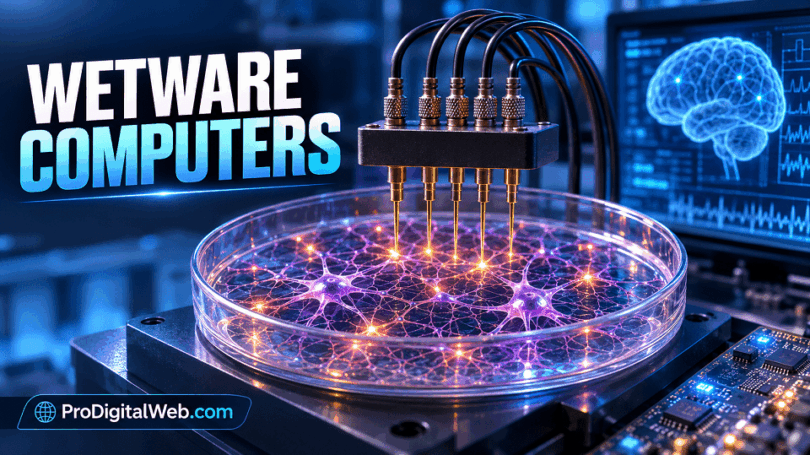
Experimental wetware systems often combine cultured neurons or neural tissue with electrodes, sensors, electronics, software, and controlled biological environments. The biological network provides part of the information processing, while electronics deliver inputs and interpret neural activity.
Wetware Computer Meaning
The term does not mean that an entire human brain is placed inside a computer. Researchers instead create controlled biological systems that can interact with electronic equipment.
Input → Living neural network → Neural response → Electronic output
How Wetware Computing Works
Researchers maintain living neural cells in laboratory cultures or, in some projects, use more complex neural tissues such as brain organoids. Electrodes can stimulate the cells and record their electrical activity.
A computer can convert information into stimulation patterns. The neural network responds with electrical activity, which can then be measured and analyzed. Feedback can be returned to the biological network so researchers can study adaptation.
Why Living Neurons Can Process Information
Neurons receive, process, and transmit information through electrical and chemical signals. Individual neurons perform relatively simple functions, but networks of interconnected cells can generate complex patterns of activity.
These networks can respond to stimuli and change their activity as connections are modified. Researchers are investigating whether some of these properties can be harnessed for specialized computing.
The goal is not to make neurons behave exactly like processors. It is to understand what biological neural networks can do differently from conventional electronic systems.
How Does a Wetware Computer Work?

Growing and Maintaining Living Neurons
Researchers grow neurons in controlled laboratory environments. Cells need appropriate nutrients, temperature, oxygen levels, and other conditions to remain healthy.
This biological requirement is one of the biggest differences from electronic computing. A processor can operate for years under suitable conditions, while living neural tissue requires continuous support.
Connecting Neurons to Electronic Systems
Electrode arrays provide a two-way interface between neural tissue and electronics. They can stimulate neurons and detect electrical activity produced by the cells.
The surrounding electronics convert those signals into information that conventional computers can process.
Sending Information to Biological Neurons
A computer can represent information through patterns of electrical stimulation delivered through an electrode array. The neurons respond by changing their electrical activity.
Designing useful and repeatable input patterns remains an important research challenge.
Reading Neural Activity as Computer Output
Electrodes can record neural activity and send measurements to a computer. Software can analyze patterns across many interconnected cells and interpret the response.
The system is therefore not simply reading a binary value from one neuron. It is measuring patterns of biological activity across a neural network.
Training Neurons With Feedback
Feedback allows researchers to study whether a biological network can adapt to a task. A simplified loop is:
Task → Neural response → Evaluation → Feedback → New neural response
This principle was demonstrated in experiments involving cultured neurons and a simplified version of Pong. The significance was the interaction between neural activity, feedback, and behavioral output—not human-like game understanding.
What Components Make Up a Wetware Computer?
A wetware computer is a hybrid system. The neurons are only one part of the architecture.
Living Neural Tissue
Cultured neurons, neural networks, or brain organoids can provide the biological processing component. Their activity can be influenced by external stimulation and feedback.
Electrode Arrays
Microelectrode arrays contain many small electrodes that can stimulate neural cells and record their electrical activity. They form a key communication layer between biology and electronics.
Electronic Interfaces
Interface electronics can stimulate, amplify, filter, record, and translate signals between the biological network and conventional computing equipment.
Software and Feedback Systems
Software controls inputs, records neural responses, analyzes activity, and can provide feedback. It creates the computational environment in which the biological network is tested.
Biological Support Systems
Living neurons require infrastructure that ordinary computers do not. Depending on the system, researchers need equipment to maintain the cells, supply nutrients, control environmental conditions, and support long-term operation.
How the Components Work Together
The overall architecture can be summarized as:
Living neurons → biological processing
Electrodes → neural interface
Electronics → signal translation
Software → control, analysis, and feedback
Support systems → biological maintenance
Why Are Scientists Using Living Neurons for Computing?
Researchers are interested in living neurons because biological networks process information, adapt to experience, and operate through highly interconnected systems. These properties are different from the precise operations of conventional processors.
Neurons Naturally Process Complex Information
Neurons continuously receive signals, combine information, and influence other cells. Large networks can produce patterns of activity that support recognition and responses to changing conditions.
Researchers are investigating whether these natural properties can be useful for specialized information processing.
Biological Networks Can Adapt and Learn
Connections between neurons can strengthen or weaken with activity. This neuroplasticity is associated with learning and adaptation in biological nervous systems.
Wetware experiments can use stimulation and feedback to investigate whether networks can modify their activity without every response being explicitly programmed.
The Potential for Extremely Low-Power Computing
The efficiency of biological neural systems is a major research interest. However, wetware computers are not automatically low-power devices.
Living cells require energy, and laboratory systems need equipment for cell maintenance, stimulation, recording, and environmental control. The research question is whether biological networks can perform particular tasks with favorable energy efficiency.
Can Living Neurons Really Work Like a Computer?
Yes, living neurons can perform forms of information processing, but they do not work like conventional computer chips.
How Neurons Process Information
Neurons receive signals, integrate them, and can generate electrical impulses that influence other cells through synapses. Computational complexity emerges from networks containing many interconnected neurons.
Researchers can measure patterns of neural activity and examine how those patterns change in response to different inputs.
Neural Networks Learn From Feedback
Biological neural networks can change their activity and connections in response to experience. Researchers can provide feedback after a response and observe how later activity changes.
The Pong experiments provided an example of this approach. The important finding was adaptive interaction under controlled conditions, not human-like understanding.
Biological Computing Is Different From Digital Computing
| Digital Computing | Wetware Computing |
| Electronic circuits | Living neural networks |
| Precisely programmed operations | Patterns of biological activity |
| Highly predictable hardware | Biological variability |
| No living conditions required | Requires biological maintenance |
| Scaling is highly developed | Scaling remains difficult |
Wetware computing therefore should not be viewed as a biological version of a desktop PC. Its value lies in investigating a different form of information processing.
Famous Experiments in Wetware Computing
Wetware computing has moved beyond theory. Researchers have connected living neurons to electronic systems and tested whether they can participate in controlled computational tasks.
DishBrain and the Neurons That Learned to Play Pong
In 2022, researchers reported an experiment using approximately 800,000 living human and mouse brain cells grown on a multi-electrode array. The cells received electrical signals and produced measurable neural activity.
The system interacted with a simplified version of Pong. The experiment created a controlled environment where researchers could observe responses to inputs and feedback.
How Scientists Connected Neurons to a Game
The electrodes stimulated the neural culture and recorded its electrical activity. Information from the game was converted into stimulation, while neural responses were interpreted as game actions.
The resulting loop was:
Pong environment → Electrical input → Living neurons → Neural activity → Game response → Feedback
What the Pong Experiment Demonstrated
The experiment showed that cultured neuronal networks could participate in an interactive system and change their activity when provided with feedback. It also demonstrated the feasibility of combining biological neural tissue with electronic interfaces for experimental computing.
What the Experiment Did Not Prove
The experiment did not demonstrate human-like intelligence, general reasoning, or a biological replacement for a modern processor. The neurons operated within a carefully engineered system involving electrodes, software, electronics, and controlled laboratory conditions.
The result should therefore be understood as a proof of concept for adaptive biological computing.
What Is a Biological Computer?
A biological computer is a broader concept than a wetware computer. It refers to a computing system that uses biological molecules, cells, or biological processes to process information.
Biological Computer vs Wetware Computer
Wetware computing generally focuses on living biological tissue, particularly neural tissue. Biological computing can also include approaches based on DNA, proteins, molecular reactions, and other biological processes.
| Term | Typical Meaning |
| Biological computing | Broad field using biological processes for computation |
| Wetware computing | Computing involving living biological tissue, often neurons |
| DNA computing | Computing using DNA molecules and molecular operations |
How Biological Computers Use Living Cells
Living cells can sense signals, respond to changes, and exchange information. Researchers can attempt to harness these processes for computational purposes.
Neural systems are particularly interesting because neurons communicate through electrical and chemical signals and can form adaptive networks.
Are Biological Computers Actually Computers?
A biological system does not need to resemble a laptop to perform computation. If it transforms information through identifiable processes, researchers can investigate it as a computational system.
A biological computer may still rely heavily on conventional electronics for stimulation, measurement, storage, and control. In many cases, the biology performs only part of the computation.
What Is Organoid Intelligence?
Organoid intelligence is an emerging research field that investigates whether laboratory-grown brain organoids can contribute to information processing and computing.
What Is a Brain Organoid?
A brain organoid is a three-dimensional cluster of laboratory-grown cells that can develop some features of brain tissue. Researchers often begin with stem cells and guide them toward neural development.
Brain organoids are sometimes called “mini-brains,” but they are not complete miniature human brains. They lack the full organization and complexity of an actual brain.
How Brain Organoids Are Used for Computing
Researchers can connect organoids to electronic systems using technologies such as microelectrode arrays. These interfaces can deliver stimulation and record neural activity.
A simplified model is:
Digital input → Electronic interface → Brain organoid → Neural activity → Computer analysis
Organoid Intelligence vs Artificial Intelligence
| Artificial Intelligence | Organoid Intelligence |
| Mathematical neural networks | Living neural networks |
| Electronic hardware | Biological neural tissue plus electronics |
| Algorithmic learning | Biological plasticity can contribute to learning |
| Highly scalable infrastructure | Biological scaling remains difficult |
Organoid intelligence is not currently superior to AI. Its interest lies in exploring whether biological networks offer useful properties that could complement artificial systems.
Could Brain Organoids Become Computing Systems?
They could become components of experimental computing systems, but the field remains early-stage. Researchers still need better methods for growing organoids consistently, connecting them to computers, controlling inputs, interpreting activity, and providing feedback.
Ethical questions may also become more important as biological systems become more complex.
How Advanced Are Wetware Computers in 2026?
From Simple Neural Cultures to Integrated Platforms
Wetware computing has progressed considerably beyond the earliest demonstrations of neurons responding to electrical stimulation. Current systems increasingly combine neural tissue with high-density interfaces, microfluidics, life-support hardware, software control, and data-processing pipelines. This shift matters because a computing technology is not defined by its biological component alone. The surrounding system determines whether that component can be controlled, measured, maintained, and used repeatedly.
Early experiments often focused on proving that cultured neurons could respond to inputs. Modern research asks harder questions: how much information can be exchanged with a neural network, how reliably can it learn, how long can the tissue remain functional, and whether its behavior can be reproduced across experiments. These questions move wetware computing from a scientific curiosity toward an engineering discipline.
Two-Dimensional Versus Three-Dimensional Neural Systems
Many experimental systems use neurons grown as two-dimensional cultures on electrode arrays. These cultures are comparatively accessible to electrical interfaces and can be useful for controlled experiments. They have also played an important role in demonstrating closed-loop learning.
Three-dimensional brain organoids provide a different architecture. They can contain more complex arrangements of neural cells and can develop internal networks that are difficult to reproduce in a flat culture. However, the extra biological complexity also creates engineering problems. It becomes harder to deliver nutrients uniformly, stimulate the entire structure, record activity throughout the tissue, and compare one organoid with another.
A three-dimensional system is therefore not automatically a better computer. It is a more complex biological substrate. Researchers still need to establish how that complexity translates into useful computation.
Brain-on-a-Chip as an Engineering Platform
Brain-on-a-chip systems attempt to integrate biological tissue with micro-engineered hardware. A typical architecture can include neural tissue, microelectrode arrays, microfluidic channels, stimulation electronics, recording circuits, environmental monitoring, imaging, and software.
This integration is important because the hardest part of wetware computing is not simply keeping neurons alive. The system must also communicate with them in a controlled way. Recent reviews describe brain-on-a-chip platforms that combine organoids with MEAs and microfluidic systems while using encoding and decoding methods to translate information between digital and biological domains.
The field is therefore moving toward complete systems rather than isolated biological experiments. That is an important step if researchers eventually want to compare wetware computers with conventional computing technologies.
What Current Platforms Can Actually Do
Commercial and research platforms now provide more than a culture dish and a set of electrodes. Cortical Labs describes CL1 as a code-deployable biological computer with closed-loop interaction between living neurons and software. Its system includes life support and programmable bidirectional stimulation and recording.
FinalSpark’s Neuroplatform takes another approach by providing remote access to human brain organoids for biocomputing research. Its platform combines neural stimulation and recording with environmental systems and software access.
These developments should not be interpreted as evidence that biological computers have become general-purpose machines. They show something more modest but important: researchers are beginning to package the infrastructure needed to conduct biological-computing experiments in a more standardized and accessible way.
Why 2026 Is an Important Stage
The significance of the current stage is less about raw neuron counts and more about system integration. Wetware computing needs reliable interfaces, stable biological environments, useful software tools, and agreed ways to measure performance.
The field is beginning to develop those layers. As platforms become more standardized, researchers can compare different biological substrates and experimental methods more systematically. That could reveal which tasks are genuinely suited to biological computation and which are better handled electronically.
The next major milestone will not simply be a bigger neural culture. It will be a reproducible biological computing system that demonstrates a measurable advantage on a clearly defined task.
Programming Through APIs and Closed-Loop Experiments
Python Can Control the Experimental Loop
The Neuroplatform paper provides a concrete example of software-controlled wetware. Researchers can use Python libraries or Jupyter notebooks to access electrophysiological functions remotely. The API can also control pumps, cameras, and UV lights, making software part of the physical experiment rather than only a data-analysis tool.
Wetware Can Run Experiments Continuously
Because stimulation, recording, environmental control, and data processing can be automated, experiments can run continuously without manual intervention at every step. The published Neuroplatform was designed for 24/7 experiments and closed-loop strategies, including workflows that can incorporate deep-learning or reinforcement-learning libraries.
The Biological Network Is Not Programmed Like Software
In an artificial neural network, changing numerical weights can directly alter model behavior. Biological networks do not provide an equivalent software variable that can simply be overwritten. Researchers instead influence them through stimulation, feedback, environment, and training conditions. The Neuroplatform paper identifies this as a central challenge in wetware computing.
How Do You Program a Wetware Computer?
Programming a Biological Network Is Different
Programming a wetware computer does not mean writing a long list of instructions that tells each neuron what to do. The researcher programs the surrounding environment and creates the conditions under which the biological network can adapt.
This distinction is central to understanding wetware computing. In a conventional program, the developer defines a sequence of operations. In a biological system, the developer may define inputs, outputs, rewards, stimulation patterns, and the task environment while allowing the neural network to determine its internal response.
Encoding Information Into Neural Signals
The first programming problem is input encoding. A digital value has to be translated into a stimulus that the biological network can receive.
Electrical stimulation is a common approach. Information can be represented through the timing, location, frequency, or pattern of stimulation across an electrode array. Other research explores chemical and optical methods.
There is no universal biological equivalent of a digital byte. The useful encoding depends on the network, interface, and task. Researchers therefore have to experimentally determine which stimulation patterns produce meaningful and repeatable responses.
Creating a Learning Environment
Once the input has been defined, researchers need a task. A task can involve classification, control, pattern recognition, a virtual environment, or another measurable objective.
The task gives the neural network something to respond to. The system then records the biological response and evaluates the result. This makes wetware programming closer to designing a learning environment than writing deterministic instructions.
Decoding the Neural Output
The next stage is decoding. Neural activity is recorded through electrodes and converted into data. Software can detect spikes, calculate firing rates, examine population activity, or use machine-learning models to classify patterns.
The decoder becomes part of the computer. If it is poorly designed, the biological network may appear ineffective even when it is producing useful activity. This is why wetware computing is inherently interdisciplinary: neuroscience, electronics, signal processing, machine learning, and software engineering all affect the final result.
Feedback and Closed-Loop Control
Feedback closes the programming loop. The system evaluates a neural response and changes the environment or stimulation accordingly.
A useful way to think about this is as an adaptive controller. The developer defines the rules of interaction, but the biological network contributes its own dynamics. Repeated feedback can then change future responses.
This approach is one of the main reasons wetware computing is interesting for adaptive systems. It tests whether biological plasticity can become a practical computational resource.
Why Wetware Programming Is Hard to Reproduce
A conventional program can normally be copied exactly. A biological network cannot be duplicated in the same way. Cells develop, connections change, and cultures can differ.
A program that works on one neural culture may therefore need calibration before it works on another. Future wetware systems will need standardized interfaces and calibration methods if developers are expected to build reusable applications.
How Do Scientists Measure Wetware Computer Performance?
Task Accuracy Is Only One Metric
A wetware computer can be evaluated by how accurately it performs a task, but accuracy alone is not enough. Researchers also need to know how much training was required, how stable the performance remains, and how much supporting infrastructure is needed.
For example, a biological system that achieves a high accuracy after extensive manual calibration may be less useful than a conventional model that reaches the same accuracy automatically.
Learning Efficiency
Learning efficiency asks how much experience a biological network needs to reach a useful level of performance. This can be measured through trials, training epochs, interactions, or another task-specific measure.
This metric is particularly interesting because biological networks may adapt differently from artificial neural networks. However, comparisons must use the same task, data, hardware assumptions, and evaluation criteria.
Latency and Throughput
Latency measures how long a system takes to produce a response. Throughput measures how much information or how many tasks it can process over time.
Biological neural signaling is not generally faster than electronic computation. A wetware system would therefore need a different advantage to justify its use. A specialized task could still be attractive if biological adaptation reduces training or computation elsewhere in the system.
Stability and Biological Lifetime
Researchers must also measure how performance changes as cells mature, adapt, or age. A system that performs well for several hours may be less useful than one that remains stable for months.
This is why life-support technology matters. Biological lifetime becomes part of the computer’s operating specification.
Reproducibility Across Cultures
One of the most important benchmarks is whether separate biological systems produce comparable results. Differences between cultures can arise from cell composition, maturation, connectivity, environmental conditions, and experimental handling.
Reproducibility is essential if wetware computing is ever to become an engineered technology rather than a sequence of individual demonstrations.
Energy at the System Level
Energy comparisons need to include the complete system. Measuring only the biological tissue can create a misleading impression.
A fair comparison should consider stimulation, recording, signal processing, life support, fluid handling, environmental control, storage, communication, and any conventional computing used to run the experiment.
Only then can researchers determine whether a biological system offers a genuine energy advantage for a specific workload.
Benchmarking Against Strong Baselines
A wetware computer should ultimately be compared with the best practical conventional solution to the same task. Saying that neurons can perform a task is not enough.
A meaningful benchmark asks whether the biological system is better on a defined metric. That metric could be energy per task, training data, adaptation time, robustness, latency, cost, or another property that matters to the application.
This approach will help the field move beyond demonstrations and toward measurable engineering results.
Real-World Wetware Computing Projects: What They Demonstrate
DishBrain: The Proof of Concept
DishBrain remains an important reference point because it demonstrated a closed-loop system in which cultured neurons interacted with a digital environment. The experiment showed that biological neural networks could participate in an embodied computational task.
Its importance is not that neurons became a general-purpose processor. The importance is that the experiment connected input, biological activity, feedback, and output into one functioning loop.
CL1: Toward a Standardized Biological Computer
Cortical Labs’ CL1 represents a more engineered direction. The company describes a system in which real neurons are cultivated on a silicon chip and connected to software through a biological intelligence operating system.
The platform is designed to provide life support, recording, stimulation, and closed-loop interaction. Its significance is therefore architectural: it packages the pieces required to make biological neural networks accessible as computing components.
Cortical Cloud: Remote Biological Computing
Remote access can change who is able to experiment with wetware. Instead of requiring every researcher to maintain a specialized biological laboratory, a cloud interface can provide access to biological computing infrastructure.
This model resembles cloud computing in one important respect: the user interacts with a remote computational resource through software. The difference is that the resource contains living biological tissue and therefore requires physical maintenance behind the interface.
FinalSpark Neuroplatform
FinalSpark’s Neuroplatform provides remote access to human brain organoids for research. The platform supports stimulation, recording, data storage, and software-based interaction.
The significance is not that organoids have become autonomous computers. It is that biological computing is beginning to acquire research infrastructure that can be accessed through standard digital workflows.
Brain-on-a-Chip Research
Academic research is also moving toward integrated brain-on-a-chip systems. These platforms can combine organoids or neural cultures with MEAs, microfluidics, electrophysiological interfaces, imaging, and data-processing methods.
The goal is to solve several problems simultaneously: keeping tissue alive, communicating with it, and turning its activity into interpretable information.
What These Projects Have in Common
The leading projects share a common architecture. Biology supplies the neural substrate. Electronics provide the interface. Software controls the experiment and interprets activity. Life-support systems keep the tissue functional.
This is why the phrase biological computer can sometimes be misleading. The system is not purely biological. It is a hybrid machine in which biology performs one part of the computational process.
What Wetware Computing Has Actually Proven
Proven at the Experimental Level
Research has demonstrated that living neural networks can be electrically stimulated, recorded, placed in closed-loop environments, and used for defined information-processing tasks. Cultured neurons have interacted with games and other controlled environments, while organoid systems are being investigated for increasingly complex tasks.
These demonstrations establish feasibility. They do not establish commercial superiority.
Not Yet Proven at General-Purpose Scale
There is no evidence that current wetware computers can replace CPUs, GPUs, smartphones, servers, or large AI clusters. Conventional computing remains dramatically more mature.
Wetware systems also depend on conventional computing for many tasks surrounding the biological component. The field is therefore better understood as an emerging specialized architecture.
Why This Distinction Matters
Separating demonstrated capability from future potential makes the technology easier to evaluate. It also prevents the article from making claims that are stronger than the underlying research.
The most interesting future developments will be measurable. If a biological system can repeatedly outperform a conventional baseline on a specific workload, that would be much more significant than simply increasing the number of neurons in an experiment.
Wetware Computing vs Brain-Computer Interfaces
The Two Technologies Are Related but Different
Wetware computing and brain-computer interfaces both connect neural activity with electronic systems, but they usually address different settings. A brain-computer interface normally connects technology to a living nervous system, often with the goal of reading or stimulating neural activity in an organism. Wetware computing generally places biological neural tissue itself inside an engineered computing system.
Where the Technologies Overlap
Both fields require bidirectional communication, signal processing, stimulation, recording, and decoding. Advances in electrodes, neural signal processing, and closed-loop control can therefore benefit both areas.
Why Wetware Computing Is Not Simply a BCI
A BCI is often designed around an existing biological nervous system. A wetware computer treats the biological neural network as part of the computational substrate. That distinction matters because wetware researchers can design the biological environment, training task, and interface around the computing objective.
Types of Neural Interfaces Used in Wetware Computing
Planar Microelectrode Arrays
Planar MEAs place electrodes on a surface where cultured neurons can grow. They are relatively established and useful for recording and stimulation across two-dimensional neural networks.
High-Density Electronic Arrays
Higher-density arrays can provide more recording and stimulation channels. Greater spatial resolution may allow researchers to exchange more information with a neural network, although more channels also create demanding data-processing and hardware requirements.
Three-Dimensional and Flexible Interfaces
Brain organoids are three-dimensional, so researchers are exploring flexible and three-dimensional electrode structures that can interact with neural tissue throughout its volume. The engineering problem includes matching the mechanical properties of tissue while maintaining stable electrical contact.
Microfluidic Interfaces
Microfluidics help maintain living tissue by controlling nutrient delivery, waste removal, and the local environment. In an integrated brain-on-a-chip system, microfluidics can become part of the computing infrastructure rather than merely laboratory support.
Why Interface Technology Matters
The neural interface determines how much information can enter and leave the biological system. Better interfaces could improve both computational performance and the ability to reproduce experiments.
The Energy Question: Are Wetware Computers Really Low Power?
Why the Brain Is Often Used as an Example
The human brain performs enormous amounts of information processing while consuming roughly the power of a small light bulb. This makes biological computation attractive as a source of ideas for energy-efficient computing.
Why That Comparison Can Mislead
A wetware laboratory system is not a complete brain. It may require pumps, temperature control, nutrient delivery, stimulation electronics, recording hardware, imaging, digital signal processing, and data storage. Those components must be included in any fair energy comparison.
What Researchers Should Compare
The useful metric is energy for a defined task at the level of the complete system. Researchers can then compare the biological platform with a conventional processor or AI accelerator performing the same workload.
Where an Advantage Could Emerge
A biological network could become attractive if it performs a specialized adaptive task with less training data or lower system energy than a practical electronic alternative. That advantage has to be demonstrated rather than assumed from biological efficiency alone.
What Would Make Wetware Computing Commercially Useful?
A Repeatable Biological Substrate
Commercial computing depends on consistency. A useful wetware platform would need biological systems that can be produced with predictable characteristics and maintained for a defined operating period.
A Stable Interface
The interface must deliver inputs and collect outputs without causing unacceptable damage or performance drift. This is especially difficult when the biological system changes over time.
A Clear Application Advantage
Wetware computing does not need to outperform silicon at everything. It needs to be better at something valuable. That could be adaptive control, a biomedical modeling task, a specialized pattern-recognition problem, or another workload where biological properties matter.
A Practical Software Layer
Researchers and developers need APIs, development tools, debugging methods, monitoring, and reproducible workflows. Without a software layer, each wetware experiment remains a custom research project.
A Sustainable Operating Model
Biological computers require consumables, maintenance, and specialist infrastructure. Commercial viability will depend on whether those costs can be reduced enough to justify the biological advantage.
What Could Stop Wetware Computing From Scaling?
Biological Variability
Living systems naturally vary. Differences in cell composition, development, connectivity, and environmental history can affect performance.
The Interface Bottleneck
A neural network may contain many active cells, but the electronic interface can access only a limited portion of that activity. Increasing neuron count without improving the interface may not increase useful computational capacity.
Data Bottlenecks
Recording many neural channels generates large data streams. Processing, storing, and interpreting those signals can become a computational burden of its own.
Long-Term Stability
A system designed around living cells must account for biological aging, maturation, adaptation, and environmental changes. Stability is therefore a core part of computer engineering in wetware systems.
Manufacturing Complexity
Traditional processors benefit from extremely mature manufacturing processes. Producing biological computing systems requires coordination among cell biology, materials science, electronics, microfluidics, and software.
Unclear Economic Advantage
Even if a wetware system performs an interesting task, it may not be commercially useful if the supporting infrastructure costs more than conventional computing. Economic benchmarking will eventually matter as much as scientific demonstration.
What Researchers Need to Solve Next
Better Biological Standardization
Future systems need neural cultures with more predictable cell composition, maturation, connectivity, and behavior. Standardization would make experiments easier to reproduce and would allow researchers to compare different platforms using common benchmarks.
Higher-Bandwidth Interfaces
More useful biological computation will require interfaces that can stimulate and record neural activity with greater spatial and temporal precision. This is especially important for three-dimensional tissues where a surface electrode cannot access every region.
Longer Operating Lifetimes
A practical wetware computer must remain functional long enough to justify its infrastructure. Longer-lived cultures and organoids would make continuous experiments possible and reduce the need to repeatedly replace biological components.
Better Encoding and Decoding
Researchers need reliable ways to translate digital information into biological stimulation and neural activity back into digital outputs. Better algorithms may be as important as better electrodes.
Standard Benchmarks
The field needs common measurements for learning, energy, reliability, latency, lifetime, and reproducibility. Without standardized benchmarks, it is difficult to determine whether one biological system actually outperforms another.
Clear Application Targets
Wetware computing will mature faster if researchers focus on tasks where biology has a plausible advantage. General-purpose computing is already exceptionally good; the opportunity is to identify workloads where biological adaptation or parallel neural processing provides something different.
The Most Likely Future: Hybrid Computing
Silicon Will Remain the Foundation
For the foreseeable future, silicon electronics are likely to remain responsible for storage, networking, operating systems, general-purpose processing, and large-scale AI infrastructure.
Biology Could Become a Specialized Processor
A biological neural network could potentially be used like a specialized accelerator. Instead of replacing the CPU, it would perform a task that benefits from biological plasticity or distributed neural processing.
AI Could Manage the Biological Layer
Machine-learning systems could help analyze neural activity, optimize stimulation, detect drift, and translate biological responses into useful outputs. This creates a feedback relationship between artificial and biological intelligence.
The Result Would Not Look Like a Human Brain
A successful hybrid computer would still be an engineered machine. Biological tissue would be one component inside a carefully controlled architecture rather than an attempt to reproduce an entire human brain.
Wetware Computer vs Traditional Computer
The two approaches use different computational substrates and have different practical strengths.
| Feature | Wetware Computer | Traditional Computer |
| Core technology | Living biological neural networks | Electronic circuits and processors |
| Processing | Biological neural activity | Digital electronic operations |
| Learning | Can involve biological plasticity | Controlled through algorithms and software |
| Speed | Biological signaling is relatively slow | Electronic circuits operate extremely quickly |
| Reliability | Biological variability can be a challenge | Highly predictable under controlled conditions |
| Scalability | Difficult and experimental | Highly developed |
| Maintenance | Requires controlled biological conditions | Conventional power and cooling |
| Maturity | Experimental | Mature and widely deployed |
| Typical role | Research and specialized computing | General-purpose computing |
Which One Is More Powerful?
For general-purpose computing, traditional computers are far more practical today. They are fast, programmable, scalable, and reliable.
Wetware computing is instead being investigated for specialized tasks where biological adaptation or information processing could be useful.
Could the Two Technologies Work Together?
Yes. A hybrid system could use conventional electronics for storage, communication, control, and software while a biological network handles a specialized processing task.
Wetware Computing vs Neuromorphic Computing
Both fields draw inspiration from biological brains, but they use different substrates.
| Feature | Wetware Computing | Neuromorphic Computing |
| Computing substrate | Living biological tissue | Engineered electronic hardware |
| Neural elements | Biological neurons | Artificial neurons or circuits |
| Biological cells | Yes | No |
| Main challenge | Maintaining and controlling living systems | Designing and scaling specialized hardware |
| Relationship to the brain | Uses biological neural activity | Imitates selected biological principles |
What Makes Wetware Computing Different?
Wetware computing uses actual biological components such as cultured neurons or neural tissue. Neuromorphic computing uses electronic systems designed to reproduce selected characteristics of neural processing.
Where the Two Approaches Overlap
Both approaches investigate interconnected neural processing, adaptive behavior, and potentially efficient information processing. They can also complement conventional computing architectures.
Why Wetware Computing Is Not Simply Neuromorphic Computing
Neuromorphic hardware is engineered and does not require living cells. Wetware systems depend on biological tissue and therefore face different maintenance, variability, and scaling challenges.
For a deeper explanation of neuromorphic systems, see ProDigitalWeb’s existing “Neuromorphic Computing” article.
The Three Core Layers of a Brain-on-a-Chip
The Biological Layer
The first layer is the living neural system. Researchers can use cultured neural networks or three-dimensional brain organoids as the biological processing component. The 2025 review describes organoids as the core decision-making unit in a brain-on-a-chip architecture, while also noting that organoids remain simplified models rather than complete brains.
The Interface Layer
The second layer is the neural interface. Microelectrode arrays, or MEAs, can deliver stimulation to neural tissue and record its electrical activity. Electrophysiology hardware then converts those signals into data that conventional computers can process.
The Support Layer
The third layer keeps the biological system functional. Microfluidic platforms can provide nutrients and support controlled exchange of oxygen, metabolites, and waste. In some organ-on-a-chip designs, continuous media perfusion is used to create a more stable environment for living tissue.
How the Three Layers Work Together
These layers form a complete computing loop: the biological tissue performs neural processing, the interface exchanges information with it, and the support system keeps the tissue viable. The surrounding software and electronics then encode inputs, decode outputs, and manage feedback.
How Do Wetware Computers Send Information to Neurons?
Electrical Stimulation
Electrical stimulation is one of the most established methods. Electrodes can deliver controlled pulses to selected locations in a neural network. By changing the timing, location, or pattern of stimulation, researchers can encode information for the biological system.
Chemical and Thermal Stimulation
The 2025 brain-on-a-chip review also discusses chemical and thermal stimulation as possible ways to influence biological neural systems. These methods show that wetware computing is not limited to one type of input, although electrical interfaces remain especially important for practical closed-loop systems.
Optical and Other Experimental Methods
Other neural-engineering approaches can use light or other physical stimuli to influence neural activity. The useful method depends on the biological model, the desired spatial precision, and the experimental setup.
Why Encoding Is Difficult
A digital computer has standardized representations for data. A biological network does not have an equivalent universal input format. Researchers therefore have to determine which stimulation patterns reliably produce useful neural responses for a particular task.
How Scientists Separate Neural Signals From Electrical Noise
Why Stimulation Creates a Problem
Wetware systems often stimulate and record through the same or nearby electrodes. The electrical pulse used to stimulate neurons can therefore appear as a large artifact in the recording. That artifact can obscure the much smaller neural signals researchers want to measure.
Spike Detection
After recording, researchers can identify electrical events associated with neuronal spikes. Spike detection methods help separate candidate neural events from background activity and other signal components.
Artifact Removal and Filtering
Artifact-removal and filtering techniques can reduce the influence of stimulation signals and other electrical interference. This step is important because an incorrect signal can lead to an incorrect interpretation of what the biological network is doing.
Feature Extraction and Decoding
Once usable neural signals have been extracted, researchers can calculate features such as firing rates and population activity. Decoding algorithms can then translate those features into task outputs. The 2025 review describes examples using firing rate with logistic regression or linear regression for specific brain-on-a-chip tasks.
Why Signal Processing Matters
The biological network and the decoder form a combined system. A wetware computer is only useful if its neural activity can be converted into reliable information. Better signal processing can therefore improve the effective computational capacity without changing the biological tissue itself.
Why Keeping Large Brain Organoids Alive Is Difficult
The Diffusion Problem
As a brain organoid becomes larger, cells deeper inside the tissue can be farther from sources of oxygen and nutrients. Simple diffusion may not be enough to maintain every region of a growing three-dimensional tissue.
Necrosis and Uneven Development
Insufficient delivery can contribute to unhealthy or necrotic regions inside organoids. This can affect neural activity and make different organoids behave differently, which creates problems for both biological research and computing.
Microfluidics and Perfusion
Microfluidic systems can help deliver nutrients and remove waste more effectively. The review describes continuous media perfusion in organ-on-a-chip systems as a way to support exchange of nutrients, oxygen, and metabolites.
Why Larger Is Not Automatically Better
A larger organoid can contain more cells and potentially richer neural activity, but greater size also increases the difficulty of maintaining and interfacing with the tissue. The useful goal is therefore not simply maximizing organoid size. Researchers need a biological structure that can remain healthy, controllable, measurable, and computationally useful.
The Maturity Problem
Brain organoids also differ from real brains in cell types, regional organization, maturation, and neural circuitry. These differences limit how closely they can model full human brain function and also affect their usefulness as standardized computing substrates.
Remote and Long-Duration Experiments
Wetware research is becoming less dependent on short laboratory demonstrations. The Neuroplatform paper describes organoids with lifetimes of more than 100 days and a system designed for 24/7 monitoring, stimulation, and automated medium changes. This enables researchers to investigate neural behavior over much longer periods. citeturn0view0
Closed-Loop Experiments Beyond Games
The same closed-loop principle used in game experiments can be applied to other tasks. The published Neuroplatform supports experiments in which stimulation can depend on previously recorded neural activity, allowing researchers to study how a biological network changes in response to its own history and feedback. citeturn0view0
What Tasks Have Wetware Computers Actually Performed?
Speech Recognition
The 2025 review summarizes a study in which a 3D organoid was used for speech-recognition research. The reported accuracy was 78.0% ± 5.2%, using electrical stimulation as the encoding method and firing rate with logistic regression for decoding. The review notes that the system used fewer data points than the comparison approach, highlighting learning efficiency as an area of interest.
Predicting Nonlinear Systems
The review also describes a 3D organoid used to predict nonlinear chaotic equations. It reports a regression score of 0.8233 and notes that the brain-on-a-chip approach used four training epochs compared with 50 epochs for the LSTM-based artificial neural-network comparison in that study.
Obstacle Avoidance
Brain-on-a-chip systems have also been investigated for obstacle-avoidance tasks. The review reports that closed-loop feedback improved travel distance between impacts compared with an empty chip and an open-loop configuration, providing evidence that the biological system could adapt to external stimulation.
Pathfinding
The review summarizes pathfinding experiments using two-dimensional neural networks. Reported implementations used firing-rate decoding with electrical stimulation, and one approach achieved a pathfinding task with a reported completion time of about 279 seconds and approximately 100% correct turning in the cited experiment.
Robot Control
Neural cultures have also been used in experiments involving robotic control, including a robotic arm drawing task. These demonstrations are important because they move wetware computing beyond abstract classification and into interaction with physical systems.
Video Games
DishBrain’s Pong experiment is another example of closed-loop interaction between neural activity and a virtual environment. The review groups video-game experiments with other demonstrated wetware-computing tasks, showing that biological networks can participate in controlled interactive environments.
What These Results Really Mean
These demonstrations show that biological neural systems can contribute to defined computational tasks. They do not show that organoids or cultured neurons are general-purpose computers. Results are task-specific and depend on the interface, decoder, training method, and biological system.
Inside a Modern Wetware Computing Platform
The Biological Computing Unit
A modern wetware platform starts with living neural tissue rather than a conventional processor. FinalSpark’s Neuroplatform, for example, uses human stem-cell-derived neural organoids as the biological component. Its 2024 platform paper described experiments involving more than 1,000 brain organoids, illustrating how a biological computing platform can be operated beyond a single laboratory demonstration.
Microelectrode Arrays Connect Biology and Electronics
Microelectrode arrays provide the bidirectional interface between living tissue and electronics. They can deliver stimulation to neural networks and record their electrical activity, allowing information to move into and out of the biological system. citeturn0view0
Microfluidics Keeps the System Alive
The biological component also needs continuous environmental support. The Neuroplatform paper describes automated microfluidic medium flow and changes, reducing physical intervention and helping maintain stable conditions around the organoids during long experiments.
Software Turns the Biological System Into a Programmable Platform
The software layer is equally important. FinalSpark’s published platform provides an API accessible through Python and Jupyter notebooks, allowing researchers to control electrophysiological operations and supporting equipment remotely.
The Complete Closed-Loop Architecture
A realistic wetware computer therefore looks like this: software defines an experiment, electronics encode stimulation, living neurons process the input, electrodes record neural activity, software decodes the response, and feedback can change the next input. Life-support and microfluidic systems operate continuously in the background. The biological tissue is one part of a larger hybrid machine.
How Much Data Does a Wetware Computer Generate?
Continuous Neural Recording Creates Large Datasets
Wetware computing creates a data problem that is easy to overlook. Neural activity can be recorded continuously across multiple electrodes, producing time-series data that must be stored and analyzed. FinalSpark reported more than 18 terabytes of collected data from over 1,000 brain organoids during the period described in its 2024 Neuroplatform paper.
Action Potentials Are the Raw Events
Much of this information consists of electrophysiological recordings containing action potentials and other signal features. Researchers can detect spikes, calculate firing rates, analyze population activity, and use the resulting data for decoding and machine-learning experiments.
Data Processing Becomes Part of the Computer
This makes a wetware computer more than a biological device. It is also a data pipeline involving recording, filtering, spike detection, feature extraction, decoding, storage, and feedback. As the number of channels and experiment duration increase, the digital layer becomes increasingly important.
What Could Wetware Computers Be Used For?
Most applications remain experimental. Researchers are investigating where biological neural networks could provide useful specialized capabilities.
Artificial Intelligence and Machine Learning
Wetware systems could potentially contribute biological neural networks to specialized learning tasks. The more realistic near-term role is complementing conventional AI rather than replacing modern AI infrastructure.
Pattern Recognition
Researchers can investigate whether biological networks can distinguish patterns of electrical activity or other inputs. Reliability and reproducibility remain important challenges.
Robotics and Adaptive Systems
Biological networks could potentially contribute to adaptive responses in robots by receiving sensor information and feedback. Such systems remain experimental because robotics requires predictable performance.
Drug Discovery and Biomedical Research
Neural cultures and brain organoids can help researchers study biological responses to substances and environmental conditions. These models may contribute to research involving drug effects, toxicity, neurological disorders, and brain function.
Studying How Biological Intelligence Works
Wetware systems provide controlled environments for studying neural activity, learning, plasticity, and information processing. This research could also influence future AI and computing design.
What Are the Advantages of Wetware Computing?
The potential advantages come from properties that living neural networks already possess. These remain research opportunities rather than established commercial benefits.
Potentially Low Energy Consumption
Biological neural systems are highly interesting from an energy-efficiency perspective. However, wetware computers also require equipment for cell maintenance, stimulation, recording, and environmental control.
Natural Learning and Adaptation
Neural networks can modify their activity and connections in response to experience. Researchers can investigate whether this biological adaptability is useful for specialized computing.
Complex Biological Information Processing
Highly interconnected neural networks can generate complex activity patterns. Researchers are studying whether these properties can be harnessed for pattern recognition, sensory processing, and adaptive responses.
Combining Biology With Electronics
Hybrid architectures allow electronics to handle control, communication, storage, and signal processing while biological networks perform specialized tasks. This may be more practical than attempting to build a completely biological computer.
Scaling the Infrastructure Is a Challenge Too
Scaling wetware computing involves more than growing more neurons. Researchers must scale organoid production, electrode interfaces, microfluidics, environmental control, recording channels, data storage, and software infrastructure at the same time. The FinalSpark paper frames large-scale experimentation as a major reason for building an automated, remotely accessible platform. citeturn0view0
Biological Variability Remains an Engineering Problem
A biological network cannot be reset to an identical state in the way a digital processor can. Cell development, connectivity, maturation, and previous stimulation can influence later responses. This variability is part of the scientific interest in wetware, but it is also a major obstacle to reproducible computing.
What Are the Limitations of Wetware Computers?
The same biological properties that make wetware computing interesting also create major engineering challenges.
Keeping Living Neurons Alive
Neurons require nutrients, oxygen, temperature control, and other conditions to remain functional. Supporting living cells makes wetware systems more complicated than conventional electronic hardware.
Limited Scalability
Modern processors can be manufactured at enormous scale. Scaling living neural networks introduces challenges involving tissue growth, connectivity, nutrient delivery, signal control, and measurement.
Controlling Biological Systems
Neural responses can depend on biological state, connections, stimulation history, and environmental conditions. This makes precise control more difficult than controlling electronic circuits.
Reproducibility and Reliability
Biological cultures can develop differently and change over time. Researchers need methods to measure, control, and compensate for this variability before wetware systems can support demanding real-world applications.
Ethical Questions
As neural cultures and brain organoids become more complex, researchers are considering questions around biological complexity, possible forms of experience, use of human-derived cells, and appropriate safeguards. These issues remain subjects of scientific and ethical debate.
Why Wetware Computers Are Not Replacing PCs Yet
Traditional computers remain faster, more reliable, scalable, programmable, and easier to manufacture. Wetware computing is therefore better understood as an emerging research field than as a replacement for personal computers.
Are Wetware Computers Better Than AI?
No. Wetware computers are not currently better than AI. Modern AI systems are much more mature, scalable, and practical.
Wetware Computing and Artificial Neural Networks
Artificial neural networks are mathematical models implemented through electronic hardware and software. Wetware systems use actual biological neurons.
| Artificial Neural Networks | Wetware Neural Networks |
| Mathematical models | Living biological neurons |
| Electronic hardware | Biological tissue plus electronics |
| Parameters adjusted computationally | Biological connections can change |
| Highly scalable | Scaling remains difficult |
Biological Intelligence vs Artificial Intelligence
Wetware computing does not automatically create biological intelligence. A laboratory neural culture is vastly simpler than a complete brain, even when it demonstrates adaptive behavior.
Why Researchers May Combine Both Approaches
A hybrid system could combine conventional AI, electronic hardware, and biological neural networks. AI and electronics could handle large-scale computation and control, while biological systems could be investigated for specialized adaptive processing.
Could Wetware Computers Replace Silicon Computers?
Not anytime soon. Silicon remains the practical foundation of general-purpose computing because of decades of progress in semiconductor manufacturing, processors, memory, networking, and software.
Why Silicon Is Still Dominant
Modern processors contain enormous numbers of precisely engineered transistors and can be manufactured consistently at scale. They can run operating systems, applications, databases, simulations, and AI workloads.
Where Biological Computing Could Have an Advantage
Biological systems may be interesting for specialized tasks involving adaptation, pattern processing, biological signals, and other problems where neural plasticity could matter.
Why Hybrid Biological-Electronic Systems May Come First
A hybrid architecture can let electronics handle storage, communication, control, and general computation while biological networks handle specialized information processing.
The realistic question is therefore not whether living neurons will replace silicon. It is where biological systems might provide a useful capability that electronic systems do not provide as efficiently.
Real-World Wetware Computing Projects
Experimental projects provide a useful reality check because they show what has actually been attempted.
DishBrain
DishBrain is a well-known example of cultured neurons connected to electronic hardware and used in a simplified Pong environment. The system demonstrated interaction between biological neural activity, digital inputs, and feedback.
Cortical Labs and Biological Computers
Cortical Labs has continued developing biological computing systems that combine living neurons with silicon-based electronics. Its CL1 platform is designed to provide a research environment for interacting with biological neural networks.
Brain Organoid Computing Research
Brain organoid research investigates whether three-dimensional neural tissues can interact with electronic systems and contribute to information processing. This work remains early-stage and faces challenges involving consistency, control, interpretation, and maintenance.
What These Projects Have in Common
These projects use biological neural tissue together with electronic interfaces and software. They demonstrate genuine experimental computing, but they have not produced a general-purpose biological computer capable of competing with modern silicon processors.
What Has Changed Since the Early DishBrain Experiments?
From Proof of Concept to Deployable Platforms
The field is beginning to move from one-off demonstrations toward deployable platforms. Cortical Labs currently describes CL1 as a code-deployable biological computer and offers Cortical Cloud for remote access to biological neural systems. These are company descriptions, so they should be treated as evidence of available platforms rather than proof that biological computing has surpassed conventional AI.
Biological Computing Is Reaching Data-Center Discussions
In August 2026, the National University of Singapore announced a prototype Biological Data Centre involving NUS Medicine, DayOne, and Cortical Labs, including a demonstration of CL1/Cortical Cloud units and microelectrode-array integration. This does not establish commercial competitiveness, but it shows that wetware computing is entering real computing-infrastructure discussions.
The Important Question Is Still Performance
The emergence of platforms should not be confused with proof of superiority. The next important step is independent benchmarking against strong electronic baselines. A useful wetware computer must demonstrate a repeatable advantage on a defined workload, whether that advantage involves learning efficiency, energy, adaptability, latency, or another measurable property.
The Future of Wetware Computing
The future of wetware computing depends on whether researchers can turn laboratory demonstrations into reliable and scalable systems.
From Laboratory Experiments to Practical Systems
Researchers need better ways to maintain neural tissue, control activity, interpret signals, and reproduce results. Moving from a successful experiment to a dependable computing platform is a much larger engineering challenge.
The Rise of Biological Computing
Wetware computing is part of a broader movement exploring biological approaches to computation. Other approaches can involve DNA, proteins, molecular reactions, or different types of living cells.
Silicon is likely to remain dominant for general-purpose computing. Biological systems may instead become specialized components within larger architectures.
Could Living Neurons Power Future AI?
Possibly, but a hybrid role is more realistic than replacing today’s AI infrastructure. Biological networks could eventually be combined with AI algorithms and electronic processors to explore specialized adaptive computing.
Whether that becomes practical remains uncertain. The field still needs advances in maintenance, interfaces, scalability, reliability, and ethical oversight.
Key Research Source for Brain-on-a-Chip Computing
Li, S., Liu, Y., Hua, S., et al. (2025). “Advanced Brain-on-a-Chip for Wetware Computing: A Review.” Advanced Science, 12(33), e08120. DOI: 10.1002/advs.202508120. The review covers brain organoids, microelectrode arrays, electrophysiology interfaces, microfluidics, encoding and decoding, wetware-computing tasks, and technical challenges.
Key Takeaways
- Wetware computers use living biological systems, especially neurons, as part of computation.
- They combine neural tissue with electrodes, electronics, software, and biological support systems.
- DishBrain demonstrated that cultured neurons can interact with a digital environment and feedback.
- Biological computing is broader than wetware computing and can include DNA and molecular approaches.
- Organoid intelligence explores computing with laboratory-grown neural tissues.
- Potential advantages include biological adaptation and specialized information processing.
- Major obstacles include maintenance, scalability, reliability, control, and ethical questions.
- Wetware computers are not currently a replacement for silicon computers or modern AI.
- Hybrid biological-electronic systems may be the most realistic path forward.
Frequently Asked Questions About Wetware Computers
What Is a Wetware Computer?
A wetware computer is a computing system that uses living biological material, especially neural tissue, as part of its information-processing system.
Are Wetware Computers Real?
Yes. Researchers have built experimental systems that connect cultured neurons or other neural tissue with electronic interfaces.
Can Neurons Be Used as Computers?
Yes. Neural networks can receive signals, generate electrical activity, and adapt to feedback, allowing researchers to investigate them as computational systems.
Can a Computer Be Made From Living Cells?
At an experimental level, yes. Living cells can form part of biological computing systems, although conventional electronics are still needed for interfaces, control, and analysis.
Are Wetware Computers Conscious?
There is no evidence that ordinary experimental neuron cultures are conscious. Brain organoids and neural cultures are much simpler than complete brains, although ethical questions may become more important as systems become more complex.
How Much Energy Does a Wetware Computer Use?
There is no single figure because experimental systems differ. Living cells and the equipment that maintains, stimulates, and records them all require energy.
Can Wetware Computers Replace Normal Computers?
Not with current technology. Conventional computers remain faster, more reliable, scalable, and versatile.
What Is the Difference Between Wetware and Neuromorphic Computing?
Wetware computing uses living biological neural tissue. Neuromorphic computing uses engineered electronic hardware inspired by biological neural processing.
What Is Organoid Intelligence?
Organoid intelligence is research into using laboratory-grown brain organoids for information processing and computing.
What Are Wetware Computers Used For?
Current uses are mainly experimental research involving neural information processing, adaptive computing, neuroscience, biological computing, and exploratory AI applications.
Conclusion
Wetware computing shows that computation does not have to be limited to electronic circuits. Researchers have demonstrated that living neural networks can interact with electronics, respond to inputs, and adapt through feedback.
That does not make biological computers ready to replace PCs, processors, or modern AI. Significant challenges remain in maintaining living cells, scaling neural systems, controlling biological variability, and achieving reliable operation.
The more realistic future is likely to involve specialized or hybrid systems. Conventional electronics could provide speed, storage, control, and scalability, while biological neural networks could contribute capabilities that researchers are still learning how to harness.
Wetware computing remains an early field. Its long-term importance may come not from replacing silicon, but from expanding our understanding of what a computing system can be made from.
Selected Research and Reference Sources
Jordan F. D., Kutter M., Comby J.-M., Brozzi F., Kurtys E. (2024). “Open and remotely accessible Neuroplatform for research in wetware computing.” Frontiers in Artificial Intelligence. DOI: 10.3389/frai.2024.1376042.
Li S. et al. (2025). “Advanced Brain-on-a-Chip for Wetware Computing: A Review.” Advanced Science. DOI: 10.1002/advs.202508120.
Cortical Labs — current CL1 and Cortical Cloud platform documentation.
FinalSpark — current Neuroplatform documentation and research updates.
About the Author
Rajkumar is a technology writer, blogger, and digital educator with a strong interest in emerging technologies, artificial intelligence, computing, and the future of digital innovation. He has been writing technology-focused content for years, with an emphasis on explaining complex technical subjects in clear, practical language. Through ProDigitalWeb, he explores emerging technologies and their potential impact on the way we work, communicate, and compute.
About the Editor
The ProDigitalWeb editorial team reviews technology articles for clarity, accuracy, relevance, and readability. Each article is checked for technical consistency, supported claims, and useful context before publication. The editorial process aims to make complex technology topics easier to understand while maintaining a practical, evidence-based approach.