

Last Updated: October 5, 2026 | 50 min read
Introduction
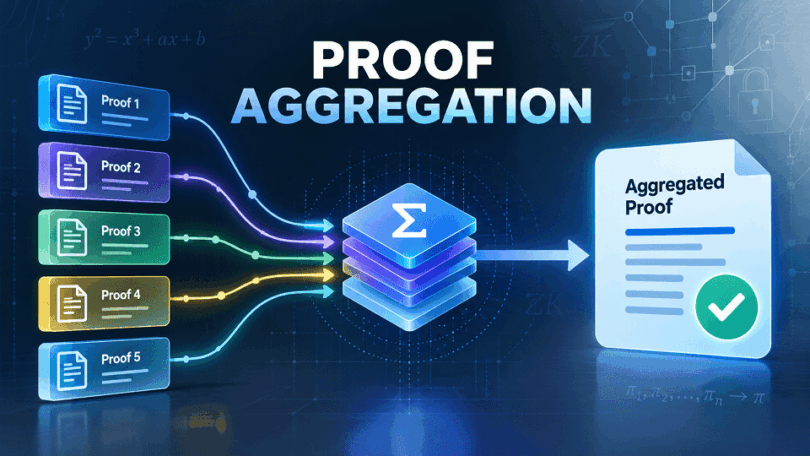
Proof aggregation is a cryptographic technique that combines multiple proofs into a single proof or a smaller set of proofs. This reduces the work required to verify many separate computations.
The idea becomes important as zero-knowledge systems handle more transactions, program executions, and computational tasks. Verifying every proof separately can increase computation, storage, and on-chain costs. Aggregation provides a way to organize those proofs into a more efficient verification process.
This matters across several areas of modern cryptography. Blockchain networks can aggregate proofs from many transactions or batches. Some zk-rollup architectures can use aggregation to reduce proof-verification overhead. A separate aggregation layer can combine proofs generated from multiple zkVM program executions. Verifiable AI can also benefit when many inference or computation proofs need verification.
Proof aggregation is closely related to recursive proofs, proof compression, and batch verification, but these techniques are not identical. Understanding the differences is important when choosing a proof system or designing a scalable zero-knowledge application.
In this guide, we will explain what proof aggregation is, how it works, the main types, how it differs from related techniques, and where it is used. We will also examine its benefits, limitations, blockchain applications, zkVM use cases, and future role in verifiable computing.
What Is Proof Aggregation?
Proof aggregation is a cryptographic technique that combines multiple proofs into a single proof or a smaller set of proofs. Instead of verifying every proof independently, a verifier can verify the aggregated result.
This approach becomes useful when a system produces many proofs for related computations. Verifying those proofs one by one can increase computational work and, in blockchain systems, can increase on-chain verification costs.
Simple Definition
Think of proof aggregation as combining many proof statements into one verifiable package.
Suppose a system generates 100 zero-knowledge proofs. Without aggregation, the verifier may need to process all 100 proofs separately. With an appropriate aggregation scheme, those proofs can be combined into one aggregated proof.
The verifier checks the aggregated result instead of performing the full original verification process independently for every proof.
The important point is that aggregation does not remove the underlying computations. The individual computations still happen, and their proofs still need to be generated. Aggregation mainly changes how those proofs are presented and verified.
How Proof Aggregation Works
A typical proof aggregation process has four basic stages:
- Generate individual proofs
- A prover creates separate proofs for different computations, transactions, or program executions.
- Collect the proofs
- An aggregation system receives the individual proofs and prepares them for combination.
- Aggregate the proofs
- The system uses a compatible cryptographic construction to produce one aggregated proof or a smaller proof set.
- Verify the result
- The verifier checks the aggregated proof. If verification succeeds, it establishes the validity of the claims represented by the aggregation.
The exact mechanism depends on the underlying proof system. Some approaches use recursive proving, while others use specialized cryptographic constructions designed to aggregate compatible proofs. Batch verification is related, but it does not necessarily create a new aggregated proof.
This distinction matters because proof aggregation is not automatically the same as recursive proving or proof compression. These techniques can work together, but they solve somewhat different problems.
Why Multiple Proofs Need to Be Combined
Modern zero-knowledge applications can generate a large number of proofs.
A blockchain, for example, may process many transactions and generate proofs for different batches. A zkVM may produce proofs for many program executions. A verifiable AI system could generate proofs for multiple computation or inference tasks.
Verifying each proof separately can create several challenges:
- Verification overhead: The verifier has more individual proofs to process.
- On-chain costs: Blockchain verification can become expensive when many proofs must be checked.
- Data requirements: Systems may need to transmit or store many proof objects.
- Scalability limits: Verification work can grow as the number of proofs increases.
Aggregation addresses this problem by creating a more compact verification workflow.
For example, imagine a system that produces 1,000 proofs from independent computations. Instead of sending all 1,000 proofs to the final verifier, an aggregation layer can combine them into a smaller verification package. The final verifier can then check that package according to the rules of the underlying aggregation scheme.
So, the main purpose of proof aggregation is not simply to make individual proofs smaller. Its goal is to make the verification of many proofs more efficient.
Key takeaway: Proof aggregation combines multiple cryptographic proofs into a single proof or smaller proof set, allowing systems to verify many computational claims more efficiently.
Why Is Proof Aggregation Important?
Proof aggregation becomes important when a system needs to verify many cryptographic proofs. As zero-knowledge applications grow, generating proofs is only part of the challenge. The system must also verify those proofs efficiently.
If every proof requires a separate verification process, the workload can grow with the number of proofs. Aggregation provides a way to combine those proofs into a more manageable verification process.
Reducing Verification Work
Without aggregation, a verifier may need to verify hundreds or thousands of proofs individually.
This creates additional computational work. It can also increase the resources required by validators, applications, or other verification systems.
Proof aggregation changes this process by combining multiple proofs before final verification.
The verifier can then verify the aggregated result rather than performing the full original verification process separately for every proof.
This does not mean the underlying computations disappear. The proofs still need to be generated and aggregated. The main improvement happens at the verification stage.
This makes aggregation useful for systems that regularly handle large numbers of proofs.
Lowering On-Chain Costs
Blockchain networks add another reason to use proof aggregation.
When proofs are verified on-chain, verification consumes blockchain resources. Depending on the blockchain and proof system, this can contribute to transaction fees and other execution costs.
Imagine a Layer-2 system that needs to submit many proofs to a blockchain. Submitting and verifying each proof separately can create unnecessary overhead.
An aggregation layer can combine those proofs before they reach the blockchain. The blockchain can then verify a smaller number of proof objects.
- On-chain verification work
- Proof-related transaction overhead
- The amount of verification data submitted to the blockchain
The exact savings depend on the proof system, aggregation method, implementation, and blockchain architecture. Aggregation does not automatically make verification free.
Scaling Zero-Knowledge Applications
Zero-knowledge systems become more useful when they can handle larger workloads efficiently.
A single application might eventually generate thousands or millions of proofs. These proofs could represent transactions, program executions, AI computations, or other verifiable operations.
Verifying every proof independently can become a scalability bottleneck.
Proof aggregation provides a way to organize this growing workload. Multiple proofs can be processed together and represented through a smaller verification structure.
This makes aggregation relevant to several areas:
- zk-rollups: Some architectures can combine proofs from multiple transaction batches.
- zkVMs: A separate aggregation layer can combine proofs from multiple program executions.
- Verifiable AI: Combine proofs from multiple computational tasks.
The broader goal is simple: increase the amount of computation that a system can verify without increasing verification work at the same rate.
Key takeaway: Proof aggregation improves scalability by reducing the work involved in verifying many proofs. It can also help lower on-chain overhead and make large-scale zero-knowledge applications more practical.
How Does Proof Aggregation Work?
Proof aggregation combines multiple cryptographic proofs into a form that can be verified more efficiently. The exact process depends on the underlying proof system and aggregation method.
At a high level, the workflow has four stages: generate the individual proofs, collect them, aggregate them, and verify the final result.
Generate Individual Proofs
The process begins with individual computations.
Each computation produces a result that needs to be verified. A prover then generates a cryptographic proof showing that the computation followed the required rules.
For example, a system could generate separate proofs for:
- Different blockchain transactions
- Multiple zkVM program executions
- Separate batches of computations
At this stage, each proof remains independent. The system has not combined them yet.
Collect the Proofs
The generated proofs are then sent to an aggregation process.
The aggregator receives the proofs and determines how they can be combined under the chosen proof system.
The proofs may represent different computations, but they must satisfy the requirements of the aggregation scheme. The aggregator may also need additional information about the statements or computations represented by the proofs.
This stage prepares the proofs for aggregation.
Aggregate the Proofs
The aggregator combines the individual proofs into a single aggregated proof or a smaller proof structure.
The exact technique varies between proof systems.
Some aggregation methods use recursive proof composition. Others use specialized cryptographic constructions that allow multiple proofs to be verified together.
The important idea is that the resulting proof represents the validity of multiple underlying proofs.
For example, suppose a system produces 100 individual proofs. An aggregation scheme may combine them into one proof that represents the validity of those 100 proofs.
The original computations do not disappear. Instead, their verification is represented through the aggregated result.
Verify the Aggregated Proof
The final step is verification.
Instead of verifying every individual proof separately, the verifier checks the aggregated proof according to the rules of the underlying proof system.
If verification succeeds, the verifier obtains assurance that the claims represented by the aggregation satisfy the required cryptographic conditions.
This can significantly simplify the verification workflow when a system handles large numbers of proofs.
The verifier does not necessarily need to reconstruct every original computation. The cryptographic properties of the aggregation scheme allow the verifier to check the combined result.
Simple Example
Consider a system that generates 1,000 proofs.
Without aggregation:
1,000 computations → 1,000 proofs → 1,000 verification tasks
With aggregation:
1,000 computations → 1,000 proofs → aggregated proof or verification structure → final verification
The aggregation step does not eliminate the cost of generating the original proofs. Its main purpose is to make the final verification process more efficient.
Key takeaway: Proof aggregation takes multiple independently generated proofs, combines them using a compatible cryptographic method, and produces a result that can be verified more efficiently.
Proof Aggregation vs Proof Compression
Proof aggregation and proof compression both aim to make cryptographic proof systems more efficient. The terms can sound similar because both can reduce the burden of handling proofs.
They solve different problems, though.
Proof aggregation combines multiple proofs into a single proof or smaller proof set. Proof compression focuses on reducing the size or representation of a proof.
Understanding this distinction is important when evaluating zero-knowledge systems.
What Is Proof Compression?
Proof compression is the process of reducing the size of a cryptographic proof or its representation.
A proof system may produce proofs that require significant storage or transmission space. Compression techniques aim to represent that proof more compactly while preserving the information needed for verification.
The main goal is therefore smaller proof representation.
For example, if a proof contains a large amount of data, a compression technique may reduce its size before it is stored or transmitted.
Proof compression can be useful when:
- Proofs need to be transmitted over a network.
- Proof storage creates a significant overhead.
- A system has strict data-size constraints.
Compression does not necessarily mean that multiple independent proofs become one proof. It can operate on an individual proof or another proof representation, and the term can cover different techniques for reducing proof size or verification data.
What Is Proof Aggregation?
Proof aggregation combines multiple proofs into a single proof or a smaller proof structure.
The proofs can represent different computations, transactions, or statements. An aggregation scheme combines them so that the resulting structure can be verified more efficiently.
For example:
Proof A + Proof B + Proof C → Aggregated Proof
The main goal is efficient verification of multiple proofs.
Aggregation can be useful when a system generates a large number of proofs and verifying each one independently would create significant computational or on-chain overhead.
An aggregation scheme may also produce a proof or verification structure that is smaller than the combined size of the inputs. That size reduction is common in succinct aggregation designs, but it is not the defining purpose of aggregation.
Key Differences
| Feature | Proof Aggregation | Proof Compression |
| Primary goal | Combine multiple proofs | Reduce proof representation size |
| Number of proofs | Usually multiple | Can involve a single proof |
| Main benefit | More efficient verification | Lower storage or transmission overhead |
| Typical input | Multiple proofs | A proof or proof representation |
| Output | Aggregated proof or proof set | More compact representation |
| Verification focus | Verify multiple claims together | Verify the compressed representation |
The two techniques can also work together.
A system may aggregate multiple proofs and then use compression to reduce the size of the resulting proof or data. In other designs, the aggregation mechanism itself produces a significantly smaller verification object.
So, proof aggregation should not simply be described as “compressing proofs.”
Key takeaway: Proof aggregation focuses on combining multiple proofs for efficient verification, while proof compression focuses on reducing the size of a proof or its representation. They address related but different efficiency problems.
Proof Aggregation vs Recursive Proofs
Proof aggregation and recursive proofs are closely related in modern zero-knowledge systems. Both can help a system handle many proofs more efficiently.
The main difference is in how the proofs are combined. Proof aggregation generally refers to combining multiple proofs into a single proof or smaller verification structure. Recursive proving uses a proof system to prove the correctness of another proof or computation.
In practice, recursive techniques can also be used to build proof aggregation systems.
How They Are Related
Both approaches address a similar scalability problem.
Suppose a system generates many proofs:
Proof 1 + Proof 2 + Proof 3 + … + Proof 100
Verifying every proof independently can require substantial computation.
An aggregation system can combine these proofs into a structure that supports more efficient verification.
Recursive proving can achieve a similar result by creating a new proof that verifies the correctness of earlier proofs.
A simplified recursive workflow looks like this:
Proof 1 + Proof 2 → Proof A
Then:
Proof A + Proof 3 → Proof B
The process can continue until a final proof represents the entire chain of computations.
This is why recursive proofs often appear in discussions about proof aggregation. Recursion is one technique that can be used to construct scalable proof aggregation systems.
Key Differences
| Feature | Proof Aggregation | Recursive Proofs |
| Basic idea | Combine multiple proofs | Prove the validity of another proof or computation |
| Main focus | Efficiently represent or verify many proofs | Build proofs that contain or verify previous proofs |
| Relationship | Can use recursive techniques | Can be used to implement aggregation |
| Structure | Multiple proofs combined into a verification structure | Proofs can be nested or composed through successive proving |
| Main benefit | Efficient verification of multiple proofs | Scalable proof composition and recursive computation |
| Typical use | Batch or multi-proof verification | Recursive aggregation, rollups, zkVMs, proof chains |
The distinction is useful because not every aggregation method has to be recursive, and not every recursive proof system is designed specifically for aggregating independent proofs.
When Is Proof Aggregation Used?
Proof aggregation is useful when a system has many proofs that need to be verified together.
Common situations include:
- Blockchain systems: Multiple transaction or batch proofs can be represented through an aggregated verification structure.
- zk-rollups: Some architectures can combine proofs from multiple batches to reduce verification overhead.
- Large-scale verifiable computation: Multiple independent computation proofs can be handled together.
The main objective is to make multi-proof verification more manageable.
When Are Recursive Proofs Used?
Recursive proofs become useful when a proof system needs to prove the validity of earlier proofs or computations.
This makes recursion useful for building long chains of computation without requiring the final verifier to process every intermediate proof independently.
For example, a zkVM can produce proofs for separate program executions. A recursive system can then create another proof that verifies those earlier proofs.
This approach is useful for:
- Building hierarchical proof systems
- Aggregating proofs recursively
- Processing large computation histories
- Creating scalable verification pipelines
Can They Be Used Together?
Yes.
In many advanced zero-knowledge architectures, recursive proving and aggregation work together.
A system might first generate many individual proofs, then use recursive techniques to combine them into progressively larger proof structures.
For example:
Individual proofs → Recursive aggregation → Final proof → Verification
This combination can help systems process large numbers of proofs while keeping the final verification process manageable.
Key takeaway: Proof aggregation describes the goal of combining multiple proofs for efficient verification, while recursive proving describes a technique for creating proofs that verify other proofs or computations. Recursive proving can therefore be an important building block for proof aggregation, but the two terms are not interchangeable.
Types and Related Approaches to Proof Aggregation
Proof aggregation can take different forms depending on the underlying proof system and the way multiple proofs are combined. The main approaches include SNARK aggregation, STARK aggregation, recursive aggregation, and batch verification.
These approaches share the goal of making multi-proof verification more efficient, but they use different techniques and have different trade-offs.
SNARK Aggregation
SNARK aggregation combines multiple zk-SNARK proofs into a single proof or a compact verification structure.
Suppose a system generates separate SNARK proofs for several computations:
Proof A + Proof B + Proof C → Aggregated SNARK Proof
The final verifier can then verify the aggregated result instead of processing every proof independently.
SNARK aggregation can be useful in blockchain systems where many proofs need to be verified on-chain. Reducing the number of verification operations can help reduce computational and transaction overhead.
The exact aggregation method depends on the SNARK construction. Some systems use recursive proof techniques, while others use specialized cryptographic aggregation schemes.
STARK Aggregation
STARK aggregation applies similar ideas to zk-STARK proofs.
STARK-based systems can generate proofs for large computations without relying on a trusted setup. When many STARK proofs are produced, an aggregation mechanism can combine them into a more manageable verification structure.
For example:
STARK Proof 1 + STARK Proof 2 + STARK Proof 3 → Aggregated Proof
This can be useful for systems that process large numbers of computational proofs.
STARK aggregation can become more complex because STARK proofs typically have different proof structures and performance characteristics from SNARKs. The specific aggregation technique therefore depends on the STARK protocol and implementation.
Recursive Aggregation
Recursive aggregation uses recursive proofs to combine multiple proofs.
Instead of directly combining all proofs into one structure, the system creates a new proof that verifies earlier proofs.
A simplified example looks like this:
Proof A + Proof B → Proof C
Proof C establishes that Proof A and Proof B were valid.
The system can then continue:
Proof C + Proof D → Proof E
This process can continue across many levels.
Recursive aggregation is useful when a system needs to combine large numbers of proofs while keeping the final verification process manageable.
It is particularly relevant to zkVMs, rollups, and verifiable computation systems, where many computational proofs may need to be combined over time.
Batch Verification
Batch verification is related to proof aggregation, but it is not necessarily the same thing.
Batch verification allows a verifier to check multiple proofs together in a single verification procedure. The verifier may use shared computations or algebraic techniques to avoid repeating the full verification process for every proof.
For example:
Proof A + Proof B + Proof C → Batch Verification
The verifier still deals with multiple proofs. It does not necessarily create a new aggregated proof.
This creates an important distinction:
Aggregation: Multiple proofs can be transformed into a combined proof or verification structure.
Batch verification: Multiple proofs are verified together without necessarily combining them into a new proof.
Batch verification can therefore reduce verification overhead while preserving the individual proofs.
How These Approaches Relate
These techniques can also be combined.
A system might generate many SNARK or STARK proofs, use recursive proving to aggregate them, and then use efficient verification techniques for the final result.
A simplified architecture could look like this:
Individual Proofs → Recursive Aggregation → Aggregated Proof → Verification
The best approach depends on the proof system, application requirements, verifier environment, and scalability goals.
Key takeaway: SNARK and STARK aggregation work with different proof families, recursive aggregation uses recursive proving to combine proofs, and batch verification checks multiple proofs together without necessarily producing a new aggregated proof.
Recursive Proof Aggregation
Recursive proof aggregation uses recursive proofs to combine multiple earlier proofs into a new proof. Instead of asking the final verifier to check every original proof separately, the system can create a proof that demonstrates the validity of those earlier proofs.
This approach is useful when a system needs to process a growing number of proofs while keeping final verification manageable.
What Is Recursive Aggregation?
Recursive aggregation is a method of combining proofs through proof recursion.
A recursive proof can contain a statement about another proof. In other words, one proof can establish that another proof was generated correctly and satisfies the required conditions.
Consider three individual proofs:
Proof A + Proof B → Proof C
Here, Proof C can verify the validity of Proof A and Proof B.
The system can then continue:
Proof C + Proof D → Proof E
Proof E now represents the validity of the previous proof combination.
This process can continue through multiple levels.
The result is a proof structure that can represent a large collection of computations or proofs without requiring the final verifier to process every original proof individually.
How Recursive Proofs Combine Earlier Proofs
The process usually begins with independent computations.
Each computation produces its own proof:
Computation 1 → Proof 1
Computation 2 → Proof 2
Computation 3 → Proof 3
Computation 4 → Proof 4
The recursive system then creates a higher-level proof that verifies earlier proofs.
For example:
Proof 1 + Proof 2 → Recursive Proof A
and:
Proof 3 + Proof 4 → Recursive Proof B
The system can then combine those recursive proofs:
Proof A + Proof B → Final Recursive Proof
The final proof therefore represents the validity of all four original proofs.
This creates a hierarchy:
Individual proofs → Intermediate proofs → Higher-level proof → Final proof
The exact construction depends on the underlying proof system. Some systems are designed specifically to support recursive proof composition, while others use specialized aggregation mechanisms.
Why Recursion Matters for Scalability
Recursion matters because the number of proofs can grow quickly in large-scale applications.
A blockchain may generate proofs for many transaction batches. A zkVM may generate proofs for many program executions. A verifiable computing system may produce proofs for numerous computational tasks.
Checking every proof independently can increase verification work as the workload grows.
Recursive aggregation changes the structure of that workload. Earlier proofs can be combined into higher-level proofs, allowing the final verifier to focus on the resulting proof rather than processing the entire proof history independently.
For example:
1,000 individual proofs → recursive aggregation → final proof
The prover still performs substantial work to generate and combine the proofs. Recursion does not eliminate computational costs.
Its advantage is that it can create a scalable verification hierarchy.
This is particularly useful for systems that need to continuously add new proofs. Instead of creating an entirely separate verification process for every proof, new proofs can be incorporated into an existing recursive structure.
Recursive Aggregation and Large-Scale Systems
Recursive aggregation can support several types of applications:
- zkVMs: Combine proofs from multiple program executions.
- zk-rollups: Combine proofs representing multiple batches of transactions.
- Verifiable computing: Build higher-level proofs from smaller computation proofs.
The same principle applies across these systems: many lower-level proofs can contribute to a smaller number of higher-level verification objects.
Key takeaway: Recursive proof aggregation uses proofs to verify earlier proofs, creating a hierarchy that can represent many computations through a final proof. This can make large-scale proof verification more manageable without eliminating the underlying proving costs.
How Proof Aggregation Works in zkVMs
zkVMs provide a natural environment for proof aggregation because they can execute programs and generate cryptographic proofs of correct execution. Instead of requiring a verifier to rerun those programs, the verifier can check the resulting proofs.
When a zkVM handles many program executions, the number of proofs can also grow. Proof aggregation can combine those proofs into a more efficient verification structure.
For a deeper explanation of zkVM architecture, execution, proving, and verification, see our guide: What Is a zkVM? How Zero-Knowledge Virtual Machines Work.
Multiple Program Executions
The process begins when a zkVM executes multiple programs or computational tasks.
For example, a system could run separate programs for different blockchain transactions, batches, or application tasks.
Each execution produces its own result and execution information. The zkVM can then use this information to create a cryptographic proof showing that the program followed the required rules.
This creates a collection of independent proofs:
Program 1 → Proof 1
Program 2 → Proof 2
Program 3 → Proof 3
As the number of executions increases, the number of proofs can also increase.
Individual Proof Generation
The zkVM generates a proof for each program execution.
The proof demonstrates that the computation was performed correctly. A verifier can check the proof without rerunning the original program.
This is one of the defining capabilities of a zkVM. The zkVM combines program execution with cryptographic proof generation, allowing another system to verify the computation without repeating it.
At this point, the proofs are still independent:
Execution 1 → Proof A
Execution 2 → Proof B
Execution 3 → Proof C
Execution 4 → Proof D
If hundreds or thousands of executions occur, the system may produce hundreds or thousands of individual proofs.
Proof Aggregation
The next stage combines these individual proofs.
An aggregation mechanism takes multiple valid proofs and produces an aggregated proof or another compact verification structure.
For example:
Proof A + Proof B + Proof C + Proof D → Aggregated Proof
The exact method depends on the proof system and aggregation technology used by the zkVM.
Recursive proving can also play a role here. A system can create a new proof that verifies earlier proofs, then continue combining those higher-level proofs.
The result can represent many zkVM executions through a smaller number of verification objects.
Importantly, aggregation does not eliminate the computational work required to execute programs or generate their proofs. It primarily changes how those proofs are combined and verified.
Final Verification
The final verifier receives the aggregated proof and verifies it according to the underlying proof system.
Instead of processing every original zkVM proof independently, the verifier can check the aggregated result.
A simplified workflow looks like this:
Multiple Programs
↓
zkVM Executions
↓
Individual Proofs
↓
Proof Aggregation
↓
Aggregated Proof
↓
Final Verification
This structure becomes valuable when a zkVM handles a large number of program executions.
The zkVM itself handles execution and proof generation, while aggregation helps organize those proofs for efficient final verification. The verifier can therefore confirm the validity of many computations without rerunning each original program.
Key takeaway: In a zkVM, proof aggregation can combine proofs from multiple program executions into a smaller verification structure. This can reduce the burden on the final verifier and make large-scale verifiable computation more practical.
Internal-link opportunity: This section is an ideal place to link the anchor “how zkVMs work” to your main zkVM guide, because the reader has just learned how individual zkVM executions produce the proofs that aggregation combines.
Proof Aggregation in Blockchain
Blockchain networks are a major use case for proof aggregation because they often need to verify large numbers of transactions or computations.
A blockchain can use zero-knowledge proofs to verify computation without repeating every underlying operation. When many proofs are involved, aggregation can further reduce the work required by the final verifier.
The exact design differs between blockchain networks and proof systems. Proof aggregation can support Ethereum scaling, Layer-2 systems, cross-chain verification, and other forms of verifiable blockchain computation.
Ethereum
Ethereum can serve as a final verification layer for zero-knowledge systems. Instead of performing every computation directly on Ethereum, an external system can execute the computation and submit a cryptographic proof.
When multiple proofs need to be verified, aggregation can combine them before submission.
A simplified workflow looks like this:
Transactions or computations
↓
Individual proofs
↓
Proof aggregation
↓
Aggregated proof
↓
Ethereum verification
This approach can reduce the number of proof-verification operations that Ethereum needs to perform.
The exact cost savings depend on the proof system, verification method, proof size, and smart-contract implementation. Aggregation therefore does not automatically guarantee a specific reduction in gas costs.
Layer-2 Rollups
Layer-2 rollups process transactions outside Ethereum and use Ethereum as a settlement and verification layer.
Zero-knowledge rollups can generate proofs showing that a batch of transactions was processed according to the required rules.
When a system processes many batches, it can potentially aggregate their proofs before final verification.
For example:
Batch 1 → Proof 1
Batch 2 → Proof 2
Batch 3 → Proof 3
can become:
Proof 1 + Proof 2 + Proof 3 → Aggregated Proof
The Layer-2 system can then submit the resulting proof for verification.
This can help reduce verification overhead as the number of batches increases. It is one reason proof aggregation is closely connected with the broader goal of scaling zero-knowledge rollups.
Cross-Chain Verification
Proof aggregation can also help when one blockchain needs to verify information originating from another blockchain or from multiple external systems.
A cross-chain application may need to verify several proofs representing different events, states, or computations.
Instead of presenting every proof independently, an aggregation layer can combine compatible proofs into a consolidated verification structure.
A simplified model is:
Chain A Proof + Chain B Proof + Chain C Proof → Aggregated Proof
The destination system can then verify the resulting proof according to the supported proof system.
This can reduce the amount of proof-verification work required by the receiving chain.
Cross-chain systems have additional challenges, though. The chains may use different execution environments, cryptographic assumptions, or proof systems. Aggregation is therefore only practical when the underlying architecture supports the required compatibility.
Blockchain Scalability
Blockchain scalability is ultimately about processing more activity without increasing verification and network costs at the same rate.
Proof aggregation can contribute to this goal by changing how large collections of proofs are verified.
Without aggregation:
Many computations → Many proofs → Many verification operations
With aggregation:
Many computations → Many proofs → Aggregated proof → Final verification
This can be particularly useful when blockchain applications generate a high volume of zero-knowledge proofs.
However, aggregation does not remove the cost of computation. Someone still needs to execute the underlying transactions or programs, generate the individual proofs, and perform the aggregation.
The benefit comes from moving toward a more efficient verification model.
Key takeaway: Proof aggregation can help blockchain systems handle large numbers of zero-knowledge proofs more efficiently. Ethereum verification, Layer-2 rollups, and cross-chain applications are important areas where aggregated verification can reduce verification overhead and support scalability.
Proof Aggregation in zk-Rollups
zk-rollups use zero-knowledge proofs to demonstrate that a batch of transactions was processed correctly. As a rollup processes more transactions and batches, the number of proofs can also grow.
Proof aggregation can combine multiple proofs into a smaller verification structure. This can reduce the amount of work required when the final proof is verified on-chain.
Transaction Proofs
A zk-rollup processes transactions outside the main blockchain. The rollup operator executes those transactions and generates a proof showing that the resulting state transition is valid.
A simplified process looks like this:
Transactions → Rollup execution → Proof generation → Verification
A proof can represent a batch containing many transactions.
As more batches are processed, the rollup may produce many separate proofs:
Batch 1 → Proof 1
Batch 2 → Proof 2
Batch 3 → Proof 3
Each proof establishes the validity of its corresponding computation.
Batch Processing
Batch processing allows a zk-rollup to handle many transactions together rather than treating every transaction as a separate on-chain verification task.
For example, thousands of transactions might be processed into several batches:
Transactions → Batch 1 → Proof 1
Transactions → Batch 2 → Proof 2
Transactions → Batch 3 → Proof 3
The rollup can then use an aggregation mechanism to combine compatible proofs from those batches.
This creates another layer of consolidation:
Proof 1 + Proof 2 + Proof 3 → Aggregated Proof
The aggregation step can become increasingly useful as the rollup processes more batches.
Aggregated Verification
The purpose of aggregation is to make final verification more efficient.
Without aggregation, the system may need to submit or verify multiple proofs:
Proof 1 + Proof 2 + Proof 3 → Multiple verification operations
With aggregation:
Proof 1 + Proof 2 + Proof 3 → Aggregated Proof → Verification
The final verifier checks the aggregated proof according to the underlying proof system.
This does not mean that the individual transactions become invisible or that their computations disappear. The original transactions still need to be executed and proven. Aggregation changes how the resulting proofs are represented and verified.
Recursive proving can also be used to build this type of aggregation. Earlier proofs can be incorporated into higher-level proofs until the system produces a final proof representing a larger collection of rollup activity.
On-Chain Verification Costs
On-chain verification is an important consideration for zk-rollups.
A blockchain must use computational resources to verify submitted proofs. If many proofs require separate verification, the associated execution and data overhead can increase.
Proof aggregation can reduce this overhead by allowing several proofs to be represented through a consolidated verification structure.
A simplified comparison is:
| Without Aggregation | With Aggregation |
| Multiple proofs | Aggregated proof |
| Multiple verification tasks | Consolidated verification |
| More proof-related overhead | Potentially lower verification overhead |
| Scaling becomes harder as proofs increase | More efficient multi-proof verification |
The actual savings depend on the proof system, aggregation technique, proof size, smart-contract implementation, and blockchain’s pricing model.
It is also important to distinguish proof verification costs from all rollup costs. Aggregation may reduce verification overhead, but it does not eliminate transaction execution, proof generation, data availability, or other infrastructure costs.
Key takeaway: In zk-rollups, proof aggregation can combine proofs from multiple transaction batches into a consolidated verification structure. This can reduce proof-verification overhead on the underlying blockchain and help rollups scale as transaction activity grows.
Proof Aggregation for AI
AI systems perform large amounts of computation. An AI model may process thousands or millions of inputs, and each computation can require significant resources.
This creates a verification challenge. It may not be enough to trust that an AI system produced the correct result. In some applications, another party may need cryptographic evidence that the computation followed the required process.
Proof aggregation can help by combining multiple computation proofs into a smaller verification structure.
AI Computation
AI computation involves many steps. A model may process an input, perform mathematical operations, and produce an output.
A verifiable AI system can use cryptographic proofs to demonstrate that specific computations were performed correctly.
A simplified workflow is:
AI Input → Model Computation → Output + Proof
The proof can provide evidence about the computation without requiring the verifier to repeat the entire process.
This becomes more challenging when an application performs many AI computations.
For example, an AI service might process thousands of requests. Generating a separate proof for every request can create a large collection of proofs that must eventually be verified.
Multiple Inference Proofs
AI inference is the process of using a trained model to produce an output from new input data.
A verifiable AI system could generate a proof for each inference:
Inference 1 → Proof 1
Inference 2 → Proof 2
Inference 3 → Proof 3
As the number of inferences increases, the verifier may need to handle a growing number of proofs.
Proof aggregation can combine compatible inference proofs into a consolidated verification structure:
Proof 1 + Proof 2 + Proof 3 → Aggregated Proof
The final verifier can then verify the aggregated result instead of processing every proof independently.
The exact approach depends on the AI proving system and the underlying cryptographic protocol.
Verifiable AI
Verifiable AI aims to provide evidence that an AI computation produced its result according to specified rules.
This can be useful when users or organizations cannot simply trust the system performing the computation.
For example, a service could provide:
AI Result + Cryptographic Proof
The verifier can then check the proof without necessarily rerunning the complete model computation.
When an application produces many such proofs, aggregation can make the verification process more manageable.
This creates a broader workflow:
AI Computations → Individual Proofs → Proof Aggregation → Final Verification
Proof aggregation therefore complements verifiable AI rather than replacing the underlying AI computation or proving system.
Large-Scale AI Verification
The need for efficient verification becomes more important as AI applications operate at larger scales.
An AI platform may generate proofs for many inference requests, models, or computational tasks. Verifying every proof separately can increase computational and infrastructure requirements.
Aggregation provides a way to consolidate those proofs.
For example:
10,000 AI computations
↓
10,000 individual proofs
↓
Proof aggregation
↓
Smaller verification structure
↓
Final verification
The proving and aggregation stages still require computational resources. Aggregation does not make AI verification free.
Its value comes from reducing the burden associated with final verification of many proofs.
This makes proof aggregation relevant to emerging areas such as verifiable inference, privacy-preserving AI, and large-scale verifiable computing.
Key takeaway: Proof aggregation can help verifiable AI systems handle large numbers of computation or inference proofs. By combining compatible proofs into a consolidated verification structure, it can make large-scale AI verification more practical without eliminating the underlying proving costs.
Applications and Emerging Use Cases
Proof aggregation becomes useful when a system needs to verify many cryptographic proofs without treating every proof as a separate verification task.
Its applications extend beyond blockchain. The same principle can support AI verification, cloud computing, digital identity, finance, and enterprise systems.
The exact implementation varies by application. In each case, the main idea remains the same: combine compatible proofs into a more efficient verification structure.
Blockchain
Blockchain is one of the most prominent applications for proof aggregation.
Networks and Layer-2 systems can generate many proofs for transactions, state transitions, or computational tasks. Aggregating these proofs can reduce the work required during final verification.
A simplified workflow is:
Transactions → Individual proofs → Aggregation → Final verification
This can help blockchain systems handle larger numbers of verifiable computations while limiting verification overhead.
AI
AI systems can generate proofs for model computations or inference tasks.
For example, a verifiable AI platform could generate a separate proof for each inference request. When thousands of requests are processed, verifying every proof independently can become expensive.
Aggregation can combine compatible inference proofs into a consolidated verification structure.
This creates a workflow such as:
AI inference → Inference proofs → Aggregation → Verification
This approach is relevant to emerging verifiable AI systems where computational results need cryptographic evidence.
Cloud Computing
Cloud applications often rely on remote infrastructure to perform computations.
A user may want evidence that a cloud service performed a requested computation correctly without having to reproduce the entire workload locally.
A proof system can provide evidence of correct computation. When a cloud platform performs many independent tasks, proof aggregation can combine their proofs for more efficient verification.
For example:
Cloud tasks → Computation proofs → Aggregated proof → Client verification
This can be useful when verification needs to scale across many remote computations.
Digital Identity
Digital identity systems can involve many claims or credentials.
A user might need to demonstrate several properties without revealing unnecessary personal information. Zero-knowledge proofs can support this type of selective verification.
When multiple proofs are required, aggregation can potentially combine them into a smaller verification structure.
For example:
Identity claim 1 + Claim 2 + Claim 3 → Aggregated verification
The exact design depends on the identity protocol and the cryptographic proof system. Aggregation does not by itself provide privacy; the underlying zero-knowledge construction determines what information the proof reveals.
Finance
Financial applications can generate large numbers of computational proofs.
Examples include transaction processing, risk calculations, financial state updates, and other verifiable computations.
A system could generate proofs for individual operations and then aggregate compatible proofs before final verification.
For example:
Financial computations → Individual proofs → Aggregation → Verification
This can reduce the burden of verifying large collections of computational results.
The actual benefits depend on the financial application, proof system, and verification environment.
Enterprise Computing
Large organizations can perform thousands of computational tasks across internal systems, cloud infrastructure, or distributed networks.
Proof aggregation can provide a way to consolidate evidence from these computations.
For example:
Enterprise workloads → Computation proofs → Aggregation → Central verification
This could support applications where organizations need to verify that distributed computations followed predefined rules.
Potential use cases include distributed computing, compliance-related verification, data processing, and other workloads where independent computational results need cryptographic verification.
Why These Applications Matter
These applications share a common problem: the number of computations and proofs can grow quickly.
Proof aggregation provides a mechanism for handling that growth more efficiently.
It does not remove the need to perform the original computations or generate their proofs. Instead, it can reduce the complexity of handling and verifying large collections of proofs.
Key takeaway: Proof aggregation can support blockchain, AI, cloud computing, digital identity, finance, and enterprise computing wherever many cryptographic proofs need to be verified efficiently.
Benefits of Proof Aggregation
Proof aggregation can improve the efficiency of systems that generate and verify large numbers of cryptographic proofs. Instead of handling every proof independently, an aggregation scheme can combine compatible proofs into a consolidated verification structure.
The benefits depend on the underlying proof system and implementation. The main advantages include faster verification, potentially lower costs, improved scalability, reduced proof-related data, and more efficient use of computing resources.
Faster Verification
Proof aggregation can reduce the amount of work required to verify multiple proofs.
Without aggregation, a verifier may need to process each proof separately:
Proof 1 → Verify
Proof 2 → Verify
Proof 3 → Verify
With aggregation, the workflow can become:
Proof 1 + Proof 2 + Proof 3 → Aggregated Proof → Verify
The verifier can then check the aggregated result instead of handling every proof independently.
The exact verification improvement depends on the aggregation scheme. Aggregation does not mean that verification becomes free or that all systems achieve the same performance.
Lower Costs
Proof verification can consume computational resources. In blockchain environments, those resources can translate into on-chain execution costs.
Aggregating multiple proofs can reduce the number of proof-verification operations required by the final verifier.
This can potentially lower:
- On-chain verification overhead
- Computational resource requirements
- Proof-related transaction overhead
The actual cost reduction depends on factors such as the proof system, aggregation method, proof size, and blockchain implementation.
Better Scalability
As applications grow, they may generate thousands or millions of proofs.
Verifying every proof separately can become increasingly difficult. Aggregation provides a way to consolidate those proofs into a smaller verification workload.
This makes the technique useful for:
Many computations → Many proofs → Aggregation → More manageable verification
This pattern can support scalable blockchain systems, zk-rollups, zkVM applications, and other forms of verifiable computing.
Reduced On-Chain Data
In blockchain applications, submitting multiple individual proofs can increase the amount of proof-related data that needs to be handled on-chain.
An aggregation scheme can combine several proofs into a consolidated proof or verification structure.
This can reduce the amount of proof data that needs to be submitted or processed by the blockchain.
However, the reduction depends on the particular proof system. Aggregation does not guarantee that every component of the underlying transaction or application data will become smaller.
Efficient Resource Usage
Proof aggregation can also improve how verification resources are used.
A verifier may otherwise spend resources repeatedly performing similar verification operations across many proofs. Aggregation can consolidate some of that work into a more efficient verification process.
This can matter for systems with limited computational resources or high verification volumes.
The benefit can extend across different environments, including blockchain validators, Layer-2 infrastructure, cloud services, and large-scale verifiable computing systems.
Key takeaway: Proof aggregation can make multi-proof verification more efficient by reducing verification work, potentially lowering costs, improving scalability, reducing proof-related on-chain data, and using computational resources more efficiently. The actual benefits depend on the proof system and aggregation technique.
Limitations of Proof Aggregation
Proof aggregation can make multi-proof verification more efficient, but it does not remove the underlying costs and technical challenges of zero-knowledge systems.
The aggregation process itself requires computation, specialized proving infrastructure, and careful system design. Its benefits also depend on whether the underlying proofs can be combined efficiently.
Computational Overhead
Aggregation requires additional computation.
The system must collect the individual proofs and perform the operations needed to combine them. Depending on the aggregation technique, this can require significant processing power.
This creates an important trade-off:
Individual proofs → Aggregation work → More efficient final verification
The verifier may perform less work, but the prover or aggregation layer may need to perform more work.
For applications with only a small number of proofs, the additional aggregation cost may not provide enough benefit to justify the overhead.
Prover Complexity
Generating individual proofs can already be computationally demanding.
Adding aggregation creates another layer of work. The prover or aggregation system must manage multiple proofs and produce a valid combined proof or verification structure.
This can increase requirements for:
- Proving infrastructure
- Processing capacity
- Proof-generation software
- Operational management
Large-scale systems may need specialized hardware or optimized proving pipelines to handle the workload efficiently.
Memory Requirements
Proof aggregation can also require significant memory.
The aggregation system may need to hold multiple proofs, intermediate data, execution information, or recursive proof states during the aggregation process.
Memory requirements can increase as the number or complexity of proofs grows.
This can become an important consideration for large-scale applications, where thousands or millions of proofs may need to be processed.
Efficient implementations may therefore need careful memory management and workload scheduling.
Implementation Complexity
Proof aggregation adds another layer to the cryptographic architecture.
Developers must handle proof generation, proof collection, aggregation, and final verification correctly. They also need to account for failure cases and ensure that the aggregation process preserves the security properties of the underlying proof system.
This makes implementation more complex than simply verifying individual proofs.
Testing and auditing also become important because errors in cryptographic infrastructure can affect the reliability or security of the entire application.
Proof-System Compatibility
Not every proof can automatically be combined with every other proof.
Aggregation depends on the underlying proof system and the specific aggregation mechanism.
For example, a system designed to aggregate a particular class of SNARK proofs may not directly support an unrelated proof construction. Different systems can use different cryptographic assumptions, proof structures, verification methods, and circuit or execution models.
This means developers must consider compatibility before designing an aggregation pipeline.
Key takeaway: Proof aggregation can reduce verification overhead, but it introduces its own computational, memory, and implementation costs. Its effectiveness also depends on the compatibility of the underlying proof systems.
Proof Aggregation vs Other Techniques
Proof aggregation is often discussed alongside recursive proofs, batch verification, and proof compression. These techniques can address similar efficiency challenges, but they do not describe the same process.
The key difference is what happens to the proofs and what the technique is designed to achieve.
| Feature | Proof Aggregation | Recursive Proofs | Batch Verification | Proof Compression |
| Primary purpose | Combine multiple proofs into a smaller verification structure | Prove the validity of earlier proofs or computations | Verify multiple proofs together | Reduce the size of a proof or its representation |
| Number of proofs | Usually multiple | Can involve multiple proofs | Multiple proofs | Can work with a single proof |
| Creates a new proof? | Often yes | Yes, in recursive constructions | Not necessarily | Not necessarily |
| How it works | Combines compatible proofs using an aggregation scheme | A new proof verifies earlier proofs or computations | Uses a combined verification procedure | Represents proof information more compactly |
| Main benefit | Efficient multi-proof verification | Scalable proof composition | Reduced repeated verification work | Lower storage or transmission overhead |
| Typical use | Rollups, zkVMs, blockchain systems | Recursive aggregation, zkVMs, rollups | Multi-proof verification | Proof storage and data transmission |
| Relationship to aggregation | The main technique discussed here | Can be used to implement aggregation | Related but does not necessarily aggregate proofs | May complement aggregation |
| Final verifier | Verifies the aggregated result | Verifies the final recursive proof | Verifies multiple proofs through one batch procedure | Verifies the compressed representation |
The Important Distinction
These techniques can overlap in a real system.
For example, a zkVM could generate many individual proofs. A recursive proving system could then combine those proofs, creating a final proof that represents the earlier proofs. A separate compression technique could potentially reduce the size of the resulting proof.
So a complete pipeline could look like:
Program executions → Individual proofs → Recursive aggregation → Proof compression → Final verification
This is why the terms should not be treated as interchangeable.
Proof aggregation focuses on combining multiple proofs.
Recursive proving focuses on proving the validity of previous proofs or computations.
Batch verification focuses on verifying multiple proofs together without necessarily creating a new proof.
Proof compression focuses on reducing the size or representation of proof data.
Key takeaway: Proof aggregation, recursive proving, batch verification, and proof compression can work together, but they solve different problems. Understanding the distinction helps developers choose the right technique for a specific verification workload.
Popular Proof Aggregation Technologies
Proof aggregation is not a single technology. It is a broader technique implemented in different ways across SNARK, STARK, recursive-proof, and application-specific systems.
For this section, it is better to discuss technology families and verified implementations rather than simply listing popular zkVM projects. Current implementations also change quickly, so project names should be tied to what they actually do.
zk-SNARK-Based Systems
Several proof aggregation approaches are built around zk-SNARK systems.
SnarkPack was designed to aggregate Groth16 proofs. aPlonk provides an aggregation approach for Plonk proofs. These systems demonstrate how multiple SNARK proofs can be combined into a more compact proof or verification structure.
Another important direction is recursive SNARK proving. Halo uses recursive proof techniques to combine proof statements without requiring a conventional trusted setup. Halo 2 provides a general-purpose proving framework based on the Halo construction.
The important distinction is that not every SNARK framework is an aggregation framework. A proving system may support recursion or efficient verification without being specifically designed to aggregate independent proofs.
zk-STARK-Based Systems
STARK-based systems can also support proof aggregation and recursive composition.
Plonky2 was a STARK-based proving system designed with efficient recursion in mind. Its architecture made it relevant to applications where multiple proofs needed to be composed. The official repository now marks Plonky2 as deprecated in favor of Plonky3, so it is best treated as a legacy example rather than a current recommendation.
Stwo is another important example. It is a STARK prover and verifier designed by StarkWare. StarkWare uses Stwo within its SHARP proving infrastructure to generate proofs for aggregated Cairo computations.
This illustrates an important distinction: STARK aggregation can happen at the application or proving-infrastructure level, rather than requiring a project to market itself specifically as a “proof aggregation protocol.”
Recursive Proof Systems
Recursive proof systems are one of the important technologies behind modern proof aggregation.
Instead of directly merging many proofs, a recursive system can create a new proof that verifies earlier proofs. That new proof can then become an input to another recursive step.
Examples include Halo, Nova, and Plonky2. Nova uses folding to achieve Incrementally Verifiable Computation (IVC), while Plonky2 was designed with efficient recursive proving in mind. Plonky2 is now a legacy example because its official repository is deprecated.
The general pattern is:
Proof A + Proof B → Recursive Proof C
Then:
Proof C + Proof D → Recursive Proof E
This approach can eventually produce a final proof representing a much larger computation or collection of proofs.
Aggregation Frameworks
Some aggregation systems operate as infrastructure rather than standalone proof systems.
SHARP (SHARed Prover) is an example of proving infrastructure for large-scale Cairo computation. It generates STARK proofs for aggregated workloads that can then be verified through a verifier.
There is also ongoing research on proof aggregation at the Ethereum protocol level. EIP-8288 is a draft proposal for recursive STARK-based aggregation of quantum-resistant signatures and STARK proofs. It should be treated as proposed protocol work rather than established mainnet functionality.
Ethereum’s broader post-quantum roadmap also explores leanVM, a minimal zkVM intended to aggregate quantum-resistant signature verification efficiently. The roadmap describes this as work toward future post-quantum infrastructure, not as deployed mainnet functionality.
A More Useful Way to Classify Them
Rather than treating all these projects as equivalent, it is better to group them by what they actually provide:
| Technology family | Examples | Primary role |
| SNARK aggregation | SnarkPack, aPlonk | Aggregate compatible SNARK proofs |
| STARK-based aggregation | Plonky2 (legacy), Stwo/SHARP | Aggregate or recursively compose STARK-based computations |
| Recursive proof systems | Halo, Nova, Plonky2 (legacy) | Build proofs that represent earlier proofs or computations |
| Aggregation infrastructure | SHARP, proposed Ethereum aggregation mechanisms | Aggregate large-scale proofs or attestations for efficient verification |
Editorial note: I would avoid presenting RISC Zero, SP1, OpenVM, or similar zkVMs as “proof aggregation technologies” merely because they generate proofs. They belong in the zkVM section unless we can document a specific aggregation mechanism they provide.
This distinction makes the article more technically precise than a generic list of ZK projects. Because proof systems and protocol proposals evolve quickly, project status should be checked against current documentation before implementation decisions are made.
Key takeaway: Proof aggregation is implemented through several technology families, including SNARK aggregation, STARK-based systems, recursive proving, and dedicated aggregation infrastructure. The right classification depends on what a project actually aggregates, how it performs the aggregation, and where the final proof is verified.
Performance and Scalability
The performance of a proof aggregation system depends on more than the final verification time. Developers also need to consider how many proofs the system handles, the size of those proofs, the time required to aggregate them, and the cost of verifying the final result.
There is no single benchmark that applies to every aggregation system. Performance varies with the proof system, hardware, aggregation method, proof complexity, and verification environment.
Number of Proofs
The number of proofs being aggregated directly affects system performance.
A system that combines 10 proofs has a very different workload from one that combines 10,000 proofs.
As the number of proofs increases, the aggregation system must process more inputs and maintain more intermediate information.
A useful performance question is therefore:
How does the aggregation system behave as the proof count increases?
A well-designed system should provide a scalable way to incorporate additional proofs without causing verification work to grow at the same rate.
Proof Size
Proof size affects storage, transmission, and blockchain data requirements.
If individual proofs are large, sending or storing thousands of them can create substantial overhead. An aggregation scheme can produce a more compact verification structure, depending on the underlying proof system.
For example:
100 individual proofs → Large combined proof data
may become:
100 individual proofs → Aggregated proof → Smaller verification payload
The exact reduction varies by aggregation technique. A smaller aggregated proof is not guaranteed in every design.
Aggregation Time
Aggregation itself requires computation.
The system must process the individual proofs and perform the cryptographic operations required to create the aggregated result.
This creates an important performance metric:
How long does it take to aggregate N proofs?
Aggregation time can depend on:
- Number of proofs
- Proof type
- Aggregation algorithm
- Hardware
- Parallelization
- Memory requirements
For high-volume systems, aggregation time can become an important part of the overall proving pipeline.
Verification Time
Verification time measures how long the final verifier takes to confirm the aggregated result.
This is one of the main reasons to use proof aggregation.
Without aggregation, verification may involve many separate proof checks. With aggregation, the verifier can potentially check a consolidated proof or verification structure.
The important metric is not simply whether verification becomes faster. Developers should examine how verification time changes as the number of underlying proofs increases.
A system that keeps final verification relatively efficient as the number of underlying proofs increases can provide a significant scalability advantage.
On-Chain Cost
Blockchain applications introduce another important metric: on-chain cost.
When a proof is verified through a smart contract, the verification process consumes blockchain execution resources. The cost can depend on the proof system, verification algorithm, calldata or other data submitted, and the blockchain’s fee model.
Aggregation can reduce proof-related on-chain overhead by allowing multiple proofs to be represented through a consolidated verification structure.
A simplified comparison is:
Without aggregation:
Many proofs → Multiple verification operations → Higher proof-verification overhead
With aggregation:
Many proofs → Aggregated proof → Consolidated verification → Potentially lower overhead
The actual savings must be measured for the specific implementation. Proof aggregation does not automatically reduce every component of an on-chain transaction’s cost.
What Should You Measure?
When comparing proof aggregation systems, it is better to look at the complete pipeline rather than a single benchmark.
| Metric | What It Measures |
| Number of proofs | How many proofs the system can aggregate |
| Proof size | Storage and transmission requirements |
| Aggregation time | Time required to produce the aggregated result |
| Verification time | Time required to verify the final result |
| On-chain cost | Blockchain resources required for verification |
Key takeaway: Proof aggregation performance should be evaluated across the entire pipeline. A system may achieve fast final verification while requiring substantial aggregation resources, so proof count, proof size, aggregation time, verification time, and on-chain cost should all be considered together.
Common Misconceptions
Proof aggregation can sound simpler than it really is. It is easy to assume that combining proofs automatically removes their costs or makes every zero-knowledge proof compatible.
In practice, aggregation involves its own cryptographic operations, technical requirements, and trade-offs.
“Aggregation Makes Proofs Free”
False.
Proof aggregation can reduce the work required for final verification, but it does not make proof generation or verification free.
The system still needs to:
- Perform the underlying computations.
- Generate the individual proofs.
- Aggregate those proofs.
- Verify the resulting aggregated proof.
In blockchain applications, aggregation may reduce proof-related on-chain overhead. It does not eliminate all transaction or computation costs.
“Aggregation Means Compression”
Not exactly.
Proof aggregation and proof compression address different problems.
Aggregation combines multiple proofs into a single proof or smaller verification structure.
Compression focuses on reducing the size or representation of proof data.
An aggregation scheme can produce a more compact result, but that does not make aggregation and compression the same technique.
For example:
Multiple proofs → Aggregation → Aggregated proof
is different from:
One proof → Compression → Smaller proof representation
The two techniques can also be used together.
“All ZK Proofs Can Be Aggregated”
False.
Proofs cannot simply be combined regardless of how they were generated.
Aggregation depends on the underlying proof system and the specific aggregation mechanism. Different proof systems can use different cryptographic constructions, assumptions, proof formats, and verification procedures.
An aggregation mechanism designed for one type of proof may not directly support another.
Developers therefore need to check proof-system compatibility before selecting an aggregation approach.
“Aggregation Eliminates Proving Costs”
False.
Aggregation does not remove the computational work required to generate the original proofs.
Consider this workflow:
Computation → Individual proof generation → Proof aggregation → Final verification
Every stage can require computational resources.
Aggregation primarily changes the way multiple proofs are combined and verified. The prover still needs to execute the underlying computations and generate valid proofs.
In some systems, aggregation can even introduce additional computational and memory requirements.
The benefit comes from making the overall verification process more manageable, especially when the number of proofs becomes large.
Key takeaway: Proof aggregation does not make cryptographic proofs free, automatically compress every proof, support every ZK proof system, or eliminate proving costs. Its main purpose is to make the verification of multiple compatible proofs more efficient.
Security and Trust Assumptions
Aggregation does not remove the security assumptions of the underlying proof system. Some aggregation constructions can also introduce additional cryptographic assumptions, parameters, implementation complexity, or soundness considerations. Developers should evaluate the aggregation scheme on its own terms rather than assuming that every security property transfers automatically from the underlying proof system.
When Should You Use Proof Aggregation?
Proof aggregation is most useful when an application generates many compatible proofs and verifying them individually creates a meaningful performance, cost, or scalability problem.
It is not necessary for every zero-knowledge application. If a system generates only a small number of proofs, the additional aggregation step may provide little benefit.
When You Generate Many Proofs
Aggregation becomes useful when a system continuously produces large numbers of proofs.
For example:
100 computations → 100 proofs → Aggregated proof
This can be more efficient than maintaining a separate verification process for every proof.
Typical examples include blockchain transactions, zkVM executions, rollup batches, and large-scale verifiable computations.
When Verification Is the Bottleneck
Use aggregation when verification work becomes a significant part of the system’s workload.
If individual proofs are already inexpensive to verify, aggregation may not provide enough benefit to justify its additional complexity.
But when thousands of proofs must be verified, consolidating them can make the verification pipeline more manageable.
When On-Chain Verification Is Expensive
Blockchain applications have a strong reason to consider aggregation.
If many proofs need to be verified by a smart contract, each verification consumes blockchain resources. An aggregation scheme can potentially consolidate those proofs before they reach the chain.
This can be useful for:
- zk-rollups
- Blockchain scaling systems
- Cross-chain applications
- On-chain verifiable computation
The actual savings depend on the proof system and blockchain implementation.
When You Need Scalable Verification
Aggregation makes sense when the number of proofs is expected to grow over time.
A system that works efficiently with 100 proofs may face a very different workload when it needs to process 100,000 proofs.
Aggregation can provide a structured way to handle this growth by consolidating proofs before final verification.
When the Proofs Are Compatible
Compatibility is an important requirement.
Before choosing an aggregation system, developers should confirm that the underlying proofs can be combined using the selected aggregation method.
This includes checking the proof system, cryptographic assumptions, proof format, verification mechanism, and available aggregation tools.
When You Should Consider Alternatives
Proof aggregation may not be necessary when:
- The application generates only a few proofs.
- Individual verification is already inexpensive.
- Aggregation adds more complexity than the application needs.
- The available proofs are not compatible with the chosen aggregation method.
In these situations, individual verification or another technique such as batch verification may be more appropriate.
Key takeaway: Use proof aggregation when you have many compatible proofs and a real verification, cost, or scalability problem. The larger and more repetitive the verification workload becomes, the more valuable aggregation can be.
When Should You NOT Use Proof Aggregation?
Proof aggregation can improve verification efficiency, but it is not the right solution for every application. Aggregation introduces additional computation and implementation complexity, so using it only makes sense when its benefits outweigh those costs.
When You Generate Only a Few Proofs
Aggregation may not be worthwhile when an application generates only a small number of proofs.
If a system produces five or ten proofs, verifying them individually may be simpler and fast enough.
Adding an aggregation layer could introduce unnecessary work:
Few proofs → Individual verification
instead of:
Few proofs → Aggregation → Aggregated verification
The simpler approach may be sufficient for small workloads.
When Verification Is Already Fast
If individual proof verification takes very little time and does not create a meaningful bottleneck, aggregation may provide limited value.
Developers should measure the actual verification workload before introducing another cryptographic layer.
The goal should be to solve a real performance problem rather than aggregate proofs simply because the technology is available.
When Aggregation Costs More Than It Saves
Aggregation itself requires computation.
The system must collect proofs, perform aggregation operations, and generate the resulting verification structure. It may also require additional memory and infrastructure.
If these costs are greater than the savings from consolidated verification, aggregation can make the overall system less efficient.
A useful comparison is:
Aggregation cost vs. verification savings
If the second is not meaningfully larger, aggregation may not be justified.
When Proofs Are Not Compatible
Aggregation requires a suitable cryptographic construction.
If the proofs come from incompatible proof systems, they may not be directly aggregatable using the chosen method.
For example, a system may generate different types of proofs using different proving systems. Combining them may require additional infrastructure or a different aggregation strategy.
In such cases, developers should first determine whether a compatible aggregation mechanism exists.
When Simplicity Is More Important
Aggregation adds another component to the architecture.
That component must be implemented, tested, maintained, and potentially audited. More cryptographic infrastructure can also create additional operational and debugging challenges.
For a small application, this complexity may not be justified.
Individual verification can sometimes provide a simpler architecture that is easier to understand and maintain.
When Another Technique Is More Appropriate
Aggregation is not the only way to improve multi-proof verification.
Depending on the problem, batch verification, recursive proving, or proof compression may be more appropriate.
The right choice depends on what the system actually needs:
- Many proofs need joint verification: Consider aggregation or batch verification.
- Proofs need to verify earlier proofs: Consider recursive proving.
- Proof data is too large: Consider compression techniques.
Key takeaway: Do not use proof aggregation simply because an application uses zero-knowledge proofs. Consider it when the number of proofs, verification workload, or on-chain costs justify the additional complexity. For small or simple workloads, individual verification or another technique may be more appropriate.
Future of Proof Aggregation
Proof aggregation is likely to become more important as zero-knowledge systems move from smaller applications toward large-scale computation.
The basic challenge will remain the same: systems will generate more proofs as they process more transactions, program executions, and computational tasks. Efficiently combining those proofs can help keep verification manageable.
Several developments could shape the future of proof aggregation.
Recursive Aggregation
Recursive aggregation is likely to remain an important direction.
Instead of combining every proof directly, recursive systems can create higher-level proofs that verify earlier proofs. Those higher-level proofs can then be combined again.
This creates a scalable hierarchy:
Individual proofs → Recursive proofs → Higher-level proofs → Final proof
As proof workloads grow, recursive aggregation can help represent large collections of computations through a smaller number of final verification objects.
Improvements in recursive proving could also reduce proving time, memory requirements, and infrastructure costs.
zkVMs
zkVMs could become an important source of aggregated proofs.
A zkVM can execute general-purpose programs and generate proofs of correct execution. When many programs run independently, each execution can produce its own proof.
Aggregation can then combine those proofs:
Multiple zkVM executions → Individual proofs → Aggregation → Final verification
This creates a connection between general-purpose verifiable computing and scalable proof verification.
As zkVM ecosystems mature, aggregation could become increasingly useful for applications that need to verify large numbers of program executions.
Layer-2 Scaling
Layer-2 networks are another major area for future-proof aggregation.
As rollups process more transactions, they can generate more proofs representing batches of computation. Aggregating those proofs can help reduce the verification workload associated with submitting them to an underlying blockchain.
The broader workflow could become:
More transactions → More batches → More proofs → Aggregation → Efficient verification
This can support the continued scaling of zero-knowledge rollups while keeping final verification manageable.
Aggregation will not eliminate all Layer-2 costs. Transaction execution, proof generation, data availability, and other infrastructure requirements will still matter.
AI Verification
AI could create a growing demand for efficient computational verification.
AI services may eventually generate proofs for large numbers of model inferences or other computational tasks. Verifying every proof separately could become difficult at high volumes.
Aggregation could allow multiple AI computation proofs to be represented through a consolidated verification structure.
For example:
Many AI computations → Many proofs → Aggregated proof → Verification
This could become relevant to verifiable inference, privacy-preserving AI, and other forms of cryptographically verifiable AI computation.
The technology is still developing, so the practical benefits will depend on improvements in AI proving systems and proof-generation performance.
Verifiable Computing
The broader opportunity extends beyond blockchain and AI.
Cloud computing, distributed systems, enterprise applications, and other computational platforms can benefit from proving that a computation was performed correctly.
As more computation moves to remote or distributed infrastructure, users may need efficient ways to verify those results.
Proof aggregation could help by combining evidence from many computations into a manageable verification structure.
This could create a broader model:
Distributed computation → Individual proofs → Aggregation → Verifiable result
The long-term importance of proof aggregation therefore depends on the growth of verifiable computing itself.
Key takeaway: The future of proof aggregation is closely connected to recursive proving, zkVMs, Layer-2 scaling, AI verification, and verifiable computing. As systems generate more cryptographic proofs, efficient aggregation can help keep verification practical at larger scales.
Frequently Asked Questions
What is proof aggregation?
Proof aggregation is a cryptographic technique that combines multiple proofs into a single proof or a smaller verification structure. It allows a verifier to handle many proofs more efficiently instead of verifying each proof independently.
How does proof aggregation work?
A system first generates individual proofs for separate computations, transactions, or program executions. An aggregation mechanism then combines compatible proofs into an aggregated proof or verification structure.
The final verifier checks the aggregated result.
Individual proofs → Aggregation → Aggregated proof → Verification
Why is proof aggregation important?
Proof aggregation becomes important when applications generate large numbers of proofs.
It can reduce verification work, lower proof-related overhead, and make large-scale zero-knowledge applications more practical. It is particularly useful for blockchain systems, zk-rollups, zkVMs, and verifiable computing.
What is the difference between proof aggregation and recursive proofs?
Proof aggregation describes the process of combining multiple proofs for more efficient verification.
Recursive proving uses a proof to establish the validity of another proof or computation. Recursive proving can therefore be used as a technique for implementing proof aggregation.
The two concepts are closely related but are not interchangeable.
Is proof aggregation the same as proof compression?
No.
Proof aggregation combines multiple proofs into a combined proof or verification structure.
Proof compression focuses on reducing the size or representation of proof data.
An aggregation system may produce a more compact result, but aggregation and compression solve different problems.
How does proof aggregation reduce blockchain costs?
Blockchain proof verification consumes computational resources. If a blockchain must verify many proofs separately, the associated execution and data overhead can increase.
Aggregation can combine multiple compatible proofs before they are submitted for final verification.
This can reduce proof-verification overhead, although the actual savings depend on the proof system, aggregation method, blockchain, and implementation.
Aggregation does not eliminate all blockchain transaction costs.
Can zk-SNARKs be aggregated?
Yes. Certain zk-SNARK constructions support proof aggregation.
Examples include aggregation approaches for Groth16 and Plonk-based proofs. Recursive SNARK systems can also combine earlier proofs into higher-level proofs.
The important limitation is that not every SNARK proof can automatically be aggregated with every other SNARK proof. Compatibility depends on the underlying proof system and aggregation construction.
Can zk-STARKs be aggregated?
Yes. STARK-based systems can support aggregation and recursive proof composition.
For example, STARK-based proving systems can combine proofs or computations through recursive techniques. The exact approach depends on the particular STARK construction and implementation.
As with SNARKs, aggregation is not automatically compatible across every STARK-based system.
What is recursive proof aggregation?
Recursive proof aggregation uses recursive proving to combine earlier proofs.
A simplified example is:
Proof A + Proof B → Recursive Proof C
Proof C establishes the validity of Proof A and Proof B. The system can then combine Proof C with additional proofs.
This creates a hierarchy of proofs that can eventually represent a large collection of computations through a final proof.
How is proof aggregation used in zk-rollups?
zk-rollups process transactions and generate proofs showing that the associated computations were performed correctly.
When multiple batches produce separate proofs, an aggregation mechanism can combine those proofs before final verification.
The workflow can look like:
Transactions → Rollup batches → Individual proofs → Aggregation → Final verification
This can reduce proof-verification overhead and help zk-rollups handle larger numbers of transactions.
However, aggregation does not eliminate other rollup costs such as transaction execution, proof generation, and data availability.
Key takeaway: Proof aggregation combines multiple compatible proofs to make verification more efficient. It can work with SNARKs, STARKs, recursive proving systems, zkVMs, and zk-rollups, but the exact benefits depend on the underlying proof system and implementation.
Key Takeaways
Proof aggregation helps systems handle large numbers of cryptographic proofs more efficiently. Instead of verifying every proof independently, compatible proofs can be combined into a smaller verification structure.
- Proof aggregation combines multiple proofs into a single proof or a smaller verification structure.
- The main goal is efficient verification, not eliminating the computational work behind the original proofs.
- Aggregation differs from compression, recursive proving, and batch verification, although these techniques can work together.
- SNARKs and STARKs can support aggregation, but compatibility depends on the specific proof system and aggregation method.
- Recursive aggregation can create higher-level proofs that represent earlier proofs or computations.
- zkVMs can benefit from aggregation when many program executions produce separate proofs.
- zk-rollups can aggregate proofs from multiple transaction batches before final verification.
- Blockchain systems can use aggregation to reduce proof-verification overhead and potentially lower on-chain costs.
- AI and verifiable computing could become important applications as the number of computational proofs increases.
- Aggregation introduces its own costs, including computation, memory requirements, implementation complexity, and proving overhead.
- Aggregation is most useful when proof volume is high and individual verification becomes a meaningful bottleneck.
- It is not always necessary. Small workloads may be better served by individual verification or another technique.
In simple terms: Proof aggregation does not make zero-knowledge proofs free. It provides a way to combine many proofs so that large-scale verification becomes more practical and efficient.
Final Thoughts
Proof aggregation is an important technique for scaling systems that rely on zero-knowledge proofs and verifiable computation.
Its value comes from a simple idea: many proofs do not always need to remain separate during final verification. Compatible proofs can be combined into a more efficient verification structure.
This can help blockchain networks, zk-rollups, zkVMs, and other systems handle growing numbers of computational proofs. The same idea could become increasingly relevant to AI verification and broader verifiable computing as these applications generate more proof workloads.
Proof aggregation is not a replacement for efficient proving. It also does not eliminate computation, memory requirements, or infrastructure costs. The aggregation process itself introduces additional work and requires compatible proof systems.
The most important consideration is therefore the overall trade-off. Aggregation makes the most sense when the benefits of consolidated verification outweigh the additional complexity and proving costs.
As recursive proving, zkVMs, and verifiable computing continue to develop, proof aggregation can provide an important bridge between large-scale computation and practical verification.
Ultimately, the goal is not simply to create more proofs. It is to make those proofs efficient to generate, combine, transmit, and verify at scale.
About Author:
Rajkumar R R
Technology Writer, Researcher & Educator
Rajkumar R R writes about emerging technologies and explains complex technical concepts in clear, reader-friendly language.
About Editor:
Dharini RR
Editor & Content Reviewer
Dharini RR reviews technology content for clarity, accuracy, structure, and readability, helping make complex topics easier for readers to understand.